

 EU Citizenship
 Slovenian Citizenship
 Romanian Citizenship
 Bulgarian Citizenship
 Austrian citizenship (investments)
 Spanish Citizenship
 Italian Citizenship
 Cypriot Citizenship
 Lithuanian Citizenship
 Portuguese Citizenship
 French Citizenship
 German Citizenship
 Hungarian Citizenship
 Dutch Citizenship
 Belgian Citizenship
 Croatian citizenship


How to Get a Greek Residence Permit in 2026

Author: Leon Scott
Published: 06.01.2026
Updated: 06.01.2026
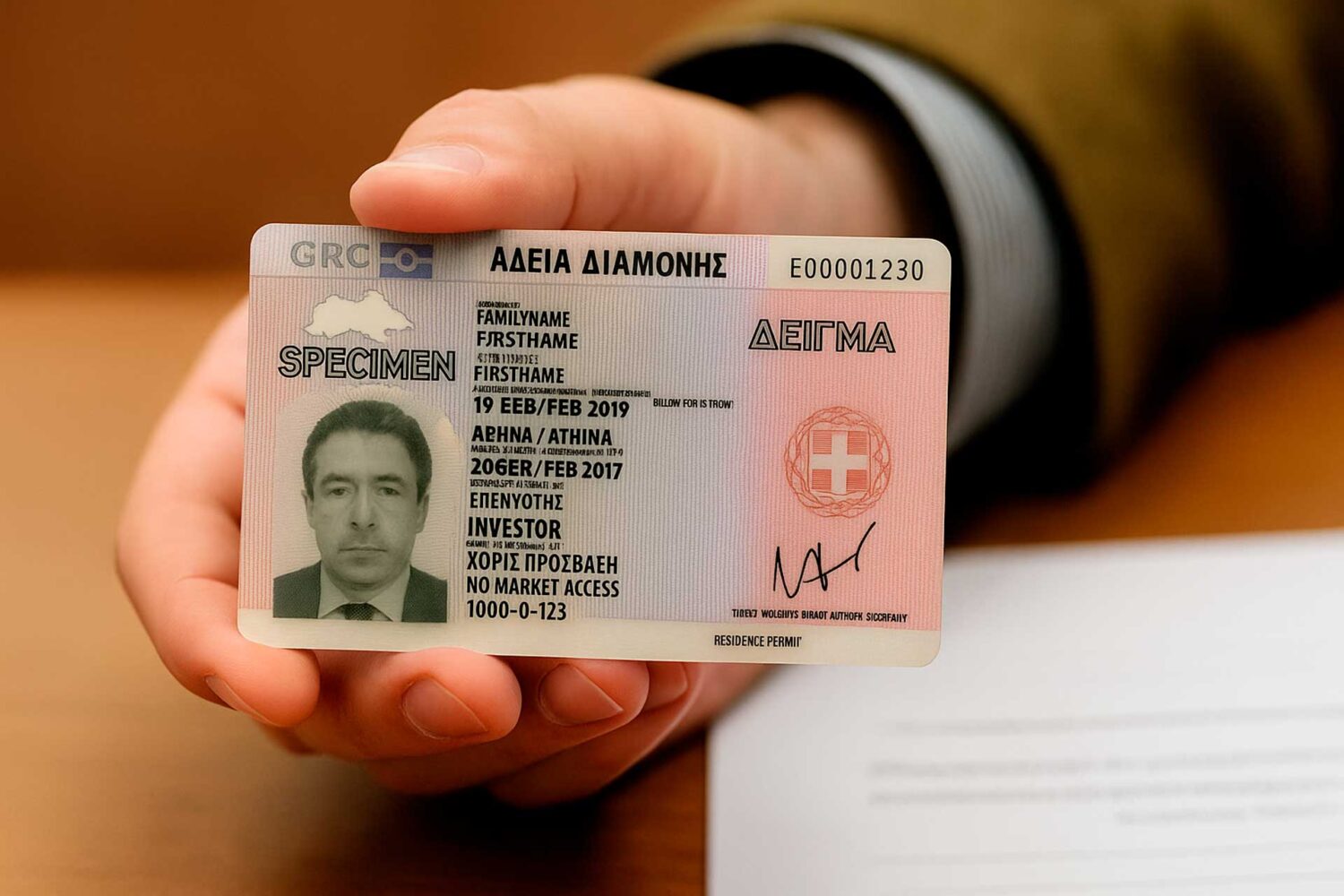
Greece residence permit is an official authorization issued by the Greek state that allows a non-EU / non-EEA citizen to legally live in Greece for more than 90 days for a specific purpose. It is issued as a biometric residence permit card and grants the holder the right to reside in Greece for a defined period (temporary or long-term), with the possibility of renewal or conversion to permanent residence, provided all legal requirements are met.
Depending on the type, a Greece residence permit may also allow the holder to work, run a business, study, reunite with family members, and travel freely within the Schengen Area for short stays. Whether you are planning to move to Greece or already considering your options, it is important to understand the types of residence permits available, the requirements, and the application process.
In this guide, an experienced immigration lawyer breaks down everything you need to know about obtaining a Greece residence permit. We cover the types of residence permits in Greece, how to get a residence permit in Greece, the latest laws and requirements, processing times, renewals, and the key benefits of Greek residency. This comprehensive article is based on up-to-date information (through 2026) and official sources, ensuring you receive accurate and reliable guidance.
Who Needs a Greek Residence Permit?
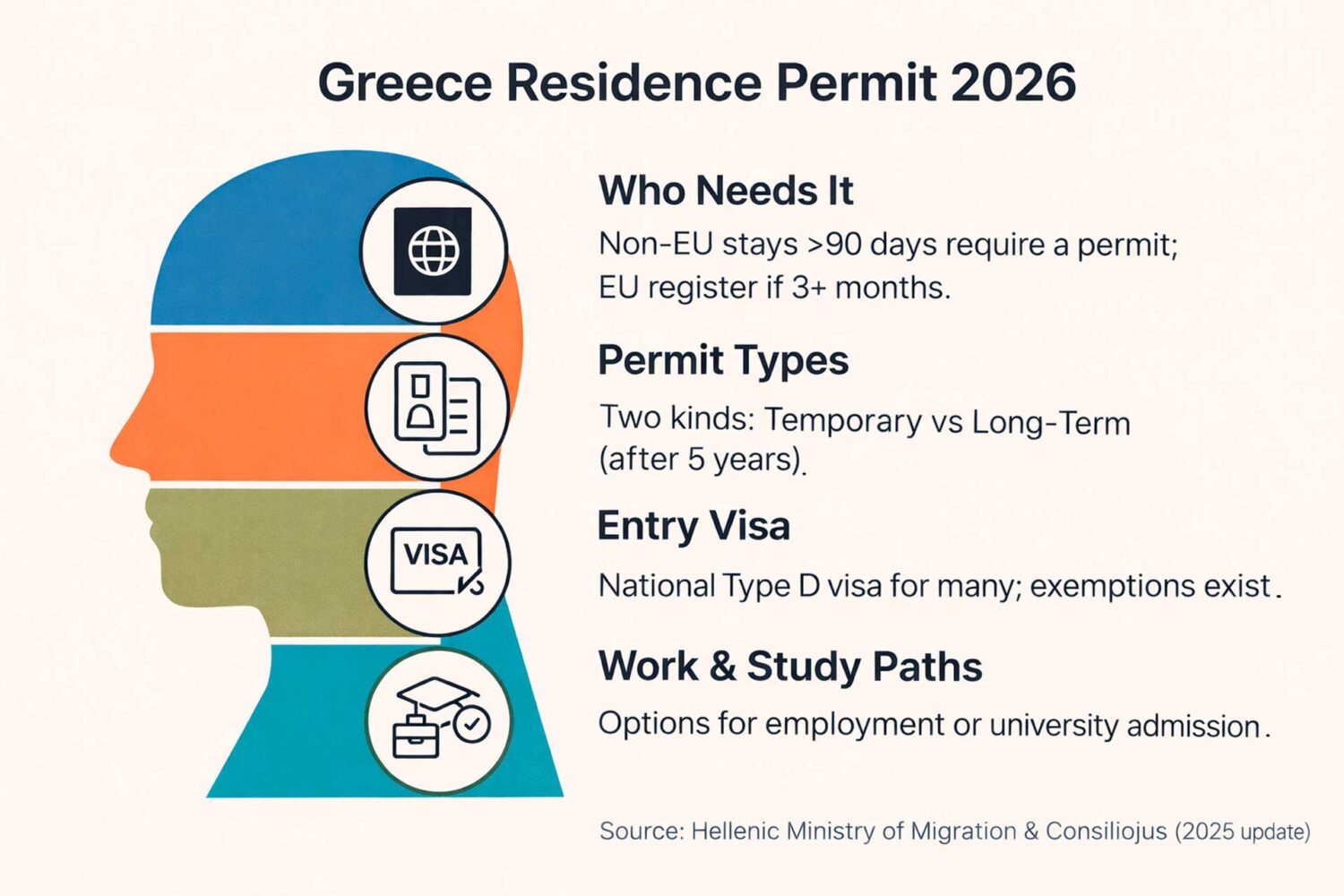
If you are not an EU/EEA or Swiss citizen and plan to stay in Greece longer than 90 days (within any 180-day period), you will need a Greek residence permit. EU/EEA citizens do not need a residence permit; they enjoy freedom of movement and can live and work in Greece, though they must register with local authorities after 90 days (they receive a Registration Certificate instead of a residence permit). Non-EU citizens, however, must obtain a residence permit to legally reside in Greece beyond short-term visa limits. This applies to people from all non-EU countries – whether you’re from the US, Canada, Asia, Africa, or elsewhere. (In other words, residence permit in Greece for non-EU citizens is mandatory for extended stays.)
⚠️Important! A residence permit (often a plastic card) is different from an entry visa. Typically, you first obtain a national visa (Type D visa) from a Greek consulate to enter Greece for the specific purpose (work, study, etc.), then after arriving you apply for the actual residence permit card. The residence permit allows you to live in Greece long-term and may confer the right to work (depending on permit type).
Types of Residence Permits in Greece
Greece’s immigration law provides many types of residence permits to accommodate different purposes of stay. Under a new Immigration Code (Law 5038/2023 and amendments) effective 2024-2025, permits have been reorganized into clearer categories. Below are the main categories of Greek residence permits and who they are for:
- Work and Employment Permits. For non-EU citizens who have a job offer or employment contract in Greece. This includes general work permits and the EU Blue Card for highly skilled workers. Work permits are typically sponsored by an employer. Initial validity is often 2 years for a standard employed-worker permit, renewable for 3-year periods. Blue Card holders (highly skilled professionals with a university degree and high salary) get a 2-year permit as well. Eligibility for a Blue Card requires a job offer of at least 6 months and a salary at least 1.6 times the average Greek gross annual wage. Work permit holders can legally work for their sponsoring employer in Greece and can eventually change employers or sectors under certain conditions. (Note: EU citizens working in Greece don’t need these permits, as they benefit from free movement.)
- Investment Permit (Golden Visa). For investors who purchase real estate or make other investments in Greece. Known as the Greece Golden Visa, this is a permanent residence permit for investors and their family members. It grants a 5-year residence permit that is renewable every 5 years as long as the investment is maintained. Key requirement: a minimum investment in Greek real estate or other eligible assets.
Important Update: Until recently, the minimum investment was €250,000 in real estate, one of the lowest thresholds in Europe. However, new laws in 2023-2024 significantly raised the required investment in high-demand areas. In regions like Attica (Athens), Thessaloniki, Mykonos, Santorini, and some popular islands, the minimum is now €500,000 to €800,000 for real estate. In other areas of Greece, the minimum is set around €400,000. (These changes were made to address housing market pressures.) The Golden Visa remains attractive because there is no requirement to live in Greece to keep the permit – you can renew it without a minimum stay, as long as you retain the investment. It also allows visa-free travel throughout the Schengen Area for up to 90 days in 180 days.
Example: Tennis legend Novak Djokovic obtained a Greek Golden Visa by purchasing a property in southern Athens for over €800,000, meeting the new investment threshold. This high-profile case in 2025 highlights the appeal of Greece’s investor residence program for global elites, drawn by Greece’s lifestyle and favorable tax options. - Financially Independent Person (FIP) Permit (Retirement or Passive Income Visa). This category is for people who have sufficient independent income (pension, savings, remote income) and want to live in Greece without working locally. It’s sometimes called the “Greek retirement visa” or passive income visa. To qualify, you must demonstrate a steady income of at least €3,500 per month (after tax), plus an extra 20% for a spouse and 15% per child. For example, a couple would need at least €4,200 monthly stable income. You must also show you won’t take up employment in Greece. The FIP residence permit is issued for 3 years and can be renewed for another 3-year term.
Important: Unlike the Golden Visa, the FIP permit does require actual residence in Greece for at least 183 days per year (half the year) to be eligible for renewal. In other words, you need to make Greece your primary home. This permit is popular with retirees or digital entrepreneurs who have sufficient funds to support themselves. Note that FIP holders are not allowed to work in Greece (no local salary jobs), but they can earn income from abroad or have passive income. - Digital Nomad Residence Permit. Greece introduced a Digital Nomad Visa in 2021 (Law 4825/2021) to attract remote workers and freelancers. It allows non-EU remote workers to live in Greece while working for foreign employers or clients (you cannot work for a Greek employer on this visa). The income requirement is similar to the FIP visa: at least €3,500 net per month (plus 20% for spouse, 15% per child if family joins).
First, you apply for a 1-year Digital Nomad visa at a Greek consulate. Then, upon arriving in Greece, you can convert it to a Digital Nomad residence permit. The initial residence permit is issued for 2 years and can be renewed for an additional 3 years. This means you could stay up to 5 years as a digital nomad in Greece. You are not required to spend 183 days/year like the FIP visa (there is no explicit minimum stay rule in the law for nomads), but the idea is that you will reside and work remotely from Greece for the duration.
Digital Nomad permit holders cannot take local Greek jobs, but they enjoy living in Greece while earning their foreign income, and even benefit from a 50% income tax break for up to 7 years if they become tax residents. (Greece offers new residents who work in Greece a 50% tax reduction, and also has a flat tax regime for high net-worth individuals, which has drawn interest from people like Djokovic.) This permit has proven popular as Greece becomes a hub for remote workers, with cities like Athens and Crete offering good internet and co-working spaces. - Student Residence Permit. Non-EU citizens accepted into a Greek university or college can get a student visa (Type D) and then a student residence permit. The permit is usually valid for the duration of your studies (often one year at a time, renewable annually until you finish the program). You must show proof of enrollment, sufficient funds for living expenses or a scholarship, and health insurance. Student permit holders are typically allowed to work part-time up to a certain number of hours per week to support themselves (this is common in EU countries, e.g., 20 hours/week during term time). After graduation, students may be able to switch to another permit (e.g., a work permit if they find a job in Greece).
- Family Reunification Permit. If you have a family member who is a Greek citizen or a non-EU resident in Greece, you may qualify for family reunification. For example, the foreign spouse of a Greek citizen or the dependent child of a Greek can get a residence permit as a family member. Likewise, family members (spouse, minor children) of a non-EU resident permit holder can usually get derivative residence permits that are tied to the principal holder’s permit.
Family reunification typically requires proof of the family relationship (marriage/birth certificates), and the principal must show adequate income to support the family. These permits usually have the same duration and renewal date as the sponsor’s permit. Notably, Greece recognizes civil partnerships and even same-sex civil partnerships for immigration since 2015, so partners in a civil union with a Greek resident may also qualify. Family members generally have the right to live in Greece and, in many cases, to work (spouses of Greek/EU citizens have full work rights; spouses of non-EU permit holders may have restricted access to the labor market depending on the type). - Other Special Permits. Greece has various other permits for specific situations, such as humanitarian and asylum-related permits (for recognized refugees, etc.), permits for researchers and academics, religious workers, athletes or coaches, and even a special visa for financially independent minors or participants in cultural exchanges. There are also seasonal work permits for farm laborers, and permits for intra-corporate transfers (employees of a multinational company moving to the Greek branch). These are more niche categories, each with its own conditions. For most readers, the categories above cover the common routes to Greek residency.
As you can see, the types of residence permit in Greece range from temporary to permanent, and from work-related to investment-based. The new Greek Immigration Code has codified these under lettered categories (E for employment, B for investment, Z for special visas like digital nomads, etc.). No matter the type, all residence permits come in the form of a biometric card (plastic ID card with your photo and a chip). Next, we’ll discuss general requirements and the process of how to get a residence permit in Greece.
Leave your contacts to have an expert contact you shortly.
General Requirements for a Greek Residence Permit
While each permit category has unique criteria, there are some common requirements you should be prepared for when applying for any residence permit in Greece:
- Valid Passport. You must have a valid passport (and often copies of it). Your passport should typically be valid for at least 3-6 months beyond the intended stay. When you apply for the visa at the consulate, you’ll need your passport; later, a copy of the passport and the visa is required for the residence permit application.
- Entry Visa (if applying from abroad). Most residence permits require you to start with a Type D national visa obtained from a Greek Embassy/Consulate in your home country. For example, if you are going for work, the employer must help secure an approval and then you get a D visa; if going for the FIP or Digital Nomad, you get a D visa on that basis. There are some cases (like Golden Visa investors) where you may be allowed to apply from within Greece either on a tourist status or via a representative, but generally the safe route is to get the proper visa first.
Tip: Always enter Greece on the correct visa for your purpose – do not arrive on a tourist Schengen visa (or visa-free entry) and expect to convert to a work/student permit, unless the law explicitly allows in-country application for that category. (The new law now allows in-country Blue Card applications for certain visa-free nationals, for instance, but this is an exception.) - Application Form. You will fill out application forms for both the visa and the residence permit. The forms must be signed and in some cases a declaration letter is needed (for example, digital nomads sign a statement that they will work remotely and not for Greek employers).
- Proof of Purpose. Documents supporting the purpose of your stay. This varies by permit type:
For work: a signed employment contract or job offer, plus an official approval if required (the Greek authorities set an annual quota by job type, and employers must get permission to hire a non-EU worker in many cases). The contract must meet minimum salary requirements (at least equal to the unskilled worker minimum wage for a standard permit, or a higher threshold for Blue Card).
For investment (Golden Visa): documents proving the investment, such as a purchase contract for real estate, notary deeds, proof of property transfer registration, and proof of payment of the minimum price (e.g., receipts showing you paid €250,000+ or the applicable threshold). If it’s a business or financial investment, you need bank certificates, share purchase agreements, etc., as detailed in the law.
For financially independent (FIP): evidence of your sufficient income, such as pension statements, bank account statements, investment earnings, or other proof of steady resources. You may also include a letter explaining that you intend to live in Greece without working, and perhaps a rental agreement in Greece to show you have accommodation.
For digital nomads: proof that you work remotely – e.g. an employment confirmation from a foreign company, or client contracts if you’re freelance, along with proof of income (bank statements, pay slips) to show the €3,500+ monthly earnings. Also a written statement that you will not seek local employment.
For students: an official acceptance letter from the Greek educational institution, proof of tuition payment or scholarship, and evidence of funds to support yourself (often a minimum amount per month is specified for students).
For family reunification: marriage certificates, birth certificates, or other documents proving the family relationship, plus proof the sponsor meets income requirements to support family and has housing. (Documents must often be officially translated to Greek and apostilled/legalized.) - Health Insurance. You are required to have health insurance coverage in Greece. For the initial visa, travel insurance covering medical emergencies may suffice. But for the residence permit, typically you need to show enrollment in a Greek health insurance fund or a private health insurance policy valid in Greece. Employees will be registered in the national social security (e.g., EFKA) by their employer, which counts as coverage. Self-sufficient people or students might buy private international health insurance plans that meet Greek requirements.
- Clean Criminal Record. A police clearance certificate from your home country (and any country you’ve lived in recently) is usually required for first-time permit applications. This certificate must show you have no serious criminal convictions. It often needs to be issued within 3 or 6 months of your application and may need legalization. Greece may also run its own background check.
- Passport Photos and Biometrics. You need recent passport-size photographs (with specific dimensions and white background). Greece now issues biometric residence permit cards, so during the process you will provide fingerprints and a digital photograph at the immigration office. Four photos are typically submitted with the application.
- Fees. There are government application fees for the residence permit. A common fee is €150 for a residency permit (though it can vary – e.g. work permits often €150, some permits are more). For instance, a standard non-EU work permit had a fee of €300 according to older rules, while the Digital Nomad visa had a €75 visa fee plus €150 administration fee. The Golden Visa has a higher one-time fee (around €2,000 for the main applicant, plus €150 per family member, under previous regulations). Additionally, there is a €16 fee for the plastic card issuance. All fees are usually paid via an e-paravolo (electronic fee system) or bank payment in Greece.
- Miscellaneous Documents. Depending on the permit, you might need to show a housing/accommodation proof (e.g., a rental contract or address in Greece, especially if applying for certain permits or when converting a visa to a permit). You may also need to get a medical certificate in Greece (sometimes required to prove you don’t have certain communicable diseases, though this is not always asked except for specific visas). Finally, you’ll fill out some local forms when submitting your application (and in some cases, an AFM (tax number) and AMKA (social security number) are needed for things like enrolling in insurance or paying fees — these can be obtained in Greece).
Documents from abroad (birth, marriage certificates, police records, etc.) must be officially translated into Greek (or sometimes English is accepted for initial visa). Greece is strict about apostille/legalization on foreign documents – make sure to legalize documents via the Apostille convention or through the Greek consulate.
The Application Process: How to Get a Residence Permit in Greece
Obtaining a residence permit in Greece is a step-by-step legal process that typically begins with securing the correct national visa and concludes with the issuance of a biometric residence permit card after arrival in Greece.
1. Planning and Visa Application
The journey to a Greek residence permit often begins in your home country. Once you identify the correct permit type for your situation (work, study, investment, etc.), you must usually apply for a national visa (Type D) at the Greek Embassy or Consulate where you live. The consular officers will review your purpose and documents. For example, for a work visa, they’ll look for the Greek labor authority’s approval and your job contract; for a student visa, they’ll want the university acceptance letter; for an investor visa, proof of funds and intent to purchase property; and so on.
The visa application will include an interview and submission of all required documents. Visa processing times can range from a couple of weeks to a couple of months depending on the type and the consulate. (For some categories like Golden Visa, the visa stage can be quite quick – some investors enter on a simple tourist visa or visa-free and then apply directly for the permit via a representative, as allowed by law.) Always check with the official Greek consulate for the latest requirements for your specific visa type.
2. Enter Greece and Apply for the Residence Permit
Once you have the visa and travel to Greece, the next step is to submit your residence permit application. This is typically done at the Decentralized Administration office (immigration one-stop shop) for your region of residence in Greece. In Athens and other areas, there are dedicated immigration offices that accept applications by appointment. Some categories, like asylum/refugee cases, are handled by the Asylum Service separately, but for most regular permits, the Decentralized Administration (under the Ministry of Migration and Asylum) is in charge.
When you apply, you will submit all your documents (including those you used for the visa) plus any additional local forms. If your paperwork is complete, they will **accept your application and issue you a blue certificate (βεβαίωση) on the spot. This blue certificate (a paper with your photo stapled on) is very important – it serves as proof that you have applied and it grants you legal temporary residence in Greece while your application is processed. It is typically valid for one year and can be renewed if the decision takes longer. With this certificate, you can reside in Greece legally and even travel in and out of Greece (within Schengen) in most cases.
As part of the application or shortly after, you will also be scheduled to give fingerprints and a signature for the permit card (if not done at application time). Some offices do it the same day; others set an appointment.
3. Processing Wait Time
Greek bureaucracy can be slow. By law, simple temporary residence permits should be issued within about 30-60 days, and indeed some permits (like Golden Visas) are often processed in 1–2 months. However, in practice many applicants face delays of several months. On paper, a temporary permit might take ~40 days, but in reality 2-3 months or more is common in high-demand areas like Athens. For some categories, significant backlogs have built up – as of late 2024, nearly 274,000 applications were in limbo, with some people waiting over a year (even up to two years) for renewals or decisions. The Greek government has been trying to modernize the system (new laws, digital submissions, more staff), but you should be prepared to be patient. The good news is that your blue certificate keeps you legal during the wait.
4. Approval and Residence Permit Card
Once your application is approved, the authorities will issue your residence permit card. Your local immigration office will either notify you to collect it, or in some cases, you can check the status online (more on that below). In Greece, you usually must pick up the permit in person. The card is a credit-card sized biometric ID that shows your photo, permit type, and validity dates. For first-time permits, the validity can be 1 year, 2 years, 3 years or 5 years depending on the category:
- Work permits: often 2 years initially (or 1 year for some first contracts, but the law now states 2 years for employed workers).
- Blue Card: 2 years.
- FIP: 3 years.
- Digital Nomad residence permit: 2 years.
- Golden Visa: 5 years.
- Student: 1 year (renewable each year of study).
- Family reunification: usually 1 or 2 years, aligning with sponsor’s permit (spouse of Greek gets 5-year permit).
When the card is ready, often an announcement is made. In fact, the Ministry of Migration maintains a “Ready Residence Permits” list on their website – applicants can search by their case number to see if their card is available for pickup. You can also use an online status checker: the official portal (General Secretariat for Migration Policy) allows you to enter your surname and passport number to check your residence permit application status online. This is very handy to track progress or see if a decision has been made.
5. What if My Application Is Denied?
If your application is rejected, you typically have the right to appeal the decision or submit a new application. Appeals can be administrative (to the Ministry) and/or judicial (to an administrative court). Common reasons for denial include missing documents, not meeting income requirements, or changes in your situation (e.g., job offer fell through). Having legal assistance at that stage is wise. But if you prepared well, hopefully you will not encounter this.
Avoid delays and mistakes. Request a consultation for help with your Greece residence permit application. No obligation. Confidential review. Clear guidance from our experienced immigration professionals.
Processing Times and Checking Status
As noted, processing times can vary widely. Here’s a quick overview of typical processing times (recent as of 2025-2026):
- Work Permits. If all goes smoothly, a work permit might be processed in a couple of months. Legally it should be done in around 40 days, but in practice often 2-3 months. If the quota or labor market test is involved before you even got your visa, that could add months at the front end. So for a job-based permit, start early – it could easily be 4-6 months from job offer to having the card in hand.
- Golden Visa. These have been relatively efficient. Many investors get their 5-year permit within 1-2 months after applying. The process is streamlined since 2022 via an online platform, and you can even authorize a lawyer to apply on your behalf. However, due to a surge of applications in 2023 (before the investment amount increase deadline), there have been backlogs and some cases are taking longer.
- Digital Nomad & FIP. These are newer and handled centrally in Athens. Processing might take 1-3 months. The first-ever digital nomad visas issued in 2022 took a few weeks, but as volume grew it may average 2+ months. The FIP permit also can take a few months since many people apply and must demonstrate income etc.
- Student Permits. Usually processed in 4-8 weeks, often timed with academic year start.
- Family Reunification. Can take a few months; renewing family permits sometimes is slow.
- Asylum-related (refugee) permits. After refugee status approval, printing the 3-year permit can take 2-3 months.
Greece’s system faced significant delays especially during 2020-2021 (COVID-19 closures) and the backlog persisted. By late 2024, some renewals were taking up to 2 years which is extremely frustrating. The government has implemented digital reforms (online application for initial permits, email submissions for renewals) and hired more staff, so we expect improvements going into 2026.
Checking Your Status. To ease anxiety, Greece provides tools for applicants to check if their permit is issued:
- The Application Status Portal. Visit the official site (pf.emigrants.ypes.gr) and enter your surname and passport number to see your status. This can show if the permit is ready or still pending.
- Ready for Pickup Announcements. The Asylum Service and Migration Ministry publish announcements when batches of residence permit cards are ready. For example, for asylum-related permits, you can find your case number on the “Ready Residence Permits” list to know when to go pick it up.
- In some regions, you might also receive a text or email, or your lawyer will inform you. Otherwise, you can always contact the immigration office handling your case. Be polite but persistent if you’ve been waiting far beyond normal times – sometimes regular follow-ups can help.

Renewals, Extensions and Permanent Residence
Most residence permits in Greece are temporary but renewable. A “temporary” (ήδηας διαμονής) permit simply means it has an expiration date. Renewal is typically straightforward if you still meet the criteria of your permit and you apply on time. Here’s what to keep in mind.
When to Apply for Renewal? You should apply to renew your residence permit about 2 months before it expires. Greek law allows renewal applications up to the last day of validity. If you apply late (within one month after expiration), they might still accept it but will charge a €50 fine. After one month overdue, a permit is usually considered lapsed and you risk being undocumented. So mark your calendar to renew in advance. When you apply to renew, you will get a new blue certificate to cover you until the new permit is issued.
For renewals, you generally must continue to fulfill the original conditions:
- Work permit renewal: you’ll need proof of continued employment or, if unemployed, proof you at least worked a certain amount or made the required social security contributions during your previous permit. If you lost your job, Greek law doesn’t automatically cancel your permit, but by renewal time you should either have a new job or meet certain minimum insurance stamps.
- Golden Visa renewal: simply show you still own the investment (e.g. you haven’t sold the property). There is no minimum stay requirement – even if you spent zero days in Greece, your investor permit will renew as long as the property/investment is retained. You will need to provide updated documents (like a recent property title certificate from the land registry showing you still own it and that it’s free of liens).
- FIP renewal: you must again prove your income and you must show you lived in Greece at least 6 months each year (e.g. you might show tax filings or utility bills to prove presence).
- Digital Nomad renewal: you’d show you still meet the income threshold and remote work status. The renewal will extend for 3 more years. After that (total 5 years), further extensions aren’t clearly defined in law yet – one might consider transitioning to another status or possibly the long-term resident status if eligible.
- Family reunification renewal: you must typically show the family is still together in Greece and the sponsor still meets income criteria. For children turning 18, they may need to switch to another status (like student or own work permit) as they can no longer renew as “dependent child” after a certain age.
Permanent Residence and Long-Term EU Resident Permit
After you have lived in Greece for a number of years, you might qualify for a more permanent status. Greek law, in line with EU rules, offers a Long-Term Resident EU permit (Επί μακρόν διαμένων). To be eligible, you must have lived in Greece continuously for 5 years on a temporary residence permit, and meet other conditions:
- You have stable and sufficient income to support yourself and any family (at least equal to the annual minimum wage in Greece, plus 10% per dependent).
- You have full health insurance coverage.
- You fulfill integration requirements – typically evidence of adequate knowledge of Greek language, history and culture. This can be proven by a certification or exam. (Some exceptions exist: e.g., having completed Greek school or being of Greek origin, etc., can waive the test.)
- Having no criminal record and not being a security threat, of course.
The Long-Term EU Resident permit is valid for 5 or 10 years (Greece has introduced a 10-year card in some cases) and is renewable automatically. It grants enhanced rights: you are entitled to equal treatment with Greek citizens in many areas such as access to employment, education, social security, and you have the right to move to other EU countries under certain conditions. (For instance, with a Greek long-term resident status, you could apply to reside in another EU state to work or study without starting from zero.) Obtaining this status is a good idea if you intend to make Greece your long-term home, as it gives you security and flexibility.
Many people also ask about citizenship. By law, a foreigner can apply for Greek citizenship by naturalization after 7 years of legal residence (or less in some cases like marriage to a Greek or recognized refugee status). You will need to meet language requirements (usually proving at least B1 level Greek and passing a civics test) and show integration into Greek society. The citizenship process in Greece is separate from the residence permit; it’s handled by the Interior Ministry. Greek citizenship grants you an EU passport and all rights of a Greek citizen (including voting). It’s a long-term goal beyond the scope of this article, but keep it in mind if you plan to settle permanently.

Benefits of a Greece Residence Permit
Why seek a residence permit in Greece? Aside from the obvious benefit of living in a gorgeous country with rich culture, history, and climate, there are practical advantages:
- Live in Greece Legally. You can live in Greece year-round without worrying about visa runs. You’ll have a local ID card (your residence permit) that you must carry, and you’ll be registered with local authorities. This opens access to renting property long-term, opening bank accounts, getting a tax number (AFM), a local SIM card, etc. Essentially, you can settle in Greece.
- Work Rights. If you hold a permit that allows employment, you can work legally and are protected by labor laws. Most permits allow work except a few (Golden Visa holders cannot be employed by someone else in Greece, and FIP or Digital Nomad permits forbid local employment as well). But you can always conduct business, own a company, or be self-employed in Greece unless explicitly restricted. If you plan to work for a Greek employer, ensure you have a work-authorized permit. Family members of Greek/EU citizens can work freely. Benefit: legally working means you can join Greece’s social security and healthcare system.
- Schengen Travel. Perhaps one of the biggest benefits: with a Greek residence permit, you can travel freely within the Schengen Area of Europe for up to 90 days in any 180-day period without needing a separate visa. For example, you could visit France, Germany, Italy, etc., as a tourist using your Greek residence card to re-enter Greece. (You still need your passport when traveling, but you won’t need Schengen visas.) This is a huge advantage for nationals of countries that normally need visas to enter Europe. Note: This doesn’t grant you the right to live in another EU country, but short visits are fine.
- Access to Services. Legally residing in Greece gives you access to public services. You can enroll your children in school (children of permit holders have the right to attend Greek public schools just like locals). You can access Greek state healthcare (if you contribute to social insurance or via voluntary coverage) and emergency care. You can also sign up for utilities, get a driver’s license (after a certain period, you’d convert your foreign license or take a test), and so on. Essentially, you can function like a local resident.
- Social Benefits. If you contribute to the system (through work and paying social security contributions), you accrue benefits such as pension rights and unemployment benefits similarly to Greeks. Non-EU residents legally working are insured and enjoy the same social security rights as Greek workers.
- Long-Term Security. After 5 years you can secure a long-term EU resident permit, which provides stability (ten-year validity in some cases) and wider EU mobility for work. After 7+ years you can pursue citizenship. This means a Greek residence permit can be a pathway to becoming an EU citizen eventually, which is appealing to many.
- Family Unification. Your legal status allows you to sponsor close family to join you (spouse, children, sometimes parents). Having a residence permit often is a prerequisite to bring family over through the proper channels.
- Quality of Life and Tax Benefits. Greece offers a high quality of life: sunny weather, Mediterranean diet, and a generally relaxed lifestyle. The cost of living is moderate compared to Northern Europe. Additionally, Greece has introduced tax incentives to attract foreign residents – for instance, a “non-dom” flat tax regime where wealthy new residents can pay a flat €100,000 tax on all foreign-sourced income per year, and a program where professionals relocating to Greece get 50% income tax reduction for 7 years. These benefits make Greece enticing for investors, retirees, and digital entrepreneurs.
- Education and Healthcare. As a resident, you can use Greece’s public healthcare (which is decent, though many expats opt for private healthcare which is still relatively affordable). You can also send your kids to local schools or international schools in Greece. Residents qualify for local tuition fees at universities (which in Greece are low or free for undergrad).
- Freedom of Movement in Greece. You can live anywhere in Greece – you are not tied to one city. Some countries’ residence visas bind you to a specific region or employer; Greece’s permits generally allow you to move around freely inside the country. You can enjoy everything from the Athens metropolis to a quiet island life, as you prefer.
In summary, a Greek residence permit comes with a host of benefits that make the bureaucratic effort worthwhile. It’s a ticket to enjoying life in Greece and Europe.

Latest News and Changes in Greek Residence Permit Laws
Greek immigration laws are evolving. Here are some recent news and updates to be aware of:
- New Immigration Code. Greece implemented a new Migration Code that took effect on 1 January 2024 (with some parts phased in by mid-2025 ). This overhauled the permit categories and aimed to simplify procedures with more digital applications. For example, online application platforms have been launched for initial permit requests, reducing the need for in-person appointments in some cases. The code also introduced stricter criteria for some permits (like higher salary for Blue Card, and stricter rules for “executive” work permits) and easier conditions for others (Blue Card holders from other EU states can transfer to Greece after 12 months, down from 18, and digital nomads now must get a visa first). The reorganization means permits are now labeled with letters (E for work, B for investment, etc.) – for instance, Digital Nomads are category Z.1 and Real Estate Investors are B.5 in the new coding. If you had an older permit type, it might be converted to a new code upon renewal. Overall, the reforms seek to modernize and attract legal migrants to Greece’s benefit.
- Golden Visa Investment Increase. As discussed, the investment threshold for Golden Visas doubled in key areas (Attica, Thessaloniki, islands) to €500k-€800k. This was legislated in 2023 and fully in effect by August 2023 for new applications. It caused a rush of investors trying to beat the deadline. The intent was to curb speculation and free up housing for locals. Along with the price increase, the law now requires the investment to be in one property of at least 120 m² (no patchworking multiple cheap properties). It also bans short-term rentals (Airbnb-type) of Golden Visa properties in those areas – you can rent them long-term, but not as vacation rentals. These changes were big news in 2024. If you’re considering a Golden Visa, make sure you know the current rules for the area you’re interested in (some less-developed regions still allow the €250k investments through a transition period, but by 2025 it’s largely the higher amounts).
- Notable High-Profile Residents. Greece has been attracting some big names via its residency programs, underscoring their popularity. The most famous recent example is Novak Djokovic’s move to Greece – the Serbian tennis star secured a Greek Golden Visa by investing in property in Athens. He spoke about feeling at home in Athens and even enrolled his children in a school there. Such stories (often covered in the media) show that Greece is on the map for global investors, athletes, and remote workers seeking a welcoming second home.
- Post-Brexit Brits and Other Nationals. After Brexit, UK nationals now fall under non-EU rules. Greece created a digital platform for UK nationals who were resident before the end of 2020 to get residence cards under the Withdrawal Agreement. New UK arrivals have to use the regular immigration routes described in this article. There has been an uptick in Brits using the FIP visa (retiring to Greece) or Digital Nomad visas.
- Ukraine Temporary Protection. Greece, like all EU countries, offered Temporary Protection status to Ukrainian refugees fleeing the war. This is a separate 1-year permit (renewable) under EU Council decisions. As of 2026, Greece explicitly allowed Ukrainians under temporary protection to apply for a standard residence permit under the migration code if they find a job or other basis, without losing their temporary protection. This is a humanitarian measure but shows how multiple frameworks can overlap.
- Digital Nomad and Remote Work Popularity. Greece has been actively courting digital nomads. Apart from the visa, initiatives like improving internet infrastructure in islands and creating co-working hubs are underway. There is also talk about extending tax incentives for remote workers. In 2026, Greece is considered among top digital nomad destinations in Europe.
- Streamlining and Digital Checks. The government launched an online residence permit status check (mentioned above) and also started accepting renewal applications via email for certain cases (for example, asylum-related permit renewals). The aim is to cut down on in-person queues. By 2026, we expect more procedures (like scheduling biometrics appointments or updating your address) to be possible online.
Always check the latest information or consult an immigration lawyer, as Greek immigration regulations can change with little notice. Official sources like the Ministry of Migration and Asylum website (migration.gov.gr) post announcements and guides.
Obtaining a residence permit in Greece may seem complex, but with the right information and preparation, you can navigate the process successfully. Remember to choose the category that best fits your situation – whether it’s working in Greece, investing in property, retiring by the sea, or working remotely from a Greek island. Each path has its own requirements, but they all lead to the same reward: the chance to live in Greece and enjoy all it has to offer.
Greece provides opportunities for everyone from entrepreneurs and investors to students and retirees. By following the guidelines (and seeking professional advice when needed), you can join the many expatriates who now call Greece home. And once you have your residence permit card in hand, you’ll be able to settle into your new life, explore the Schengen Zone freely, and perhaps eventually upgrade to permanent residence or even citizenship.
In summary, this guide covered how to get a residence permit in Greece, the requirements and documents needed, the different types of permits (work, investment, nomad, etc.), the application process, how to check your residence permit status online, rules for renewing or extending your permit, and the benefits and recent news regarding Greek immigration law. Armed with this knowledge, you’ll be better prepared to start your Greek immigration journey.
Leave a Comment

We have prepared answers to the most common questions about Greece residence permit. If you want to clarify anything, please contact us - we will provide detailed explanations.
To get a residence permit in Greece, apply for a national (Type D) visa at a Greek consulate, enter Greece, and submit your permit application with the required documents based on your purpose (work, investment, study, etc.).
It's not difficult if you meet the requirements. Investor and digital nomad permits are relatively straightforward, while work and family reunification permits may take longer due to quotas and documentation.
Apply for renewal 2 months before expiration at your local immigration office. Submit updated documents proving you still meet the conditions (employment, income, property ownership, etc.).
Use the official Greek Ministry status portal to check your residence permit application status online with your surname and passport number.
The new Immigration Code (Law 5038/2023) restructured permit categories, raised investment thresholds for Golden Visas, digitized procedures, and added new options like expanded digital nomad rules.
You can prove residency with your valid residence permit card, tax registration (AFM), utility bills, rental contracts, or proof of enrollment in public services (like healthcare or school).


Comments
No comments found.