

 EU Citizenship
 Slovenian Citizenship
 Romanian Citizenship
 Bulgarian Citizenship
 Austrian citizenship (investments)
 Spanish Citizenship
 Italian Citizenship
 Cypriot Citizenship
 Lithuanian Citizenship
 Portuguese Citizenship
 French Citizenship
 German Citizenship
 Hungarian Citizenship
 Dutch Citizenship
 Belgian Citizenship
 Croatian citizenship


How to Get a Romanian Residence Permit in 2026

Author: Leon Scott
Published: 20.01.2026
Updated: 20.01.2026
A Romania residence permit is an official document that allows a foreign national to live in Romania legally for an extended period (beyond 90 days). In recent years, Romania has seen growing interest from international workers, students, and families seeking to reside there. Every foreigner who plans to stay in Romania for longer than 90 days must obtain a residence permit or, in the case of EU citizens, register their residence. Romania still has a relatively small foreign-born population (around 3.1% as of 2024) but immigration is rising, with 23,000+ new long-term residence permits issued in 2021. Employment is the leading motive for these permits, reflecting Romania’s workforce shortages in certain sectors.
This comprehensive guide explains what a Romanian residence permit is, the types of permits available, who needs one, and how to apply. We’ll cover the different grounds for obtaining a permit (such as work, study, family reunification, business, or the new digital nomad visa), the step-by-step application process, required documents, processing timelines, and what rights you gain as a permit holder. You’ll also learn how to transition from a temporary permit to permanent residence or citizenship, common reasons for refusals, and answers to frequently asked questions. The goal is to provide a clear, factual roadmap to make your Romanian immigration process as smooth as possible.
What Is a Romania Residence Permit?
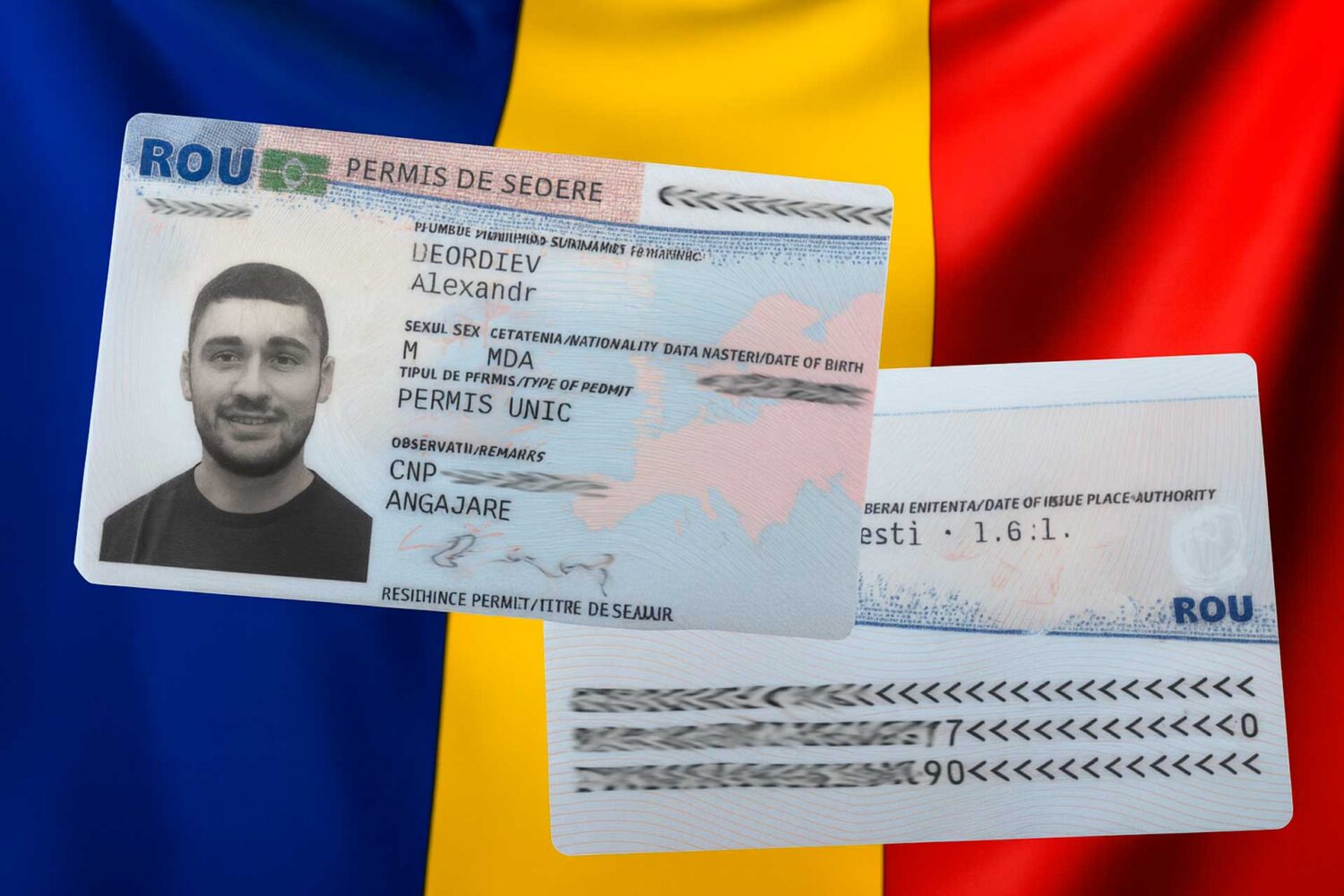
A Romanian residence permit is a biometric identification card issued by the General Inspectorate for Immigration (IGI) that certifies your right to reside in Romania for a specific duration. It is typically issued to non-citizens who intend to stay in Romania longer than 90 days (the usual limit for short-term visits). The residence permit is distinct from a visa: a visa (usually a long-stay “D” visa) allows you to enter Romania, whereas the residence permit allows you to legally stay and live in Romania beyond the visa’s validity. In other words, if you are a non-EU national, you generally must first obtain an appropriate long-stay visa for your purpose of travel, then apply for a residence permit after arriving in Romania.
Even EU/EEA and Swiss citizens—who don’t need entry visas—must register with the immigration authorities if they stay in Romania for more than 90 days. However, their process is simpler: EU citizens receive a registration certificate (essentially a residency document) without needing a long-stay visa. For non-EU citizens, the residence permit is mandatory for extended stays and is usually tied to a specific purpose (such as work, studies, family reunification, etc.). The permit card will display your personal details, photo, and the type and duration of your authorized stay.
In summary, a Romanian residence permit is the key to living in Romania legally for the long term. It grants you the right to reside (and in many cases, to work or study) in Romania for the period it’s valid. Failing to obtain a residence permit when required can result in overstaying your visa, which may lead to fines, deportation, or entry bans. Therefore, if you plan to make Romania your home for more than three months, securing the proper residence permit is one of the first priorities.
Types of Residence Permits in Romania
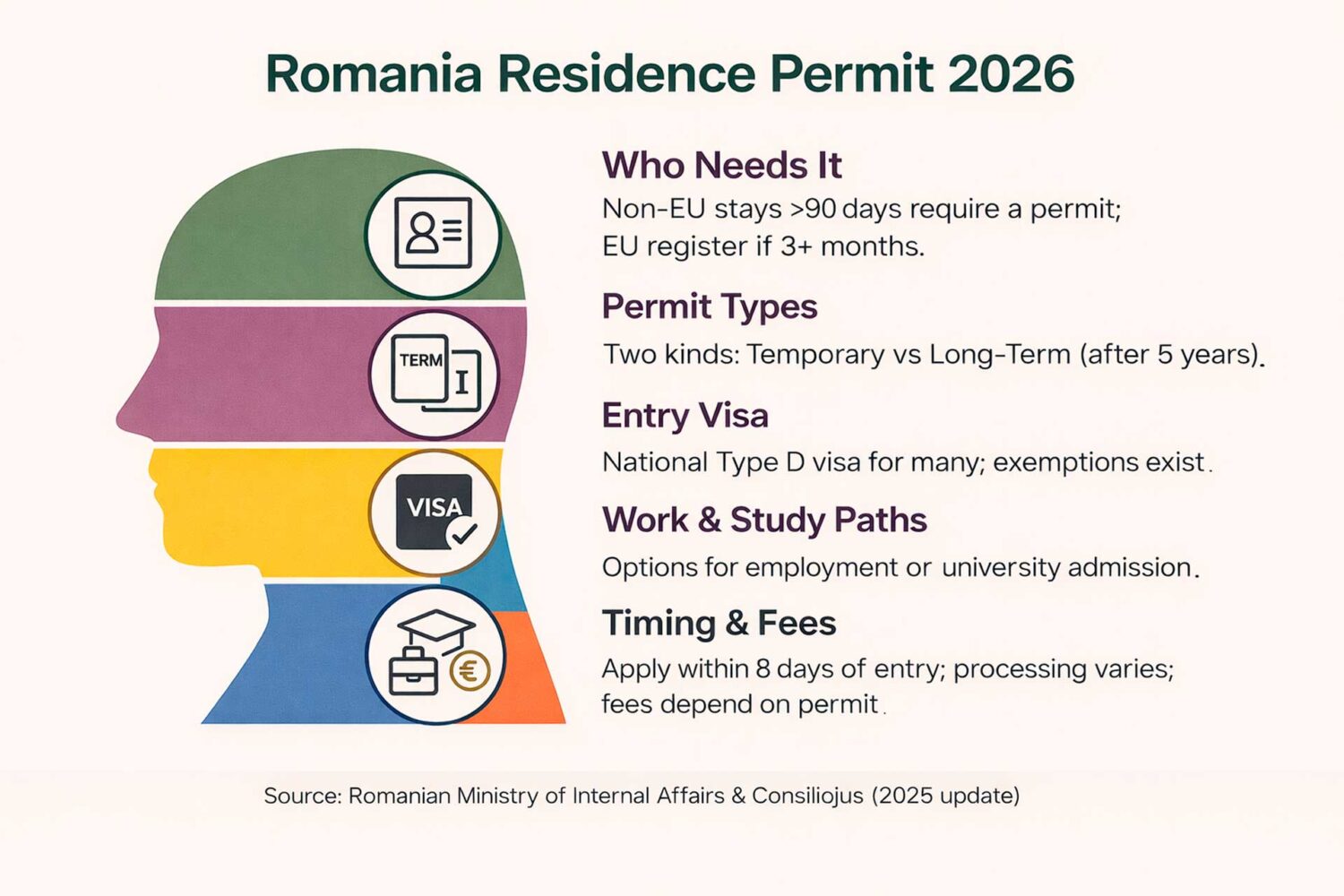
Romania’s immigration system offers two main categories of residence permits:
- Temporary Residence Permits – These are time-limited permits (typically valid for up to 1 year, sometimes up to 2–3 years in certain cases) issued for specific purposes, such as employment, studies, business, family reunification, or other authorized activities. A temporary residence permit can usually be renewed periodically as long as you continue to meet the conditions. Most foreign nationals begin with temporary permits. Each temporary permit is tied to the original purpose of stay (you must continue to engage in that activity, e.g. work or study, to maintain the permit).
- Long-Term Residence Permits (Permanent Residency) – After legally residing in Romania for a continuous period (generally 5 years), a non-EU national can apply for a long-term residence permit, which is the equivalent of permanent residency. Long-term residency grants a more secure status and a longer validity document (usually 5 years, or 10 years if you are the family member of a Romanian citizen). It also confers rights similar to those of Romanian citizens in many areas (except voting and a few exceptions), and it is a stepping stone to citizenship. We’ll discuss the transition to permanent residence in detail later.
In addition, EU/EEA/Swiss nationals do not need these typical permits but instead get a registration certificate (for temporary residence) and can obtain a permanent residence card after 5 years. Their documents serve a similar purpose but are issued under EU freedom of movement rules.
Comparison of Romania Residence Permit Types:
| Permit Type | Purpose / Who | Initial Validity | Renewable | Leads to PR/Citizenship |
| Temporary Residence Permit (various purposes) | Non-EU citizens residing in Romania for work, study, family, business, etc. | Usually 1 year (some permits up to 2–3 years maximum) depending on purpose | Yes – can be extended annually (or for same duration as initial) as long as conditions are met | Yes – after 5 years of continuous legal stay (certain categories like students or seasonal workers don’t count fully). |
| Long-Term Residence Permit (“Permanent Residence”) | Non-EU citizens after 5 years of legal stay; EU/EEA family after 5 years; Romanian citizen’s spouse after 5 years marriage | 5 years (standard long-term resident card); 10 years if family member of Romanian citizen | Yes – long-term permits are easily renewable every 5 or 10 years (so long as no major absence or legal issues) | N/A – This is permanent residency. Holders can later apply for citizenship (typically after 8 years of total residence, or 5 years if married to Romanian). |
| EU/EEA/Swiss Registration | EU/EEA/Swiss nationals living in Romania | 5 years (registration certificate for temporary residence) | Yes – they can receive a permanent residence document after 5 years of continuous stay | EU nationals can eventually apply for Romanian citizenship if desired (usually after 8+ years), but most enjoy EU rights without needing citizenship. |
Key point: All non-EU foreigners intending to stay over 90 days will start with a temporary residence permit of some kind. The exact type of temporary permit depends on your grounds for stay (see next section). After meeting the requirements and time period for long-term residence, you can apply for a permanent residence permit.
Next, we will explore the common grounds for obtaining a Romanian residence permit, which correspond to the main types of long-stay visas and temporary permits available.
Grounds for Obtaining a Romanian Residence Permit
Romanian law provides for several grounds (purposes) on which you can obtain a residence permit. The requirements and process can vary slightly for each category. Here are the most common reasons you might be granted a Romanian residence permit:
1. Employment (Work Permit)
Employment is one of the most common routes to a Romanian residence permit. If you are a non-EU citizen hired by a Romanian company (or a foreign company’s Romanian branch), you will need a work-based residence permit. The process begins with the employer in Romania: your prospective employer must first obtain a work authorization (work permit) for you from the IGI before you apply for a visa. This involves the employer proving that the job couldn’t be filled by a Romanian/EU citizen and that you have the requisite qualifications. Once the work permit is approved, you can apply for a D/AM long-stay visa (for employment) at a Romanian consulate, and then travel to Romania to apply for the residence permit.
Validity: A work-based temporary residence permit is typically granted for the duration of your work contract plus 3 months, up to a maximum of 3 years at a time. In practice, many work permits and residence cards are issued for 12 months and renewed annually, but multi-year permits (up to 2 or 3 years) are possible if your contract and circumstances allow.
Documents: In addition to the standard documents (passport, application form, proof of address, insurance, etc.), a work permit applicant must submit their employment contract, details of their salary, and the work authorization obtained by the employer. A medical certificate (confirming you don’t have any communicable diseases of public health concern) is also required. You will need to show that you’ve paid the residence permit issuance fee as well.
Rights: A residence permit for employment allows you to work only in the position and for the employer that sponsored you. If you change jobs, a new work authorization and permit are needed. Romania also participates in the EU Blue Card scheme for highly skilled workers: if you have a high-paying job offer meeting the salary threshold (e.g. approx. €2,743 gross per month in 2023), you may qualify for an EU Blue Card. Blue Card holders get certain benefits, like easier mobility to other EU countries after 18 months and a path to long-term EU residence. Additionally, Romania has work permit quotas for sectors facing labor shortages, and in recent years tens of thousands of non-EU workers (especially from Asia) have been hired to fill gaps.
Overall, obtaining a work-based residence permit requires coordination with your employer but is a well-trodden path. Most new residence permits in Romania are issued for employment purposes, reflecting the country’s demand for foreign talent in industries like construction, manufacturing, IT, and healthcare.
2. Business and Investment
Romania welcomes foreign investors and entrepreneurs, and there are residence permits designed for those establishing or managing businesses in Romania. This can cover several scenarios:
- Business Owner or Administrator: If you register a company in Romania (such as an SRL — limited liability company) and take an active role in managing it, you can apply for a long-stay visa for commercial activities (often noted as D/AC or similar) and the corresponding residence permit. You’ll need to present a business plan and proof of sufficient financial resources for the enterprise. Typically, you must show that your business will create economic benefits (such as jobs or capital investment in Romania).
- Investor Residency: Significant investors may obtain residency on the basis of their investments. Romania does not have a classic “golden visa” program with a guaranteed passive investment path, but large investments can fast-track long-term residency. For example, investing at least EUR 1 million or creating 100+ full-time jobs can grant an exemption from the normal 5-year residency requirement for permanent residence. In other words, a major investor could potentially obtain long-term (permanent) residency more quickly. There are also thresholds for qualifying investments in smaller amounts: for temporary residency through investment in a Romanian company, thresholds like EUR 150,000 and 25 new jobs or EUR 200,000 and 50 jobs are noted in law. These relate to different incentives or permit conditions (for instance, an investment of €150k or creation of 25 jobs may qualify you for certain residency facilitation).
- Self-Employment and Freelance Business: Romania may allow residency for certain liberal professions or freelance activities, though typically one would establish a PFA (authorized natural person) or a company to formalize the business activity.
Validity: A business-based temporary residence permit is usually granted for 1 year initially (renewable annually). If you continue to meet the investment or business activity criteria (e.g. your company remains active, meets revenue or job creation targets if applicable), you can extend the permit. After 5 years of continuous legal residence, you can apply for permanent residence like any other category. As mentioned, major investors can even obtain permanent residence faster than 5 years in specific cases.
Documents: Key documents include your company’s registration papers, a business plan or description of activity, proof of financial means for the business, and in some cases a letter of endorsement from the relevant Romanian ministry (for investments deemed of national interest). You must show proof of accommodation and health insurance for yourself as well. For an investor, evidence of the investment (capital injection, property purchase, etc.) or job creation will be required.
Rights: A business residency allows you to manage your own company or engage in business activities in Romania. It does not automatically allow you to take up local employment under a labor contract for another company; if you wish to also work as an employee, you might need a separate work permit or to hire yourself under your company. However, as the owner/administrator of the business that sponsored your permit, you are permitted to derive income from that business. Romania’s policy aims to attract genuine entrepreneurs who will contribute to the economy. If you meet the criteria, you also have the benefit of potentially obtaining permanent residence more quickly than other categories – for instance, as noted, the 5-year wait can be reduced to 4 years or even 2½ years for certain protected categories and investors, and there’s a full residency requirement exemption for investments of EUR 1 million+.
3. Study (Students)
If you are coming to Romania to pursue higher education (university studies) or other long-term studies, you can obtain a residence permit for study purposes. Romania is home to many universities (including programs taught in English and other languages), and it attracts international students particularly in fields like medicine, engineering, and IT. To get a study residence permit:
- First, you must be accepted by a Romanian educational institution. The Ministry of Education issues a letter of acceptance for foreign students, which is required to apply for the long-stay visa for studies (D/SD).
- After obtaining the D/SD visa and arriving in Romania, you apply for a temporary residence permit for studies.
Validity: A student residence permit is typically issued for up to 1 year at a time. If your study program is multi-year (e.g. a 3-year bachelor’s or 2-year master’s), you will need to renew the permit annually, showing that you are still enrolled and making progress. In some cases, permits might be granted for the expected duration of the academic year or program, but one year is the norm.
Documents: You’ll need the university’s acceptance/enrollment letter, proof that you have paid any required tuition fees, and evidence of financial means to support yourself during studies. Romanian law requires student visa applicants to show funds at least equal to the minimum gross monthly wage for the entire stay (or an equivalent scholarship). You also need proof of accommodation (e.g. dormitory or rental contract) and a health insurance policy. A medical certificate of good health is required as well. When renewing, you may need to show proof of academic progress (such as transcripts or a letter from the university confirming you are still enrolled).
Rights: International students in Romania are allowed to work part-time on their student residence permit without needing a separate work permit, up to 4 hours per day (20 hours per week). This enables students to take internships or part-time jobs to support themselves, but they cannot legally work full-time unless they switch to a different permit (or obtain a work authorization for more hours). After graduation, a student can usually extend their stay for a limited time (often 9 months) to seek employment in Romania. If they find a job, they can transition to a work permit without leaving the country.
It’s important to note that time spent in Romania as a student only partially counts toward permanent residence. By law, certain temporary residence periods (study, asylum seeker, seasonal work, au pair) do not count in full for the 5-year requirement for long-term residency. Typically, student years count at 50% or are excluded, meaning you might need additional time after studies to reach the 5-year threshold for PR. Nonetheless, a study permit is an excellent pathway to experience Romania and potentially move into another residency status after your education.
4. Family Reunification
Family reunification allows the close family members of a person already in Romania to join them and reside in the country. The rules differ slightly depending on whether the sponsor (the family member in Romania) is a Romanian citizen, an EU/EEA citizen, or a non-EU resident:
- If your family member in Romania is a Romanian citizen, you (as a non-EU spouse or child) can apply for a long-stay visa for family reunification and then a residence permit. Romanian citizens can sponsor their spouse, minor children, or dependent adult children/parents under certain conditions. The marriage (for spouses) must be legally recognized, and not a marriage of convenience (authorities will check that the relationship is genuine, including requiring a statement that the marriage is not polygamous/bigamous).
- If your family member is a non-EU citizen holding a Romanian residence permit, they can generally sponsor you after they have met some prerequisites. Usually, the sponsor needs to have a valid residence permit for at least one year (or be a Blue Card holder, researcher, or other special category) before bringing family. They can reunify with their spouse (married partner) and children under 18. The sponsor must show they have sufficient accommodation and income to support the family in Romania. Approval from IGI is needed prior to your visa: the sponsor in Romania applies for a family reunification approval; once granted, you apply for the D visa at the consulate.
Validity: A family reunification residence permit is typically granted for the same duration as the sponsor’s permit if the sponsor is a non-EU temporary resident. For example, if a worker has a permit valid until end of next year, the spouse’s permit will usually have the same expiry. If the sponsor is a Romanian citizen, the family member’s residence permit can be issued for up to 5 years at a time (since the Romanian citizen has no “expiry” on their status). These permits are renewable as long as the family relationship continues and the sponsor maintains their legal residence (or citizenship).
Documents: Key documents include proof of the family relationship – e.g. marriage certificate for spouses, birth certificates for children – which, if issued abroad, must be translated and legalized/Apostilled. The sponsor in Romania must provide an authenticated letter of guarantee or statement that they will support the family members and that you will live together at the same address. For spouses, a statement affirming that the marriage is monogamous is needed. Evidence of the sponsor’s financial means (income) and housing (rental contract or property deed) is required to show they can accommodate and support the family. Both the sponsor and the family applicant will need to provide medical certificates and health insurance proof as well. Copies of the sponsor’s residence permit or ID and the passports of family members are also part of the application.
Rights: A family reunification permit allows the family member to live in Romania and, in many cases, to work as well. Notably, spouses of Romanian citizens are free to work in Romania without needing a separate work permit. Spouses of non-EU residents typically also gain access to the labor market, as current Romanian law exempts certain family members from needing a work authorization (for instance, family members of EU Blue Card holders can work without a permit). It’s always wise to double-check the specific regulations, but generally, family members with a residence card can seek employment in Romania. Children can attend local schools. After 5 years of continuous residence, family members are usually eligible for permanent residence. Additionally, being married to a Romanian citizen opens the door to citizenship after 5 years of marriage and residency (versus the usual 8 year requirement). We’ll elaborate on this in the citizenship section.
It’s important to keep the family permit conditions – if the marriage or partnership ends, or the sponsoring foreign resident loses their status, the family member’s permit may not be renewable. Always inform the immigration authorities of any changes in marital status or family situation as required by law.
5. Digital Nomad Visa
Romania launched a Digital Nomad Visa in 2022 to attract remote workers and freelancers from abroad. This program is designed for non-EU citizens who work remotely (for an employer or business based outside Romania) and want to live in Romania while working online. It’s an increasingly popular option, as Romania offers a low cost of living, excellent internet infrastructure, and now a welcoming visa policy for digital nomads.
Eligibility: To qualify as a digital nomad in Romania, you must work for a company registered abroad or own a company outside Romania, and your work should be the kind that can be done remotely with a laptop and internet. Both employees and entrepreneurs/freelancers can qualify. A key requirement is income – you must prove a monthly income at least 3 times the average gross salary in Romania. As of 2025, that threshold is roughly 18,000 RON per month (around €3,600). You need to show this income for at least the last 6 months prior to applying. Additionally, you must have private health insurance covering your stay, a clean criminal record, and a local address in Romania (such as a rental).
Process: The digital nomad visa is actually a type of long-stay visa (D visa) that you apply for online through the Romanian eVisa portal or at a consulate. Once approved, you travel to Romania and then apply for a temporary residence permit for digital nomads. It’s important to note that obtaining the visa alone does not grant you a full year of stay – you must finalize the residence permit after arrival. The initial temporary residence permit for digital nomads is often granted for 6 months, but it can be extended in-country. In total, you can renew and stay up to a maximum of 3 years on successive digital nomad permits. (Some sources indicate the visa itself may be issued for up to 12 months, but in practice you will transition to a 6-month permit then renew.)
Documents: When applying for the visa, you will need typical visa documents plus specific proof of your remote work status and income. These include: a letter from your foreign employer confirming you are employed and can work remotely (or proof of company ownership if self-employed), an employment contract or business registration, proof of income (bank statements, pay slips) for 6+ months, a tax compliance document from your home country (showing you pay taxes or are up to date), travel medical insurance valid for at least 6 months, a rented accommodation or hotel booking for at least 3 months, and a motivation letter explaining your intention to work remotely from Romania. You’ll also need two passport photos and of course a valid passport (with at least 6 months validity beyond your intended stay).
Restrictions: The digital nomad residence permit does not allow you to take local Romanian employment. You must continue working for your foreign employer or business. You also cannot bring family members under the same permit – each family member would have to qualify on their own or come under a different visa (currently, Romania’s digital nomad scheme doesn’t include dependents in a straightforward way). Essentially, it’s meant for individuals. You are also expected to maintain health insurance privately (since you might not contribute to the Romanian social health system unless you choose to).
Advantages: As a digital nomad resident in Romania, you live legally for an extended period and can enjoy traveling in the region. With Romania joining Schengen in 2025, digital nomads holding a Romanian residence permit can travel freely within the Schengen Area for short stays. Romania’s costs for housing, food, and entertainment are considerably lower than Western Europe, making it an attractive base. If you end up loving Romania, you could potentially switch to another type of permit later (for example, if you get a local job or start a Romanian business, you might convert to a work or business permit).
Overall, the digital nomad visa is a fantastic new option for remote workers. Just be prepared to document your financial stability and health insurance. At an application fee of around €120 for the visa, it’s a reasonably accessible pathway to experience life in Romania for up to a year or more.
Note: Aside from the above, Romania also issues temporary residence permits for other purposes such as research and scientific activities, religious activities, volunteer work, detached workers (intra-company transferees), seasonal work, etc. These are more niche categories, each with its own requirements. For brevity, we focus on the major categories that cover the vast majority of cases.

Application Steps for a Romanian Residence Permit
The process of obtaining a Romanian residence permit can be broken down into clear stages. Below is a step-by-step guide that applies primarily to non-EU citizens (EU citizens have a simplified registration process, noted afterward):
- Obtain Necessary Pre-Approvals (if required): Before applying for the residence permit or even the visa, ensure you have any required authorization for your purpose of stay.
- Apply for a Long-Stay Visa (D Visa): With your supporting documents in hand, apply for the appropriate Romanian long-stay visa at a Romanian embassy or consulate in your country (or online via the eVisa portal in some cases). This visa application will include forms, fees (around €120), and submission of all documents proving your purpose (work permit, acceptance letter, etc.). The visa issued will be a D visa valid for 90 days (in some instances up to 180 days validity, but 90 days of stay per entry). The visa allows you to travel to Romania to complete the residency process. Important: You cannot obtain a residence permit if you entered Romania on a short-stay (tourist) visa or visa-free – you must have the proper D visa for your purpose.
- Enter Romania and Register Your Presence: Once you have the D visa, travel to Romania. Upon arrival, if you come from a visa-exempt country that didn’t need a D visa (e.g., some nationals married to Romanians might enter visa-free), you still proceed with the next steps. Ensure you enter within the validity of your visa. After arriving, it’s often required to register your local address with the authorities within a short time (this is usually done as part of the permit application, but some local offices request a notification of arrival for certain nationals – check with IGI if in doubt).
- Prepare and Submit Residence Permit Application: You must submit your residence permit application in person at the territorial office of the General Inspectorate for Immigration (IGI) corresponding to your area of residence in Romania. Timing is critical: you should apply at least 30 days before your visa’s expiration. Do not wait until the last minute. In fact, IGI regulations clearly state: “To obtain a residence permit you have to submit personally a number of documents at least 30 days before the expiry of the right to stay granted by the visa.”. Romania has an online portal (Portal IGI) where you can fill in your data and upload documents ahead of your appointment. This can speed up the process at the office and reduce waiting time. However, even if you apply online, you must go to IGI in person to submit originals, provide fingerprints and photos (biometrics), and sign documents. When you go, take all required original documents + copies.
- Wait for Processing: The standard processing time for a residence permit application in Romania is 30 days from the date you file the complete application. In practice, many applicants get the result sooner (2–4 weeks), but it can take the full 30 days and occasionally longer if additional checks are needed. By law, if further investigation is necessary, the process can be extended up to 90 days in total, though this is not common. You can often check the status online (if you applied through the portal) or inquire at the office. During this waiting period, you should not leave Romania for long, because you won’t have your permit yet (you can travel with the visa if still valid, but if the visa expires, you’d need a re-entry visa to return before your permit is issued).
- Receive Your Residence Permit Card: Once approved, you will be issued a biometric residence permit card (plastic ID card). This card is typically collected in person from the IGI office. On the card, you’ll see your personal details, a photo, the type of permit, and validity dates. Congratulations – you are now a legal resident of Romania for the validity period stated! If your application is denied, you will receive a notice with the reasons. You have the right to appeal a refusal or provide additional information, usually within 15 to 30 days depending on the type of decision. (More on refusals below.)
- Register with Other Authorities if Necessary: After getting the permit, there are a couple of housekeeping steps. Foreign residents should register with the National Tax Authority (ANAF) to obtain a fiscal number if they will conduct taxable activities (work, etc.) – often, IGI issues a Personal Numerical Code (CNP) to you on the residence permit, which doubles as a tax ID. Ensure your address is updated with the population registry if needed. If you plan to work, your employer will need a copy of your permit. Students should continue their enrollment. Essentially, life goes on – but now with legal status.
- Renewal: Mark your calendar for when your permit expires. To extend your stay, you must apply to renew the residence permit at least 30 days before expiration, similar to the initial process. Renewals typically require updated documents (e.g., renewed work contract, proof of continued study, updated bank statements, etc.). If you forget to apply in time, you risk overstaying. Romania does not have an automatic renewal; you must actively apply for an extension each time.
Special note for EU/EEA/Swiss nationals: The process is much simpler – you do not need a visa or a work permit. You simply enter Romania with your passport/ID. If you stay more than 3 months, you go to IGI to register your residence. You’ll need to show proof of purpose of stay (employment contract, student enrollment, or proof of sufficient funds if you’re not working) and health insurance. They will issue a Registration Certificate (often a paper document or card) on the spot or within a day, valid for up to 5 years. After 5 years, you can request a Permanent Residence Certificate (often a card valid 10 years). The steps are fewer, and no visas or prior authorizations are required by virtue of EU free movement laws.
By following these steps diligently and preparing your documents, you can navigate the Romanian residence permit process successfully. Next, let’s look at the required documents in a bit more detail, as having a complete application is key to avoiding delays or refusals.
Required Documents for a Romania Residence Permit
The exact documents required will vary based on the type of residence permit (ground for stay) you are applying for. However, there is a core set of documentation that almost everyone must provide, plus additional papers specific to your purpose. Below are the common documents for all applicants:
- Application Form: Completed application for a residence permit (available from IGI or online). Make sure to fill it out accurately and sign it.
- Passport: Your original passport (or travel document) plus a photocopy of the identification page and the Romanian visa page (for non-EU nationals). The passport should be valid longer than the period you’re applying for.
- Proof of Accommodation: Documents showing you have a place to live in Romania. This could be a rental contract or lease agreement in your name, a notarized invitation or statement from a host, or a property deed if you own a residence. Submit the original for verification and a copy.
- Health Insurance: Proof of health insurance coverage is mandatory. For employed people, enrollment in the national health system via your employer suffices; students might use private insurance or show European Health Insurance Card if EU; others need private medical insurance valid in Romania for the duration of stay. Many long-stay visa holders would have bought travel medical insurance to get the visa – that can often be used until you switch to the national system.
- Medical Certificate: A certificate from a Romanian medical provider (public or private clinic) stating that you do not suffer from diseases that pose a threat to public health (such as TB, syphilis, etc.). This is usually a standard form; you might get it from a local hospital or a medic family doctor by doing a basic check-up or blood test.
- Financial Means Proof: (if applicable) Documents showing you have sufficient funds to support yourself. This is particularly required for students, self-sufficient persons, and family members. For instance, students must show at least the equivalent of the minimum gross monthly wage for each month of stay. This can be evidenced by bank account statements, scholarship letters, or a sponsor’s statement of support. For family reunification, the sponsor must show income above a certain threshold to support the family. Workers normally do not need to show bank funds since their work contract and salary slip suffice as proof of income.
- Receipt of Fee Payment: Evidence that you paid the residence permit issuance fee (and any other applicable fees). As noted, this is often 259 RON for the permit card, paid via bank or online. Keep the receipt and submit a copy.
When preparing your dossier, make photocopies of everything and organize documents by category. Romanian authorities appreciate a well-organized file. If any document is not in Romanian (or in an acceptable language like English, depending on the officer), you may need a certified translation into Romanian. This is especially true for civil documents (birth, marriage certificates, police records, etc.) that are not originally in Romanian.
Finally, always check the latest requirements on the IGI website or with the local immigration office, as lists can update. IGI often has downloadable checklists for each permit type. Having complete documentation greatly reduces the chance of a refusal or delay. Speaking of refusals, in the next section we cover what can cause an application to be denied.
Leave your contacts to have an expert contact you shortly.
Processing Times and Permit Validity
Understanding the timeline and validity of Romanian residence permits is crucial for planning your stay.
Processing Times:
- Residence Permit Processing: Once you submit your application to IGI, the law provides a 30-day timeframe for a decision. In many cases, approvals come sooner (even within 2–3 weeks), but you should be prepared to wait up to 30 days. If additional background checks or documents are needed, IGI can extend the processing to up to 90 days in complex cases. This is more common if there are security screenings or verification of foreign documents. If you have not heard back in 30 days, you can follow up, but it’s often just a matter of time.
- Long-Stay Visa Processing: Prior to that, the long-stay D visa from the consulate usually takes around 10–30 days to be issued, depending on the workload and whether they need approval from authorities in Romania. Digital nomad visas, for instance, have been reported to take roughly 30–45 days. Work visas might be quicker if all is in order, since the heavy lifting (work permit) is already done.
- Overall Timeline: From the start (job offer or school acceptance) to getting your residence card in hand, it could be anywhere from 2 to 4 months or more. Plan accordingly, especially if you have a firm start date for a job or classes.
Important: During the processing period after applying for the permit, you can legally stay in Romania even if your visa expires, as long as you applied in time. The submission confirmation serves as proof. However, you cannot leave Romania after your visa expires until you have your permit, unless you obtain a special re-entry visa. So try to apply early (30 days before visa expiry) to receive the permit before your visa runs out, making travel easier.
Long-Term (Permanent) Residence Permit Validity: A long-term residence permit (indefinite/permanent residency) is issued for 5 years validity for most, and 10 years if you are a family member of a Romanian citizen. These are renewable upon expiry as a formality (they check if you haven’t been away too long or lost status). Essentially, once you have this, your status in Romania is secure and you only update the card every 5 or 10 years.
Extensions and Expiry:
- You must apply for extension (renewal) of a temporary residence permit no later than 30 days before it expires. IGI will similarly process a renewal application in about 30 days. You will need updated documents (e.g., new work contract if extended, latest bank statements for proof of means, etc.) but the procedure is similar to the first time. Don’t overstay an expired permit; if you do, you may be fined and even receive a removal order.
- If a permit expires and you did not apply in time, you may have to leave Romania and reapply from scratch with a new visa. There is a short grace period of 30 days after expiry where you can still apply by paying a penalty fee, but beyond that, it’s quite problematic.
Travel Validity (Schengen): Starting 2025, with Romania in Schengen, your residence permit allows you to travel to other Schengen countries for up to 90 days in any 180-day period without additional visas. This freedom of movement is a huge perk – effectively, a Romanian residence permit is like a Schengen residence permit now. However, remember that your permit must be valid; if it’s close to expiring, traveling could be risky. Always carry your residence card when crossing borders within Europe.
In summary, temporary residence permits in Romania are usually valid for one year and renewable, with some exceptions for multi-year work permits or family of citizens. Permanent residency is valid for 5–10 years per card. Processing tends to be efficient (around one month). Mark renewal dates on your calendar and maintain your eligibility (job, enrollment, etc.) so that extensions go smoothly.
Refusals: Common Reasons and What to Do
While many residence permit applications are approved if the requirements are met, there are cases where the Romanian authorities may refuse (reject) an application. It’s important to be aware of the potential pitfalls that can lead to a refusal. Common Reasons for Residence Permit Refusal:
- Incomplete or Incorrect Documentation: The most frequent cause of problems is missing documents or information. For example, failing to provide a translated and legalized marriage certificate for a family reunification, or not including the medical certificate, can result in a denial or at least a delay. Always double-check that your application is complete and responds to every requirement.
- Insufficient Financial Means: If you cannot demonstrate the required funds for your stay (be it tuition + living expenses for students, or income for family support), the application may be refused. Romania wants to ensure that foreigners can support themselves and not become a public burden.
- Lack of Suitable Accommodation: If you don’t have a legitimate address (e.g., submitting a vague hotel booking that isn’t credible for long-term stay, or no proof of accommodation at all), IGI can refuse the permit. They need to know you have a place to live.
- Not Fulfilling the Purpose Conditions: Each permit is purpose-bound. If there’s evidence you are not genuinely pursuing the purpose.
- Overstaying or Late Application: If you did not apply within the required timeframe (before your visa or previous permit expired), you might already be in breach of immigration rules. An application filed after an overstay could be rejected and a return order issued instead. Always apply on time; once you overstay, it’s often too late to fix by application – you may need to leave and face a ban.
- Criminal Record or Security Concerns: A residence can be refused if the applicant has a serious criminal history or is considered a threat to national security or public order. Romania (like other EU countries) checks for alerts in the Schengen Information System and their own databases. Minor offenses might not bar you, but undeclared criminal convictions or any terrorism/organized crime suspicions certainly will be a reason to deny.
- Health Reasons: Although rare with modern medicine, if someone is found to have a highly dangerous communicable disease and refuses treatment, theoretically a residence could be denied on public health grounds. The required medical certificate is meant to screen this.
- False Information or Fraud: If any of your documents are discovered to be fake or you misrepresented facts on your application, refusal is certain. Worse, you could be banned from entering Romania for a period. Always be truthful and use legitimate documents.
What to Do If Your Application Is Refused
First, don’t panic. The refusal letter will state the reason(s) for the decision. Under Romanian law, you typically have the right to appeal the decision or submit a contest within a specified timeframe (often 10 to 15 days for an appeal to a court, or sometimes an administrative appeal to the Ministry of Internal Affairs). For a visa refusal, one common route is to appeal to the Ministry of Foreign Affairs in Bucharest or via the consulate within 30 days. For a residence permit refusal, you may appeal to the county Court of Appeal where you reside within 10 days of being notified.
However, appeals can be technical and may require a Romanian lawyer. If the issue is something straightforward like a missing document, sometimes a simpler path is to correct the issue and reapply (if time allows). For instance, if you were rejected because you didn’t show enough funds, gather the proof of funds or sponsorship and submit a new application. If refused due to a document issue and your visa is still valid, fix the paperwork quickly and try again.
If your visa has expired by the time of refusal, you might have to leave Romania and reapply for a new long-stay visa after addressing the issue. This is inconvenient, so it’s best to avoid refusals by doing it right the first time.
Many refusals can be overturned on appeal or via reapplication, especially if they were due to missing info. That said, it’s stressful and time-consuming to appeal, so aiming for a complete and honest application initially is the best strategy.

Transition to Permanent Residence and Citizenship
Many foreigners in Romania aim not just for short-term residency, but eventually for permanent settlement or even citizenship. Here’s how that process works.
Permanent Residence (Long-Term Resident Status)
After you have lived in Romania for a continuous period of 5 years on temporary residence permits, you can apply for a long-term residence permit (permits de ședere pe termen lung), which is essentially permanent residency. Continuous means you have not been absent from Romania for more than 6 consecutive months, and your total absences don’t exceed 10 months in those 5 years. (There are some exceptions for certain cases like EU Blue Card holders moving around, etc.)
Eligibility Criteria: In addition to the 5-year legal stay requirement, you must:
- Prove you have stable income and means of support (e.g., a job or business earnings above a threshold).
- Have a place to live (rental or owned).
- Have health insurance in Romania.
- Obtain a police clearance certificate from the Romanian authorities (to show you haven’t committed serious crimes during your stay).
- Possibly demonstrate a basic knowledge of Romanian language and culture – Romania’s implementation of this for long-term residency has been relatively lax historically (unlike citizenship which does test language). As of now, there isn’t a standardized exam for PR, but local IGI offices might ask a few simple questions or evaluate if you’ve integrated.
Importantly, not all years count fully: time spent as a student, asylum seeker, seasonal worker, or au pair does not count towards the 5 years for long-term residence. For students, typically only half the time counts (e.g., 4 years of study = 2 years credit). So you might need a couple extra years on a work permit afterward to accumulate the 5 effective years.
Procedure: You first apply to IGI for long-term resident status. This is a separate application from a normal renewal. If approved, you’ll be granted a long-term residence permit which, as noted, is valid 5 years (or 10 years if you’re the spouse or family member of a Romanian citizen). The card will explicitly say “LONG-TERM RESIDENT – EU” on it. With this status:
- You no longer need to have a specific permit purpose (it’s not tied to work or study, etc.). You can work freely without needing any work permit at all (even if you were family-based before, now you’re independent). You can also engage in business or just live retired.
- You enjoy nearly equal rights as Romanian citizens in terms of work conditions, social security, healthcare, education, and social assistance. The main rights you still lack are political (voting, being elected) and some public sector employment rights.
- You benefit from EU long-term resident status, which means you can use your Romanian long-term resident permit to request residency in other EU countries (except Denmark and Ireland) under certain facilitated conditions. For example, a Romanian permanent resident can move to Germany for work and after fulfilling Germany’s procedures, get a German residence permit without starting from zero quota (the EU LTR status gives some advantages).
- A Romanian permanent resident can leave Romania for longer periods without losing the status, but there are limits: if you leave the EU for more than 12 consecutive months, you can lose the long-term resident status. Also, if you acquire long-term resident status in another EU country, you lose the Romanian one. And of course, if you get Romanian citizenship, you no longer need it.
Romania also provides some exceptions and shorter paths to permanent residence:
- Refugees or those under international protection can apply after 4 years instead of 5.
- If such a protected person is married to a Romanian citizen, they could get it in 2.5 years.
- Major investors as mentioned might bypass temporary residence and go straight to long-term (though in practice they often still clock some time in Romania).
Citizenship
Becoming a Romanian citizen is the final step of integration. You do not need to become a citizen to live permanently in Romania (permanent residence gives you an indefinite right to stay), but citizenship grants you a Romanian/EU passport, the right to vote, and the ability to hold public office, among other things.
Naturalization Requirements: Under the Romanian Citizenship Law, a foreign national can apply for citizenship by naturalization if they meet the following general conditions:
- Residence Duration: Typically at least 8 years of legal residence in Romania (on any legal status). If you are the spouse of a Romanian citizen, the required period is only 5 years of marriage and residence. These years are counted up to the date of application (and you must still hold a valid residence at the time).
- Permanent Residence: In practice, you need to have permanent resident status or EU/EEA family member status before applying. The law in Romania often expects that you first obtain the 5-year long-term residence, and then after 3 more years (making 8 total) you can apply for citizenship. Indeed, one clause says you can initiate the citizenship procedure 3 years after obtaining a permanent residency certificate – which aligns with the 8-year timeline (5 + 3).
- Romanian Language and Culture Knowledge: Romania now requires demonstrated language proficiency. As of 2025, new rules introduced a mandatory Romanian language test (level B1) for citizenship. Applicants must show they can speak and understand Romanian at an intermediate level and have some knowledge of Romanian culture and constitution. This is usually assessed in an interview with the citizenship commission, but presenting a recognized language certificate (B1 or higher) might be required or beneficial.
- Good Character: You should have a clean criminal record (or any minor offenses explained) and be of good conduct. You’ll submit police clearances.
- Means of Livelihood: You have to show you have a stable income or employment in Romania (not to be a burden on the state).
- Integration: They may ask questions about Romanian history, culture, and the national anthem (learning the anthem “Deșteaptă-te, române!” by heart is a common requirement for the ceremony).
You apply for citizenship at the Romanian Citizenship Authority (Autoritatea Națională pentru Cetățenie), and the process can take a year or two to be completed, as there’s an evaluation and then you must attend a swearing-in ceremony. At the ceremony you take an oath of loyalty to Romania.
Dual Citizenship: Romania allows dual citizenship. You are not required to renounce your original citizenship to become Romanian. This is great for those who want to keep their birth nationality. However, keep in mind your original country’s laws – some countries might revoke your citizenship if you voluntarily take another, though most allow dual citizenship with Romania.
Citizenship by Descent: This is a side note, but worth mentioning: a significant number of people (especially from Moldova and Ukraine) obtain Romanian citizenship by descent because an ancestor was Romanian. This doesn’t apply to most expatriates, but if by chance you have Romanian grandparents, you might be eligible for a simpler route.
Once you are a citizen, you enjoy all rights – including the right to vote, work anywhere in the EU without restrictions, consular protection as an EU citizen, etc.
One thing to note: If you plan to reside long-term, it’s recommended to apply for permanent residence as soon as you qualify (5 years), even if you aim for citizenship later. PR gives you a safety net in case anything delays your citizenship or if you fail the language test initially – you’d still have secure status.
Transitioning to PR and citizenship is the ultimate reward for those who make Romania their home. It grants full security and belonging under the law. Romania, as an EU member, then gives you a platform to live and work across Europe as well. Many foreigners have successfully naturalized in Romania, especially with the country’s openness to dual citizenship and relatively standard requirements.

Obtaining a Romania residence permit is a multi-step process, but with the right preparation it is very achievable. Romania offers a range of permit types to accommodate different goals – whether you’re coming to work in Romania’s growing economy, pursue your studies, reunite with family, invest in a business, or live as a digital nomad enjoying the country’s low cost of living and rich culture. By understanding the requirements and procedures – from securing the correct long-stay visa to assembling a complete application dossier – you can smooth out the journey to Romanian residency.
Remember to plan ahead, meet application deadlines, and maintain the purpose of your stay (work, study, etc.) to keep your permit in good standing. Once you’re a resident, take advantage of the opportunities: explore Romania’s landscapes from Transylvania to the Black Sea, build your career or education, and engage with the community. With Romania now in the Schengen Area, your residence permit also unlocks easy travel across Europe, making Romania an excellent base for a global lifestyle.
Finally, keep in mind your longer-term options. After five years, consider applying for permanent residence to secure your status long-term. And if you’ve grown roots in Romania, perhaps look towards citizenship, which grants you full rights as a Romanian and EU citizen. Romania allows dual citizenship, so you wouldn’t have to give up your original nationality.
Need guidance or assistance? Navigating immigration procedures can be complex, especially if you’re unfamiliar with the language or local regulations. It’s often helpful to consult with an immigration professional or legal advisor if you encounter difficulties. Our migration company is here to help you at every step, from choosing the right permit category to handling paperwork and communicating with authorities. Feel free to reach out for personalized support in making Romania your new home.
Leave a Comment

We have prepared answers to the most common questions about Romania residence permit. If you want to clarify anything, please contact us - we will provide detailed explanations.
You can stay in Romania for the full validity of your residence permit. Temporary permits are usually issued for up to 1 year and can be renewed, while permanent residence is granted after 5 years of continuous legal stay and allows long-term residence.
Yes. Non-EU students may work up to 20 hours per week without a separate work permit. Full-time employment requires switching to a work residence permit.
Yes. Eligible spouses and children can join you through family reunification if income, accommodation, and legal residence requirements are met. Family permits usually match the sponsor’s permit validity.
The residence permit card costs about 259 RON (€50–55). Most long-stay visas cost around €120, with additional costs possible for documents and translations.
Yes. Since 2025, Romania is part of the Schengen Area. A Romanian residence permit allows short-term travel within Schengen (up to 90 days in any 180-day period).
You may appeal the decision or reapply after correcting the issue, depending on the reason for refusal. Missing documents and unmet financial requirements are common causes.
No language skills are required for a residence permit. Romanian language knowledge (B1 level) is required for citizenship, but not for temporary or permanent residence.


Comments
No comments found.