

 EU Citizenship
 Slovenian Citizenship
 Romanian Citizenship
 Bulgarian Citizenship
 Austrian citizenship (investments)
 Spanish Citizenship
 Italian Citizenship
 Cypriot Citizenship
 Lithuanian Citizenship
 Portuguese Citizenship
 French Citizenship
 German Citizenship
 Hungarian Citizenship
 Dutch Citizenship
 Belgian Citizenship
 Croatian citizenship


Bulgaria Residence Permit Guide 2026: Types, Requirements & Costs
Author: Leon Scott
Published: 27.01.2026
Updated: 27.01.2026
A Bulgarian Residence Permit is an official government-issued authorization that allows a non-EU citizen to legally live in Bulgaria for more than 90 days. It is issued by the Bulgarian Migration Directorate in the form of a Bulgarian residence permit card, which serves as the holder’s legal identification and proof of residence status.
Whether you’re a retiree looking for a peaceful Black Sea retirement, a digital nomad seeking a base in Europe, a student, investor, or someone reuniting with family, Bulgaria offers pathways tailored to each category. This guide explains the main types of Bulgarian residence permits: temporary, long-term, and permanentalong with the eligibility criteria for each and the step-by-step process of how to get a residence permit in Bulgaria.
Updated for 2026, this article also covers the latest Bulgaria residence permit news, including full Schengen Area access, and provides comparisons with residence permit programs in other EU countries. By the end, readers will have a clear understanding of Bulgaria residence permit requirements, key benefits, and how to plan a successful relocation.
Why Live in Bulgaria? Key Benefits of a Bulgarian Residence Permit
Bulgaria has become increasingly popular among international migrants for good reasons. Here are some Bulgaria residence permit benefits that make it stand out:
- Schengen Travel: Bulgaria joined the Schengen Area in late 2024, which means a Bulgarian residence permit now allows visa-free travel to 29 European countries. By 2025, all internal border checks were lifted. This benefit makes a residence permit in Bulgaria even more valuable for non-EU citizens who want to explore Europe freely.
- Affordable Living: The cost of living in Bulgaria is one of the lowest in Europe. For example, monthly expenses for a single person average around €600 (without rent), and a family of four might spend ~€2,000. Housing is affordable (rents from ~€400 for a studio). Retirees especially appreciate that their pensions stretch further in Bulgaria’s economy, fulfilling Bulgaria retirement residence permit requirements with relatively modest income (more on this below).
- Low Flat Tax Rate: Bulgaria boasts a flat 10% personal and corporate income tax, one of the lowest in the EU. This is attractive for entrepreneurs, investors and remote workers (digital nomads) who become tax resident. For example, an expat with a Bulgarian residence permit can enjoy significantly lower taxes on global income compared to Western Europe. There are also tax treaties to avoid double taxation in place.
- Path to EU Permanent Residency & Citizenship: A Bulgarian residence permit is a stepping stone to permanent residency (and eventually citizenship). After five years of continuous temporary residence, you can qualify for a Bulgaria permanent residence permit (indefinite stay). This permanent status grants nearly all the rights of a Bulgarian citizen, including the ability to live and work indefinitely in Bulgaria and access to public healthcare and education. After holding permanent residency for a further five years (or in some cases fewer, such as three years if married to a Bulgarian citizen), you can apply for Bulgarian citizenship. As an EU citizen, a Bulgarian passport gives visa-free access to ~170 countries and full rights across the EU.
- Quality of Life and Climate: Beyond finances, Bulgaria offers a high quality of life. You can enjoy a diverse climate – sunny beaches on the Black Sea coast in summer and ski resorts in the mountains in winter. The country’s rich history, friendly communities, and growing expat network make it welcoming to newcomers. English is widely spoken in cities, and major hubs like Sofia, Plovdiv, and Varna have modern amenities. A Bulgarian residence permit card also lets you easily open local bank accounts, buy property, get a local SIM card, and generally integrate into daily life.
In short, a residence permit Bulgaria program can be your gateway to European travel, economic advantages, and a comfortable lifestyle. Now, let’s break down the types of permits and Bulgaria residence permit requirements for each category.
Types of Bulgarian Residence Permits (Temporary, Long-Term, Permanent)
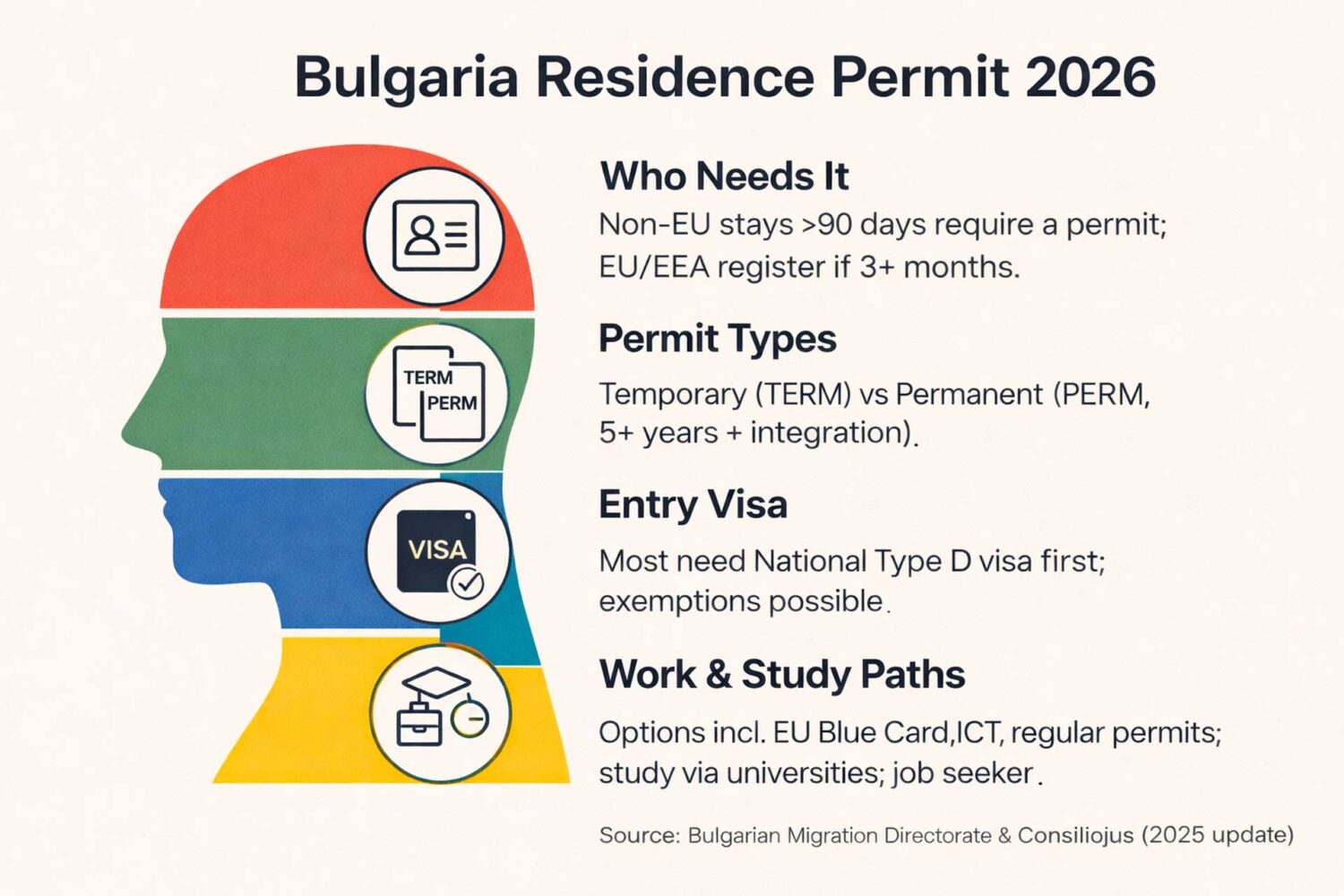
Before diving into the specific categories (retiree, work, investment, etc.), it’s important to understand the main types of residence permits in Bulgaria and their validity:
- Temporary Residence Permit (Prolonged Residence): This is the initial permit most non-EU immigrants get. Sometimes called “prolonged residence permit” or “extended residence,” it allows a stay of up to 1 year at a time. It is usually renewable annually as long as you maintain the grounds for your stay (e.g. still employed, studying, married, etc.). The temporary residence permit in Bulgaria is issued as a plastic ID card (containing your photo and personal data). With a temporary permit, you can live in Bulgaria year-round and exit/re-enter without a visa. Note: EU/EEA citizens do not need this permit; they simply register after 90 days in-country, since EU nationals have freedom of movement.
- Long-Term Residence Permit (Long-Term EU Resident Status): Often achieved after five years of continuous temporary residence, this Bulgaria long-term residence permit grants a more secure status. In EU terms, it corresponds to the EU Long-Term Resident status. The long-term residence card in Bulgaria is typically valid for 5 years at a time but essentially gives you a right to stay permanently, subject to renewal of the card. To get this, you must have lived legally in Bulgaria for five years without significant absences (no more than 6 consecutive months away and no more than 10 months total outside Bulgaria during the 5-year period). Long-term residents enjoy enhanced rights: for example, they can be away from Bulgaria for longer periods (up to 12 consecutive months) without losing their status, and they can more easily move to other EU countries for work under EU rules.
- Permanent Residence Permit: Bulgaria also offers a permanent residence permit status which is very similar to (and often overlaps with) the long-term status. “Permanent” generally means an indefinite permission to reside with no expiration on the right (though the ID card may need periodic renewal). In practice, after 5 years of holding temporary permits, you can apply for permanent residency. However, certain categories can obtain Bulgarian permanent residence much faster or even immediately – for instance, large investors, persons of Bulgarian origin, or family members of Bulgarian citizens (details in the next section). Permanent residents are treated almost like Bulgarian citizens in many respects: they can work without restrictions (even government jobs except those requiring citizenship), access social services, and their family members can also obtain residence statuses. One key difference: Voting rights and holding certain public offices are exclusive to citizens. Permanent residents also must maintain a Bulgarian address and not be absent from Bulgaria for more than 2.5 years out of 5 (30 months), otherwise the permit can be revoked.
Terminology: Bulgaria’s law uses “continuous/prolonged residence” for the 1-year permit, “long-term residence” for the 5-year EU status, and “permanent residence” for indefinite term permission. However, these terms can be confusing. In this guide, we use “temporary residence permit” (1-year, renewable) and “permanent residence permit” (indefinite after fulfilling requirements). When needed, we’ll specify the “long-term (5-year) EU residence permit” as well. In everyday usage, people often say “permanent residency” once they complete five years, even though they technically get a long-term EU card. The good news is that either status (long-term or permanent) gives you a durable right to live in Bulgaria, and both count towards the timeframe for citizenship.
Lastly, the physical Bulgarian residence permit card is an important document you should carry. It serves as your identification in Bulgaria and proof of legal status. After you apply in-country, you’ll get this ID card within days or weeks (you can even pay for expedited 3-day service). The card will show the type of permit (e.g., “Temporary” or “Permanent”) and its validity dates. Now, let’s explore how to get a residence permit in Bulgaria under various eligibility categories.
Pathways to Obtain a Temporary Residence Permit in Bulgaria
To receive a temporary residence permit Bulgaria, you must have a valid reason or ground allowed by Bulgarian law. The most common pathways are: work, business or investment, retirement, family reunification (marriage), study, and freelancing (digital nomads). We will cover each in detail, including any specific Bulgaria residence permit requirements and steps.
Each of these pathways typically requires first obtaining a long-stay D Visa from a Bulgarian embassy/consulate abroad, then converting it to a residence permit after arrival. We’ll discuss the application process in a later section; for now, let’s focus on eligibility categories.
1. Working in Bulgaria (Employment Residence Permit)
If you secure a job with a Bulgarian employer, you can obtain a residence permit for work. There are two main routes for employment:
- General Work Permit: The employer in Bulgaria must sponsor you by obtaining a work permit through the Employment Agency. They need to prove that no suitable EU/EEA candidate is available for the role (labor market test) unless an exception applies. Priority is often given to highly skilled professionals in IT, academia, medicine, etc. – for example, IT specialists, professors, doctors, and even tour guides are in demand. Once the work authorization is approved, you can apply for a D visa and then a 1-year residence permit tied to that job contract. The permit can be renewed as long as you continue working in Bulgaria. Over time, this can lead to long-term or permanent residence.
- EU Blue Card: This is a special type of work permit for highly qualified non-EU professionals, part of an EU-wide scheme. A Blue Card in Bulgaria requires that your salary is at least 1.5 times the national average wage and you have a higher education degree or at least 5 years of professional experience in the field. The Blue Card residence permit is usually issued for up to 4 years (or the duration of the employment contract) and can be renewed. It also allows some mobility to other EU states after 18 months. If you hold a Blue Card, you benefit from a faster route to EU long-term resident status (only 5 years total in EU on a Blue Card, with at least 2 years in Bulgaria). Family members of a Blue Card holder can join more easily as well.
Requirements: For a work-based Bulgarian residence permit, you’ll need an employment contract or a job offer from a Bulgarian entity, the work permit or Blue Card approval, proof of your qualifications, and the standard documents (police clearance, health insurance, accommodation, etc.) we’ll detail later. Once you start work, your employer should register you for social insurance. After five years of legal employment and residence, you can apply for permanent residency.
Dependents: Your spouse and minor children can obtain residence permits as family members of a worker. They will each need their own D visas to enter, but the process is simplified once the principal applicant (worker) has legal residence. Do note that initially the family members’ permits will be temporary (usually one-year renewals) and their clock for long-term or permanent residency also becomes five years (which can run concurrently with the main applicant’s timeline).

2. Starting a Business or Investing in Bulgaria (Business Residence Permit)
Bulgaria encourages foreign investment and entrepreneurship, and there are visa pathways for business owners and investors. Here are the sub-categories:
- Company Formation & Job Creation: One popular route for entrepreneurs is to register a Bulgarian company (such as an LLC) and hire at least 10 Bulgarian citizens on full-time contracts. This can qualify you for a one-year temporary residence permit on the basis of entrepreneurial activity. The idea is that your business contributes to the economy via job creation. You’ll need to maintain those 10 jobs throughout your stay, or the permit might not be renewed. In practice, some people establish a small business or even a startup to meet this requirement, though it comes with overhead costs of salaries and compliance. This route is sometimes used by foreign entrepreneurs as an alternative to work permits.
- Trade Representative Office: If you own or work for a foreign company outside Bulgaria, you can open a Bulgarian Trade Representative Office (TRO) of that company. Registering a representation with the Bulgarian Chamber of Commerce and Industry (BCCI) allows up to 3 foreign representatives of the company to get D visas and one-year residence permits. The representative office route does not require hiring 10 people or investing a certain sum; however, the foreign company must be real and provide documents on its business activity and finances.
Many non-EU businesspeople (for example, from Turkey, etc.) have used this TRO mechanism to base themselves in Bulgaria and manage regional operations. It’s important to note that a representative office cannot conduct commercial trade in Bulgaria directly (it’s not a separate legal entity, just an outpost of the foreign company), but it suffices for residency purposes. This is a good option if you want to get a residence permit in Bulgaria to work remotely or oversee a business abroad, effectively functioning similar to a “digital nomad” visa in practice. - Startup Visa: In recent years, Bulgaria introduced a Startup Visa program to attract innovative entrepreneurs. Applicants with a high-tech or innovative business idea can apply for a certificate from the Ministry of Innovation and Growth (previously Ministry of Economy) to be recognized as a startup project. If approved, this can be a basis for a D visa and residence permit. The exact criteria include presenting a convincing business plan in a high-tech field. The Startup Visa is a newer initiative, aimed at founders of tech startups, and is part of Bulgaria’s effort to boost innovation.
- Real Estate Investment (Property Purchase): Buying property in Bulgaria alone doesn’t grant automatic residency, but it can qualify in specific cases. The law allows a one-year prolonged residence permit if you purchase real estate worth at least BGN 600,000 (approximately €307,000). This can be one property or multiple, and it can be residential or commercial. An equivalent option is to own over 50% of a Bulgarian company that purchases property worth that amount. Note that you must prove the funds were paid in full from your account (loans can only cover up to 25% of the property value). This property-based residence permit is temporary (renewable each year as long as you keep the property).
It’s somewhat analogous to other countries’ “golden visa” by real estate, though Bulgaria’s threshold (~€300k) is higher than, say, Greece’s (€250k, recently raised to €500k in some areas) and unlike Greece, it gives only a temporary (not immediate permanent) permit. After five years of renewing this, you could apply for permanent residency, but you would also need to show you lived in Bulgaria at least half the time (if aiming for long-term status). - Residence Permit by Investment (Fast-Track Permanent Residency): For investors with significant capital, Bulgaria offers a residency by investment program that can lead directly to permanent residence (bypassing the 5-year temporary stage). As of 2025, the main route is to invest at least 1 million BGN (around €500,000) into approved Bulgarian investment assets. These assets can include: shares in Bulgarian companies traded on the stock exchange, units of Bulgarian mutual funds or alternative investment funds (AIF) that meet certain criteria, or capital in a Bulgarian company implementing a priority investment project.
There are also options like investing BGN 250,000 (~€128k) in a company in a disadvantaged region + 5 jobs, or BGN 500,000 (~€255k) in a company + 10 jobs created, among other investment avenues listed by law. Importantly, real estate investment alone is not an option for direct permanent residency – the program was reformed to focus on productive investments. If you meet the criteria and deposit the funds, you can apply for a Bulgaria residence permit by investment and typically receive permanent resident status immediately upon approval. There is no prolonged physical stay requirement for investors under the law – meaning you are not obliged to live in Bulgaria 183 days/year, unlike some other visa types. This makes Bulgaria’s investor residence attractive to global investors who want an EU foothold without relocating full-time. Processing time for the investment residency is around 3–6 months. Family members (spouse and minor children) can be included, gaining residency as well. After holding permanent residency for 5 years, investor residents become eligible for citizenship like anyone else.
(Note: Bulgaria’s citizenship by investment – the so-called “golden passport” – was abolished in 2022 under EU pressure. The current program grants only permanent residence, not a fast track to citizenship, and requires maintaining the investment for at least 5 years.)
In summary, Bulgaria’s business and investment routes range from starting a small local business with 10 employees to committing half a million euros in financial assets. The Bulgaria residence permit cost in these cases can be significant (in terms of investment amount), but the payoff is residency rights and, for major investors, immediate permanent residence.
Compared to other EU programs, Bulgaria’s investor threshold (~€500k) is similar to Spain or Portugal’s former programs, and higher than Greece’s real estate route (though Greece’s is temporary permit only). Unlike some countries, Bulgaria currently does not offer a cheap “financially independent” visa for remote income earners aside from the retirement category and freelance category discussed below. You typically need to either do business, invest, or fall into another specific category to qualify.
3. Retiring in Bulgaria (Pensioner Residence Permit)
Bulgaria is an increasingly popular retirement destination for non-EU citizens, thanks to its low living costs, pleasant climate, and relaxed lifestyle. The Bulgaria residence permit for retirees is often informally called the “retirement visa” or “pensioner D visa”. It is available to foreign nationals who are officially retired and receive a pension in their home country or in Bulgaria. This is a great option if you want to retire to Bulgaria and live off your pension or savings.
Key requirements for a Bulgaria retirement residence permit:
- Pension Status: You must prove that you are retired and entitled to a pension. Typically, this means being above the retirement age or having officially retired early due to years of service or other provisions. You will need an official document from your country’s pension authority confirming you receive a pension, translated and legalized for use in Bulgaria.
- Minimum Income: Bulgaria requires retirees to have sufficient means to support themselves. The minimum income requirement is relatively low – about 500 euro per month (which is roughly the amount of the Bulgarian minimum pension or minimum wage). In practice, authorities ask that you have a pension equal to at least the Bulgarian minimum monthly pension (around 500 BGN, which is ~€250) or the minimum wage (~€400). However, meeting 12 times the minimum monthly pension in savings is also often cited as a requirement. One source notes you should show funds equivalent to 12 months of Bulgarian minimum pension (approximately €3,300) in a Bulgarian bank account. To be safe, most applicants ensure they have at least a few thousand euros saved and a monthly pension income stream above the minimum. This is far more accessible than retirement visas in many Western European countries (for example, Spain’s non-lucrative visa requires about €27,000/year income). Bulgaria’s low threshold makes it a top choice for budget-conscious retirees.
- Accommodation in Bulgaria: You must have an address in Bulgaria – either owned property or a rental where you will live. A rental contract or property deed in your name serves as proof of accommodation.
- Health Insurance: As with all long-stay applicants, you need valid medical insurance. Retirees usually must show private health insurance coverage that is valid in Bulgaria (or show enrollment in the Bulgarian National Health Insurance if/when possible) for at least €30,000 coverage of medical expenses. After you get the residence permit, if you become a tax resident, you can also pay into the public health fund to get local coverage.
- Clean Criminal Record: You’ll provide a police clearance certificate from your country of citizenship or recent residence (apostilled and translated) to show you have no serious criminal history.
If you meet these Bulgaria retirement residence permit requirements, the process is straightforward. You apply for a D visa at the Bulgarian embassy, citing retirement as the reason. After entering Bulgaria, you apply for a temporary residence permit (one-year) on the basis of being a pensioner. The permit is renewable annually.
Validity and Next Steps: The retiree residence permit is initially valid for 1 year. Each year, you’ll need to renew it, proving that you still meet the conditions (i.e. you’re still receiving your pension and have an address, etc.). After 5 years of continuous residence on this basis, you become eligible for permanent residency in Bulgaria. Notably, time spent as a retiree resident does count toward the 5-year requirement for long-term/permanent status. Once you have permanent residence, you won’t need to renew annually; permanent residence for retirees is typically indefinite, and you need to replace the card only every 5 or 10 years as an ID. After obtaining permanent residency, you can even apply for Bulgarian citizenship if you wish to live in Bulgaria permanently (standard rule: 5 years of permanent residency, or sooner if married to a local). However, many retirees simply maintain the permanent resident status. An advantage of the retirement visa is that it can facilitate family reunification – once you settle in Bulgaria, you can bring your spouse (even if they are not of retirement age) under family reunification, and they will get a residence permit too.
Example: An American retiree with a $1,200 monthly Social Security pension easily meets the income criteria and can enjoy a comfortable life in Bulgaria given the lower costs. They open a local bank account (required to show pension deposits locally) and rent a small apartment by the sea. After one month for visa processing and a few weeks to get the residence card, they settle in. They enjoy privileges like buying a car in Bulgaria, traveling to neighboring countries, and after 5 years, they apply for a Bulgaria permanent residence permit to secure their status long-term.

4. Family Reunification (Marriage or Close Family Ties)
If you have a close family member who is Bulgarian or who already holds a Bulgarian residence permit, you may qualify for a Bulgarian residence permit by marriage or family reunion. Here are the scenarios:
- Spouse of a Bulgarian Citizen: Marrying a Bulgarian citizen gives you a strong right to reside in Bulgaria. As the non-EU spouse, you still need to go through the visa D and permit process, but it is generally facilitated. Upon marriage, you can apply for a D visa as a family member of a Bulgarian. Once in Bulgaria, you’ll receive a temporary residence permit (usually one year at a time) as the spouse. The great news is that you can apply for permanent residence after only 5 years of marriage and cohabitation in Bulgaria. In fact, Bulgarian law provides that if you have been married to a Bulgarian citizen for 5 years, you can be granted permanent residency even if you haven’t lived in Bulgaria that entire time (the residency requirement can be waived in this case).
Moreover, the citizenship timeline is faster: after 3 years of marriage to a Bulgarian and at least 3 years of residence, you become eligible to apply for Bulgarian citizenship by naturalization. This is a shorter path compared to the standard 5 years PR + 5 years citizenship route for others. In summary, marriage to a Bulgarian gives a clear route: initially a Bulgarian residence permit by marriage, then permanent residence in 5 years (or sooner in special cases), and potentially citizenship in 3–6 years. - Spouse of a Foreign Permanent Resident: If your husband or wife is not a Bulgarian citizen but has permanent resident status in Bulgaria (or long-term EU resident status), you can also apply for family reunification. You’ll need to show proof of the marriage and that your spouse has sufficient means and housing to support you in Bulgaria. Initially, you get a one-year family reunification permit (renewable). After five years of continuous residence in Bulgaria, you could then apply for permanent residency yourself. (One nuance: if the spouse obtained permanent residency through the Investment route, the 5-year wait can be waived for the family – meaning you might get permanent residence more quickly).
- Children and Parents: Minor children (under 18) of a Bulgarian citizen or of a foreigner who is a permanent resident can receive residence permits as dependents. They will usually be granted the same type of permit as the parent. For example, if a non-EU citizen obtains a temporary residence for work, their non-EU spouse and minor kids can get temporary residence; if that person later gets permanent residency, the family can also get permanent status. Additionally, foreign parents of adult Bulgarian citizens can sometimes get residence on the basis of family ties, especially if the Bulgarian citizen child will support them. The law allows financially dependent parents of Bulgarian citizens or of foreign permanent residents to apply for residence. In practice, the authorities will check that the Bulgarian (or PR holder) child has sufficient income and housing to support the parent in Bulgaria. This is a route, for instance, for a Bulgarian living in Bulgaria to bring an aging non-EU parent to live with them.
In all family cases, proof of the family relationship is critical: marriage certificates, birth certificates, etc., must be provided, translated into Bulgarian and legalized. The authorities will also verify the authenticity of the relationship (especially in marriages, to prevent sham marriages). Once approved, the family member typically must obtain a visa D from the Bulgarian consulate (if they are abroad) then come to Bulgaria to get the ID card.
Living Requirements: Family members on temporary permits should be mindful of the residency rules. For example, a spouse on a temporary permit shouldn’t be continuously outside Bulgaria for more than 6 months, otherwise renewal could be an issue (unless the Bulgarian spouse was with them abroad). After obtaining permanent residence by marriage, you are allowed longer absences (up to 30 months total out of 5 years) without losing the status. And as mentioned, the citizenship waiting time is shorter for spouses of Bulgarians – 3 years of residence post-marriage instead of 5.
Overall, Bulgaria is quite accommodating to family reunification, aligning with EU directives. The Bulgarian residence permit card issued to family members will indicate they are a family member (“family of …”). One benefit of the family reunification route is that the residence permit cost is modest (the same standard fees apply, often around 150 BGN for the application in this case, which is ~€75). Also, applications for family members are usually processed quickly (often within 2 weeks).
5. Studying in Bulgaria (Student Residence Permit)
If you are admitted to a Bulgarian educational institution – such as a university, college, or even a high school or language program – you can obtain a student residence permit. Bulgaria has several universities (in Sofia and other cities) that attract international students, including programs in English (for medicine, engineering, etc.) at comparatively low tuition fees. A Bulgaria student residence permit allows you to live in Bulgaria for the duration of your studies.
Requirements and process:
- University Acceptance: First, you need a letter of acceptance or enrollment from a recognized Bulgarian educational institution. For university programs, foreign students often go through an application process and receive an acceptance letter, which is then used to apply for the visa. The Ministry of Education in Bulgaria may issue a certificate or confirm the acceptance for visa purposes.
- Visa D for Study: With your acceptance letter and proof of paid tuition (if applicable), you apply for a Type D long-stay visa under the study grounds. You’ll need to show you can cover your finances during your stay (scholarship or personal funds) and have health insurance, as well as a clean criminal record certificate. According to Bulgaria’s visa fees, the D visa application for study typically costs €100 (standard fee). Some student categories might be exempt or have reduced fees (for example, EU-funded exchange students sometimes don’t pay visa fees).
- Residence Permit Application: After arriving in Bulgaria, you must apply for a temporary residence permit (usually valid for one year at a time, or sometimes for the length of one academic year/program). The student residence permit fee for the permit card itself is not high – roughly 110 BGN (about €55) for a 1-year card under normal processing. If you need it faster, express processing can cost up to 3x more (e.g., ~€150 for 3-day service). Students need to provide documents such as proof of enrollment, a letter or certificate from the university confirming they are a student, evidence of accommodation (like a dormitory letter or rental contract), and proof of finances (sometimes universities or government scholarships handle this).
- Work Rights: It’s important to note that foreign students in Bulgaria are allowed to work part-time with some limitations. Bulgaria follows the EU directive that students can work up to 20 hours per week during term and full-time during vacations, without a separate work permit. This can be a benefit for students looking to earn extra money or do internships, though Bulgarian student jobs might require Bulgarian language depending on the field.
- Renewal and Post-Graduation: Student permits are renewed each year by providing an updated confirmation of enrollment and that you passed your exams, etc. After finishing studies, students can often switch to another permit type (for example, to a work permit if they find a job, or even a job search permit if Bulgaria implements the EU rule allowing graduates 9 months to seek work – check the latest Bulgaria residence permit news for any new post-study visa options).
Time spent on a student permit usually counts as half towards the 5-year requirement for long-term residence (EU rules often count study years at 50% for permanent residency purposes). However, if you remain in Bulgaria and transition to a work or other permit, eventually you can accumulate the required years for permanent residency.
Fees and processing time: The overall Bulgaria student residence permit cost isn’t very high aside from tuition. You have visa D fee (~€100) and then the residence card state fee (~€55 standard) plus any translation/notary expenses. Processing time for the residence card after application is usually a couple of weeks (students often apply through the university with the Migration office’s coordination). In total, from visa application to getting your card could be 1–2 months, so it’s advised to start early in the summer if aiming for a fall semester. Bulgarian universities often assist foreign students with the paperwork.
Leave your contacts to have an expert contact you shortly.
6. Freelancers and Digital Nomads
With the rise of remote work, many people ask about a Bulgaria digital nomad residence permit. Unlike some other EU countries, Bulgaria does not yet have a dedicated “Digital Nomad Visa” by name. However, there is an existing legal pathway for freelancers and self-employed individuals which effectively serves the same purpose.
Bulgaria’s Foreigners Act allows a non-EU national to obtain a D visa and residence permit to practice freelance or self-employed activity in Bulgaria. In practice, this is often referred to as a “Freelancer Visa”. It is used by remote workers (bloggers, IT contractors, consultants, designers, etc.) who want to base themselves in Bulgaria while working for foreign clients or their own online business.
How it works:
- Permission from Ministry of Labor: To qualify, you must get permission to work as a self-employed person in Bulgaria. The Ministry of Labor and Social Policy assesses applications for foreign freelancers under Article 24(1)(6) of the Foreigners Law. You typically need to show your professional qualifications or business plan, and evidence that your activity can be done independently and will generate income. Essentially, they want to ensure you won’t become a burden on the state. Professions that Bulgaria might welcome in this category include IT and tech specialists, digital marketers, content creators, and other location-independent professionals.
- D Visa Application: Once you have the authorization, you apply for the D visa at a Bulgarian consulate, just as other categories. You’ll show the authorization letter, proof of funds, insurance, etc. There isn’t a set minimum income published for freelancers, but as a guideline, having at least the equivalent of the Bulgarian minimum wage or higher (€400+ per month) as stable income is expected. In one source, it’s mentioned that having a stable income or bank deposit of at least 477 € per month (the Bulgarian minimum wage in 2025) is required. This aligns with the general rule that any residence applicant must have means of support above the minimum wage/pension.
- Residence Permit for Freelance: After arriving, you apply for a one-year temporary residence permit on the basis of self-employed/freelance work. This permit allows you to reside in Bulgaria and conduct your business legally. Note that as a resident, if you earn income in Bulgaria or from Bulgarian clients, you might need to register as a self-employed person or register a Bulgarian sole-proprietor business and pay taxes locally. Many digital nomads earning from abroad also opt to register a Bulgarian company for favorable taxation (10%) and then be employed by their own company – but that drifts into the business category. If truly freelancing without a local company, you’d likely pay personal income tax and social contributions as a self-insured person in Bulgaria.
- No Separate “Nomad” Visa, but an Alternative: It’s worth comparing: countries like Portugal, Spain, Greece, Croatia, etc., have introduced specific “digital nomad visas” or remote work visas which require proof of higher income (often €2000+ per month). Bulgaria’s equivalent path is actually more accessible in terms of income threshold (just demonstrate you have enough to live on, ~€500+ per month). However, the paperwork to get the freelance permit can be a bit involved, since you need that Labor Ministry approval. Despite the extra steps, Bulgaria is gaining popularity among digital nomads due to its affordability and now easy travel access to the rest of Europe.
In fact, Sofia and Plovdiv have become hubs for digital nomads and IT freelancers – co-working spaces are common, and there’s a vibrant community. Bulgaria offers modern infrastructure (fast internet, etc.) at a fraction of the cost of Western Europe. As one 2025 review notes, “there is no separate visa for nomads, but an alternative one for freelancers”, which many remote workers choose. Freelancers get a type D visa and permit for “pursuing freelance activities,” which lets them legally reside and even register a business if needed.
Renewal and beyond: The freelance-based permit is renewable each year, provided you still have your self-employment and are earning sufficient income. After five years, you could apply for permanent residency just like any other category. Keep in mind you must adhere to the same residency rules (not being absent too long). There’s no obligation to employ others or invest a specific sum – you simply must sustain yourself. Many digital nomads appreciate this flexibility. And if your circumstances change (say you get a job with a Bulgarian company or start a family), you can switch your permit category accordingly.
7. Other Special Categories
Bulgaria’s immigration law includes several other grounds for residence which are less common but worth mentioning for comprehensiveness:
- Volunteers: Participation in international volunteer programs (e.g., European Voluntary Service) can grant a residence permit for the duration of the volunteering, with appropriate documentation.
- Researchers and Scientists: If you have a hosting agreement with a research institution in Bulgaria, you can get a residence permit as a researcher. This often applies to PhD students or postdoctoral researchers under EU science programs. Researchers may get a long-stay visa up to 1 year for research purposes.
- Students in Exchange Programs or Interns: Aside from degree students, those coming for Erasmus+ or exchange programs, or even school pupils on exchange, can get temporary residence for the program duration.
- Humanitarian Cases: Recognized refugees or individuals granted asylum/subsidiary protection in Bulgaria receive residence permits as part of their status (outside the scope of typical immigration categories). Also, foreigners who cannot be returned to their home country for humanitarian reasons might get permission to stay.
- Special Contribution or Bulgarian Origin: Persons of Bulgarian origin (proved by ancestry and certified by the State Agency for Bulgarians Abroad) can usually obtain permanent residence quite easily. In fact, Bulgarians by origin are exempt from the 5-year wait – they can get permanent residency without prior temporary permits. Often, they can apply directly at the embassy and get a 5-year or permanent card upon arrival. Similarly, individuals who have made special contributions to Bulgaria (cultural, sports, etc.) or who are deemed beneficial to the country can be granted residence or even citizenship on exceptional basis. These cases are rare and discretionary.
As you can see, temporary residence permit Bulgaria programs cover a wide range of situations. For most readers, the focus will be on the main ones (work, business/investment, retirement, family, study, freelance). In the next sections, we’ll explain how to apply for the Bulgarian residence permit and detail the process, processing time, and documents. After that, we will also compare Bulgaria’s scheme with other countries to give context.
How to Apply for a Bulgarian Residence Permit: Step-by-Step Process
Getting your residence permit in Bulgaria is typically a two-stage process: Stage 1 – Obtain a long-stay visa (Visa Type D), and Stage 2 – Apply for the residence permit (ID card) in Bulgaria. Here’s a breakdown of the steps, documents, fees, and Bulgaria residence permit processing time at each stage.
Stage 1: Visa D Application (Entry Visa for Long-Term Stay)
Secure Your Basis for Residency. Before you apply for the visa, make sure you have all the prerequisites for your chosen category (as discussed above). For example, if it’s work, have your work permit or contract; if it’s retirement, have your pension documents; if it’s family, have marriage or birth certificates; if study, your acceptance letter; if investment, documents proving your investment, etc.
Prepare Required Documents. Though specifics vary by category, a typical Visa D application packet includes:
- A valid passport (with at least 6-12 months beyond the intended entry and some blank pages).
- Completed visa application form (available from the Bulgarian embassy or consulate or online).
- Recent passport-size photos.
- Documents proving your intended grounds for long-term stay in Bulgaria (e.g., work permit, university acceptance, marriage certificate, investment certificate, etc.).
- Proof of sufficient financial means for the duration of stay (this might be bank statements, pension slips, scholarship letters, or an employment contract showing salary). For most, showing funds to cover at least €50 per day of stay or a lump sum for a year (around the minimum wage * 12) is expected.
- Proof of accommodation in Bulgaria: either a rental contract, property deed, or a hotel reservation/letter promising you will have a place to stay.
- Health insurance valid in Bulgaria and all EU covering at least €30,000 in medical costs (often a travel health insurance for 3-6 months is required for the visa; later, after you get residency, you’ll switch to Bulgarian health insurance).
- Police clearance certificate (background check) from your country of citizenship or recent long-term residence, to show no criminal convictions.
- Visa fee payment: The visa D fee is €100 for most applicants (some categories like children under 18 or family of EU citizens are exempt). Some consulates might charge in local currency or have an added service fee – check with the specific embassy.
These documents must often be translated into Bulgarian and legalized (with apostille or consular certification) especially for official papers like marriage or birth certificates and police clearances. The Bulgarian consulate can provide guidance on translation requirements.
Submit at the Bulgarian Embassy/Consulate. Visa D applications are submitted in person at a Bulgarian diplomatic mission in your country (or a country you legally reside in). Unfortunately, you generally cannot apply for this visa from within Bulgaria; you must do it abroad. Some embassies require appointments in advance. You’ll submit your application and all documents, pay the fee, and possibly attend a short interview.
Wait for Processing. The processing time for a D visa is usually about 30 calendar days, though it can vary. Bulgarian law allows up to 35 business days for a decision. In many cases, applicants get their visa in 3-6 weeks. It’s wise to apply well ahead of your planned move (but not more than 6 months early). If there are missing documents or clarifications needed, the consulate might call you to provide more info, which can extend the timeline.
Receive Visa D. Once approved, the D visa is stamped or affixed in your passport. It’s typically a six-month validity, multiple-entry visa that allows you to enter Bulgaria and stay up to 180 days (or it might say 360 days, but note that it’s not the actual permit, just the entry visa). In practice, upon entry the border officer will give you a 90-day stay stamp, because within 90 days you are expected to convert it to a residence permit. If you fail to apply for residence in time, you would have to leave when the visa expires. The D visa can be single-entry or multiple-entry (recently they issue multiple-entry so you can come and go during the initial period if needed).
Stage 2: Residence Permit Application in Bulgaria
Travel to Bulgaria: enter on your D visa. Upon arrival, you officially have the right to apply for residency. It’s recommended to head to the city where you intend to live (since you’ll apply at the local Migration Office there). You should register your address if you’re staying in a private accommodation – by law, foreigners must register an address within 5 days of entry. Hotels do this automatically for guests, but if staying at an apartment, you’d do a registration at the local police or Migration (often done together with the permit application).
Prepare Documents for Migration Office. Some documents from your visa application will be reused, but you may need additional copies or updates:
- Application form for residence permit (available at Migration Directorate or online).
- Your passport (original and copies of photo page, and the page with the visa and entry stamp).
- A document for paid state fee for the application – typically 10 Bulgarian leva (about €5) for the application processing. This is usually paid by bank transfer or at a bank counter; you attach the receipt.
- Proof of address in Bulgaria (notarized rental contract, or a declaration from your landlord, or property deed copy). They may also want an address registration letter from the local municipality (obtained with your landlord’s help).
- Medical insurance valid in Bulgaria. If you have a private policy, show the card or certificate. If you have entered the public health system (some categories can immediately register for Bulgarian health insurance by paying the monthly contribution), provide that evidence. This requirement ensures you won’t rely on state aid for health issues.
- Proof of financial means: e.g., recent bank statement, pension payment slip, or an employment contract stating your salary. The law asks for an amount not smaller than the minimum monthly salary or pension for the length of your stay. For one year, having at least 12 * minimum monthly salary is a guideline. In 2026, the minimum salary in Bulgaria is around BGN 940 (~€480), so roughly €5,760 per year could be considered sufficient means. Presenting savings or regular income meeting that is important.
- Criminal record certificate: If you didn’t submit the original to the embassy or if they didn’t keep it, the Migration Office will want to see it (original with apostille plus Bulgarian translation). This is usually only needed on the first-time application.
- Category-specific documents.
The Migration Office provides a checklist, and it can vary slightly. It’s advised to consult the official Migration Directorate website or a lawyer for the latest requirements. Some offices might ask for things like a notarized affidavit that you won’t seek social assistance, etc., but those are usually covered by the standard forms.
Submit Application at Migration Directorate. In Sofia, this is at the national Migration Directorate; in other cities, at the local Migration Sector of the Police (Ministry of Interior). You must apply in person (fingerprints and photo will be taken). Hand in your application form and all documents. You will pay the small application fee (if not already paid) and get a receipt.
Processing Time: the law stipulates a relatively fast processing – about 14 days for a temporary residence application. In practice, many applicants get a decision in 1–2 weeks. Some offices even issue the decision in a week if all papers are in order. If there’s any complexity or missing document, they might extend the processing by up to 1 month (you’ll be notified and asked to supply additional info within 14 days). For permanent residence applications, the processing is up to 2 months (with a possible 2-month extension if needed). But for most first-time temporary permits, expect about 2 weeks.
Approval and Paying Card Fee. Once approved, you’ll be instructed to pay the fee for the residence card issuance. The fee depends on the validity and speed you want:
- For a standard 1-year permit, the state fee for the card is around BGN 110 (lev) which is roughly €56.
- If you want faster service for printing the card, there are options: for example, in Sofia, a 10 working day service is ~BGN 90 (around €45), and a 3 working day (express) service is ~BGN 225 (around €115). The visa-digital-nomad resource quotes the card fees as €22 for 30-day service, €45 for 10-day, and €110 for 3-day which are approximations. These might have been conversions to Euro – the official fees in leva are what you’ll pay. Essentially, you pay more to get your ID card faster. Many applicants choose the fast or express option to have their card in hand quickly.
- Students and some categories might pay slightly reduced fees if their permit validity is shorter (e.g., a 6-month permit might cost ~€50 instead of €100, as one source indicated 6-month ~100€, 12-month ~250€, but this needs clarification; likely those figures included ancillary costs. The core card fees are as above.)
At the time of application, or sometimes after approval, your biometric data (photo, fingerprints, signature) will be taken at the Migration Office. This will be stored in your residence card’s chip. Once the card is ready, you (or an authorized representative with a power of attorney) will pick it up in person. Congratulations – you now have your Bulgarian residence permit card!
With your new card, you’ll also receive a Bulgarian Personal Number (called ЛНЧ or “LNCh” for temporary residents, or ЕГН for permanent residents which is like a Bulgarian ID number). This number will be on your card. It’s used for everything from opening bank accounts to seeing a doctor. Temporary residents get an LNCh (which often starts with 98 or 99 as a prefix), while permanent residents get an EGN (which is the same format as Bulgarian citizens’ ID number, usually encoded with birthdate). The difference isn’t very noticeable, but it exists behind the scenes.
Renewal: A temporary residence permit is typically valid for one year and needs renewal annually before it expires (file the extension application at least 14 days before expiry). The renewal process is similar: you submit updated documents proving you still meet the requirements (e.g., renewed rental contract, recent bank statement, etc.). The state fees for renewal are about the same (and you’ll get a new card each time). After five continuous years on temporary status, you can apply for long-term or permanent residence. That application involves proving you indeed lived in Bulgaria (they’ll check your entry/exit records to ensure you didn’t exceed allowable absences) and again showing financial means and address. The permanent residence application fee is 1,000 BGN (approx €511), and the decision can take up to 2–4 months. Once approved, the permanent residence card is usually valid for 5 years at a time but easily renewable with just a small fee (sometimes at no cost for renewals).
Processing Time Summary: In total, from the day you apply for a D visa to the day you receive a residence card can take about 2 to 3 months on average. This breaks down to roughly a month for the visa and a few weeks for the permit. Of course, prepare well because any missing paperwork can introduce delays. For the Bulgarian residence permit processing time, the in-country part is relatively quick (14 days by law for temporary permits), which is faster than many EU countries where residence permits often take 1–3 months to be issued. Bulgaria’s system is quite efficient if everything is in order.
Bulgaria vs. Other EU Countries’ Residence Programs
Bulgaria’s residence permit programs are often considered user-friendly and cost-effective, especially for retirees and entrepreneurs. Here’s a quick comparison with some other EU countries on key categories.
Retiree Residence Permits
Many EU countries offer retirement or “financially independent” visas, but the income requirements differ hugely.
- Bulgaria: ~€6,000 annual income (around €500/month pension) plus some savings. Low cost of living means even middle-income retirees can qualify and live comfortably.
- Spain: Non-lucrative visa requires about €27,000/year income (plus ~€6,800 for a spouse) in 2024. That’s over 4 times the Bulgarian requirement. Cost of living in Spain is higher too.
- Portugal: The D7 “passive income” visa requires about €9,150/year for a single person (in 2024), which is higher than Bulgaria but still moderate. However, demand for Portugal’s visas has been high and processing slower, whereas Bulgaria’s is relatively quick.
- Greece: The FIP (Financially Independent Person) visa needs proven income of €2,000/month (i.e. €24,000/year) for a single, plus rent or owned housing. Again, Bulgaria’s bar is far lower.
- Italy: Elective Residency visa (for retirees) wants ~€31,000/year income for a single.
Verdict: Bulgaria clearly has one of the lowest income thresholds in Europe for a retirement residence permit, making it accessible. Additionally, things like property ownership are not required (whereas some countries implicitly expect you to buy property as a retiree).
Investment Residency (“Golden Visa” programs)
- Bulgaria: ~€500,000 investment in stocks/funds or business for immediate permanent residency. Real estate €300k gives temporary residency but not PR directly. No physical stay required for investors. Citizenship after 5 years of PR (no shortcut anymore).
- Greece: €250,000 (now €500,000 in Athens and some areas) real estate for a renewable 5-year temporary residency (the Greece Golden Visa). No required stay. But it’s not permanent until after 5 years of living (which most investors didn’t do). No direct citizenship; must reside 7 years and learn Greek.
- Portugal: Golden Visa (now ended in 2023 for new applicants) was €280k–€500k in property/funds for temporary residency; required minimal stay (7 days/year); could get citizenship after 5 years with language exam. Portugal ended this program due to housing pressure.
- Spain: €500,000 in real estate for a renewable 2-year residency (also no required stay). No direct PR; you could get PR after 5 years if you actually lived in Spain 5 years. Citizenship after 10 years.
- Malta: Malta’s Golden Visa (Permanent Residency Program) requires a combination of a ~€100,000 government contribution + buying or renting property + showing €500,000 in assets. It gives immediate permanent residence. Malta also has a separate citizenship by investment (paused as of 2022 for Russians and under scrutiny by EU).
- Ireland: Ireland closed its investment program in 2023. The trend in Europe has been tightening golden visas.
Verdict: Bulgaria’s Residency by Investment stands out for granting permanent residency straight away with a ~€500k investment, and allowing family inclusion with no extra investment. While €500k is not a small sum, the fact it’s permanent (and an EU status) is a big plus. Many other golden visas only give temporary status that hinges on renewals. Also, Bulgaria’s no physical presence rule for investors is similar to Greece/Spain, but Bulgaria leads to citizenship in 5 years of PR (if one chooses to meet the conditions then), whereas Spain requires 10 years of actual residency for citizenship. The downside is Bulgaria’s program focuses on financial assets and creating jobs, not as straightforward as just buying a luxury home; some investors prefer tangible real estate (but you can still do real estate in Bulgaria, it’s just not an immediate PR unless combined with other steps).
Digital Nomads / Remote Workers
- Bulgaria: No dedicated DN visa, but freelancer permit route. Low financial requirement (~€480/month) but requires some bureaucracy (labor ministry permission). Once obtained, very low living costs and 10% tax if you become tax resident.
- Croatia: Digital Nomad Visa allows up to 1-year stay (not renewable consecutively) with no local work allowed. Requires ≈€2,300/month income and background check. No tax on foreign income during the stay. Good for a temporary year, but not a path to PR unless you switch to another visa.
- Estonia: Digital Nomad Visa 1 year (with 1 possible extension) requiring ≈€3,500/month income. Again, temporary.
- Greece: Digital Nomad Visa requires ~€3,500/month income (higher if with family). Can convert to 2-year permit called Digital Nomad Residence. Offers a 50% income tax break for 7 years if you actually become a tax resident in Greece.
- Spain: Newly launched Digital Nomad Visa (under Startup Law) requires about €2,520/month income for single. Gives 1 year visa, renewable for up to 5 years, and a special 15% flat tax on foreign-sourced income for up to 4 years if qualified.
- Portugal: D8 (Digital nomad/remote work visa) requires about €3,040/month income (4x minimum wage). Grants 2-year residence, renewable, and opportunity for permanent residence/citizenship at year 5. Taxes can be 0% on foreign income for 10 years under NHR regime in some cases.
Verdict: For long-term relocation, Portugal and Spain now have very attractive remote worker visas that lead to residency and eventually citizenship, but the income bar is high. Greece has a tax incentive but also high income requirement. Bulgaria’s “freelancer” route has a much lower income threshold, making it one of the most accessible for nomads who might not have Silicon Valley-level salaries. The trade-off is that Bulgaria doesn’t market it as a “Nomad Visa,” so you have to navigate the process more on your own (possibly with legal help). However, once you get it, Bulgaria’s low cost of living and taxes can significantly benefit remote workers. And you still have a path to permanent residency and citizenship if you stay long enough, something pure “nomad visas” often lack.
Permanent Residency and Citizenship Ease
| Country | Permanent Residency (PR) Eligibility | Citizenship Eligibility | Language Requirement |
| Bulgaria | After 5 years of legal residence (or immediate PR for major investors or persons of Bulgarian origin) | After 5 years of permanent residency (typically 10 years total) | Bulgarian language test |
| Romania | After 5 years of legal residence | After 8 years of residence | Romanian language test |
| Hungary | After 3 years in certain cases | After 8 years of residence | Hungarian language test |
| Spain | After 5 years of legal residence | After 10 years of residence | Spanish language + culture test |
| Italy | After 5 years of legal residence | After 10 years of residence | Italian language B1 |
| Portugal | After 5 years of legal residence | Citizenship possible after 5 years (no PR required first) | Portuguese language A2 |
| Germany | After 5 years (or 3 years for EU Blue Card holders with B1 German) | After 8 years (can be reduced to 6 years) | German language B1 |
| Greece | After 5 years (EU long-term residence) | After 7 years of actual residence | Greek language test (high difficulty) |
Bulgaria’s timeline is fairly standard, but the citizenship waiting time effectively totals 10 years which is on par with many EU states (though a few allow in 5 or 6). The easier parts of Bulgaria’s process are the lower financial barriers and relatively quicker and simpler bureaucracy once you know the steps. Also, dual citizenship is allowed (some EU countries like the Netherlands and Austria generally do not allow dual citizenship, but most others including Bulgaria do).
Cost of Living and Integration
Bulgaria shines in cost of living – an important factor if you plan to actually live there (not just hold residency). Housing, utilities, food, and services are cheaper than in Western Europe. On integration: learning Bulgarian (a Slavic language with Cyrillic script) can be a challenge, but many expats manage basics and the younger generation often speaks some English. Compared to, say, integration in France or Germany where language is absolutely needed, one can get by in Bulgaria’s expat circles with English, though learning Bulgarian is rewarding and necessary for deeper integration and ultimately for citizenship (a language test in Bulgarian is required for naturalization).
In summary, Bulgaria’s residence permit programs offer a blend of affordability, reasonable requirements, and now enhanced travel perks (Schengen). For many, it’s an underrated choice compared to the more publicized programs of Western Europe. If you want an EU base but don’t have a sky-high income or millions to invest, Bulgaria is worth serious consideration.
Conclusion In this comprehensive overview, we’ve explored how to obtain a residence permit in Bulgaria – covering everything from the Bulgarian residence permit requirements for each category to the application steps, costs, and benefits. By now, you should have a clear idea of the main pathways: whether it’s residence permit Bulgaria by investment, a Bulgaria retirement residence permit, a temporary residence permit Bulgaria for work, study or family, or using the Bulgaria digital nomad residence permit alternative for freelancers, the opportunities are diverse. We also discussed how Bulgaria stands in comparison to other EU countries’ immigration programs, and it’s evident that Bulgaria offers a welcoming, low-cost gateway into Europe for those who qualify.
As of 2026, Bulgaria’s EU membership combined with Schengen access adds even more value to its residence permits – granting you mobility and options that extend far beyond this beautiful country’s borders. The bulgarian residence permit benefits now include not just life in Bulgaria, but easy travel across Europe, low taxes, and a path to EU citizenship if you desire.
Ready to take the next step? If you believe Bulgaria is the right destination for you, begin organizing your documents and perhaps reach out for a consultation with an immigration expert to tailor a plan for your move. Embarking on the journey to obtain your Bulgarian residence permit might seem daunting, but with the right preparation it can be very manageable – the system is quite straightforward compared to many other countries. Bulgaria is eager to welcome foreign professionals, investors, retirees, and students into its community. The rewards (from financial savings to quality of life) can be well worth the effort.
Leave a Comment

We have prepared answers to the most common questions about Bulgaria residence permit. If you want to clarify anything, please contact us - we will provide detailed explanations.
A Bulgarian residence permit is an official document that allows non-EU citizens to legally live in Bulgaria for more than 90 days. It is issued as a Bulgarian residence permit card and can be temporary, long-term, or permanent depending on the legal basis and length of stay.
To get a residence permit in Bulgaria, you usually follow two steps. Apply for a Type D long-stay visa at a Bulgarian embassy abroad. After entering Bulgaria, apply for a temporary residence permit Bulgaria at the Migration Directorate. You must qualify under a legal ground such as work, business, investment, retirement, study, family reunification, or freelance activity.
The Bulgaria residence permit processing time is usually: visa D: about 30–45 days, residence permit in Bulgaria: 10–14 working days after application, permanent residence applications may take up to 2–4 months.
The Bulgaria residence permit cost typically includes: visa D fee: around €100. Temporary residence permit card: approx. €55–€115, depending on processing speed. Permanent residence application fee: approx. €500. Additional costs may apply for translations, notarization, and legal assistance.
Yes. As of 2025, Bulgaria is fully part of the Schengen Area, which means holders of a residence permit Bulgaria can travel freely within Schengen countries for short stays.
Bulgaria does not have a visa officially called a “digital nomad visa,” but freelancers and remote workers can apply for a residence permit in Bulgaria based on self-employed or freelance activity. This option is often used as a Bulgaria digital nomad residence permit alternative.
Yes. The Bulgaria residence permit by investment allows foreign investors to obtain permanent residence by investing approximately €500,000 in approved Bulgarian assets. This program does not require continuous physical presence in Bulgaria.
Yes. Spouses and minor children can apply under family reunification once the main applicant has a valid residence permit in Bulgaria. Each family member receives their own residence card.


Comments
No comments found.