

 EU Citizenship
 Slovenian Citizenship
 Romanian Citizenship
 Bulgarian Citizenship
 Austrian citizenship (investments)
 Spanish Citizenship
 Italian Citizenship
 Cypriot Citizenship
 Lithuanian Citizenship
 Portuguese Citizenship
 French Citizenship
 German Citizenship
 Hungarian Citizenship
 Dutch Citizenship
 Belgian Citizenship
 Croatian citizenship


Turkish Residence Permit 2026: Complete Guide to Types, Costs & Application Process

Author: Leon Scott
Published: 23.02.2026
Updated: 23.02.2026
Turkey’s residence permit (ikamet) is an official document that allows foreign nationals to live in Turkey beyond the typical 90-day tourist visa limit. If you plan to stay in Turkey longer than 90 days in a 180-day period, you are legally required to obtain a residence permit – otherwise you risk fines, deportation, or a ban on re-entry. This comprehensive 2026 guide explains what a Turkish residence permit is, who needs one, the types available, and how to apply step by step. We’ll also cover costs, renewals, common pitfalls, and how a residence permit differs from a visa or Turkish citizenship. By the end, you’ll have a clear roadmap to legally reside in Turkey, whether you’re a digital nomad, student, retiree, or joining family.
What Is a Turkish Residence Permit?
A Turkish residence permit is a document issued by the Directorate of Migration Management (DGMM) that authorizes a foreigner to reside in Turkey for a set duration beyond a visa’s validity. In practical terms, it’s your proof of legal stay in Turkey after your visa or visa-free allowance (usually 90 days) runs out. The permit is tied to a specific purpose (such as tourism, study, work, family reunification, etc.) and location, and it grants you a Foreign ID number and access to certain services like healthcare and education while in Turkey. Importantly, a residence permit is not the same as a work permit – it allows you to live in Turkey, but on its own does not grant the right to work (working requires a separate work permit or work visa status, explained later).
In summary, if you intend to stay in Turkey longer than the time allowed by your entry visa or visa exemption, you must apply for a residence permit after you arrive. Turkish law (Law No. 6458 on Foreigners and International Protection) obliges foreigners to obtain a residence permit appropriate to their reason for staying beyond 90 days. With a valid residence permit (often a biometric card), you can come and go from Turkey freely during its validity, rent property, open bank accounts, get a local SIM card, and otherwise reside legally without doing border visa runs.
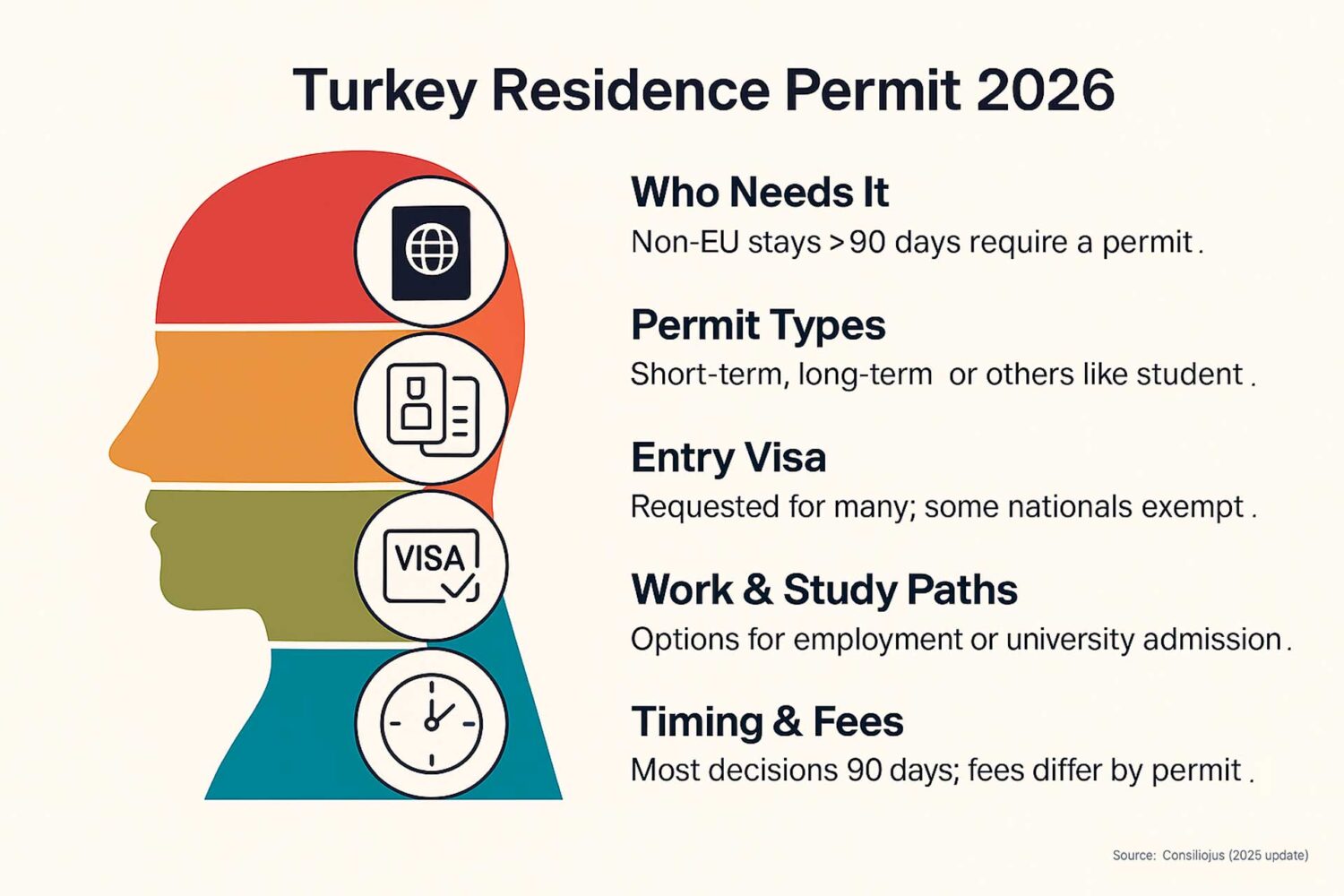
Turkish Visa vs. Residence Permit
It’s important to distinguish a visa from a residence permit, as they serve different purposes:
- Visa – A visa is an entry permission (sticker or e-visa) obtained before or upon arrival that allows a short stay in Turkey, typically for tourism or business. Most tourist visas or visa-free entries allow a stay of up to 90 days within a 180-day period. Visas are temporary and do not confer resident status. You use a visa to enter Turkey for a short visit.
- Residence Permit – A residence permit (ikamet) is an authorization to live in Turkey long-term. It is applied for after you arrive (via the online system) and is issued in Turkey. A residence permit allows stays beyond 90 days, often for 6 months, 1 year, or 2 years at a time (renewable). While a visa is about entry, a residence permit is about continued stay. It typically requires more documentation (proof of address, income, etc.), but once you have it, you can reside in Turkey legally for the permit’s duration without needing to leave.
Key differences: Visas are short-term and for visits; residence permits are long-term and for living in the country. For example, a tourist e-visa might let you visit Turkey for up to 3 months, but if you decide to stay longer (to live, study, work, etc.), you must obtain a residence permit to extend your stay legally. Another difference is process: you get a visa from a Turkish embassy/consulate or online before travel, whereas you apply for a residence permit inside Turkey through the immigration authorities. In short, visas get you into Turkey; residence permits let you remain in Turkey legally beyond the visa period.
Who Needs a Turkish Residence Permit?
Any foreigner who plans to stay in Turkey for more than 90 days in any 180-day period will need a residence permit. This applies regardless of your nationality or visa-exempt status. For example, U.S. or EU citizens who can enter visa-free still must get a residence permit if staying longer than 3 months. Here are common scenarios of who needs to apply for a Turkish residence permit:
- Long-Term Tourists or Remote Workers: If you wish to live in Turkey beyond the 90-day tourist limit – for instance, digital nomads or retirees enjoying Turkey’s climate – you’ll need a residence permit once your initial visa/90 days expire. Essentially, anyone extending their stay past the allowed tourist duration must get a permit (often a short-term residence permit for “touristic” purposes).
- Students: Foreigners enrolled in Turkish universities, language courses, or exchange programs must obtain a student residence permit to stay for the duration of their studies.
- Foreign Employees and Businesspeople: Those working in Turkey will need a work permit (which doubles as a residence permit) or, if conducting business long-term without local employment, a short-term permit for business purposes. (Notably, if you secure a work permit through an employer, you do not need a separate residence permit – the work permit card itself grants legal residency.)
- Family Members: If you are joining a family member who is a Turkish citizen or a legal resident, you likely need a family residence permit (e.g. foreign spouses of Turks, or dependent children joining a parent in Turkey).
- Property Owners: Foreigners who purchase property in Turkey and wish to reside in it can obtain a short-term residence permit as property owners (sometimes called a “property residence permit”).
- Medical Treatment or Health Reasons: Foreigners undergoing long-term medical treatment in Turkey (beyond 90 days) need a residence permit (there’s even a specific short-term permit category for medical purposes).
- Humanitarian Situations: Those who cannot easily get other permit types – for example, due to emergency situations, refugees awaiting status decisions, or other humanitarian reasons – may qualify for a humanitarian residence permit on a case-by-case basis.
In summary, any extended stay beyond the standard visa timeframe means you must apply for a residence permit. Short visits (vacations, short business trips, under 3 months) won’t require it, but if you’re settling in Turkey for the medium or long term, it’s obligatory to have an ikamet. Failing to obtain one can result in overstaying fines or entry bans.
Note: Some exceptions exist. For instance, diplomatic personnel or holders of certain work visas may be exempt from needing a separate residence permit. Also, holders of valid work permits are automatically allowed to reside in Turkey without a separate ikamet. But for the vast majority of foreigners, the 90-day rule applies.
Types of Turkish Residence Permits
Turkey offers several types of residence permits to accommodate different purposes of stay, as defined by the Law on Foreigners and International Protection (Law 6458). Choosing the right category is important, as each type has specific eligibility criteria and duration limits. Below is a summary of the main residence permit types and their key features:
| Type of Residence Permit | Purpose & Eligibility | Duration |
| Short-Term Residence Permit | For general purposes including tourism, business, owning property, attending Turkish language courses, research, or non-work related stays. Most first-time applicants (remote workers, retirees, etc.) use this. | Up to 2 years per permit (renewable). |
| Family Residence Permit | For foreign spouses and children of Turkish citizens or legal residents (permit holders) in Turkey. Sponsor (the Turkish or resident family member) must meet income and housing requirements. | Up to 3 years at a time (renewable), not exceeding the sponsor’s permit validity. |
| Student Residence Permit | For foreigners studying at a Turkish university or school, or in Turkish language programs. Requires enrollment proof. Also used for exchange students (Erasmus, etc.). | Length of the academic program (can be multi-year, renewable until studies finish). |
| Long-Term Residence Permit | Permanent residency for those who have lived in Turkey at least 8 years continuously on other permits. Subject to good conduct (no recent social aid or serious crimes, stable income). Essentially Turkey’s version of indefinite permanent residence. | Indefinite (no expiry). Does not require renewal, but can be canceled if the holder stays abroad for too long or for public security reasons. |
| Humanitarian Residence Permit | Extraordinary humanitarian cases – e.g. war/refugee situations, medical emergencies, or other circumstances where a foreigner needs temporary stay but doesn’t fit other categories. Granted at discretion of authorities (often when deportation is not possible or during legal status waits). | Typically 6 months to 1 year, and can be renewed as needed. Duration is decided case-by-case. |
| Victims of Human Trafficking | A special permit for identified victims of human trafficking, to allow them to stay legally and receive support. | 30 days initial, can be extended in 6-month increments up to 3 years total. |
Each permit type has its own conditions and required documents, which we’ll outline in the next section. Note that work permits are not listed here because they are handled under a separate process by the Ministry of Labor; a work permit, when granted, doubles as a residence permit (it allows you to live in Turkey for the duration of the work authorization, so no separate ikamet is needed). For completeness, foreigners can also obtain work residence status by getting an employment-based work permit, but this guide will focus on the standard residence permit categories above.
Let’s break down the most common permit types in plain language:
- Short-Term Residence Permit: The most versatile category, covering stays for tourism, long-term visits, property ownership, business exploration, participation in Turkish language courses, or research. This is often the go-to permit for expats, remote workers, and foreigners who want to live in Turkey without formal employment in the country. It’s issued for up to 1 or 2 years and can be renewed. (There are some sub-classes: e.g. one specifically for property owners, one for “touristic” stay, one for academic research, etc., but these all fall under short-term permits.) Example: A digital nomad renting an apartment in Istanbul or a foreign retiree in Antalya would use a short-term residence permit (reason: tourism or retirement). Property owners also use this permit type (reason: owning immovable property) – if you buy a house or condo in Turkey, you qualify to apply for a short-term residence permit on that basis.
- Family Residence Permit: Meant for family reunification. If you are married to a Turkish citizen, or you’re the dependent child of a Turkish citizen or of a foreigner who holds a Turkish residence/work permit, you can get a family residence permit. The Turkish spouse or resident acts as your sponsor and must have sufficient income and housing to support the family. Family permits are valid up to 3 years at a time and can be renewed. They allow spouses and children to reside in Turkey and, for children, they also confer the right to study in Turkish schools without a separate student permit. Example: An American who marries a Turkish national would typically obtain a family residence permit (instead of short-term), and after 3 years on that permit, they become eligible to apply for Turkish citizenship by marriage (if they wish). Family permits can also apply to the spouse and kids of a foreigner who has, say, a work permit in Turkey – the spouse/kids would get family ikamets tied to the worker’s status.
- Student Residence Permit: For foreign students in Turkey. If you enroll in a Turkish university degree program, or even secondary education as a foreigner, you need a student residence permit (under 18, usually the family permit can cover, but over 18 and in higher education, you must get a student permit). The permit duration matches your enrollment period – e.g. one academic year at a time or the full length of your program, and it’s renewable if you continue studies. This permit lets students legally stay and also allows part-time work rights for university students (students in higher education can work up to 24 hours/week with some conditions) – although undergraduates typically need to finish first year before being allowed to work part-time. Example: If you come to Turkey for an Erasmus exchange or a full master’s program, you’ll apply for a student residence permit using your university’s acceptance letter.
- Long-Term Residence Permit: Think of this as permanent residency in Turkey. To be eligible, you must have 8+ years of uninterrupted legal residence in Turkey on any permit (student years count half) and meet other conditions like not having received social aid in recent years, having enough income, and health insurance. Long-term residents enjoy most of the rights of Turkish citizens except voting, running for public office, military service, and certain public sector jobs. The permit has indefinite validity (no renewal needed every few years). However, it can be revoked if you live outside Turkey for more than a year continuously without an approved reason (or for security/public order issues). Example: A foreigner who has lived in Turkey on work and short-term permits for 8+ years could apply for a long-term residence permit, granting them a lifelong right to reside in Turkey without periodic renewals.
- Humanitarian Residence Permit: A special one-year permit (renewable) for situations where strict criteria of other permits can’t be met but the foreigner needs to stay for humanitarian reasons. This could include war or conflict refugees, people waiting on decisions for refugee or subsidiary protection status, or other emergencies. One might be granted this if, for example, they cannot be deported due to risk in home country and don’t have other permit basis. It’s granted ex officio (by the government’s discretion) and doesn’t require all the normal conditions (like full documents) given the circumstances.
- Victims of Human Trafficking Permit: A very niche category intended to protect foreign victims of trafficking. It’s initially very short (30 days) but can be renewed multiple times (each renewal up to 6 months) for up to 3 years maximum, while the individual receives rehabilitation and support. Most readers won’t need this, but it exists as part of Turkey’s international obligations to combat human trafficking.
Knowing your permit type is important because the application requirements and allowed activities (like work or study) vary by type. Next, we’ll look at the general requirements and application process, which for many permit types – especially short-term, family, student – are quite similar.

Requirements for a Turkish Residence Permit (Checklist)
Before applying, you’ll need to gather several documents and proofs. Being prepared with a complete checklist of required documents will save you time and reduce the chance of rejection for incomplete application. While specific requirements can vary slightly by permit type, all applications will generally need the following core items:
- Valid Passport: You must have a passport (or travel document) valid for at least 60 days beyond the end date of the residence permit you’re seeking. For example, if you apply for a permit until Dec 31, 2026, your passport should be valid through at least Feb 29, 2027. You will provide the original passport at your appointment plus photocopies of the photo page and of your latest entry stamp/visa page. If your passport is not in the Latin alphabet, a sworn Turkish translation may be required.
- Completed Application Form (İkamet Başvuru Formu): This is the official Residence Permit Application Form, which you fill out on the e-İkamet online system and then print out. It will include an application/reference number and your details. You sign this form and include it in your documents. (If you have a legal representative or lawyer, they can fill it, but you must still sign or provide power of attorney.)
- Biometric Photographs: Typically 4 passport-size biometric photos (with a white background, taken within the last 6 months) are required. Turkey has specific biometric photo standards (face visible, neutral expression, no headgear unless religious). It’s best to get photos done in Turkey to meet the exact specs. You’ll attach one photo to the form and provide extras.
- Proof of Accommodation in Turkey: You need to prove where you’ll be living during your stay. This can be done in several ways: if you rent: a notarized copy of your rental contract (lease) in your name, covering the permit duration. The contract should be in Turkish and notarized by a Turkish notary. If you own property: a copy of the Tapu (title deed) showing you as owner. If you’re staying with a friend/family: an official letter of accommodation (taahhütname) signed by the host and notarized, plus their ID and proof of address. Students in dorms can use a letter from the dormitory. The address on your proof will be used to register your residence. Ensure the address is correctly and clearly stated – inconsistent addresses between your documents can cause delays. Tip: After getting your permit, you are also expected to register your address with the Nüfus (population registry) office, but for application, the above proofs suffice.
- Proof of Financial Means: You must declare and, if requested, show evidence that you have sufficient financial resources to live in Turkey without needing state assistance. There isn’t a fixed amount in law, but a common guideline is having at least the equivalent of one month’s Turkish minimum wage per month of stay (or around $500-600 USD per month) available. This can be shown via: a signed declaration in the application form stating you have enough resources (the form has a section for this). Bank statements (Turkish or foreign bank) showing adequate balance. Proof of income (pension statements, salary slips if working remotely, etc.). For short-term tourist permits, often the signed declaration is accepted without additional proof, but some provinces/officers might ask for bank statements to see you can support yourself. Family permit sponsors must show income >= minimum wage + rent, etc.. Students might need to show ability to pay tuition and living costs or have a scholarship.
- Health Insurance Coverage: Foreigners under age 65 are required to have health insurance valid in Turkey for the duration of the residence permit. You will need to obtain a Turkish health insurance policy (private insurance) unless you have an exemption. The insurance must cover inpatient and outpatient care, and the policy document (or an insurance certificate) is included in your application. Many local insurers offer special “ikamet insurance” packages. Costs can range from ~1,000 TL to 3,000+ TL per year depending on age and coverage. If you are over 65, insurance is not required (though still recommended). Note: Students can alternatively enroll in the Turkish public health insurance (SGK) within 3 months of school enrollment, which counts as coverage. Also, certain exchange program students or those with bilateral social security agreements might be exempt. For most adults, a private policy from a Turkish provider (such as Allianz, Anadolu Sigorta, etc.) is easiest.
- Criminal Record (Police Clearance): This is not always required, but the authorities reserve the right to request a criminal background certificate from your home country (or any country you’ve recently lived in). In practice, for first-time short-term permit applications, it’s rarely asked. It is more commonly requested for certain nationalities or for long-term and some family permit applications. If you have one, you can include it to be safe (with apostille and Turkish translation). But unless instructed, it’s optional. The application system might indicate if needed based on your country.
- Miscellaneous Documents: Depending on your permit type, there will be additional papers: Student: an official acceptance letter or enrollment document from the Turkish educational institution. Family: marriage certificate, birth certificates for children, copies of the sponsor’s ID and proof of income, etc. (Any foreign civil documents must have an apostille and Turkish translation). Property owner: title deed (tapu) and perhaps a current property valuation or “no debt” document from the municipality (to show property tax paid), though not always needed. Also, if family members are applying through a property owner, a marriage certificate or birth certificates to prove relationships. Work permit holders: the work permit card or reference number (though again, separate residence permit not needed if you have a work permit). Others: If your application is on a basis like research, you might need a letter of approval from a Turkish institution; for medical treatment, a letter from the hospital, etc..
- Payment Receipts: Proof that you paid the required fees (discussed in detail later) – usually the residence permit fee and the card fee. These can be paid at a tax office or bank before your appointment (or sometimes online). You will get receipts (makbuz) which you should attach. If you haven’t paid before the appointment, some provinces allow payment during the appointment via credit card or direct at a tax desk in the immigration office – but it’s safer to pay beforehand and bring the receipts.
- Tax Number: While not a document to include in the file, obtaining a Turkish Tax Number (Vergi Numarası) is often necessary to pay the fees at a bank or online. You can get a tax ID easily from any tax office or via the e-Devlet portal online. It’s essentially your ID for financial transactions in Turkey.
Make sure all documents are up-to-date and any foreign-language documents are translated into Turkish and notarized. Organization is key: keep everything in a file, and it can help to also make a copy of the whole application to keep for your records.
Checklist Summary: To illustrate, a typical short-term residence permit applicant (e.g. a foreign remote worker renting in Turkey) would prepare: Printed application form, passport + copy, 4 photos, notarized lease, bank statement or income letter, Turkish health insurance policy, fee receipts, and a copy of the online appointment confirmation. Having everything in order will make your application process much smoother.

How to Apply for a Turkish Residence Permit (Step-by-Step)
Applying for a residence permit in Turkey involves both an online application and an in-person appointment. As of 2026, the process is managed through the e-İkamet online system and appointments at your local Provincial Directorate of Migration Management (İl Göç İdaresi). Below is a step-by-step breakdown.
Step 1: Determine Your Permit Type and Gather Documents.
Before you go online, be clear on which permit category you are applying for (short-term, family, student, etc.) and ensure you have all required documents ready (refer to the checklist above). Your passport should be valid long enough, and you should have your local address and insurance lined up. This preparation is important because the online form will ask specific questions about your purpose of stay and prompt you to enter details that should match your documents.
Step 2: Create an Account on e-İkamet and Fill Out the Application Form.
Visit the official e-Residence (e-İkamet) website (https://e-ikamet.goc.gov.tr) . You can switch the interface to English. You’ll first register with your passport details and an email to get an account. Then start a “First Application” (Yeni Başvuru) if this is your first time applying (or “Extension” if renewing). The online form will ask for personal data (name, surname, parents’ names, etc.), passport info, address in Turkey, contact info, and the purpose of your stay (you’ll select the permit type and sub-type). Fill in all information accurately.
- For address, as you type it, the system may auto-fill matching official address records – choose the correct one.
- You’ll also enter your income/financial declaration (often just checking a box that you have sufficient funds or entering an approximate amount of funds you have).
- If applicable, enter your property details (if applying as property owner) or your school details (if student) or family sponsor details (if family permit).
- Pick an appointment location – the system will usually assign the Göç İdaresi office for the province/district of your address. Larger cities like Istanbul have multiple branch offices; you might choose the one for your district.
- Upload Photo: The system will require you to upload a digital biometric photo as part of the form. Make sure to have a recent photo file ready to upload.
- Appointment date: Towards the end, the system will generate an appointment date and time based on availability. In busy provinces, the date might be several weeks (or months) out. In smaller cities, you might get a closer date.
After confirming all details, the system will generate your application PDF documents:
- The Residence Permit Registration Form (İkamet İzni Kayıt Formu) – which is basically your application summary with an application number.
- A fee payment form or reference number (for paying the fees).
Print out the application form (or save it to print later). Note your application/reference number, as you’ll need it to pay fees and for any inquiries.
Step 3: Pay the Residence Permit Fees.
Before your appointment, you should pay the required fees: this includes the Residence Permit Fee (harç) and the Residence Permit Card fee (kart bedeli). For first-time applicants who entered visa-free, there’s also a “single-entry visa fee”. These can often be paid online via the e-Ikamet system by credit card after you complete the form, or you can pay in person at a tax office or certain bank branches (Ziraat Bank, Vakıfbank, Halkbank are common). To pay:
- If paying at a tax office/bank, bring your passport and the payment reference (your application number). The tax officer will process the payments. You’ll get separate receipts for the “ikamet harcı” (permit fee) and the card fee (and entry fee if applicable).
- Keep the receipts safe to submit with your file.
Details on fee amounts are in the next section, but as a quick example: many nationalities pay around $80 for a one-year permit fee, plus in 2026 a card fee of 964 TL, and if you entered without a visa, a single-entry fee of 9,376 TL.
Step 4: Attend Your Appointment at the Migration Office (Göç İdaresi).
On the appointment date, go in person to the specified Provincial/District Migration Office (Göç İdaresi Müdürlüğü). Arrive on time, and take with you:
- All the required original documents (passport, originals of any deeds, etc.).
- Copies of required documents (the officer will keep copies, e.g. copy of passport photo page and entry stamp, copy of lease, etc. – having copies prepared speeds things up).
- Your printed application form (signed) and photos attached.
- The fee payment receipts from the tax office/bank (or if paid online, the system might show them, but bring printouts of payment confirmation just in case).
At the office, you will usually take a queue number for residence permit applications and wait for your turn. An immigration officer will review your file. They might ask a few questions or ask for any missing items. If anything is missing, they often give you a document requesting the missing item and a deadline (usually 15 days) to submit it. Common example: if your insurance paper was not adequate, they’ll ask you to email or bring a new one.
They will take your biometric data (fingerprints) if it’s your first application. You’ll also sign some forms, and the officer will print out an Application Document (Müracaat Belgesi) for you. This document is very important – it serves as proof that you have an ongoing application.
Step 5: Receive the Application Document (Proof of Application).
Before leaving the appointment, ensure they give you the Residence Permit Application Document (a stamped/signed paper with your details and application number). This document, combined with your fee receipts, allows you to stay legally in Turkey while your application is processed, even if your visa expires in the meantime. In fact, with this document, you can also exit and re-enter Turkey once within a 15-day period without a new visa, if needed (showing it at the border). Keep this paper safe; it’s valid until a decision is made on your application.
Step 6: Wait for Processing and Approval.
After your appointment, your application goes into processing at the provincial immigration office. The processing time can vary widely:
- In major cities (Istanbul, Antalya, Ankara) expect anywhere from 4 to 8 weeks (sometimes longer during peak times).
- In smaller provinces, it might be faster (2–4 weeks). The immigration authority might do additional verification of your documents during this time.
You can track your application status online on the e-Ikamet website using your application number. Often statuses will change from “Application received” to “Under assessment” to “Approved – card printing” etc., though updates are sometimes slow.
Step 7: Residence Permit Card Issuance.
If approved, your residence permit will be issued as a plastic ID card (with your photo, foreign ID number, type of permit, and validity dates). The card is usually printed in Ankara and then sent by mail.
Step 8: Receive Your Permit Card by Mail.
The residence permit card is delivered by PTT (the national postal service) to the address you provided. It typically requires someone to sign for it. If you’re not home, they’ll hold it at the local PTT branch for a short time. You can use the tracking number (often sent by SMS or available through e-Ikamet status page) to see when it’s out for delivery. In some cases, if delivery fails, the card is returned to the Göç İdaresi office where you might pick it up. But usually, it arrives to your door in 1-3 weeks after approval.
Once you have your ikamet card in hand, congratulations – you are now a legal resident of Turkey for the duration specified! Make sure to carry your permit card (or a copy of it) along with your passport, as it’s your primary ID in Turkey.
Step 9: Register Your Address (Post-Arrival).
After getting your card, it’s recommended (and legally required) to go to your local Nüfus Müdürlüğü (Population Registry) and register your address under your name (Address Registration System). Many Göç İdaresi offices now automatically notify Nüfus, but you should confirm. Registering is needed for things like getting a tax number online, or certain government services. You’ll need your passport and new residence permit for address registration. This should be done within 20 working days of receiving your permit, to be safe.
Following these steps diligently will help you navigate the process with minimal hassle. Turkey’s system can seem bureaucratic, but it has improved with the online portal. Always use the official channels – do not trust any third-party who says they can “guarantee” a permit without you being present. Personal attendance is required in almost all cases. The only exception is if you appoint an attorney; even then, the immigration office can demand you show up in person.
Tip: Be polite and patient during your appointment, even if there’s a language barrier. In many offices, there are English-speaking staff, but not always. If you feel uncertain, you can hire a certified immigration consultant or lawyer to accompany you.

Cost Breakdown of a Turkish Residence Permit
The costs for obtaining a residence permit include several components. It’s important to budget for these in advance, as you’ll need to pay some of them during the application process. Here’s a breakdown of potential costs:
- Residence Permit Fee (Harç): This is the main processing fee for the permit itself, essentially a tax for the duration of your stay. The amount varies by nationality and the length of stay. Turkey groups countries into fee categories based on reciprocity. For many nationalities (including the US, UK, most of EU, etc.), the fee is calculated in USD (or Euros for some) then converted to Turkish Lira. As a general guide, a one-year residence permit fee for many nationalities is around $80 USD (or equivalent in TL). For a two-year permit, it might be around $140. Some countries have much lower fees (or even zero) due to bilateral agreements – for example, citizens of certain Central Asian or EU countries might be exempt from the harç fee. On the other end, a few nationalities might pay more. The fee is pro-rated by months: Turkey’s Ministry of Finance sets a per-month rate and a minimum/maximum for the first month. In 2026, for those not exempt, the first month costs at least 653.70 TL (and up to 3,359.90 TL max) and each additional month is 2,232.30 TL. But rather than memorizing that, it’s simpler to check the official fee table when applying. The e-Ikamet system will usually calculate your exact fee once you input nationality and duration.
- Residence Permit Card Fee (Kart Bedeli): This is a fixed cost for the physical ikamet card (ID card). It applies to everyone regardless of nationality. This fee is set each year as “valuable paper fee.” For 2026, the card fee is 964 TL. This is paid for each issuance (so you’ll pay 964 TL for a new application, and again for each renewal, since a new card is printed every time). Even if your application is rejected, the card fee is non-refundable once paid.
- Single-Entry Visa Fee: This fee only applies to first-time applicants who entered Turkey without a visa (e.g. on a visa waiver or e-Visa). It’s essentially a penalty/charge for not having obtained a residency visa beforehand. If you came in on a tourist visa-exempt entry and then apply for a residence permit, you are charged a “single entry visa” fee equivalent to the visa fee. In 2026, this fee is 9,376.40 TL. You pay it along with the residence fees. Important: If you did enter with a visa specifically for the purpose of residency (rare, since currently Turkey doesn’t require that for most), or if you are extending/renewing a permit, you do not pay this again. It’s a one-time fee for the initial application if you were visa-free. (Many applicants from Europe, UK, USA, etc., will have to pay this since they typically enter visa-free for 90 days).
- Health Insurance: As mentioned, a private health insurance policy is mandatory for most applicants under 65. The cost of these policies depends on your age and coverage. For a rough estimate: a person in their 20s might pay around 1,000 TL for one year of basic coverage; someone in their 50s might pay 2,500–3,000 TL or more. The policy must cover the full permit duration (e.g. a 2-year permit needs a 2-year policy, or two consecutive annual policies). This cost is paid to the insurance company. Shop around – there are many providers and agencies that offer “ikamet insurance” online in a few minutes.
- Notary and Translation Fees: You may encounter some smaller costs for notarizations and translations: Notarizing a rental contract can cost a few hundred TL (depending on number of pages, e.g. ~300–500 TL). If you need a translated copy of your passport or birth/marriage certificate, certified translators usually charge per page (~150–250 TL per page) and notary certification for a translation might be another ~200 TL. If a Turkish host is giving you an accommodation letter (taahhüt), notarizing that letter costs maybe ~200 TL. These costs vary but plan for a few thousand TL in total if you have multiple documents to notarize. For many straightforward cases (like one passport translation + one lease notarization), it might be around 1,000 TL or less.
- Photographs: Getting biometric photos in Turkey is cheap – about 50–100 TL for a set of 4-8 photos.
- Agency/Consultancy Fees (Optional): If you use an immigration agent or lawyer to assist with your application, they will charge a service fee. This is entirely optional. Some companies quote around 4,000–5,000 TL for full-service assistance. Again, if you’re comfortable, you can save this by doing it yourself. However, some people choose this route for convenience or language help.
In summary, the approximate cost for a first-time applicant from a country like the USA in 2026, applying for a 1-year short-term permit will be in total ≈ 15,000 TL. If that same person were renewing (extension) for a second year, they would not pay the single-entry fee again – only the permit fee and card fee (and of course insurance again). So renewal might cost more like 3,000–4,000 TL plus insurance.
For some European nationals, the residence permit fee is actually 0 TL (due to reciprocity agreements). For them, costs are much lower (just card fee, insurance, etc.). Always check the latest fee schedule on the official DGMM website or the e-ikamet system – fees are updated annually because of inflation and policy changes.
Payment Method: As mentioned, you can pay these fees at certain banks or tax offices in Turkey. In many cases, paying online via credit card on the e-Ikamet site is convenient (the system will direct you to an online payment for the harç and card fee after you submit the form). If the online payment doesn’t work (it sometimes fails for foreign cards), you can pay in person. Keep all receipts. At the appointment, the officer may ask for the receipts to verify payment.
Note: If you overstayed your visa before applying (which you shouldn’t – you should apply while your visa is valid to avoid penalties), you might have overstay fines to pay separately at the airport upon exit. That’s outside the residence permit fee structure.
Finally, costs like housing and living expenses are separate – ensure you also budget for your rent, utilities, etc., as proving sufficient financial means is part of the process.
Leave your contacts to have an expert contact you shortly.
Renewal and Extension of Residence Permits
Residence permits are not one-and-done; if you plan to stay beyond your initial permit’s expiry, you’ll need to renew (extend) your residence permit. Here’s what to know about the renewal process:
- When to Apply for Extension: You can apply to extend your residence permit starting 60 days before it expires, up to the expiration date – but no later than the last day of validity. It’s highly recommended to start the renewal process about 2 months before your permit’s end date. Mark your calendar – there is no need (and no way) to renew earlier than 60 days prior. If you miss renewing before it expires, you risk falling out of status or incurring fines.
- How to Apply for Renewal: The extension application is done online through e-Ikamet, very similar to the first application. You’ll select “Extension Application” and enter your existing permit details (your foreign ID number, etc.). The system will again generate an appointment (in some cases for renewals, physical attendance might be waived and you could be instructed to mail your documents – this has happened on and off depending on province and workload. Always follow the latest instructions on the e-Ikamet screen). Generally, for renewals: fill out the online renewal form (confirm/update your personal info, address, and provide details of your current permit). Prepare updated documents. Pay fees and keep receipts. Submit application.
- During Renewal Processing: If you applied before your permit expired, you are allowed to stay in Turkey legally during the processing, even if your old permit expires in the meantime. Your application document (for extension, you’ll get one too) and old card together act as evidence. So do not panic if your card’s expiration passes while waiting – this is normal. Just don’t leave Turkey without understanding re-entry rules (if you must travel, consult the migration office; generally similar 15-day rule applies).
- Processing Time: Renewals often are quicker than first applications. They could be done in a few weeks if documents are in order. But in busy provinces it can still take over a month. Track status online.
- Renewal Approval & New Card: Once your extension is approved, you’ll get a new residence permit card with a new expiry date. (The card number remains the same – it’s tied to your foreign ID number – but you’ll have a new document number/issue date.) The card again is sent by mail or collected in person depending on local practice. Important: If you miss the renewal window (permit already expired), technically you can’t “extend” and must do a brand new first-time application (which might involve leaving and re-entering Turkey, especially if you overstayed). However, if you have a compelling excuse for missing it (e.g. hospitalization), the law allows late renewal with a penalty fee. This is discretionary and risky, so it’s best to renew on time.
- Changes on Renewal: If any of your circumstances changed, you should declare them. For example, if you switched from being on a tourist purpose to now owning a property or starting a different activity, you might need to apply as a “transfer” to another permit type rather than a straight renewal. E.g.: You held a short-term permit for tourism for 1 year, and now you got married to a Turkish citizen – you might switch to a family residence permit (this is a change of status, usually done by a new application for the new type). Or if you finished studies and want to stay for work, you’d get a work permit, etc. If the basis of your permit no longer exists, you should apply for a different permit that matches your new situation. For instance, if you were on a student permit but graduated, you can’t renew a student permit; you’d have to either depart or get another permit (short-term for job-seeking, etc., some graduates can get a 6-month short-term if they apply within 6 months of graduation).
- Continuous Residence and Gaps: As long as you apply in time, your residence status is continuous. If you let your permit lapse and leave Turkey even for a short time, you’ll be considered to have a break in residence (which could reset the clock if you had long-term or citizenship timelines in mind). So timely renewal is not just about legality, but also about maintaining continuous residency records.
- Renewal Rejections: Sometimes renewals can be rejected if the authorities believe the conditions are no longer met or suspect misuse. For example, there was a period when touristic short-term permits were not being renewed back-to-back indefinitely without a new reason (to prevent perpetual tourist status). This policy has fluctuated. In any case, if you provide solid documentation (especially if you have property, or you show you still legitimately reside and have funds), renewals are usually routine.
- 60-day Rule: Keep in mind that even if you apply 60 days early, the new permit’s validity will start from when the current one ends – you don’t “lose” any time by renewing early, they will queue it. So there’s no disadvantage to applying early (and if your renewal is processed quickly, they typically issue the new card but it only becomes valid after the old expiry).
In summary, treat renewal much like the first application: mark the date, update your paperwork (like buying a new insurance policy to cover the next year, etc.), apply online, and follow instructions. If all is consistent, renewal is usually straightforward. Most foreigners successfully extend their permits year after year if they continue to meet the requirements. Just don’t let it expire, or you’ll have to start from scratch with possibly extra fees or exit/entry.
How to avoid problems: Stay organized, keep your information updated, follow the rules of your permit, and keep copies of everything. If unsure, calling the YIMER 157 helpline can provide guidance in multiple languages. And if you face a complex issue (like legal hurdles), consulting an immigration lawyer could be worthwhile.
Common Reasons for Residence Permit Rejection (and How to Avoid Them)
While many residence permit applications are approved, there are cases of rejections or non-renewals. Knowing the common pitfalls can help you avoid them:
- Incomplete or Incorrect Documentation: The #1 cause of rejection is missing documents or errors. If you fail to submit a required document (like proof of address or insurance), or if the information on your form doesn’t match your documents, the application can be rejected or at least significantly delayed.
Solution: Double-check the requirements for your permit type and ensure everything is provided and consistent. If the immigration office asks for an additional document within 15 days, make sure to comply in that timeframe. - Insufficient Financial Means: If you cannot demonstrate you have enough funds to support yourself, the application may be refused. For instance, showing a nearly empty bank account and no income could be an issue.
Solution: Always declare honestly that you have resources, and provide supporting bank statements if possible. A simple rule is to have a few thousand lira accessible per month of stay. For family permits, sponsors need income above a threshold (not less than minimum wage for the family, etc.). - Lack of Valid Accommodation: If you cannot prove a legal place of residence (like if your rental contract is not notarized or your hotel booking isn’t accepted for long term), you might be rejected. Also, if the address you provided is in a district closed to foreign registration (due to quotas), the application can be denied automatically.
Solution: Always have a proper rental contract or property deed. Check with local authorities if your district is open to new foreign residents (recently, over a thousand neighborhoods in Turkey are off-limits for new foreign address registration because the foreign population exceeded 20% there). If you mistakenly apply with an address in a closed area, the system might flag it. In such a case, moving to a different neighborhood that’s open and updating your address can be necessary. - Using the Permit for Wrong Purpose: If the authorities determine that you are misusing your residence permit, they can refuse or cancel it. Essentially, one or more of the conditions for the permit not being met or no longer applying will result in refusal or cancellation.
Solution: Always stick to the purpose of your permit. If your situation changes (e.g., you stop studying, or you divorce your sponsor), you should inform the immigration department and possibly switch to a different permit if you intend to stay. - Criminal Issues or Security Concerns: A foreigner with a serious criminal record, or one who is considered a security threat, can be denied a residence permit. This could include having been involved in crimes in Turkey or flagged on an international watchlist. It could also include being previously deported or banned from Turkey – if there’s an active entry ban on you, any application will be refused.
Solution: Obviously, abide by Turkish laws while you’re there. Minor things like a traffic ticket won’t affect your permit, but serious offenses might. If you were deported before, you must resolve the ban through legal channels before trying to apply again. - Overstaying Outside Turkey (for long-term permits): This mostly applies to long-term (permanent) residence holders – if you spend an extended period (over 1 year) outside Turkey without an accepted reason, your long-term permit can be canceled. For short-term permits, leaving Turkey for too long in a given year can sometimes jeopardize renewal (e.g., if you are never actually present, they might question the intent of your residence).
Solution: If you have a long-term permit, try not to be abroad for more than a continuous year unless for education or duty which are exceptions. For short-term, ensure you are spending a reasonable amount of time in Turkey; it is a residence permit after all. - Failure to Attend Appointment: If you do not show up to your scheduled immigration appointment without a valid reason, your application is considered abandonded (never completed).
Solution: Always attend your appointment. If you absolutely can’t (emergency), try to go to the office as soon as possible to explain and get a new date. Usually, missing it means you’d have to start over. - Applying too Early or Wrongly: If you applied before entering Turkey (generally not allowed, except certain consular applications which are not active yet) or if you applied for the wrong type (like you applied to extend a permit that can’t be extended, or applied for a category you don’t qualify for), you’ll get rejected.
Solution: Follow the official guidance – applications are done after arrival and choose the category that truly fits you. - Province-Specific Issues: Some provinces have unwritten rules. For example, Istanbul at times stopped accepting new touristic short-term applications for a period unless you had a compelling reason (students, property, etc.). Those were policy changes due to high demand. If you apply in a province that currently isn’t accepting certain applications (like Antalya halted new tourist permits in some areas in 2022 due to overpopulation), you could be rejected with a note referencing that.
Solution: Keep an eye on announcements. Working with local authorities or consultants can provide insight if any moratoriums exist.
If your application is rejected, you will receive a written notification stating the reason and instructions. The notice will also inform you of your right to appeal the decision and the timeframe (usually within 10 days to file an objection or 30 days to file a judicial appeal). In practice, many people don’t appeal unless there was a clear mistake, because it can be simpler to correct the issue and reapply or to leave and re-enter to reset the situation. For example, if rejected for missing paperwork, often the letter gives you another short window to submit additional documents before finalizing the rejection.
Remember, a rejection doesn’t necessarily mean you are barred from Turkey forever. Often, it’s a bureaucratic issue. You might fix the problems and apply again. However, if rejected, you should exit Turkey within the time given (sometimes immediately or within 10 days) to avoid overstaying illegally.

Turkish Residence Permit vs. Turkish Citizenship
It’s important to understand that a residence permit is not citizenship. They confer different rights and have different requirements. Many foreigners live in Turkey for years on residence permits without becoming citizens, which is perfectly fine. Here we compare key differences between holding a residence permit and becoming a Turkish citizen.
Status Duration
A residence permit is temporary. Most short-term permits are issued for one or two years and must be renewed regularly. Even a long-term residence permit, available after eight years of uninterrupted legal stay, can be cancelled if the holder remains outside Turkey for too long. Turkish citizenship is permanent. It does not expire and does not require renewal. Citizenship can only be revoked in rare situations such as fraud during the application process or serious national security concerns.
Passport
Residence permit holders are not entitled to a Turkish passport. They continue to use the passport of their original nationality for international travel. Turkish citizens receive a Turkish passport, which allows visa-free or visa-on-arrival access to more than 110 countries. Citizens are also entitled to consular protection from Turkish embassies abroad.
Political Rights
A residence permit does not provide political rights. Foreign residents cannot vote in Turkish elections, run for office, or participate in formal political processes. Turkish citizens have full political rights. They can vote in national and local elections, join political parties, and run for public office, subject to standard eligibility rules.
Work Rights
A residence permit alone does not authorize employment in Turkey. Foreign residents must obtain a separate work permit in order to work legally. Certain categories, such as university students, may work part-time under specific conditions, but this still requires official authorization. Family residence permit holders may also apply for work permits after meeting certain requirements. Turkish citizens can work freely in Turkey without applying for a work permit. They have unrestricted access to employment in the private sector and most areas of the public sector, although some sensitive positions may require citizenship by birth.
Access to Services
Residence permit holders have partial access to public services. They can access private healthcare easily and may use public healthcare if they register with and contribute to the national social security system (SGK). Their children can attend public schools. However, some public subsidies, social benefits, or university quotas may not be fully available to non-citizens. Turkish citizens have full access to public services, including healthcare, education, and social welfare programs, provided they meet eligibility criteria. At the same time, citizenship brings civic obligations, including potential military service requirements for eligible males.
Family Benefits
If you hold a residence permit, you can sponsor your spouse and dependent children for residence permits. However, they remain foreign residents. Children born in Turkey to foreign parents do not automatically receive Turkish citizenship, as Turkey grants citizenship primarily by descent rather than by birthplace. If you become a Turkish citizen, your minor children can usually obtain citizenship along with you, depending on the application route. Future children will automatically acquire Turkish citizenship at birth. A spouse may apply for citizenship after meeting the legal conditions, typically after three years of marriage.
Property Ownership
Foreign residents are allowed to own property in Turkey, subject to certain location-based restrictions, particularly in military or strategic zones. Inheritance procedures for foreign nationals may require additional legal planning, such as preparing a will. Turkish citizens generally face fewer restrictions regarding property ownership. Inheritance matters are simpler under Turkish law for citizens. Individuals who acquire citizenship through investment may sell their qualifying property after the required holding period, typically three years, without losing citizenship.
Ease of Attaining Status
Residence permits are generally easier and faster to obtain. Many nationalities can secure a short-term residence permit within weeks if documentation is complete. A long-term residence permit, available after eight years, provides an indefinite status without requiring language or integration exams. Citizenship is more demanding. It may require five years of continuous legal residence combined with proof of integration, sufficient income, and basic Turkish language skills. Other routes include marriage to a Turkish citizen, which requires at least three years of marriage, or citizenship by investment, which currently requires a minimum investment of 400,000 USD in real estate or other qualifying assets. Citizenship applications involve background checks and final approval by the Ministry of Interior.
Obligations
Residence permit holders must keep their permits valid by renewing on time and maintaining health insurance coverage. Violating permit conditions, such as working without authorization, can result in cancellation. Residents do not have military obligations. Tax obligations depend primarily on tax residency status, which is usually determined by physical presence in Turkey for more than six months in a calendar year. Turkish citizens are subject to all obligations applicable to nationals. This includes potential military service requirements for eligible males, although exemptions or paid alternatives may apply depending on age and circumstances. Citizens must use a Turkish passport when entering or leaving Turkey if they hold dual nationality. Turkish tax laws apply fully to citizens in the same way they apply to other nationals.
In essence, a residence permit grants you the right to live in Turkey under defined conditions, but you remain a foreign national. Turkish citizenship gives you full integration into the nation’s political and economic life, with a Turkish passport and identity.
Many expats are content with a residence permit, renewing it as needed. It gives a lot of practical benefits: you can live where you want, come and go, and enjoy Turkey’s lifestyle. However, if you seek long-term certainty, not having to deal with renewals, and rights like voting, or plan to make Turkey your permanent home, you might aim for citizenship eventually.
Pathways from one to the other: Time spent on a residence permit can lead to eligibility for citizenship by naturalization (the standard route is 5 years of continuous residence with an actual intent to settle, ability to speak Turkish, and proof of income/integration). Owning property or being on a family permit can support that naturalization application but doesn’t automatically grant it – it’s a decision of the Ministry of Interior. There’s also the fast-track Citizenship by Investment (CBI) route: investing ${400k}+ in real estate (or $500k in bonds, or creating jobs) can get you citizenship approved in about 6-12 months. That bypasses the 5-year wait but requires significant capital.
Costs difference: A residence permit is relatively cheap to maintain (a few hundred dollars a year in fees). Citizenship by investment costs hundreds of thousands of dollars, but then you’re done with permits. It’s a one-time big cost vs ongoing small costs/tradeoffs.
Reversibility: If you decide to leave Turkey, a residence permit simply lapses (no big consequence). Renouncing citizenship is a bigger step if you ever chose to (and Turkey might require military service issues resolved for men before allowing renunciation).
So, weigh your goals. Residence permit vs citizenship isn’t an “either-or” for many – you can live on a permit for a long time and decide later if citizenship is worth pursuing. Many foreigners do eventually apply for citizenship after years of living on ikamets, especially if they have children born/raised in Turkey or deep ties. Others prefer to keep their original nationality and just renew residency. Turkey allows dual citizenship, so obtaining Turkish citizenship doesn’t force you to give up your existing one (unless your home country forbids dual citizenship).
Ready to make Turkey your temporary or permanent home? Navigating the residence permit process might seem complex, but with the right preparation it’s quite manageable. Turkey is very welcoming to foreign residents who follow the rules, and hundreds of thousands successfully renew their ikamets each year. If you feel unsure at any stage, consider consulting a professional. Otherwise, use this guide as a roadmap, and you’ll soon be enjoying life in Turkey with your residence secured.
Leave a Comment

We have prepared answers to the most common questions about Turkish residence permit. If you want to clarify anything, please contact us - we will provide detailed explanations.
Most foreigners can stay up to 90 days in a 180-day period in Turkey without a residence permit (using a visa or visa-free entry). If you want to stay longer than 90 days continuously, or more than 90 days total within 6 months, you must apply for a residence permit.
Not with a standard residence permit alone. A residence permit allows you to live in Turkey, but it does not give you the right to work legally. To work in Turkey, you need a work permit (which is a separate application usually done by an employer) or another status that includes work rights (like Turquoise Card, etc.).
Yes, for applicants under 65 years old it is mandatory to have valid health insurance covering the period of your residence permit. You will be asked to provide proof of insurance when applying. This can be a Turkish private health insurance policy, or if you’re eligible, documentation of coverage by Turkey’s national health insurance (SGK) or a bilateral agreement. The insurance must cover inpatient and outpatient care. If you’re over 65, you are exempt from the insurance requirement (although it’s still wise to have health coverage). Students can use school-provided insurance or join SGK. Failing to have insurance will lead to a rejection of the application, so make sure it’s sorted. The policy document needs to show validity dates covering your intended permit dates.
Processing times can vary. On average, expect around 4 to 8 weeks (1 to 2 months) for first-time applications in major cities. In Istanbul, it often takes 6-8 weeks due to high volume. In Ankara or Izmir, it might be around 4-6 weeks. Smaller cities can be faster, sometimes just 2-3 weeks. Renewals may be a bit quicker, often a few weeks if all is in order.
Technically yes, but with some conditions. When you apply, you receive an “Application Document” (başvuru belgesi) which, along with your fee payment receipt, allows a one-time exit and re-entry into Turkey within 15 days. So if you have an emergency and need to leave, you can do so for up to 15 days and come back without losing your application status, even if your visa expired (you won’t pay a fine or need a new visa as long as it’s within 15 days). You must show the document at departure and upon return. If you stay outside longer than 15 days, your application could be considered abandoned, and you might have issues re-entering (you’d likely need a new visa to come back and might have to restart the process). It’s strongly advised not to travel while waiting for your first residence permit unless absolutely necessary.
If you get rejected, the authorities will provide a written notice stating the reason and often give you a grace period to leave Turkey, usually within 10 days or so (if your previous visa has expired). During that time, you should exit to avoid being overstayed. You have the right to appeal a rejection or cancellation through administrative courts or by petitioning the DGMM, but appeals can take time and might require legal assistance. It’s often more practical to fix the issues and reapply if possible.
No – if you hold a Turkish work permit, it doubles as your residence permit. Turkish law states that a valid work permit (or work visa sticker in your passport for some categories) is also a residence permit for the same duration. So you do not need to apply separately for an ikamet. When you get a work permit approved, you’ll be paying relevant fees (entry visa fee, work permit fee, residence fee) as part of that process. The card you receive from the Çalışma Bakanlığı (Labor Ministry) will state “Çalışma İzni” and also serves as “İkamet Tezkeresi”.
Yes, after 5 years of continuous residency (with some conditions). The general rule for naturalization is: 5 years of legal residence in Turkey (with a total absence from Turkey of no more than 6 months in that period) and intent to settle (e.g. you have ties, like property, a job or business, or family in Turkey). You also need to show basic proficiency in Turkish language, have a means of income, and a clean criminal record. If you meet those, you can apply for citizenship and the government will evaluate your case. Time spent on student permits counts half, but time on most other permits counts full.


Comments
No comments found.