
 EU Citizenship
 Slovenian Citizenship
 Romanian Citizenship
 Bulgarian Citizenship
 Austrian citizenship (investments)
 Spanish Citizenship
 Italian Citizenship
 Cypriot Citizenship
 Lithuanian Citizenship
 Portuguese Citizenship
 French Citizenship
 German Citizenship
 Hungarian Citizenship
 Dutch Citizenship
 Belgian Citizenship
 Croatian citizenship


How to get a residence permit in Sweden in 2026

Author: Leon Scott
Published: 13.03.2026
Updated: 13.03.2026
Moving to Sweden is an exciting prospect, but navigating the residence permit process is a crucial first step. This comprehensive guide will walk you through everything you need to know about Swedish residence permits – what they are, who needs one, types available, requirements, application steps, processing times, fees, extensions, work rights, common pitfalls, and more. Whether you’re a student, a professional worker, joining family, or seeking a long-term stay, this friendly overview will help you plan your move with confidence.
What Is a Swedish Residence Permit?
A Swedish residence permit is an official authorization that allows a foreign national to reside in Sweden for an extended period (typically longer than 90 days). It is usually issued in the form of a plastic residence permit card with your photo and fingerprints stored on a chip. This card serves as proof of your right to live in Sweden and indicates the type of permit and its validity period. Keep in mind, a residence permit is different from a short-term visa: it’s intended for temporary or long-term residence (such as studying, working, or joining family), whereas a Schengen visa or tourist visa only allows short visits (up to 90 days) and does not permit long-term stay or work in Sweden.
Having a residence permit lets you live in Sweden legally for the duration of the permit and often grants you additional benefits like the right to work (depending on your permit type) and access to public services. For example, most residence permits allow you to obtain a Swedish personal identity number by registering with the Tax Agency if your stay exceeds one year, which then gives you access to Sweden’s healthcare and other social systems. With a valid passport and residence permit card, you can also travel freely within other Schengen countries for short trips (up to 90 days in any 180-day period) without needing additional visas.
In summary, a residence permit is your key to relocating to Sweden for an extended period – it is required for non-EU citizens planning to study, work, or live with family in Sweden, and it is obtained before you move to Sweden in most cases. Below, we’ll cover who exactly needs a residence permit and the different types available.
Who Needs a Residence Permit in Sweden?
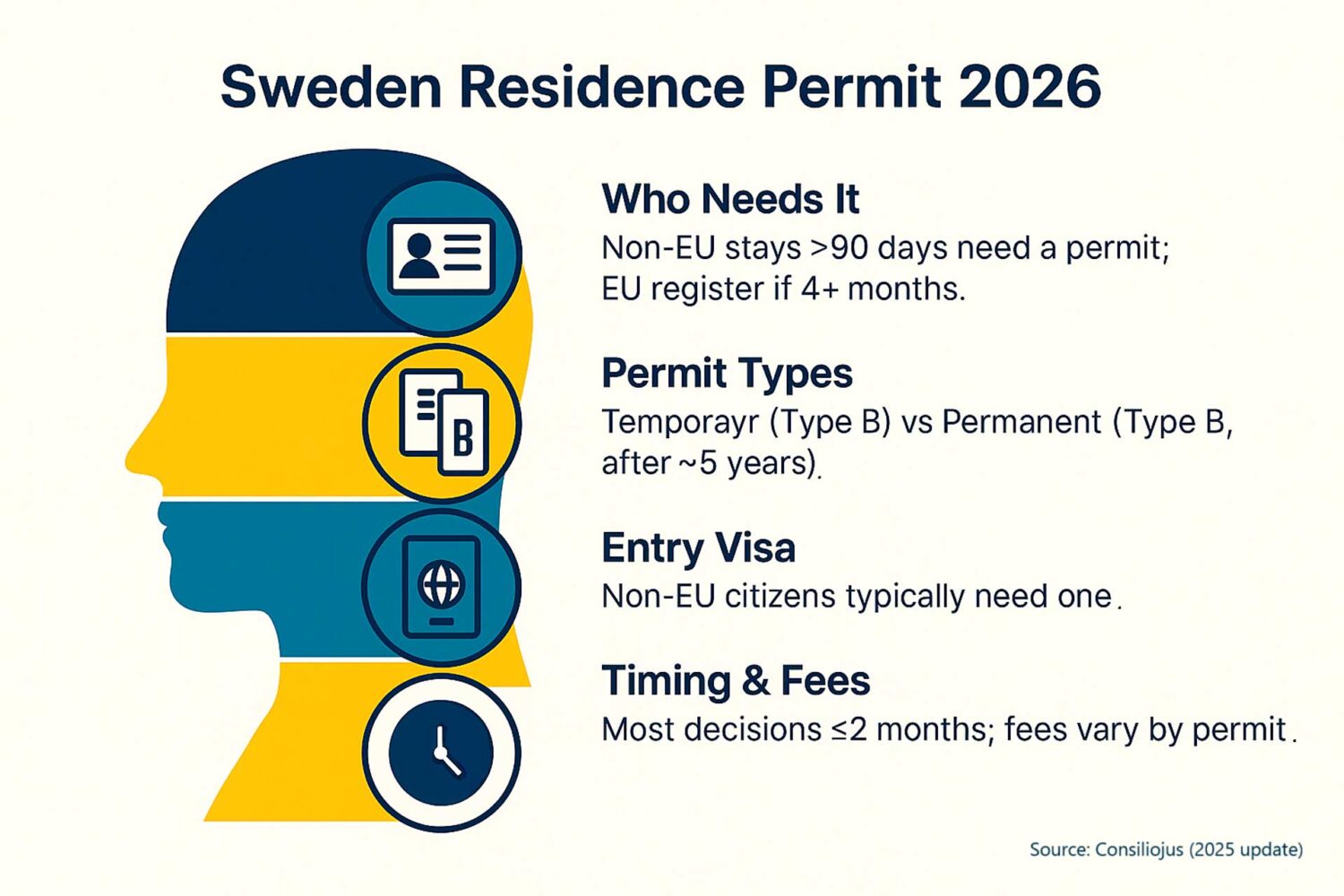
Whether you need a Swedish residence permit depends primarily on your nationality and how long you intend to stay:
- Non-EU/EEA Citizens: If you are from outside the EU or EEA and plan to stay in Sweden for more than 90 days, you must obtain a residence permit before entering the country. This applies to all non-EU foreigners, including Americans and other nationalities, who intend to move to Sweden for work, studies, joining a partner/family, or any stay longer than three months. In other words, all foreign nationals who aren’t EU/EEA citizens need a residence permit for stays over 90 days in Sweden. A short-term Schengen visa alone is not sufficient if your stay exceeds 90 days or if you plan to reside and settle in Sweden.
- EU/EEA Citizens: Citizens of EU/EEA countries do not need to apply for a residence permit to live in Sweden, thanks to freedom of movement rights. Instead, EU/EEA citizens have right of residence in Sweden as long as they meet certain conditions (such as working, studying, being self-employed, or having sufficient funds). You can live and work in Sweden without a permit if you’re an EU/EEA national, but you must register with the Swedish authorities (e.g. obtain a personal number) if staying for a year or more. Note: While EU citizens don’t need a “residence permit”, if an EU citizen doesn’t fulfill the conditions for right of residence (for instance, not working or studying and without sufficient funds), they might need to apply for a form of residence permit or leave after 3 months. Generally, though, EU/EEA citizens and their family members have an easier process and no permit requirement for residence in Sweden. (Swiss citizens have similar rights but must apply for a special residence permit if staying longer than 3 months, due to separate agreements.)
- Nordic Citizens: Citizens of Nordic countries (Norway, Denmark, Finland, Iceland) have even more streamlined rules: they can live and work in Sweden without any permit or registration, under Nordic agreements.
- Short Stays (up to 90 days): If you plan to visit Sweden for 90 days or less (for tourism or a short business trip), you do not need a residence permit. Depending on your nationality, you might need a Schengen visa for the short visit, or you may be visa-exempt for those 90 days. For example, U.S. citizens can visit Sweden up to 90 days visa-free, but any stay longer than 90 days will require a residence permit.
- Special cases (UK citizens, etc.): Since Brexit, UK nationals are treated as non-EU and thus do need permits for stays over 90 days. However, those who were living in Sweden under EU free movement rules may have special status if they registered in time (e.g. under the Withdrawal Agreement). Swiss nationals, as mentioned, need a residence permit for stays beyond three months, but the process is simplified for them.
In summary: If you are not an EU/EEA (or Nordic) citizen and you plan to reside in Sweden longer than three months, you will need to apply for a Swedish residence permit in advance. EU/EEA citizens don’t need a permit but must meet “right of residence” conditions to stay beyond 90 days. Always check the latest rules for your specific nationality, as agreements and laws can change.
Types of Swedish Residence Permits
Sweden offers several types of residence permits, each corresponding to the purpose of your stay. The major categories include:
- Work Permits (Employment or Business): For people moving to Sweden to work. This includes permits for those with a Swedish job offer, permits for the self-employed or entrepreneurs, and special categories like researchers, EU Blue Card holders, athletes, etc. A work permit is usually tied to a specific employer or occupation initially. Most work permits are temporary (often granted for 1–2 years at a time) but can be extended and may lead to permanent residence after a few years. (We’ll discuss requirements in the next section, but generally you need a concrete job offer that meets certain salary and employment condition thresholds to qualify for a work permit.)
- Student Residence Permits: For non-EU students admitted to study in Sweden. If you’ve been accepted into a Swedish university or other higher education for a course longer than 3 months, you need a student residence permit. This also covers exchange students and PhD students. Student permits are typically granted for the duration of an academic program (often one year at a time, renewable if your program is longer). Students must be enrolled full-time and show they can support themselves during their studies. One benefit: international students in Sweden are allowed to work during their studies with no specific hour limit (though maintaining full-time study is expected) – no separate work permit is required for student permit holders.
- Family Reunification Permits: For those moving to Sweden to live with a spouse, registered partner, cohabiting partner (sambo), or other close family member who is already in Sweden (or who is a Swedish citizen). These are often called **residence permits for family ties. If you have a Swedish husband/wife or partner, or if you’re a dependent child joining a parent in Sweden, you would apply for this permit. Usually, the Swedish resident (the sponsor) needs to meet a maintenance requirement, meaning they must have sufficient income and housing to support the family member coming over (exceptions apply for certain cases like Swedish citizen sponsors in well-established relationships, or refugees – more on this under requirements). Family permits are typically granted for 1 or 2 years at a time and are renewable as long as the relationship continues. After a few years, family permit holders can often apply for permanent residence as well.
- Residence Permit for Visiting (>90 days): If you intend to visit Sweden longer than 90 days but not settle permanently – for example, an extended stay with relatives or a long private visit – Sweden offers a visitor’s residence permit. This is essentially a temporary permit for a stay between 90 days and up to one year for non-EU visitors. It’s useful for those who don’t neatly fit into work, study, or family categories but want to stay longer than a tourist visa allows. Important: A visitor’s residence permit does not grant the right to work in Sweden (it’s for visits only). You must also show you have funds to support yourself (at least 450 SEK per day for the visit, according to the Migration Agency) and medical insurance.
- Asylum and Protection Residence Permits: Individuals who seek asylum or refugee status in Sweden have a different process. If granted protection (refugee status or subsidiary protection), they receive a residence permit (often temporary, valid for 3 years for refugees or 13 months for subsidiary protection under current rules, subject to extension). Family members of persons granted asylum can also get residence permits. There was a shift in Swedish law in recent years toward temporary permits for refugees, with a pathway to permanent residence only if certain conditions are met (like ability to support themselves) or by eventually qualifying for citizenship. This guide focuses on regular immigration routes, but be aware the asylum route exists if you are seeking protection.
- Special Categories: Sweden has a few other niche permit types, for example:
EU Blue Card: a special work permit for highly skilled non-EU professionals with a high salary job offer, which can lead to easier movement within the EU. Requirements are stringent (higher salary threshold and university degree or extensive experience).
Researcher Permit: for academic researchers with a hosting agreement in Sweden.
Au Pair or Cultural Exchange Permits: limited programs for young people (often these fall under work permits or special trainee categories).
Working Holiday Visas: Sweden has working holiday agreements with a few countries for youth (e.g., with countries like Australia, Canada, South Korea, etc.), allowing young adults to live and work in Sweden for up to a year. These are also a kind of temporary residence permit.
Long-Term Resident (EU) Status: If you’ve lived in Sweden for 5+ years, you might qualify for EU long-term resident status, which is a special permanent residency recognized across EU countries. This is usually similar to having permanent residence in Sweden, but it’s a separate application in some cases for those who want EU-wide mobility.
Most people moving to Sweden will fall under work, study, or family permit categories, so our guide will focus on those. Next, we’ll discuss the general requirements and documents needed for a successful residence permit application.

Requirements and Documents for a Residence Permit
While each type of residence permit has its own specific requirements, there are several common requirements and documents you should prepare for any Swedish residence permit application:
- Valid Passport: You must have a valid passport and include copies of the photo page with your application. The permit cannot be granted for longer than your passport’s validity, so ensure your passport won’t expire soon. Copies should clearly show your personal details, signature, passport number, and any extensions. (If your passport will expire, renew it before applying!)
- Application Form: Most applications are done online via the Swedish Migration Agency’s e-service. You’ll need to fill out the form relevant to your permit type (work, study, family, etc.). If applying on paper, use the correct form and fill it in English or Swedish.
- Photographs & Biometrics: You typically do not need to submit passport photos with the initial application. Instead, after submitting your application, you will be required to provide biometrics (fingerprints and be photographed) for the residence permit card. This is usually done at an embassy/consulate if you’re outside Sweden, or at a Migration Agency office if you’re already in Sweden. Every time a new permit card is issued, you will need to go through this photo/fingerprint process.
- Purpose-Specific Documents: You must prove the reason you’re moving to Sweden:
For Work Permits: You need a job offer or employment contract from a Swedish employer. The employer typically initiates an online work permit application by providing details of the job (salary, insurance, etc.), and the relevant labor union may give an opinion on the terms. As the applicant, you’ll need copies of the job contract, and proof that the job offer meets Swedish work permit requirements (the job must usually pay at least a minimum salary and have been advertised in the EU prior to hiring you). If you’re self-employed, you need a solid business plan, financial resources, and documentation showing how your business will operate in Sweden.
For Student Permits: You need the university or school acceptance letter showing you’ve been admitted to full-time studies in Sweden. For university studies, “full-time” generally means 30 ECTS credits per semester (or equivalent). Distance-learning programs don’t qualify – you must study on-site in Sweden. Also, if tuition is required for your program, you must show that you have paid the first tuition installment before applying (the university notifies the Migration Agency when tuition is paid).
For Family Permits: You need to show proof of your relationship to the person in Sweden. This could be a marriage certificate for spouses, proof of cohabitation for partners (like a rental contract you both signed, photos together, etc.), birth certificates for children, or other documents proving family ties. If you’re engaged or a fiancé, you might need documents like correspondence to prove a serious relationship. The family member in Sweden (sponsor) may also need to provide documents about their housing (rental contract or ownership deed) and income/employment to satisfy the maintenance requirement.
For other permits (e.g. research, EU Blue Card, etc.): Provide the specific documents listed by the Migration Agency (e.g., hosting agreement for researchers, proof of qualifications for Blue Card, etc.). - Financial Proof (Maintenance Requirement): You must show that you can support yourself financially during your stay so as not to require social assistance. The required amount varies by permit type:
Students must show funds for living expenses covering the entire study period (minus any scholarships or free housing/food provided). As of 2025, a single student needed at least SEK 13,000 per month for their expenses while studying. This can be demonstrated with bank statements, scholarship letters, or a financial guarantee. If family will accompany the student, additional funds per family member are required.
Work permit holders usually meet the financial requirement through their job’s salary. If your family is accompanying on a work permit, you (the worker) must earn enough to support them as well. For example, in 2026 a worker with a spouse needed to have, after paying rent, at least SEK 10,314 per month left for living expenses for a couple (this figure is the standard maintenance amount and is higher if children are included). The exact income required depends on family size and actual housing cost, as detailed by the Migration Agency.
Family reunification applicants: the sponsor in Sweden often must satisfy the maintenance requirement, meaning the Swedish resident must have a certain disposable income and a suitable housing size for the family. For instance, for two adults the sponsor needs to have at least ~SEK 13,400 per month after rent in 2026 (this corresponds to 1.3 times the “normal amount” for a couple). There are exceptions – if the sponsor is a Swedish citizen and you have lived together abroad for a long time or if the sponsor is a refugee, the requirement can be waived or eased. But generally, be prepared to show documents like pay slips, employment contracts, or tax statements for the sponsor, plus a rental contract showing they have adequate accommodation for you.
Visitors (long stay visits) need to show sufficient funds for the intended stay (as noted, at least 450 SEK per day per person), plus proof of travel medical insurance covering the entire stay. - Health Insurance: If you will be staying in Sweden for less than one year (e.g., a 6-month study program or a short-term visiting permit), you must have comprehensive health insurance valid in Sweden. This insurance should cover emergency and non-emergency medical care, hospitalization, dental care, and medical evacuation/repatriation. Many students are covered by university-provided insurance or need to purchase a private plan if their stay is short. If your permit is for one year or more, you generally do not need private health insurance, because you can register in the Swedish Population Register upon arrival and then you’ll be covered by the Swedish national healthcare system. Still, you may need to show proof of insurance or ability to get insured when applying, depending on the scenario.
- Proof of Housing (sometimes): For certain permits (especially family reunification), the Migration Agency may ask for evidence that there is adequate housing for the family. This could be a rental agreement or proof of home ownership in Sweden by the sponsor, with enough space for the family members.
- Translated Documents: All documents you submit that are not in Swedish or English should be accompanied by an official translation into one of those languages. Always include a copy of the original document as well. For example, if your marriage certificate is in another language, get it translated by a certified translator.
- Passport Presentation/Interview: As part of the process, you will likely need to present your original passport at a Swedish embassy or consulate (or Migration Agency office if in Sweden) to verify your identity. When applying online, you’ll select which embassy/consulate you plan to visit for this. In some cases, an interview may be required (family applications often involve an interview with the applicant or the Swedish sponsor to verify relationship details). If you’re applying from abroad, be prepared to travel to the specified embassy/consulate on appointment.
- Application Fee Payment: Each application comes with a fee (in SEK), which you typically pay by credit/debit card when applying online. If you apply by paper through an embassy, you’ll be instructed on how to pay (often also by card or bank transfer). The fee is non-refundable, even if your application is denied. (We’ll detail the fees in a later section, but as an example: a work permit application is about SEK 2,200 for the worker, while a family reunification application for a spouse is SEK 2,000.)
In addition to these, each permit category has specific requirements. Below are some highlights by category.
Work Permit Requirements: You must have a concrete job offer in Sweden that meets certain conditions. The job must typically pay at least the Swedish collective bargaining wage or a minimum of SEK 13,000 per month (this minimum was recently raised to around SEK 27,000 per month in late 2023 for new work permits – ensure you check the current threshold). The employer must have advertised the job in the EU/EEA for at least 10 days (to show no suitable local candidates were available). The terms of employment must be on par with Swedish standards (proper insurance, etc.). The Migration Agency will also ask for a statement from the relevant labor union to confirm the salary and conditions are acceptable in that industry. If you’ve studied in Sweden and found a job, you can apply to change from a student permit to a work permit without leaving, provided you do so before your student permit expires.
Student Permit Requirements: You need to be admitted to full-time studies in Sweden (e.g., a university program) and, if applicable, pay the first semester’s tuition fee in advance. You must show funds of roughly SEK 9,450 per month (this was the older amount for 2023; it has since increased to around 13,000 as mentioned) for your living expenses. If you are receiving a scholarship or student aid, documentation of that can count toward the funds. You will also declare (and later show) that you have health insurance if your studies are short-term. Remember, you can’t get a residence permit for studies if the courses are remote/online – you have to be physically attending classes in Sweden.
Family Reunification Requirements: You must prove a genuine relationship with your Swedish sponsor. For spouses/partners, this might include providing a marriage certificate, proof of living together, joint bills, photos together, and detailed answers in the questionnaire about your relationship history. The Swedish sponsor typically must meet the maintenance and housing requirement (adequate income and a home of sufficient size) unless exempt. The Migration Agency may conduct interviews with both the applicant and the sponsor to verify the relationship’s authenticity (common in spouse cases). If the relationship is less than two years old and you haven’t lived together before, expect that the initial permit might be shorter and the scrutiny higher, as authorities want to ensure the relationship is stable. After two years on a temporary family permit, if you are still together, you can usually get an extension and eventually apply for permanent residence.
Others: A jobseeker permit (for those who finished a master’s or PhD abroad and want to come to Sweden to look for work) has specific requirements: you must have completed a second-cycle (master’s level) degree, have enough savings to support yourself (at least SEK 13,000 per month for the duration you apply, up to 9 months), have health insurance, and apply from outside Sweden. This permit can be granted for up to 9 months and does not allow working until you actually find a job and convert it to a work permit.
Once you have all required documents in order, you’re ready to move on to the application process. It’s wise to double-check the official Swedish Migration Agency website for a checklist of documents for your specific permit type, as requirements can update. Now, let’s go through how to apply, step by step.

How to Apply for a Swedish Residence Permit (Step by Step)
Applying for a residence permit for Sweden is largely a digital process and can be broken down into clear steps. Here’s a step-by-step guide:
- Determine the Correct Permit Category: Identify which type of residence permit you need (work, study, family, etc.). This will dictate what documents are required and which online application form to use. The Swedish Migration Agency’s portal will ask you the purpose of your stay and guide you to the appropriate e-service. Be sure you meet the key criteria for that permit (for instance, you have an admission letter if applying as a student, or a job offer if applying as a worker).
- Gather All Required Documents: As outlined in the previous section, assemble your paperwork. This includes a valid passport (make sure it’s signed and not expiring soon), official documents proving your purpose (job contract, university admission, marriage certificate, etc.), proof of funds, insurance documents if needed, and translations of any documents not in English/Swedish. It’s helpful to scan these documents in advance because you will upload them during the online application.
- Submit the Application Online: The easiest and fastest way is via the Migration Agency’s online e-service. Create an account (or use the “My Page” login if you already have one) and fill in the application form for your permit type. You’ll answer questions about your personal details and your planned stay. Take care to fill everything accurately and completely – incomplete applications can delay the process significantly. At the end of the form, you’ll be prompted to pay the application fee with a Visa or MasterCard. The fee varies (usually in the range of SEK 1,000–2,200 for most permits – see the Fees section below). Once you submit, you should get a confirmation that your application has been received by the Migration Agency.
If you cannot apply online: In some cases, you might apply via a Swedish embassy or consulate (for example, certain family applications or if you have trouble with the online system). You would need to fill out a paper form and submit copies of your documents in person. The officials will then forward your application to the Migration Agency in Sweden. This route can be slower, so online is preferred when possible. - Visit the Embassy/Consulate for Passport Check (and Biometrics/Interview if required): After submitting the application, most applicants outside Sweden must show their original passport at a Swedish mission (embassy or consulate) to verify identity. In your online application, you will have selected which city’s embassy/consulate you will use – the system helps you pick based on your country. The Migration Agency or the embassy will notify you when it’s time to come in. At this visit, you will also be fingerprinted and photographed for the residence permit card (this can be done at the same time as the passport check, or you may be asked to come back once a decision is made – practices vary by embassy). Interviews: Some categories (especially family reunification or asylum) may involve a detailed interview. For spouse/family permits, you and/or your partner could be interviewed about your relationship history. For work permits, usually no interview is needed unless something needs clarification.
- Wait for the Decision: Now comes the patience part. The application will be placed in queue for processing. How long it takes can vary widely depending on the permit type and how complete your application is. (We cover processing times in detail in the next section, but be prepared to wait anywhere from a few weeks to several months or more.) During this time, the Migration Agency might contact you (or your employer or partner) if they need additional information or documents. They may also consult other Swedish authorities as needed (for example, a security check or a union statement for a work permit), which can add time. You can check the status of your application by logging into your online account (My Page). The Migration Agency also provides general waiting time statistics on their website so you can get an idea of typical processing times.
Important: Do not move to Sweden or quit your current job until you have the actual residence permit approved (unless you have some legal way to be in Sweden and wait). In most cases, you must wait outside Sweden for the decision. Applying for the first time from within Sweden is generally not allowed and can lead to a rejection, except for certain exceptions (e.g., you’re already in Sweden on a different valid permit or certain visa-free job visit programs). So, plan to remain in your home country or current country of residence while waiting. - Receive the Decision: The Swedish Migration Agency will notify you once a decision has been made. If you applied online, you typically get an email that tells you to check your account for an update. In many cases, you’ll see a scanned decision letter there. If approved, congratulations! If not, the decision will include reasons and information on how to appeal (more on rejection scenarios later). For many work and family cases, the embassy will also contact you to say “Your decision is ready.”
- Obtain Your Residence Permit Card: Upon approval, the residence permit card is issued. If you already provided biometrics earlier, the card will be produced right after the decision. It takes up to 4 weeks for the card to be manufactured and delivered to the embassy/consulate you chose. The embassy will then inform you to pick up your residence permit card (bring your passport when picking it up). If you didn’t do fingerprints/photo earlier, you’ll be asked to come do that, and then the card is ordered. In some situations, if you need to travel to Sweden quickly after approval, the embassy can issue a temporary visa sticker in your passport to let you enter Sweden, and then you can collect the permit card in Sweden. But usually, you’ll just wait for the card.
If you are applying from within Sweden (e.g., extending a permit or converting from one permit to another), you would get your card sent to your address in Sweden within about 2 weeks after decision, or you pick it up at a service center. Always double-check that your name is spelled correctly on the card and that all details match your passport when you receive it. - Travel to Sweden: With your residence permit card (and valid passport), you can now enter Sweden. The card should be shown to border officials on entry along with your passport. The permit card cannot be used as a travel document on its own – it’s not an ID or passport replacement, so always carry your passport when traveling. Once in Sweden, if your permit is for at least one year, you should register at the Tax Agency to get your personal identity number (“personnummer”) which unlocks many practical aspects of living in Sweden (bank account, healthcare, etc.).
- After Arrival – Final formalities: Depending on your permit, there may be a few more things: if you got a work permit, inform your employer and start work; if you’re a student, show up at your university and enroll; if on a family permit, you can now enjoy life with your partner. Children of permit holders can attend school. Also, consider checking the duration and conditions on your permit – for example, a work permit might be employer-specific (you must work for the employer who sponsored you), or a family permit might be conditional on living with your partner. Make sure to abide by any conditions.
Throughout the process, it’s crucial to rely on official information. The Swedish Migration Agency’s website has detailed instructions for each permit type and even an online guide that walks you through the steps. If something is unclear, you can contact them or a Swedish embassy for guidance. For complicated cases (like self-employment permits or if you have unusual circumstances), you might consider consulting a legal expert in immigration.
Next, let’s talk about how long you might wait for the permit (processing times) and what the costs are.
Processing Time for Swedish Residence Permits
One of the most common questions is: How long will it take to get my residence permit? The answer is it depends – on the type of permit, the completeness of your application, and the current workload of the Migration Agency. Here’s an overview of processing times as of 2025/2026, and some recent improvements:
- Family Reunion Permits (Spouses/Partners): Unfortunately, these tend to have one of the longest wait times. Recent statistics show that 75% of first-time applications to “live with a partner” were decided within 15 months. Yes, over a year in many cases. It can be faster if your case is straightforward, but many applicants report waiting 12+ months for a decision. Sweden has been working to speed this up – for example, from January 2026 the Migration Agency introduced a goal to process complete applications from family members of Swedish citizens moving back to Sweden within 90 days (with digital applications). However, regular family applications still often experience backlogs. Extensions of family permits are faster – often a few months wait (75% of partner extension decisions were within 7 months, but many are quicker than that median).
- Work Permits: Processing times for work visas have improved, especially for high-skilled jobs: High-skilled workers (and researchers, EU Blue Card): Sweden launched a fast-track in 2024 for highly qualified labor to reduce wait times. Now, if your work permit application is complete and you’re in a high-skill category, decisions can come in around 1 month for 75% of cases. Indeed, statistics show that 75% of “highly qualified” work permit cases that were complete at submission were decided within 1 month, and even if additional info was needed (incomplete cases) within 3 months. Other work permits: For regular work permit categories (“other employments”), the median processing was about 4 months for complete applications and up to 11 months if the application needed extra information. So the range is quite broad. Many standard work permits (e.g., service industry jobs, etc.) might take a few months. Work permit extensions: These are generally faster than first-time permits. If your extension application is complete, many are processed in 1–2 months (especially for high-skilled jobs). Job seeker permits: The “look for work or start a business” 9-month permit for graduates had a median processing around 9 months (for both complete and incomplete) – possibly because this is a newer category or lower priority. Hopefully this improves as the program becomes routine.
- Student Residence Permits: These are relatively faster in recent years, especially after efforts to streamline them. The law requires study permits to be decided within 90 days if the application is complete (and indeed the Migration Agency tries to meet this). As of late 2025, Sweden even introduced a 30-day processing guarantee for doctoral student permits – meaning international PhD students and their families should get a decision within a month, which is a big improvement. For typical university students: Recent stats show 75% of first-time higher education study permit applications were decided within 2 months. Many students report getting a decision in 1–3 months, provided they applied in a timely manner with all documents. If additional documents are needed, it could take longer, but generally study permits are among the quicker categories. Tip: Applying as early as possible (once you have your admission letter and paid tuition) is key, because many students applications flood in around June-July for autumn semester. An early complete application might be processed faster.
- Visitor Permits (>90 days): These are relatively quick. 75% of cases for visits over 90 days (when applied from outside Sweden) were done within 3 months. If applied from inside Sweden (some visitors extend while there), around 4 months.
- Permanent Residence applications: If you apply for permanent residence (after having temporary permits for the required years), those also take some time – often several months. (Not the focus of this guide, but note that in 2025 the median for citizenship applications was extremely long – around 47 months for adults – but that’s citizenship, not permanent residence. Permanent residence usually is shorter, often under 6 months, depending on category.)
Why do times vary? Several factors: If your application is complete (all required documents provided, correct information, fee paid) it goes more smoothly. If the Migration Agency has to ask for additional information (making it “incomplete”), that adds months – for example, incomplete family applications might drag on to 18–24 months versus a well-prepared one might be closer to 10–12 months. Security checks can cause delays for certain nationalities (the Security Service may review some cases, which the Migration Agency can’t control and isn’t counted in their service guarantee). There have also been backlogs in past years due to high volumes of cases.
Recent improvements: The Migration Agency is actively trying to reduce processing times. As mentioned, they expanded fast-track procedures: in late 2025 they announced international doctoral students’ applications (and their family members’ permits) will be processed in 30 days for complete cases. They also aim to increase efficiency through digitalization and better communication so applicants submit everything correctly upfront. This is in response to criticism about long waits that made headlines. So, by 2026, we expect continued improvements, but it’s safe to still plan for possibly a few months of waiting for most permits.
What can you do? Submit a complete application and do it as early as possible. Check the Migration Agency’s official Waiting Time statistics tool – you can select your permit type and see the current stats on how many months for 75% of cases. Keep an eye on your email in case the Agency asks for any supplemental documents – responding quickly can prevent further delays. If a very long time passes with no answer and it’s beyond normal, you can call or email the Migration Agency for an update. In extreme cases, Swedish law allows you to request the Agency to conclude your case if it’s been delayed beyond reason, but using this right (called “requesting an acceleration” after 6 months) can sometimes result in a refusal if the Agency doesn’t have time to fully process – so use with caution.
Always check for any service updates from the Migration Agency – they sometimes publish news (e.g., certain embassies closing migration sections which can affect processing if you applied there, as seen in recent news). Also, note that during your waiting time, if you applied from abroad, you generally cannot enter Sweden to stay; you’d have to wait for the permit (short visits as a tourist might be okay if visa-exempt, but you cannot move until the permit is ready).
Now let’s look at the costs and fees involved in getting a residence permit.
Costs and Fees for a Swedish Residence Permit
Applying for a residence permit in Sweden usually requires paying an application fee. The fee amount depends on the type of permit and sometimes the age of the applicant. Below is a breakdown of typical fees (as of 2025/2026):
- Work Permit (employed): SEK 2,200 for the main applicant (worker). If the worker’s family members apply together: adult accompanying family members pay SEK 1,500 each, and children pay SEK 750 each. (Example: A worker moving with a spouse and one child would pay 2,200 + 1,500 + 750 in total). Japanese citizens are exempt from work permit fees (due to a reciprocal agreement).
- Self-Employment (start a business): This often carries the same fee as a work permit (approx 2,000–2,200 SEK for the main applicant). Always verify on the application page, as the fee could differ slightly for self-employed permits.
- Residence Permit for Study: SEK 1,500 for adult students, SEK 750 for a child student (e.g., for high school level studies). Students from certain partner countries or scholarship programs might be exempt or reimbursed, but generally most pay this fee. (Notably, PhD students might pay the work permit fee instead if they’re considered employees of the university; otherwise, if on a study permit, 1,500 SEK is standard.)
- Family Reunification Permit: SEK 2,000 for an adult applicant, SEK 1,000 for a child (under 18). This fee applies if you are applying to live with a spouse/partner, parent, or other relative in Sweden. The fee is the same whether the family member in Sweden is Swedish or a foreign resident (though if your family member in Sweden is an EU citizen using their EU free-movement rights, you might be fee-exempt as noted below). Example: A non-EU spouse moving to Sweden to join their partner would pay 2,000 SEK; a child joining a parent would pay 1,000 SEK.
- Visitor’s Residence Permit (>90 days visit): SEK 1,500 for adults, SEK 750 for children (these are often the same as study permit fees, since it’s a similar short-term stay category). Check the specific form for “uppehållstillstånd för besök” for exact fees.
- Permanent Residence Permit application: SEK 2,000 for an adult, SEK 1,000 for a child (this is usually paid when you apply to switch from temporary to permanent residency, often alongside an extension application). For example, when you apply to extend a work permit and simultaneously ask for permanent residence after 4 years, you’d pay 2,000 SEK.
- Citizenship application (just for context): SEK 1,500 for adults, SEK 175 for children. (Citizenship is a separate process later on, but we mention it so you don’t confuse it with permanent residence fees.)
Exemptions: Some people do not have to pay an application fee:
- Family members of EU/EEA citizens are exempt from fees for residence permits. Important: This does not include family of Swedish citizens (Sweden doesn’t count its own citizens as EU in this context). It’s meant for, say, an American who is married to a German citizen living in Sweden – their permit would be free under EU rules.
- EU/EEA citizens themselves, if they for some reason apply for a residence permit (usually they wouldn’t need to, except certain cases like an EU citizen who doesn’t meet right of residence and is applying based on family ties) – no fee.
- Swiss citizens and their family members – no fee for their permit application.
- Japanese citizens – notably, Japan has a special agreement, so Japanese applicants pay no fee for Swedish residence permits (this applies to work, study, etc.).
- Family members of refugees or others in need of protection: If you are applying for a residence permit to join a family member who has refugee status or similar (protected person) in Sweden, and you apply within a certain time (usually within 3 months of your family member getting their status), you may be exempt from fees. Specifically, spouses/partners and under-18 children of persons who received a residence permit as a refugee or under “exceptionally distressing circumstances” don’t pay a fee.
- Children under 18 often pay a reduced fee (as shown above) and in some categories possibly no fee (for example, if the child of an EU citizen as noted, or sometimes if born in Sweden while parents had permits, etc.).
When applying online, the system will automatically take you to the payment if a fee is required. If you’re exempt, it usually skips the payment step or later the embassy will not charge you. If applying via an embassy and you need to pay there, they typically accept cards and sometimes cash in local currency equivalent.
Note: You will not be refunded the fee if your application is denied. The fee is for processing the application, not for the outcome. So make sure you meet the requirements before applying to avoid losing money on a likely refusal.
If finances are tight, unfortunately there are not many ways around the fee (except the exemption cases above). However, compared to some countries, Sweden’s visa fees are moderate.
| Permit Type | Applicant | Fee (SEK) |
| Work Permit (general) | Main applicant (worker) | 2,200 |
| Work Permit – Family member | Adult family member | 1,500 |
| Work Permit – Family member | Child family member | 750 |
| Student Permit (higher edu) | Adult student | 1,500 |
| Student Permit – Child student | Minor (e.g. exchange student under 18) | 750 |
| Family Reunification Permit | Adult (spouse/partner) | 2,000 |
| Family Reunification Permit | Child (under 18) | 1,000 |
| Permanent Residence (PUT) | Adult | 2,000 |
| Permanent Residence (PUT) | Child (under 18) | 1,000 |
| Fee Exemptions (pay 0 SEK) | Family of EU/EEA; EU citizens; Swiss citizens; Japanese citizens; Family of refugees | 0 |
SEK = Swedish Kronor. Fees are subject to change by the Swedish Migration Agency, so always confirm current fees on the official site.
Paying the fee is usually straightforward online. If for some reason you have to pay via bank transfer or later (like some embassies might give you payment instructions), be sure to include the application reference so it’s tracked. The application isn’t processed until payment is received.
Now that you know the costs, let’s discuss what happens after you get your permit – specifically, how to extend a permit when it’s expiring, and what rights you have while living in Sweden on a residence permit.
Extending Your Residence Permit (Renewals)
Most initial residence permits in Sweden are temporary – commonly valid for 1 or 2 years. If you plan to continue your stay beyond the permit’s expiration (and you still meet the conditions), you will need to apply for an extension (förlängning) of your residence permit before it expires.
Here’s what you need to know about extending:
- When to Apply for Extension: You can submit an extension application from within Sweden. Mark your calendar – you should apply before your current permit expires. The Migration Agency generally allows you to apply up to 3 months before expiration for work permits, and at least 1 month before for most others (you can check their guidelines for each permit type). Don’t apply too early (earlier than 3 months prior) as they might not process it, but definitely don’t wait until after expiry. If you apply on time, you have the right to stay in Sweden while the extension is in process, even if your old permit expires during that time. For work permit holders, applying on time also means you may continue working under the same conditions while awaiting a decision on the extension.
- How to Apply for Extension: The process is very similar to the first application. There is an online service for extensions (e.g., “You want to extend your permit to work/study/live with someone” on the Migration Agency website). You will fill out a form and provide updated documents. Essentially, treat an extension like a mini version of the original application: update proofs and demonstrate you still satisfy all criteria.
- Fees for Extension: Yes, there’s usually another fee for an extension application (often the same amount as initial). For example, extending a work permit costs 2,200 SEK again for an adult, extending a family permit is 2,000 SEK, etc., and similar exemptions apply. So budget for those fees each time you extend until you get permanent residency.
- Processing Time for Extensions: These can be shorter than first applications, but not always instant. Many permit extensions (especially work and study) are processed in a few months, but some family extensions might take longer. The good news is you can remain in Sweden during the wait (and continue working or studying). One caution: If your initial permit expires and you only have the extension under processing, traveling out of Sweden can be problematic – you might not be able to return without a valid permit or special entry permit. There is a thing called “D-visas” some can get if they need to travel while extension is pending, but it’s discretionary. It’s often safer to avoid international travel between the expiry of your old permit and the approval of your extension or permanent permit.
- Switching Purpose: If you change your reason for staying in Sweden, you often need to apply for a new permit under the new category, rather than a direct extension. Some examples: You finish studying and get a job – you need to apply for a work permit (possibly from Sweden if done quickly after studies). You divorce your Swedish spouse – your family permit won’t be extended just on that basis. You might need to qualify for another permit (like work or study) on your own, otherwise your right to stay ends. The Migration Agency provides guidance on when a new application is needed vs an extension. Don’t assume an extension covers a totally different situation.
- Permanent Residence Opportunity: When extending after a certain number of years, you might be eligible to apply for permanent residence (PUT) at the same time. For most, this is after 4 years on work permits, or after 3 years for some family permits or refugees, etc. The extension form will often have a checkbox like “Apply for permanent residence”. To be granted permanent residency, special requirements apply – currently, you must have demonstrated ability to support yourself (usually via employment income) and have shown good conduct (they check that you haven’t committed crimes, paid taxes, etc.). Starting in 2023, Sweden also introduced a requirement that any new permanent residence applicant must have completed an approved Swedish language and civics test (though as of early 2026, I believe this is planned for citizenship rather than PR – but integration requirements are being discussed for PR too). Always check the latest rules when you reach that stage. If you meet all conditions, you could get a permanent residence permit instead of another temporary extension, which means you won’t have to renew again (as long as you live in Sweden).
- If Extension Is Denied: If your extension application is refused (say you no longer meet the criteria, or insufficient income, etc.), the decision letter will usually come with a deadline by which you must leave Sweden (often 2–4 weeks). You can appeal the decision within 3 weeks of receiving it, and in many cases you are allowed to stay in Sweden during the appeal. However, if it’s a final refusal and no appeal or appeals are exhausted, you’ll need to depart or risk overstay consequences (possibly a re-entry ban). If you overstay after a refusal, you could be issued a re-entry ban for at least a year in Schengen. So take extensions seriously and don’t let your permit lapse.
To sum up, extending your permit is usually straightforward if your situation remains the same and you continue to meet the requirements. Mark the expiry date and apply in time. Keep copies of your important documents during your stay (like pay slips, study transcripts, etc.) because you’ll need to show them again. Each extension keeps you on track toward permanent residence and, eventually, the option of Swedish citizenship (which requires typically 5+ years of residence and a permanent permit/citizenship test).
Next, we’ll discuss some common reasons applications get rejected (so you can avoid those pitfalls).
Common Reasons for Residence Permit Rejection
While many people do successfully obtain Swedish residence permits, applications can be rejected for various reasons. Knowing these common pitfalls can help you avoid a refusal. Here are some frequent reasons a residence permit application might be denied:
- Incomplete or Insufficient Documentation: A very common reason is not submitting all required documents or information. If you fail to provide a key document (for example, missing a marriage certificate in a family application, or not submitting the university admission letter for a student application), the Migration Agency may eventually reject the application for lack of evidence. Often they will ask you first to complete the application, but if you don’t respond adequately, it’s a ground for refusal. Always double-check the checklist and include certified translations if needed.
- Financial Requirements Not Met: If you cannot prove sufficient funds or income, your application can be denied. For instance, a student who doesn’t show the required maintenance money will be refused on those grounds. A family reunification case where the sponsor in Sweden doesn’t meet the maintenance requirement (income or housing standard) will likely be refused (unless exempted). Similarly, if a work permit applicant’s salary is below the minimum threshold or the job hours/pay are too low to support oneself, that triggers a denial.
- Not Meeting Eligibility Criteria: Each permit has core criteria – if you don’t meet them, you’ll be rejected.
- Identity or Passport Issues: If you cannot prove your identity with a valid passport or travel document, Sweden will not grant a permit. Using false documents or false identity is obviously a serious offense – it will lead to rejection and possibly a ban. Even honest applicants can hit a snag if their passport is not considered valid or if it’s going to expire imminently. Always use a valid, internationally recognized passport. In rare cases, refugees/stateless people without passports have processes with alternative ID proofs, but for regular permits, no passport = no permit.
- Misrepresentation or False Information: Honesty is crucial. If an applicant is caught providing false information or fake documents, the application will be rejected and the applicant could be banned from re-entry for a period. The Migration Agency does conduct verification – they may call employers, verify bank statements, etc. They also collaborate with other authorities. So never lie on your application.
- Previous Violations or Overstays: Your immigration history matters. If you have overstayed a visa or been deported from Sweden or another Schengen country before, this can cause a new application to be denied. Especially if you have an active re-entry ban in Schengen (perhaps due to an earlier overstay), you cannot get a new permit until that ban is cleared. Clean up any past issues or be prepared to explain them.
- Criminal Record or Security Concerns: If a background check reveals serious criminal history or security threats, Sweden can refuse a residence permit in the interest of public order. Minor offenses usually won’t derail an application, but a very serious crime might. During the process for permanent residency, good conduct is explicitly required – even unpaid debts or serious traffic violations can complicate things, and certainly criminal convictions can. For first-time temporary permits, it’s less common to check foreign criminal records unless something triggers it, but Swedish authorities do run security checks for certain nationalities and cases via the Security Service.
- Lack of Intention to Leave (for temporary stays): This one comes up for visitor’s visas or permits – if the Migration Agency/Embassy suspects that a person applying for a short stay visa or visitor permit actually intends to overstay or settle illegally, they will refuse it.
- Specific Family Situations: Some rejections happen if, say, someone applies for a family permit for a relationship that doesn’t qualify – e.g., trying to bring over a cousin or an adult sibling who isn’t covered under family reunification (Sweden’s rules for family are mostly spouse/partner and minor children, or, in some cases, adult who was dependent). Those would be refused because they fall outside the scope of family immigration rules. Also, if the Swedish sponsor is a recent asylum refugee who hasn’t yet got housing or income, and the family applies after the grace period (3 months), they could be rejected if maintenance can’t be shown.
- Applying for the Wrong Category or Not Qualifying: For instance, someone might apply for a work permit as self-employed but their business plan is not convincing or they don’t have sufficient funds to run the business – the application will be refused for not meeting the criteria. Or applying for a permit to “live with other relative” which is very restricted – many such applications are rejected unless exceptional dependency is proven.
If your application is rejected, the decision notice will explain the reason. You typically have the right to appeal within 3 weeks of the decision. The appeal goes to a Migration Court in Sweden. During the appeal process, in most cases you can remain in Sweden (if you were in Sweden or had interim permission), except if it was a very clear-cut refusal with an order to leave immediately (that usually happens if they think you’ll abscond, etc., but for typical cases you can wait for the appeal outcome). The appeal can take several months or more and you may need to provide additional information to counter the reasons for rejection.
If you’re uncertain, get advice from the Migration Agency or reputable immigration advisors. Sometimes a small mistake can lead to a refusal that costs you time and money to appeal or reapply. To recap common reasons: insufficient finances, incomplete paperwork, failing specific criteria, false info, and not following the proper procedure are top reasons for denial. By being honest, organized, and meeting the requirements, you greatly improve your chances of approval.
Leave your contacts to have an expert contact you shortly.
Benefits of Having a Swedish Residence Permit
Holding a Swedish residence permit comes with a host of advantages that can significantly improve your quality of life and opportunities in Sweden. Here are some key benefits:
- Legal Right to Live in Sweden: First and foremost, a residence permit gives you the legal right to reside in Sweden for the duration of the permit. You can rent housing, open bank accounts, and register for utilities using your permit and personnummer (personal number) once you have one. You won’t be worrying about overstaying a visa – you’re a lawful resident.
- Ability to Work and Build a Career: As discussed, most residence permits allow you to work in Sweden. This means you can pursue job opportunities, start a career, or even open your own business. Sweden has a strong economy and a healthy work-life balance culture, so being able to work legally is a huge benefit. For spouses or partners coming on a family permit, the freedom to work means you can integrate faster and have your own career path. Gaining Swedish work experience can be valuable for your CV and future too.
- Access to Social Welfare Systems: Once you’re a resident, you have access to Sweden’s extensive social benefits: Healthcare, Education, Child benefits, Social security.
- Personal Identity Number (Personnummer): With a permit longer than 1 year, you can register and get a personnummer, which is essential in Sweden. It makes life easier – you can sign up for a mobile phone plan, gym membership, library card, etc., usually just by giving your personnummer. You also become eligible for BankID, a digital identity that is used for almost all online services (banking, signing documents, etc.). Having a personnummer effectively means you’re recognized as part of Swedish society officially.
- Schengen Travel Freedom: With your Swedish residence permit, you can travel to other Schengen countries without a visa for short stays. Want to have a weekend in Paris or Rome? You can hop on a plane with just your passport and residence permit card. This is a huge plus for travel enthusiasts. Also, if your home country doesn’t have a strong passport, having a Swedish residence card can ease visa processes for some other countries (though it’s not a guarantee, it often helps to show you have permanent ties in Sweden).
- Pathway to Permanent Residence and Citizenship: A temporary residence permit is the stepping stone to more permanent statuses. After the required time and meeting conditions, you can get permanent residency, which gives even more security (no need to renew permits) and rights (like voting in local elections). After typically 5 years of residence (some or all of which on temporary, then with a permanent permit), you can apply for Swedish citizenship, which grants you a Swedish/EU passport, right to vote nationally, and the ability to live and work anywhere in the EU without permits. Thus, starting with a residence permit, you can eventually become a full member of the society with the same rights as native Swedes.
- Quality of Life: Sweden consistently ranks high in quality of life indexes – by living there legally, you get to enjoy: Clean environment, beautiful nature and the “right of public access” to roam in forests and countryside. Safe cities with low crime rates. Excellent public transportation and infrastructure. A culture that values work-life balance: standard working hours, ample vacation time (minimum 25 paid vacation days per year by law), and strong employee protections. As a resident, you benefit from anti-discrimination laws and equal treatment in services and employment. For families, Sweden is extremely family-friendly – long parental leaves, affordable childcare, and even payments for parents staying home when kids are sick (VAB). For students and researchers, being in Sweden gives access to world-class education and research facilities, often with the possibility of scholarships or stipends.
- Integration Support: Many municipalities have integration programs for new residents – language classes, mentorship programs, job matching services for newcomers, etc. For example, some cities have “International House” or welcome centers that help expats and immigrants settle in (with info on finding housing, learning Swedish, networking events). All of this becomes accessible once you have the legal status to live there.
- Political Participation: While you might not be able to vote for Parliament until you’re a citizen, as mentioned, if you have lived in Sweden for at least 3 years with a residence permit, you can vote in municipal and county council elections. This means you have a say in local issues (schools, local transport, healthcare at regional level, etc.) even before citizenship. Sweden encourages residents to be active in society – you can also join unions, clubs, and community organizations freely.
- Swedish Personal Security: With a residence permit, you are protected by Swedish laws. You have the right to be treated fairly by employers (labor laws apply to you), you can rent under the same rights as others (rental contracts, etc.), and you can seek justice through the legal system if needed. If someone violates your rights, you can report to the police or relevant authorities, and your immigration status is stable (not like an undocumented person who might fear seeking help).
- Family Reunion: Once you are a resident, you might be able to sponsor family members to join you (if you meet income requirements). For example, if you moved as a worker, you could bring your spouse and kids. If you’re a student, you can bring your spouse/kids for the duration of your studies as well. Later, as a permanent resident or citizen, you can more easily bring close family over through the family permit process.
- EU Long Term Residence: If you maintain 5 years of legal residency, you can also apply for EU long-term resident status in Sweden. This is a status that gives rights similar to permanent residence and also makes it easier (in theory) to move to other EU countries for work. For instance, an EU long-term resident from Sweden can move to Germany and apply for a local permit there with some facilitated conditions. It’s another option aside from citizenship for mobility.
In essence, having a Swedish residence permit places you on an almost equal footing with Swedish citizens in daily life, especially if it’s a permanent permit. You can live in a stable, prosperous country with a strong social safety net and a high standard of living. You can plan your future – career, family, education – knowing you have permission to stay.
Many residents also praise the intangible benefits: the chance to experience Swedish culture (fika, midsummer, Lucia, etc.), the ability to learn a new language (Swedish, which is a gateway to understanding other Nordic languages too), and generally the secure, calm living environment Sweden provides. It’s worth noting that integration can take effort – learning Swedish, making local friends – but the permit is the ticket that allows you to do all that legally and without fear of having to leave suddenly.
Along with rights, remember responsibilities:
- Follow Swedish laws. A serious crime can jeopardize your permit or future extensions (good conduct is required for permanent residence).
- Keep the Migration Agency informed if your circumstances change (e.g., if you divorce when on a spouse permit, or if you change employer on a work permit).
- Don’t overstay your permit – always extend or leave in time.
- If you leave Sweden for a long period, know that can affect your permit. Permanent residents can lose their permit if they reside outside Sweden for more than 1–2 years without maintaining ties.
- Pay taxes on any income in Sweden – once you have a personnummer, you’re in the tax system.
Overall, a Swedish residence permit gives you a stable legal standing in Sweden with the ability to work, access services, and live much like any resident. It’s your stepping stone to eventually feeling at home in Sweden.
Obtaining a Sweden residence permit is a process that requires preparation and patience, but as we’ve seen, it opens the door to a wealth of opportunities and a high quality of life in Sweden. To recap, make sure you identify the correct permit for your situation, meet all the requirements, and submit a thorough application well ahead of your planned move. Once in Sweden, take advantage of integration resources, learn some Swedish, and enjoy the benefits of your new status – from working or studying, to exploring Sweden’s beautiful nature and embracing its culture.
Sweden is known for its efficient systems and transparency, so while the process might seem bureaucratic, remember that every year thousands of people successfully obtain residence permits and move to Sweden. By following the guidelines and using official resources, you can be one of them.
If you’re unsure about any step or have a complex case, consider reaching out to our qualified immigration advisor for a consultation. Getting personalized guidance can help avoid delays, ensure your application is complete, and increase your chances of success.
Leave a Comment

We have prepared answers to the most common questions about Swedish residence permit. If you want to clarify anything, please contact us - we will provide detailed explanations.
You must apply through the Swedish Migration Agency, usually online, for the specific type of residence permit you need (work, study, family, etc.). This involves submitting an application form, supporting documents (passport, proof of purpose like job offer or university admission, financial proof, etc.), and paying a fee. The application should be made before you travel to Sweden (exceptions apply for some in-country changes). After applying, you wait for the Migration Agency’s decision. If approved, you receive a residence permit card which allows you to travel to Sweden and reside there. In short: determine the category you fit, prepare the requirements, apply online, then go to an embassy for identification, and wait for approval.
It varies by permit type. Some permits can be fast: work permits for highly skilled jobs might be processed in as little as 1 month if the application is complete. Student permits typically take a couple of months. Family reunification permits are slower – often around 10 to 15 months for spouses. The Migration Agency publishes median processing times; for example, 75% of partner permit cases were decided within 15 months recently, while 75% of work permit cases for key workers were done in 1–3 months. Always check current estimates on the Migration Agency website. Plan ahead and apply early to account for these waits.
Yes, in most cases. If you have a residence permit for work, study, or as a family member, you have the right to work in Sweden. Students can work part-time or full-time with no official limit (though they need to manage their studies). Spouses on family permits can work without restriction. The only common permit that doesn’t allow work is a visitor’s permit for extended visits, which is purely to stay longer as a visitor (and those are not so common). The residence permit card usually notes “Får arbeta” (may work) if applicable. So yes – once you have a valid residence permit (except for short-term visit purposes), you can seek employment in Sweden.
No, language is not a requirement for obtaining a residence permit. Permits are granted based on your purpose of stay (work, study, family), not language skills. Many people come to Sweden without knowing Swedish and learn after arrival. However, for permanent residence or citizenship, Sweden is introducing language and civics knowledge requirements. As of 2025, there is a proposal that citizenship will require passing a Swedish language test and a basic society knowledge test. For permanent residence, currently there’s a requirement to be able to support oneself, but no language test (though discussions are ongoing, no law yet for language at PR stage as of early 2026). In short, you can get the initial permit without Swedish.
A residence permit (temporary) allows you to live in Sweden for a limited period, like 1 or 2 years, and is tied to a specific reason (job, studies, etc.). Permanent residence is an upgraded status you can apply for after a few years – it has no end date (indefinite permission to stay). With permanent residence, you aren’t tied to a specific reason anymore; you can live and work in Sweden freely without worrying about extensions. It also makes it easier to qualify for citizenship. Think of it this way: a temporary residence permit is like a visa with an expiration, while permanent residence is a long-term status akin to being a settled resident.
If you applied from outside Sweden, you simply shouldn’t move to Sweden until it’s approved. You can travel elsewhere as you like, but remember you might need to visit the Swedish embassy for an interview or to pick up your card. If you applied for an extension within Sweden and your old permit expired, you are in a tricky spot: you can remain in Sweden legally during processing, but if you leave, you may have trouble coming back in without a valid permit. While an application is pending, you don’t have a visa to re-enter. You can request a return visa (D-visa) from the Migration Agency before traveling in such cases, but they grant those only for urgent travel. It’s safer to avoid non-essential travel while waiting for an extension decision.
Yes, if the Migration Agency rejects your application, you typically have the right to appeal the decision. The rejection letter will inform you of the deadline (usually within 3 weeks of receiving the decision) and the process. You send a written appeal to the Migration Agency (which can reconsider or forward it to the Migration Court). Appeals can take a few months and you may need to provide additional evidence to overturn the decision. If the Migration Court also denies, you could appeal to the higher Migration Court of Appeal, but only certain cases are taken up there. It’s wise to seek legal advice for an appeal.
Yes, Sweden still grants permanent residence, but the rules have tightened. Since 2021, most applicants start with temporary permits and must meet stricter criteria, like financial self-sufficiency, to qualify for permanent residence after several years. A proposal from late 2025 may phase out permanent residence for refugees by 2027, and language/civics tests may also be introduced. The system is evolving, so check official guidelines when you're eligible.
No, not directly. A Swedish residence permit only allows you to live in Sweden. You can visit other Schengen countries for up to 90 days, but to live or work in another EU country, you’ll need to apply for a permit there. An exception is if you gain EU Long-Term Resident status in Sweden (after 5+ years), which can ease the process, but it still requires an application and valid reason.


Comments
No comments found.