

 EU Citizenship
 Slovenian Citizenship
 Romanian Citizenship
 Bulgarian Citizenship
 Austrian citizenship (investments)
 Spanish Citizenship
 Italian Citizenship
 Cypriot Citizenship
 Lithuanian Citizenship
 Portuguese Citizenship
 French Citizenship
 German Citizenship
 Hungarian Citizenship
 Dutch Citizenship
 Belgian Citizenship
 Croatian citizenship


How to obtain Malta Residence Permit in 2026
Author: Leon Scott
Published: 27.03.2026
Updated: 27.03.2026
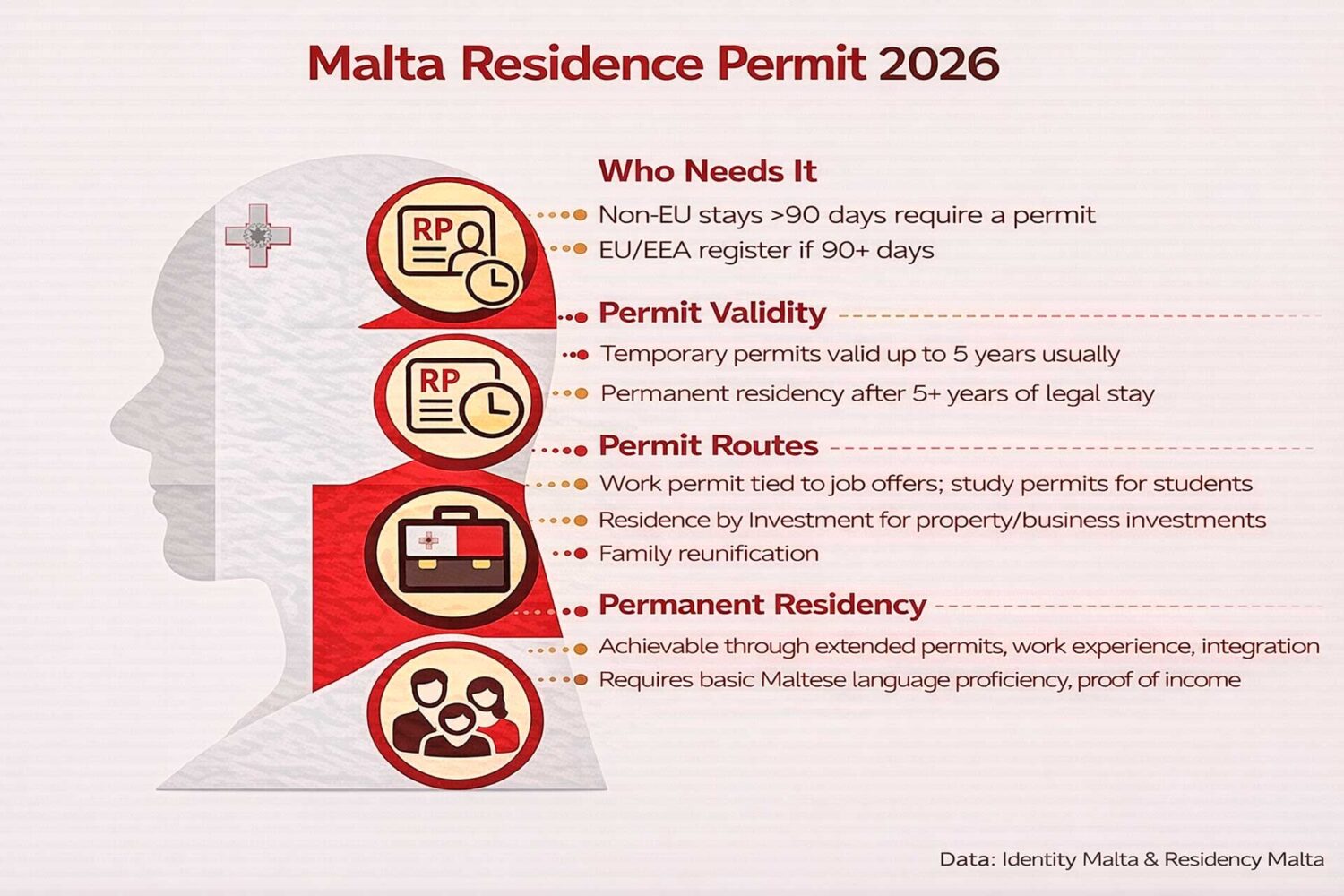
A Malta residence permit is an official authorization that allows non-Maltese nationals to live in Malta for more than 90 days. It is available for workers, students, investors, retirees, and remote workers, and is usually issued for 1 year (renewable) or long-term in specific programs. Applications are submitted through Identità (Identity Malta) or the Residency Malta Agency, depending on the permit type.
This comprehensive 2026 guide covers everything about living in Malta legally, whether you’re a student, worker, retiree, investor, digital nomad or moving with family. We’ll explain the types of residence permits, requirements, application steps, costs, timelines, benefits, and how a residence permit compares to Maltese citizenship. Throughout, we link to official Maltese government sources for the most accurate information, including Identity Malta (now Identità), Residency Malta Agency, and others.
What is a Malta Residence Permit?
A Malta residence permit is an official document (eResidence card) that allows a non-Maltese citizen to live in Malta legally for an extended period. It serves as proof that you have the right to reside in Malta beyond short tourist stays. Both EU/EEA nationals and third-country nationals (non-EU) may need to obtain a residence document or permit if staying longer than 3 months, although the process and type of document differ by nationality.
- Who can get it? Virtually anyone intending to reside in Malta long-term can apply, including employees, self-employed persons, students, retirees, investors, family members joining relatives, and remote workers. EU/EEA/Swiss nationals exercise free movement rights and receive a registration certificate (residence document), whereas non-EU nationals must apply for a residence permit (often tied to employment, study, family reunification or special programs).
- How long does it last? Most temporary residence permits are valid for one year (or the duration of a work/study contract) and can be renewed annually. Some programs offer longer validity or even permanent residence. For instance, the Malta Permanent Residence Programme (MPRP) grants lifelong residence status (with a card renewed every 5 years), while the Nomad Residence Permit is issued for one year at a time (renewable up to 4 years). EU nationals’ registration certificates have 5-year validity by default.
- Why do you need it? If you plan to live in Malta for more than 90 days, you are required by law to obtain the appropriate residence permit or registration. This permit not only keeps your stay legal, but also grants you a host of benefits like access to local services, ability to open bank accounts, and visa-free travel in the Schengen Area for non-EU residents. Essentially, it’s your ticket to living in Malta hassle-free.
In summary, a Malta residence permit is the cornerstone of any long-term relocation to Malta, ensuring you reside in the country lawfully and enjoy rights similar to Maltese residents. Next, let’s look at the different types of permits available and find which one fits you best.
Types of Residence Permits in Malta
Malta offers several residency pathways to accommodate different needs. They range from investment-based programs and tax residency schemes to work visas, student permits, and a special digital nomad permit. In this section, we break down the major types of residence permits and programs in Malta.
Malta Permanent Residence Programme (MPRP)
The Malta Permanent Residence Programme (MPRP) is a residency-by-investment scheme for non-EU nationals seeking permanent residence rights in Malta. It is often termed a “golden visa” program, as it requires a significant economic contribution but in return grants indefinite Maltese residency for the main applicant and eligible family members.
- What it offers: Successful applicants receive a Certificate of Maltese Permanent Residence and a 5-year renewable residence card, allowing them and their dependents to live in Malta indefinitely. They enjoy residency rights almost immediately – since 2025, applicants can even get a one-year interim residence permit at the start of the process. Permanent residents can travel visa-free within the Schengen Area (90 days in 180) and access Malta’s high quality lifestyle, healthcare, education, and even employment opportunities (though a separate work permit may be needed for certain jobs).
- Eligibility: MPRP is open to non-EU, non-EEA, non-Swiss individuals over 18 who are fit and proper (clean background) and financially solvent. An applicant must demonstrate a minimum capital of €500,000, out of which €150,000 must be in financial assets. They also cannot be beneficiaries of other Maltese residence schemes.
- Investment requirements: The program’s rules were updated in 2025 to streamline fees. Now the key financial components are: a government contribution of €37,000, an administrative fee of €60,000 (usually €15k paid at initial submission and €45k after approval in principle), a charitable donation of €2,000, and a qualifying property in Malta. You must either buy a property (minimum €375,000) or rent long-term (minimum €14,000 per year) and maintain it for at least 5 years. These obligations are designed to invest in Malta’s economy and community.
- Process: Applications must be submitted through a licensed agent authorized by the Residency Malta Agency. The process involves rigorous due diligence (4-tier screening) to ensure only reputable applicants are approved. After initial checks, a letter of approval-in-principle is issued within a reasonable timeframe (often ~6–9 months after full application). The applicant then fulfills the remaining investments (contribution, property, etc.), and final approval is granted. Beneficiaries get a Certificate of Residence and their eResidence cards, initially valid 5 years (shorter for children who will turn 18, etc.).
- Who it’s for: MPRP suits investors and high-net-worth individuals planning long-term relocation or a “plan B” residence in Europe. It’s popular with those who want a secure EU foothold for their family, without necessarily working in Malta. Notably, MPRP allows inclusion of four generations of dependents (spouse, children of any age if financially dependent, and even parents/grandparents who are dependent) under one application – a very generous family coverage.
In essence, MPRP is Malta’s flagship permanent residency (PR) program that exchanges investment for the right to settle in Malta permanently. It has a high upfront cost but grants lifetime residency rights in an EU country with relatively quick processing.
Malta Global Residence Programme (GRP)
The Malta Global Residence Programme (GRP) is a special tax residency scheme aimed at affluent individuals from outside the EU/EEA/Switzerland who want to reside in Malta for tax purposes and enjoy a favorable tax rate. Unlike MPRP, the GRP is focused on tax status rather than permanent settlement, and it grants a renewable residence permit tied to meeting certain financial criteria each year.
- What it offers: The GRP grants a special tax status in Malta with a flat 15% tax rate on foreign income remitted to Malta. Beneficiaries also receive a Maltese residence certificate/permit, allowing them to live in Malta and travel in Schengen. However, GRP is primarily for tax optimization, not a PR visa – it does confer residence rights, but holders typically must retain Malta as their principal place of residence and not spend over 183 days in any other single country. Many GRP holders are retirees or international entrepreneurs who base themselves in Malta for its tax regime and lifestyle.
- Eligibility requirements: Applicants must be non-EU/EEA/Swiss and fit and proper (due diligence on good conduct). They should have stable financial resources and health insurance covering EU risks. Crucially, they must either rent or purchase qualifying property in Malta and commit to an annual minimum tax payment. There is no minimum stay requirement (unlike some countries, Malta doesn’t force GRP holders to live X days in Malta, but to be tax-resident you generally should not reside 183+ days elsewhere).
- Financial requirements: The GRP rules set thresholds for property and tax: one must rent a property for at least €8,750 per year (in the south of Malta or Gozo) or €9,600 per year (in northern/central Malta), or buy a property worth at least €220,000 (south/Gozo) or €275,000 (elsewhere). Additionally, a one-time application fee of €6,000 (or €5,500 for property in south/Gozo) is payable to the tax authorities. Most importantly, GRP beneficiaries must pay an annual minimum tax of €15,000 to Malta’s Inland Revenue. This €15k covers the flat 15% tax on the first €100k of foreign income remitted; any foreign income remitted above that is also taxed at 15%. Foreign income not remitted to Malta is not taxed in Malta at all under this scheme (and foreign capital gains are not taxable even if remitted, as long as the gain occurred outside Malta). Local Malta-source income is taxable at normal rates, but many GRP holders have little or no Malta-source income.
- Validity and renewals: The GRP certificate effectively remains valid indefinitely as long as the individual continues to meet the conditions each year – i.e. maintains a qualifying property and pays the minimum tax. There is no set “expiry” as long as compliance continues, though one must file annual tax returns. The person is given a residence card that is typically renewable annually or every few years with proof of continued eligibility.
- Who it’s for: The Global Residence Programme is ideal for high-income individuals and retirees seeking a Mediterranean base with favorable tax treatment. For example, non-EU nationals who draw pension or investment income can become Malta tax residents under GRP and benefit from the 15% flat rate (with a minimum tax), no inheritance or wealth taxes, no taxation on worldwide income unless remitted, and Malta’s network of double taxation treaties. They enjoy a legal residence in Malta (and Schengen travel privileges) but without the heavier financial outlay of the MPRP. The trade-off is that GRP is not permanent residency – it’s a tax residence status that can be maintained long-term but does not on its own lead to EU long-term residence or citizenship. It’s truly about the lifestyle and tax perks.
⚠️Note: Malta also has other special residency schemes managed by the Commissioner for Revenue, such as the Malta Residence Programme (MRP) for EU nationals (very similar to GRP but for EU/EEA/Swiss citizens, offering 15% tax on foreign income with €15k minimum tax), the Malta Retirement Programme (for pensioners drawing foreign pension income, taxed 15% with a €7,500 minimum tax), and the United Nations Pension Programme (for ex-UN officials). These are beyond the scope of this article but serve specific niches. The High Net Worth Individual (HNWI) scheme was an older program replaced by the GRP. Always refer to the Inland Revenue (CfR) guidelines for up-to-date info on tax residency schemes in Malta.
Nomad Residence Permit
Malta’s Nomad Residence Permit is a digital nomad visa program launched in 2021 for remote workers and online business owners from outside the EU. It enables third-country nationals who work remotely (independent of location) to live in Malta for up to one year (renewable) while working for foreign employers or clients. Essentially, you keep your non-Maltese job or freelance business and enjoy an idyllic life in Malta for a year (or more).
- Who is it for? The permit targets non-EU/EEA/Swiss citizens who can perform their job online. Applicants must be in one of three categories: (1) Employed by a company registered abroad (i.e. a foreign employer) with a work contract, (2) Self-employed or partner in a foreign-registered business, or (3) Freelancer/consultant with clients outside Malta. In all cases, your income should come from outside Malta. EU citizens don’t need this permit since they can reside and work freely; and importantly, Nomad permit holders are not allowed to take up local employment with Maltese companies (the work must be for foreign entities).
- Key requirements: To qualify, you must prove a sufficient income and a remote work arrangement. The minimum income threshold is €42,000 gross per year (i.e. €3,500 per month) as of 2024. You’ll need to show payslips, contracts, or bank statements to verify you meet this earning requirement. Additionally, applicants must have: Valid travel document (passport), Health insurance covering you in Malta, Clean police conduct (background check), A Maltese address – you should rent or buy property in Malta for the duration (proof of accommodation is required before the actual permit card is issued), Be at least 18 years old.
- Duration and renewal: The Nomad Residence Permit is typically issued for 1 year, with possibility to renew. Malta currently allows renewing up to a maximum of 3 additional years (total 4 years) at the discretion of Residency Malta Agency. Each renewal requires showing you still meet the criteria (including income and that you spent at least 183 days in Malta in the prior year for renewal). There is also a short-term option: if you plan to stay less than a year, Malta can issue a National Visa for 91-180 days under similar nomad terms, but most prefer the one-year permit for flexibility.
- Family members: You can bring your family on the Nomad permit. Spouses and minor children (and in some cases adult dependents with special conditions) can be included, subject to approval and potentially higher income requirements to support them. There is an additional fee of €300 per dependent for the application (see below). Family members of Nomad permit holders also get residence cards and can reside in Malta (note: family members cannot work locally either, except maybe remotely or if they independently qualify).
- Application process: The application is handled by the Residency Malta Agency via an online portal. You need to fill out forms (Form N1 and others for dependents) and submit supporting documents electronically. After an initial check, you’ll receive an invoice to pay the fee. The application fee is €300 per applicant and per family member, non-refundable, for each year (initial application and each renewal). Once you pay and the background checks are done, you should get an approval letter in around 30 working days if all is in order. After approval, you must within 30 days submit proof of your Malta accommodation and health insurance to receive the permit. Finally, you (and family) travel to Malta (if not already here), and pick up your eResidence card in person at Identity Malta or RMA offices – there’s a card printing fee of €27.50 to be paid per card.
- Tax and legal considerations: Malta has created a tailored tax rule for Nomad permit holders. For the first 12 months, income from your remote work is tax-free in Malta (to avoid double taxing short-term digital nomads). After that, Malta taxes your “authorized work” income at a flat 10% rate (considerably lower than normal income tax). “Authorized work” basically means the foreign-sourced remote work that the permit covers. Any other local income would be taxed at normal rates. Additionally, Nomad residents can benefit from Malta’s tax treaties to avoid double taxation. It’s also worth noting that time spent in Malta on a Nomad permit does not count as formal “ordinary residence” for citizenship or permanent residence purposes – it’s meant to be temporary (up to 4 years max).
In short, the Nomad Residence Permit offers a sunny EU base for remote workers. Imagine working by day with high-speed internet and hopping over to Sicily or Paris on weekends. You keep your overseas job but enjoy Malta’s lifestyle. The program has proven very popular among digital nomads, with its reasonable income threshold and straightforward process. Just remember you must remain a remote worker – if you find local employment, you’d need to switch to a work permit.
Work / Employment Residence Permit (Single Permit)
If you are a non-EU national moving to Malta for a job, you will need a Single Permit, which is Malta’s combined work and residence permit for third-country nationals. Often simply called a “work permit,” this allows you to legally work and reside in Malta. It is typically sponsored by your employer in Malta. (EU/EEA citizens don’t need a work permit due to free movement; they only need to register their residence if staying 3+ months.)
- Single Permit overview: Malta’s Single Permit system implements the EU’s directive for a one-permit process. It merges the work authorization and residence permission into one application. Getting a job offer in Malta is the first step – the permit is tied to a specific employer and role. The permit is usually valid for one year and is renewable if you still meet conditions (renewals can be for up to 3 years in some cases). The process involves both Identity Malta (Identità), which issues the residence card, and Jobsplus (Malta’s employment agency), which provides labor market clearance for the job position.
- Application process: Normally, your employer applies on your behalf or at least provides the necessary documents. An application pack is submitted to Identity Malta’s Expatriates Unit, including: the filled form, your passport, job contract, employer covering letter, proof of qualifications and experience (for skilled jobs), a medical clearance form, health insurance (if not contributing to national insurance yet), and a police conduct certificate. A government application fee of €280.50 is payable for each Single Permit application. This fee covers both work license and residence processing. The law allows up to 4 months processing time for work permits, but Malta aims for faster processing – the average is about 2 months if all documents are in order. Some applications (especially in-demand roles or via fast-track schemes) can be approved in a few weeks, whereas others might take longer if there are backlogs or missing documents. As of 2026, Malta reports that on average it’s closer to 8–10 weeks for a straightforward case.
- Labor market test: Malta often requires a labour market needs test before issuing a work permit to a non-EU worker. This means the employer should show they couldn’t fill the vacancy with a Maltese/EU candidate. However, certain categories are exempt or fast-tracked. For example, the Key Employee Initiative (KEI) is an expedited 5-day processing scheme for highly skilled roles with salary above ~€30,000, which bypasses some bureaucracy. Additionally, healthcare, gaming, and other sectors may have pre-approved quotas. If you are applying normally, expect that Jobsplus will advertise the vacancy for a short period or verify that you have unique skills.
- Pre-Departure Training (new in 2026): A brand new requirement has been introduced for first-time work permit applicants. Effective March 2026, all non-EU nationals who are applying for their first Single Permit must complete a Pre-Departure Course before applying. This is an online training and assessment covering “Living and Working in Malta” and “Rights and Obligations at the Workplace”, plus an English language interview. It’s essentially meant to ensure migrant workers have basic English skills and understand Maltese work culture and laws. The course takes ~20-24 hours in total and can be done online from abroad, followed by a virtual interview. Upon completion, you get a Pre-Departure Course Certificate. Identity Malta will require this certificate in the work permit application from March 1, 2026 onward. The cost of the course is €250. Note: Part 2 of the system may include sector-specific skill tests (e.g. for hospitality) if you work in certain industries. This is a significant new step – so a common mistake to avoid is skipping this course (see Mistakes section later). Be sure to check homeaffairs.gov.mt for details on the Pre-Departure Course and complete it before your Single Permit application.
- Rights and limitations: With a Single Permit, you have the right to reside and work in Malta for your sponsoring employer. You also enjoy equal treatment as locals in working conditions, social security, etc., as per EU rules. However, your permit is job-specific. If you stop working for that employer, the permit can expire and you may need to apply for a new one if you find a new job (Malta now allows a 30-day grace period to find a new job if you’re laid off). Changing employers requires a new Single Permit application, though in some cases a simpler process is followed if within same industry. After 5 years on continuous residence and work, you could become eligible for Long-Term Resident status (which grants a 5-year renewable autonomous permit) – more on that later.
- Who it’s for: This is the standard route for non-EU professionals, skilled workers, and even laborers who have a job in Malta. Whether you’re an IT specialist in the iGaming industry, a teacher, a healthcare worker, or a blue-collar worker in construction or caregiving, if you’re from outside the EU, you’ll need this permit. Malta has been attracting foreign workers due to booming sectors like finance, gaming, and medical services. Just ensure your employer is credible and will sponsor your permit. Students graduating in Malta can also convert to a work permit if they find a job (Malta even offers a 6-month post-study permit to seek work).
In summary, the Employment Residence Permit (Single Permit) is your go-to if you have a Maltese job offer. It combines your work visa and residence into one, typically lasting 1 year at a time. The process can be paperwork-heavy but Malta has tried to streamline it. By mid-2026, make sure you’ve done the Pre-Departure training too. Once approved, you’ll be living and working in Malta legally – enjoying your career in the sunshine!
Student Residence Permit
Malta is an emerging hub for international education, with an English-speaking environment and reputable institutions (like the University of Malta and various language schools). If you’re a non-EU student coming for a full-time course longer than 90 days, you will need a National Long-Stay Visa (D visa) to enter (if applicable) and then a Student residence permit (eResidence card) to stay in Malta during your studies. EU nationals don’t need a visa; they simply register after arrival if studying.
- Visa vs Permit: The process usually starts with obtaining a Student Visa from the Maltese embassy/consulate in your home country. Requirements include an acceptance letter from a Maltese educational institution, proof of sufficient funds to cover tuition and living expenses, health insurance, and police clearance. For Malta, proof of funds is often around €14,000 per year (e.g. in a bank account or via a sponsor) to show you can support yourself. Once you arrive in Malta on the visa and begin your course, you then apply for the eResidence card (student permit) which formalizes your legal residence for the duration of studies. The application is submitted to Identity Malta (Expatriates Unit) with documents like your passport, visa, school letter, proof of address in Malta, etc. Many schools assist students with the paperwork.
- Validity: Student residence permits are generally issued for one year at a time, or for the academic year duration, and can be renewed each year of your course. If your study program is shorter (e.g. a 6-month language course), the permit will cover that period. Each renewal requires proof of ongoing enrollment, attendance, and continued financial means.
- Work rights for students: Since 2018, Malta allows non-EU students to work part-time (up to 20 hours per week) alongside their studies. However, you can only start working after 90 days of residing in Malta and once you have obtained both your residence permit and a work authorization. The employer needs to apply for a student work notification, but it’s a simpler process than a full work permit. This is a great way for students to gain experience and supplement income, but your primary purpose must remain studying (and you must maintain passing grades/attendance). Upon graduation, students can apply for a temporary permit to seek employment in Malta or directly transition to a Single Permit if hired.
- Family members: Generally, student visas in Malta do not easily allow you to bring family (there’s no automatic dependent visa for spouses/children of third-country students as there is for workers or investors). There are some exceptions for say PhD students or if you prove very high funds, but in practice it’s uncommon for student permit holders to have dependents with them unless those dependents secure their own independent status.
- Post-study options: After finishing studies, many international students aim to stay and work. Malta now offers a 6-month “Stay Extension” (Temporary Residence) for graduates to find a job. Once you get a job offer, you would switch to a Single Permit (work permit). Time spent as a student doesn’t usually count towards the 5-year requirement for long-term residency, but once you switch to a work permit, the clock starts.
Overall, the Student Residence Permit is straightforward: get accepted to a program, secure your visa, then within Malta obtain your residence card. Just remember to budget enough money (Malta will ask for proof of finances each year) and keep up with any medical insurance and tests (Malta may require an annual TB test or health check for some students). Studying in Malta can be a pathway to eventual residency and employment if you plan accordingly.
Those are the core residence permit types: permanent residency by investment (MPRP), tax residency (GRP), digital nomad visa, employment permits, and student permits. There are also permits for family reunification (if you marry a Maltese or have a family member working in Malta, you can apply as a dependent) and long-term residency (after 5 years legal stay) which we’ll touch on later. Next, let’s see the general requirements you’ll need to meet for any Malta residence permit.

Malta Residence Permit Requirements
While each permit type has its specific criteria, there are some common requirements and documents that most Malta residence permit applicants must prepare. This section outlines the key requirements in terms of finances, documentation, and eligibility criteria.
Financial Requirements
Every residency route in Malta requires demonstrating that you have sufficient financial means and will not become a burden on the state.
- Proof of income or funds: If you’re working, a job contract showing your salary suffices. For students, you must show savings or sponsorship covering at least €14,000 per year. Self-sufficiency (e.g. retirees) may require proving a stable income (like pensions or investments) or a bank balance above a threshold. For instance, economically self-sufficient applicants (including retirees) often need to show capital and income well above the minimum wage, plus private health insurance. Investors under MPRP must prove €500k in assets; Nomad visa requires €42k/year income; GRP requires ability to pay €15k tax yearly. Essentially, Malta wants assurance you can support yourself (and any dependents) without relying on social assistance.
- Property accommodation: You will need to have an address in Malta – either a rented property or owned. Almost all permits require proof of accommodation. For temporary and long-term permits alike, you might submit a rental agreement or property title deed as part of the application. Certain programs set minimum housing specifications (MPRP and GRP specify minimum property values or rents as discussed). For work or student permits, there’s no minimum value, but you do need a legitimate residential address (hotel bookings won’t cut it for the actual permit, though they might for initial visa). Malta is small, so make housing arrangements early.
- Application fees and finances: Be prepared to pay the relevant government fees and have funds for any stamp duties or processing. As covered, a single permit costs ~€280; nomad permit €300; student visa ~€70 (visa fee) plus €27 card fee; MPRP tens of thousands; GRP ~€6k + tax, etc. Also, certain documents (like police certificates) might need apostilles and translations which cost money. And don’t forget to budget for health insurance (see below) and the cost of living in Malta, which is moderate but not negligible.
Documentation Required
Though exact checklists vary, below are typical documents you will need for a Malta residence permit application:
- Valid Passport: Your passport must be valid for the duration of the permit (ideally 6+ months beyond). You’ll provide copies of the bio-data page, and show the original. If you have visas or stamps showing entry to Malta, those are included.
- Application Forms: Each type has specific forms (e.g., Form ID 1A for first-time non-EU residents for work permits, Form C for temporary residence, Nomad Forms N1/N4, etc.). These must be filled and signed. Many are downloadable from Identity Malta or Residency Malta websites.
- Passport-sized Photos: Usually two identical passport photos are required for the eResidence card issuance. Ensure they meet size and format guidelines (typically 35x45mm, white background).
- Proof of purpose in Malta: A document explaining why you need residence. For workers, this is the job contract or official employer letter. For students, the letter of acceptance from the university/college. For family reunification, a marriage or birth certificate proving relationship to the sponsor. For self-sufficient retirees, perhaps a personal cover letter and documentation of ties to Malta (lease, etc.). For nomads, a letter of intent and your foreign work contract or business certificate. The goal is to show you meet the specific grounds for the permit you seek.
- Financial evidence: As mentioned, bank statements (usually 3-6 months), scholarship letters, pension statements, or salary slips. If a bank statement, it should be recent and show your name and balance. Malta may require you to demonstrate a lump sum in a Maltese bank in some cases (though usually foreign accounts are fine if you can access funds). For investment programs, official bank statements and asset declarations are needed.
- Health Insurance: Non-EU applicants must have health insurance covering all risks in Malta (minimum coverage €30,000 is a common requirement for visas). The insurance should cover hospitalization, emergencies, and ideally repatriation of remains. Students and temporary residents often get private travel medical insurance for the visa, then maybe local health insurance later. Workers contribute to Malta’s national insurance via social security, which grants access to public healthcare, but at application time first-time workers also need private health cover until they are formally on Malta’s employment register. MPRP requires a global health insurance policy as well. Always include a copy of the insurance policy and payment proof.
- Police Conduct Certificate: Malta requires a recent police clearance certificate from your country (and any country you resided in long-term) for most permit applications (especially work, student, investment). This must be apostilled or legalized and ideally issued within the past 6 months. It proves you have no criminal record. A clean record is generally mandatory (certain minor offenses might be overlooked, but serious crimes will result in refusal). Malta also runs its own background checks in parallel.
- Medical tests: Certain applicants might need to undergo a medical examination or tests. For example, students are often asked to do a chest x-ray or TB test annually. Some work sectors (food handling, healthcare) require medical fitness certificates. The forms for medical clearance are typically provided by Identity Malta or the employer and must be signed by a Maltese-licensed doctor. Check if this applies to you and get it done promptly when in Malta.
- Civil status documents: If you are including family members, you’ll need marriage certificates for spouses, birth certificates for children, etc., all translated to English (if original is not English) and apostilled. These prove the dependency relationships. Even for your own application, some forms ask your civil status and may require a marriage certificate if married, or proof of divorce if divorced.
- Passport copy of sponsor: If you are applying as a dependent of someone (e.g. your spouse works in Malta and you are joining), include copies of the sponsor’s passport/residence card and a letter from them confirming support. Similarly, if on a family permit, provide evidence of the main applicant’s permit or application.
- Miscellaneous: Other documents can include a CV (especially for Nomad and some work applications), academic or professional qualifications (for jobs requiring certain degrees or licenses – these should be legalized and accompanied by recognition statements if needed), reference letters, and signed declarations as required by specific programs. Always check the official checklist for your permit type. For example, MPRP applications include detailed forms about source of funds, etc., while student permits might include attendance reports.
Eligibility Criteria and Background:
Before applying, it’s important to understand the general eligibility criteria that Malta uses to assess residence permit applications.
- Good conduct and fit & proper test: As noted, Malta conducts robust due diligence. You should not have a criminal history or any involvement in activities that pose security or reputational risks. If you have minor offenses, disclose them and provide context. Background screening also checks that you’re not on EU sanctions lists, etc. MPRP and citizenship applications have multi-tier vetting.
- Health and Insurance: You must not carry certain contagious diseases (some applicants must undergo medical checks). You need valid health insurance (can’t stress this enough) for yourself and family covering Malta. Also, having stable health (or a plan for treatment if moving for healthcare reasons) is important as an eligibility factor.
- Age: You generally must be an adult (18+) to apply in your own right for a permit. Dependents can be children or elderly parents. Some programs (like MPRP) explicitly say main applicant 18 or older. There’s no upper age limit for most permits, though very elderly retirees might need to show extra healthcare plans.
- EU vs Non-EU distinction: Keep in mind EU/EEA/Swiss nationals exercise treaty rights. They must show they are working, studying, or financially self-sufficient when registering in Malta. The requirements are lighter (no investment needed, no heavy fees), but they do need to show proof of employment or funds and health coverage if not employed. Non-EU nationals have the stricter permit application processes described above.
- Integration measures: For Long-Term Residency (after 5 years), Malta now requires passing an integration requirement – a basic Maltese language and culture test (at least CEFR A2 in English or Maltese, plus an A2 spoken Maltese and A1 written Maltese for LTR, per new 2020s rules). This doesn’t apply to first-time temporary permits but is good to be aware of if you aim to settle permanently.
- Licensed Agent (for investment routes): If applying for MPRP or certain investment-based routes, you must use a government-licensed agent. You cannot apply directly as an individual. The agent will ensure you meet all eligibility and prepare your forms. (This is both a requirement and a help, but note agents charge their own professional fees on top of government fees).
In summary, prepare a complete application with all required documents and proof. Incomplete applications often result in delays or rejections. As the official government site says, applications “with all supporting documentation” must be submitted in person or online as required. If the checklist says you need it, don’t ignore it. A well-prepared application that ticks all boxes (financially, documents, and eligibility-wise) has a high chance of success.
How to Get a Malta Residence Permit (Step-by-Step)
Obtaining a Malta residence permit may seem daunting, but breaking it down into clear steps makes it manageable. Below is a step-by-step guide applicable to most permit types (work, study, family, investment, etc.), with notes where the process may differ. Follow these practical steps to go from planning to living in Malta legally:
Step 1: Determine the Right Permit Type for You
First, identify which residence route fits your situation and goals. Are you moving to Malta for a job offer? Then you need a Single Permit (work permit). Are you investing in property and funds? Then maybe the MPRP (permanent residency by investment) is right. Retiree or high-net-worth seeking tax advantages? Look at the GRP (Global Residence Programme). A student? Student visa and permit. A remote worker? The Nomad Residence Permit. Each has its own requirements and benefits (see previous section). Choosing the correct category is crucial – applying under the wrong scheme will waste time. If in doubt, consult Identity Malta’s website for guidance on permits for “Employment”, “Study”, “Family reunification”, etc., or the Residency Malta Agency for special programs. Ensure you meet the core criteria (e.g. job contract in hand, sufficient income for nomad, etc.) for your chosen route.
Step 2: Prepare the Required Documents and Prerequisites
Once you know your permit type, gather all necessary documents and fulfill any pre-application steps:
- Collect documents: Use the requirements we outlined as a checklist. Get your police clearance certificate early (as it can take a few weeks and needs apostille). Secure a health insurance policy that meets Malta’s coverage requirements. Prepare proof of finances: bank statements, scholarship letters, etc. If your documents aren’t in English or Maltese, have them translated by a certified translator. Make photocopies of everything (as you’ll submit copies, but always have originals on hand). Download and fill in the application forms relevant to your permit (many are on Identity Malta’s site or servizz.gov.mt). For example, employment Single Permit uses Form CEA/Form ID 1A; family members use Form ID 1G; MPRP has its own set of forms via the agent.
- Secure Maltese address: In most cases, you’ll need at least a rental agreement in Malta. If you’re applying from abroad (as is common for MPRP, Nomad, or visas), you might initially book temporary accommodation and then sign a lease when you arrive (some permits allow proof of address to be given just before card issuance). But be ready to show proof of accommodation – a signed lease or property purchase contract.
- Preliminary approvals: Some categories require extra steps: for work permits, your employer might need to advertise the job vacancy or apply for a sanction letter from Jobsplus. For KEI fast-track, your employer must fill that specific application. If you’re going for Nomad or MPRP, you’ll likely start the application online and get a pre-approval or letter of intent before completing final steps. For first-time work permit (Single Permit) applicants in 2026 onward – ensure you complete the Pre-Departure Course and obtain the certificate before applying. You will need to attach this certificate to your application for a work permit, otherwise it will be rejected for not meeting new requirements.
- Licensed agent engagement (if needed): If you’re pursuing MPRP or any investment-based residency, find a Malta-authorized licensed agent and engage them. They will guide document preparation (e.g. source of funds proof, wealth declarations) and submit on your behalf. Agents can also help with GRP or retirement applications, although not strictly required by law, it’s often advisable.
- Passport photos and forms: Get the required number of passport photos (Malta typically needs two per applicant). Fill out application forms carefully. For family members, some forms (like Form N2 for nomads, or Form MRVP 2 for MPRP dependents) might be needed per person.
Double-check everything against the official checklist for your permit. It’s wise to keep both physical and digital copies of your application packet.
Step 3: Submit Your Application
Now it’s time to file the application. Depending on the permit type, the submission process differs:
- Non-EU work permit (Single Permit): If you’re in Malta on a visa or visa-exempt, you can submit in person at Identity Malta’s Expatriates Unit (by appointment). Often, the employer or a representative submits the application on your behalf (especially if you are still abroad). As of 2023, Malta also has an online portal for employers to submit Single Permit applications digitally. Either way, the application goes to Identity Malta, which coordinates with Jobsplus. Make sure the €280.50 fee is paid (usually via a bank draft or POS at Identity Malta). You’ll get an acknowledgment or receipt which you should keep. If applying from overseas, some sectors allow an application while abroad but you will typically need entry clearance – Malta doesn’t issue the final work permit until you enter Malta and do biometrics.
- EU/EEA nationals: The process is simpler – you book an appointment with Identity Malta (Identità) after arrival (must be within 3 months of arriving). At the appointment, you submit your registration form, passport, and supporting docs (proof of employment/student status or funds) and you’ll receive a Registration Certificate and residence card usually within the same visit or a couple weeks. No heavy fees (just a nominal card fee) and no prior visa needed.
- Residency Malta Agency programs (MPRP, Nomad, Startup, etc.): These are generally done online or through an agent. For Nomad Permit, you apply through the Residency Malta online portal from abroad. You upload all documents, then RMA will email you an invoice for the €300 fee. After paying (usually by bank transfer) and getting approval, you’ll then travel to Malta to finalize (see Step 5). For MPRP, your licensed agent compiles the full application and submits to Residency Malta Agency. MPRP has a two-stage submission: optionally a Temporary Residence (TR) application first (for the 1-year interim permit), followed by the permanent residence application. The TR application is submitted as soon as you have a lease and health insurance in place, to quickly get you a 1-year permit while the big application is processed. If you skip TR and go straight to PR application, you’ll pay the first €15k fee at submission instead. Either way, the agent will handle the actual lodging of forms and documents with the Agency.
- Student visa & permit: For students, the initial visa application is submitted to the Maltese embassy/consulate in your country (or VFS if outsourced). This must be done well in advance of the course start (at least 4–8 weeks). Once you get the visa and arrive, your school will often help arrange the residence permit submission. You may need to go to Identity Malta in Valletta or the international office of your college to submit the permit application (with your passport, visa, and documents). Pay attention to deadlines – some student residence applications must be filed within a short time after arrival.
- Family members: If you are applying as a dependent family member, your application usually is submitted at the same time or after the main applicant’s. For example, if your spouse is working in Malta, they should mention you and kids in their application and file your Family reunification applications once they have their permit. Family reunification for non-EU usually requires the main sponsor to have accommodation suitable for family and certain income (e.g. about €19,000 annual + €3800 per each dependent as of guidelines). These are filed at Identity Malta as well, often using form ID 1A/1G series.
At submission, ensure you submit all required documents because missing items will delay the process. Identity Malta might refuse to accept incomplete applications or will issue a letter requesting additional docs (which could pause your processing).
Step 4: Pay the Fees and Await Processing
When submitting, you will pay the relevant government fees. Keep the receipts. For example:
- Work permit: €280.50 fee upon application.
- Nomad permit: €300 per person via bank transfer on invoice.
- MPRP: €10,000 or €15,000 of the admin fee at initial submission (agent will guide this).
- Student card: a small fee (~€27) for the eResidence card.
- Registration for EU: around €20-€25 for the card.
Once paid and accepted, your application goes into processing. Now the waiting game begins:
- Background checks: Authorities will verify your documents, run background vetting (Interpol/Europol checks especially for investment or nomad), and ensure all criteria are met. They may reach out for clarifications or additional info. If Identity Malta or RMA sends queries, respond promptly via your agent or directly.
- Processing times: As covered earlier, expect roughly: Work permits: ~2 months on average (max 4 months by law). Nomad permits: ~30 days for approval. MPRP: 4–6 months for the full PR approval, though you get a 1-year temp permit earlier if applied. Student residence: a few weeks (often the permit card is issued within 2-4 weeks of applying if all is in order). EU registrations: same-day or within 2-3 weeks for the card. Malta’s agencies have improved speed in many cases, but it also depends on the volume of applications and time of year (summer often slower). Pro tip: Submit in off-peak months if possible (e.g., avoid August holidays for work permits; avoid last-minute student rush in September).
During this time, if you applied in-country, you might not yet have a permit card. Identity Malta may issue you a reference number or interim document. Always keep copies of submission receipts – they prove you’re in process, which can help if questioned for overstaying a visa, etc.
Step 5: Approval, Biometrics, and Collecting Your Residence Permit
Finally, once your application is approved, you’ll proceed to activate and collect your eResidence card – this is the physical permit.
- Approval notification: You or your representative will receive an approval letter or email. For Nomad and MPRP, RMA issues an Approval in Principle letter (for MPRP) or a direct approval email (for Nomad). For work permits, Identity Malta sends an approval letter to your employer or lawyer. For student permits, you might simply get a notification to come for biometrics.
- Biometric appointment: All applicants must provide biometric data (photo and fingerprints) in Malta to get the card. If you applied from abroad (Nomad, MPRP), you must travel to Malta after approval to do this. The approval letter often doubles as a visa facilitation: nomad approval allows you to travel to Malta (present it at border if you needed a visa). In-country applicants likely already gave biometrics at application. If not, Identity Malta will schedule you. At the biometrics appointment, you’ll need your passport and the letter. Note: For MPRP, if you did the Temporary Residence step, you already did biometrics for that 1-year card. Post-approval, you may just update the card.
- Final requirements: Some permits have final steps before issuance: MPRP: After Approval in Principle, you have 2 months to pay the remaining €45,000 fee and 8 months to complete all investments (contribution €37k, property purchase/lease, donation). Once you submit evidence of these, then the Certificate of Residence is issued and you can get the PR cards. Nomad: Within 30 days of in-principle approval, you must show your Malta address rental contract and health insurance to RMA. Then they give final confirmation. Work permit: If you applied from abroad, you may get a letter to collect an employment license on arrival. You must enter Malta with a visa (if needed) and then go to Identity Malta for the card. Sometimes a specific single-entry visa is given to collect the permit. Student: Often, you may already be in Malta on the visa, so after approval you just wait for the card.
- Residence card collection: When ready, you’ll receive your eResidence card – usually to be picked up in person (bring your passport for ID). The card is a credit-card-sized ID showing your name, photo, permit type, and validity dates. At collection, you often pay a small card fee (~€27.50) if not already paid. Congratulations – you are now officially a Malta residence permit holder!
⚠️Important! Registration & compliance: Once you have the card, ensure you register for other obligations. For instance, if on a work permit, your employer should register you for social security number and tax number. If on Nomad or GRP, you should register with tax authorities for a Tax ID and possibly notify for tax residency certificate. EU nationals with a registration certificate should also get a Maltese ID number (which is on the eResidence card). Additionally, within 2 weeks of moving into a new address, you must update Identity Malta (there’s a form for Change of Address). Keep your address updated to receive any official letters.
Step 6: Post-Approval: Maintaining Your Permit or Moving Forward
After obtaining your residence permit, be mindful of maintaining the conditions:
- Renewals: Mark your calendar for when renewals are due (usually 1 year minus a month from issue). Start renewal process at least 4-6 weeks in advance. Provide updated documents (e.g., renewed lease, updated insurance, recent payslips, etc.). Pay renewal fees (work permit renewal fee is similar €280, nomad €300, etc. per year). If you fail to renew on time, your permit can lapse and you might become illegal, so don’t procrastinate.
- Conditions compliance: Some permits have ongoing conditions. MPRP requires you to maintain qualifying property, investments, and health insurance for at least 5 years, and continuously meet wealth thresholds. GRP requires paying your €15k tax each year. Work permit holders must only work in the role for which the permit is issued and inform Identity Malta if job ends. Students must maintain enrollment and attendance. Identity Malta can revoke permits if conditions are breached, so stay compliant.
- Reporting changes: If you change address, change job, or personal status (marry, divorce, have a baby in Malta), inform Identity Malta promptly. For example, changing employer means applying for a new work permit (the new employer must file a new application). If you got a new passport, update the records as well.
Following these steps carefully will make your journey to Maltese residency much smoother. Thousands of expats have successfully navigated it – you can too. Next, let’s talk about money: how much will all this cost?
Malta Residence Permit Cost
How much does it cost to obtain and hold a Malta residence permit? The costs can be divided into government fees, investment or financial outlays, and incidental expenses. This section breaks down costs by permit type and highlights any hidden or ongoing expenses you should budget for.
Government Application Fees
Most permit types have an official fee for processing the application (and often renewal). Below is a table of key fees:
| Permit Type | Application Fee (Government) | Renewal Fee |
| Single Work Permit (Non-EU) | €280.50 for application | €280.50 per renewal (yearly) |
| Malta Permanent Residence (MPRP) | €60,000 Administrative fee (non-refundable), paid in parts (e.g. €15k at submission, €45k after approval) | No annual fee, but one-time fees as left (no direct “renewal fee” for the 5-year card, just card reissue fee) |
| Global Residence Programme (GRP) | €6,000 one-time registration fee (or €5,500 for South/Gozo property) | No renewal fee, but must pay minimum €15,000 tax each year |
| Nomad Residence Permit | €300 per applicant (and each dependent) | €300 per person per renewal (annual) |
| Student Residence Permit | ~€66 visa fee (if applicable) + ~€27 card fee | ~€27 card renewal fee (annual). No large fees for students beyond visa and card. |
| EU Registration (Certificate) | €0 for application (no fee for exercising EU rights) | €0 (five-year document). Only ~€25 card fee. |
⚠️Note: All residence cards cost about €27.50 to issue for non-EU (and ~€22 for EU), which is usually paid on collection. This is a small fee but mandatory for printing the physical permit card.
Investment and Contribution Costs
Some permits require significant investments or contributions.
MPRP (Permanent Residency by Investment) – total cost is substantial:
- Government Contribution: €37,000 (whether renting or buying property).
- Administrative Fee: €60,000 (as noted above).
- Property: If renting, commit to €14,000/year lease (5 year obligation = €70,000); if buying, spend at least €375,000.
- Donation: €2,000 to a Maltese NGO.
- Dependent fees: €7,500 each for additional adult dependents (other than spouse).
- Agency/Broker fees: Don’t forget the licensed agent’s professional fee, which can be ~€5,000–€10,000 or more, depending on the firm (not a government fee, but part of cost).
- So, an example for a family of four renting: €60k + €37k + €2k + (maybe €7.5k*2 for two parents) + €70k rent = easily €170,000+ over 5 years, plus agent fee. If buying property, a chunk of that goes into the house (you own an asset).
GRP (Tax Residency) – the initial outlay:
- One-time fee ~€6k.
- Property rental or purchase: e.g. if renting at €10k/yr, that’s a recurring cost (but you get housing for it).
- Annual tax: at least €15,000 per year to maintain status. This is effectively an ongoing cost as long as you hold GRP. If you actually have foreign income to remit more, you may pay more, but €15k is minimum.
- If you hire a tax representative or firm to handle your GRP application, they will have service fees as well.
Nomad Residence Permit:
- Application fee: €300 per person as above.
- No further government contributions or taxes required specifically (Nomad taxpayers eventually pay 10% on income, but that’s after a year and only if they owe – many nomads might still be taxed mainly in their home country depending on circumstances).
- Hidden cost: Must maintain a rental in Malta. If you rent a modest apartment, that could be €800-€1500 per month depending on location. For a year, that’s say ~€10,000. So budget for Malta living expenses.
- Health insurance: If not provided by employer, a private plan might be ~€500-€1000 per year for basic coverage for a single person.
- Dependents: additional 20% of median wage income requirement per dependent (implied higher cost of living) and €300 each fee.
Work Permit (Single Permit):
- Aside from the €280 fee, there aren’t large upfront costs. However:
- Pre-Departure Training (from 2026): €250 course fee for first-time applicants.
- Translations/apostilles: maybe €50-€150 depending on documents.
- Airfare to Malta, initial accommodation, etc., are personal costs.
- Once working, you’ll contribute around 10% of salary to national insurance (social security) and pay income tax according to brackets (no flat tax scheme unless you came via GRP or other).
- If you use an agency to help find a job or process, they might charge a service fee (though employers often cover application).
- Employers might have to pay a security bond for some nationalities (common in domestic work), but that’s not your cost usually.
Student Permit:
- Tuition fees (varies by institution/course) – not a “permit cost” but a major cost of moving to Malta as a student.
- Visa fee (~€66) and eResidence fee (~€27).
- Financial maintenance: You need to show funds (e.g. €14k in bank) but you don’t have to spend it all – just show it’s available. However, in reality you will spend on living costs.
- Annual medical test maybe ~€50 if required.
- No government contributions or taxes (students generally don’t pay taxes unless they work part-time).
Ongoing Costs and Hidden Expenses
In addition to initial application fees, it’s important to consider the ongoing costs associated with maintaining a Malta residence permit.
- Housing and Living Expenses: Residence permits require you to actually reside in Malta (except maybe some GRP holders who travel a lot but still maintain a home). So, rent is a major ongoing cost for most. Rental prices vary: a 1-bedroom in town might be €700-1000/month; larger family flats €1200+; cheaper in Gozo or south. Utilities are moderate (€100-150/mo for a flat). If you bought property (like for MPRP or by choice), factor in purchase tax (5% stamp duty) and maintenance costs.
- Health Insurance: If you’re not working (or until you qualify for national health coverage), you’ll be paying private health insurance premiums annually. Many expats get international health plans or local ones (~€500-€2000/yr depending on coverage and age).
- Taxes: GRP and MRP (for EU nationals) have mandated minimum tax payments yearly. Nomad permit holders must file a Malta tax return if they stay past a year and will pay 10% on their remote income (which is actually quite an attractive low rate). Ordinary work permit holders will pay income tax as per Maltese rates (progressive up to 35%). Ensure you budget for income tax unless your employer withholds it (most do via Pay-As-You-Earn). Malta has no municipal taxes, but there is a modest residence permit card annual fee (the €27 card) and a once-only e-ID registration fee of ~€280 (which we discussed) for work permits.
- Renewal costs: Each time you renew, plan for: Renewal application fees (similar to initial fee, e.g. another €280 for work, €300 for nomad each year, etc.). Possibly visa renewal fees if you had a visa. Document renewal: update health insurance, possibly get a new bank letter, etc. For MPRP, after 5 years your card renewal is just a formality (no big fee), but you must not forget to renew the residency card itself every 5 years.
- Compliance costs: For MPRP, you might hire an accountant or advisor yearly for the first 5 years to file compliance reports (some agents include first 5-year monitoring). Not huge, but a few hundred euros.
- Opportunity cost: If you have to keep €500k tied up in assets for MPRP or maintain a property you might not fully use year-round, those are financial opportunity costs to consider.
In the big picture, obtaining a Malta residence permit can range from minimal costs (a few hundred euros for a worker or student) to significant investment (hundreds of thousands for an investor program). The good news: many of these costs (like rent, property, tax) are in exchange for real value (housing, low-tax environment, etc.). And Malta’s cost of living is moderate compared to say Western Europe – you get a lot of sunshine and sea for your buck!
Always refer to official sources or published legal notices for up-to-date fees, as these can change. For instance, legal changes in 2025 adjusted MPRP fees. Malta does occasionally revise fees (though usually modestly for admin fees, except where major program overhauls happen).
Next, we address how long each permit typically takes to be processed, because as the saying goes, “time is money” too.
Leave your contacts to have an expert contact you shortly.
How Long Does It Take to Get Malta Residence Permit?
The processing time for a Malta residence permit depends on the type of permit and your specific case. Here we break down expected timelines for each major category, from application to approval. Keep in mind that these are average estimates; processing can be faster or slower based on the completeness of your application and the workload of the authorities.
Work / Single Permit (Non-EU workers): By law, a Single Permit application should be decided within 4 months maximum. In practice, Malta typically processes work permits in about 8–10 weeks (2 to 2.5 months) for most straightforward cases. Identity Malta itself noted the “average processing time is closer to two months from the date of submission of all required documents”. Some fast-track cases like the Key Employee Initiative (KEI) can be approved in as quick as 5 working days (if you meet criteria, salary > €30k, etc.). On the other hand, lower-skilled work permits or those requiring labour market testing might take the full 3-4 months, especially if any documents were missing initially. Tip: avoid submitting right before summer holidays to minimize delays. Once approved, card issuance is quick (a few days after biometrics). So overall: expect ~2 months for most work permits, but be prepared for up to 3-4 months worst case. Renewal processing is usually faster (around 4-6 weeks) since less vetting is needed.
Nomad Residence Permit: The Residency Malta Agency aims to process Nomad applications in around 30 days (1 month) once a complete application is received. According to official guidance, 30 working days is typical, which is roughly 6 weeks. Attard Baldacchino’s FAQs also mention 30 to 60 working days from payment to issuance as an outside range for the whole process. In many cases, applicants have reported approvals even within 3-4 weeks. So, plan for about 1 month to get approval, then factor in a week or two to travel to Malta (if coming from abroad) and pick up your card. If any documents are missing or background checks take longer, it could stretch a bit beyond a month. The renewal each year should also be processed within a few weeks as it’s simpler (provided you still meet criteria and have lived in Malta at least 6 months of the prior year).
MPRP (Permanent Residence by Investment): This is a two-stage process:
- Temporary Residence Permit (optional): If you apply for the one-year interim permit to reside while your PR is in process, this Temporary Residence (TR) permit is issued quite fast – typically within a month of applying (the aim is “within a month or so of kicking off the process” for a temporary permit). In fact, a key benefit introduced in 2025 is that new MPRP applicants “can secure a temporary Maltese residence permit, valid for one year, right at the start… within a month or so of starting the process”.
- Permanent Residence approval: The official processing time for the full MPRP application is usually 4 to 6 months after submission of the complete file. High-quality applications may get a decision in around 6 months. More complex cases might take up to 8–10 months if due diligence raises queries. The Attard Baldacchino guide suggests “an application decision may be expected within around 6 to 9 months from a complete submission”. This includes rigorous due diligence. So, realistically ~6 months on average for approval in principle. After approval, you have up to 8 months to finalize contributions and investments, then the actual certificate is issued promptly after you show proof. So from start to finish (including fulfilling post-approval requirements), many MPRP cases complete in 8-12 months total. However, since you can live in Malta on the interim permit during that waiting period, you’re not in limbo.
Global Residence Programme (GRP): GRP applications are often processed faster than MPRP because it’s mostly a tax status check and not as heavy on due diligence. Many law firms report about 3 months to get GRP special tax status confirmed. Some have seen even 6-8 weeks if everything (property lease, etc.) is in place. There is an initial issuance of a certificate by the Commissioner of Revenue. So plan on 2-3 months on average for GRP. Plus add time to secure a property lease or purchase beforehand, as that’s required.
Student Visa & Permit: For a student visa, you should apply at least 4-8 weeks before your intended travel (some embassies recommend 8 weeks). Processing of student visas can take anywhere from 2 to 6 weeks, depending on the volume and if any clearance from Maltese authorities is needed. Once in Malta, the student eResidence card application is usually quick – students often get their card within 2-3 weeks of applying (some have gotten it in days, others a month). Overall, if you start the process early, you can generally get everything done to start your semester. The key is to not delay visa application (if required) because that’s the gating factor. Renewal of a student permit yearly in Malta takes just a couple weeks if your papers (transcripts proving you passed, etc.) are in order.
Family and Other Permits: If you’re applying as a family member of an EU citizen, your residence card must be issued within 6 months by law, but Identity Malta often issues family cards within 2-3 months or faster when possible. If you’re a family member of a non-EU worker (i.e. family reunification), your timeline is tied to when the main sponsor gets their permit plus maybe 2-3 months for yours after you apply. Long-Term Residence (5-year) applications are processed in a few months and citizenship naturalization can take 1-2+ years after application (not counting the years waiting to be eligible).
Bottom line: The fastest route to have a residency document in hand is likely the Nomad permit (~1 month), or a work permit via KEI (a few weeks). Most other routes are in the 2-6 month range, except citizenship which is much longer. Planning ahead is crucial. If you know you want to be in Malta by a certain date, start the process as early as possible. For example, to move by summer 2026 on a work permit, better to start job and permit process by spring 2026. Use the average times above as a guideline but build in some buffer for unexpected delays.
Now that you know the timeline, let’s look at what you get out of a Malta residence permit – the benefits and advantages that make it worthwhile.
Benefits of Malta Residence Permit
Why relocate to Malta? What advantages come with Maltese residency? Below we explore the key benefits of holding a Malta residence permit, from practical perks to lifestyle enhancements:
- Live in a Safe, High-Quality Environment: Malta consistently ranks as a safe country with a low crime rate. As a resident, you can enjoy a peaceful life in a politically stable, EU jurisdiction. The public order is stable, and it’s family-friendly. The lifestyle is laid-back Mediterranean – expect a warm, community-oriented vibe and a slower pace than big cities. Many expats appreciate the blend of modern conveniences with rich history, plus the fact that English is an official language, making daily life and bureaucracy much easier (almost everyone speaks English fluently).
- Schengen Travel Freedom: A Malta residence permit allows you to travel visa-free within the Schengen Area. You can spend up to 90 days in any 180-day period in the other Schengen countries without additional visas. This is a huge benefit for non-EU nationals – weekends in Italy or France become a reality. Note: You must still abide by the 90/180 rule and use Malta as your main residence (the permit doesn’t let you live in another EU country long-term, but it eases short trips). For those who previously needed visas to Europe, this travel convenience is invaluable.
- Access to Healthcare and Education: Malta has high-quality healthcare, ranking among the top in the world. As a resident, if you are employed and paying social security, you and your family will generally have access to the government healthcare system (which is robust and mostly free at point of use for residents). Even if you’re not working (e.g. retirees), once you’re a permanent resident or long-term resident, you can apply for public health services access, or use private clinics which are still reasonably priced. Many expats also choose private health insurance for faster elective treatment. For families, Malta offers world-class education in English – there are international schools, British curriculum schools, and of course local schools and the University of Malta. Education up to age 16 is free in public schools (though instruction is in English and Maltese). There is also a growing array of international universities and programs. So if you have kids, Malta is a solid choice for their schooling (safe environment, multiple languages, internationally recognized qualifications).
- Employment and Business Opportunities: With a residence permit, you can seek employment or run a business in Malta (subject to permit conditions). If you hold a work permit, you obviously can work for that employer, and switching jobs is possible with a new permit. Permanent residents (MPRP) and long-term residents can take up employment or self-employment generally (though MPRP holders may need to obtain a work license, it’s not usually denied). Malta’s economy is thriving in sectors like finance, iGaming, blockchain, maritime, aviation, and tourism, so there are plenty of job opportunities. If you’re entrepreneurial, Malta offers a good base to start a company (English-speaking, EU member, decent corporate tax frameworks with refunds). There’s even a new Startup Residence Programme for innovative entrepreneurs. As a resident, you also can enjoy EU funding opportunities and easier business travel in Europe.
- Tax Advantages for Non-Domiciled Residents: Malta’s tax system is very favorable to resident non-citizens who are non-domiciled (which is the case for most expats). If you become a resident but not domiciled in Malta, you benefit from the remittance basis of taxation. This means: Foreign-source income is taxed only if remitted to Malta, and then typically at a flat 15% (under programs like GRP) or at normal rates but you can use remittance strategies. If you don’t bring foreign income into Malta, it’s not taxed at all. Foreign capital gains are not taxed in Malta even if remitted. There are no inheritance, estate, or net worth taxes in Malta. Also no municipal taxes or council tax. If you do work in Malta, that local employment income is taxable in Malta, but Malta’s top rate 35% kicks in at relatively high income levels, and there are ways to optimize. Special 15% tax schemes (GRP, Retirement Programme, etc.) for qualifying individuals, as discussed, which can significantly lower tax burdens for those with foreign income. For digital nomads who become taxable in Malta, a flat 10% income tax on remote work earnings applies, which is very low by international standards. In summary, many residents legally pay much less tax than they would in their home countries, especially if they’re coming from high-tax jurisdictions. Always get professional tax advice, but Malta residency can be a smart part of financial planning.
- Lifestyle and Climate: This is arguably the biggest draw. Malta offers a sunny Mediterranean lifestyle that’s hard to beat. Over 300 days of sunshine a year, mild winters (~12-20°C in January) and hot summers. You’re never far from the sea – swimming, diving, sailing can be part of your weekly routine. The country is steeped in history, with three UNESCO World Heritage sites (including the entire capital Valletta). Expats enjoy a vibrant social life: festivals, cafes, restaurants, and a buzzing expat community. English being widespread means you can integrate easily. And Malta’s compact size means everything is within a short drive or ferry ride – no long commutes to enjoy leisure activities.
- Location in Europe: Malta’s geographic location is strategic. It’s just a 1-3 hour flight to most European cities. Having a base in Malta means spontaneous trips to Sicily (90 min ferry) or weekend jaunts to London, Paris, Athens are feasible. Also, for those with business in EMEA, being in an EU time zone and an EU jurisdiction is beneficial.
- Pathway to Long-Term Settlement: Holding a residence permit can put you on a path to more permanent status. After 5 years of continuous legal residency, you can apply for Long-Term Resident (LTR) status which gives a permanent right to live in Malta (and some mobility rights in EU). Long-term residents enjoy nearly all the rights of citizens except voting and holding certain public offices. And after a number of years (typically 5 years of physical residence, but in practice often longer), one could apply for citizenship by naturalization (more on that next). So a temporary residence permit can be the first step towards planting deep roots in Malta, if that’s your goal.
- Family Benefits: Your Malta residency can usually extend to close family. Permits like MPRP, Nomad, work permits, etc., allow bringing spouse and dependent children (and in MPRP even parents) either immediately or after certain conditions. Your family then enjoys the same rights – your kids can attend local or international schools, your spouse can often obtain a work permit or at least live visa-free and potentially work (EU family members can work without separate permit; non-EU spouses of non-EU workers might need their own work permit but being in Malta makes that easier). Malta’s family reunification policies are quite accommodating for legal residents. There’s also a sense of community – children grow up bilingual (English/Maltese), in a safe environment, and the island’s small size means support networks are strong.
- Cultural and Social Integration: Being a resident allows you to truly immerse in Maltese life – from feasts (village festivals) and carnival to learning Maltese cuisine and exploring the islands of Gozo and Comino. Many expats highlight the friendly locals and large international community that make it easy to make friends and feel at home.
In short, a Malta residence permit is not just a document – it’s the key to unlocking a Mediterranean lifestyle with European benefits. You get EU mobility, fiscal advantages, safety, excellent services, and sunshine. Whether you want to optimize taxes, raise a family in a charming environment, or just enjoy the sea after work, Maltese residency provides that opportunity.
Common Mistakes When Applying
Applying for a Malta residence permit involves careful attention to detail. Here are some practical tips and common mistakes to avoid in order to ensure a smooth application:
- Incomplete or Incorrect Documentation: The number one mistake is missing documents or submitting documents that don’t meet requirements. Examples: not apostilling your police certificate, forgetting to include a translated copy of a birth certificate, or missing a required signature on the application form. Such omissions will delay your application or lead to rejection. Solution: Use the official checklist for your permit and double-check every item. If a document needs to be recent (e.g. bank statement last 3 months) or certified, ensure it is. It’s wise to have a knowledgeable agent or lawyer review your packet if possible.
- Choosing the Wrong Permit Category: People sometimes apply for the wrong type of permit – e.g. trying to apply as “self-sufficient” when they actually intend to work (which requires a work permit), or using a tourist visa while actually planning to study (should get student visa). This can lead to refusals or legal issues if you aren’t on the correct status. Solution: Be honest with yourself about your primary purpose in Malta and apply for the appropriate permit from the start. If your situation changes (you came as a student but then got a job), update your status officially. Don’t try to misuse a permit (like working on a student or nomad permit without permission – that’s illegal).
- Applying Too Late: Timing is crucial. Some people wait until the last minute – for instance, arriving on a 90-day visa waiver and then scrambling on day 85 to apply for a work permit. By then, it’s too late; you’ll likely overstay because work permits take longer than a few days. Solution: Start the process early. If you need a visa to enter Malta, apply well in advance. If you’re switching from one permit to another, begin that process while your current permit/visa is still valid for a comfortable period. Always have at least a month (preferably two) of validity left when you file a new application.
- Not Completing the New Pre-Departure Course (for workers): This is a 2026-specific pitfall. Starting March 2026, all first-time work permit applicants who ignore the Pre-Departure Training requirement will find their application automatically refused for not having the certificate. This is new, so many may be unaware. Solution: If you’re a third-country national planning to work in Malta, check the official information and complete the online modules + English interview before applying. Don’t assume your application can be processed without it – Identity Malta will be checking for the course certificate.
- Insufficient Proof of Funds or Resources: Some applicants underplay or misunderstand the financial requirements. For example, applying as self-sufficient with barely the minimum in savings, or a student not showing enough funds in the bank. Malta will reject applications that don’t convincingly demonstrate financial stability. Solution: When in doubt, show more assets/income than the bare minimum. If minimum is €14k, showing €20k is better. If you have multiple bank accounts, show them. Include a letter explaining your financial plan (especially for retirees – e.g. “I have X in savings, Y annual pension, plus rental income Z – well above what I need.”). Over-documenting finances (within reason) can prevent doubts.
- Using Incorrect Forms or Portals: Malta has transitioned some applications online (e.g., Single Permit employer portal, RMA’s portals). Using an outdated form or sending to the wrong address causes issues. Solution: Always download forms from the official source right before applying to ensure you have the latest version. If applying online (like Nomad), follow the official portal instructions; don’t send documents by email unless instructed.
- Overstaying or Working Illegally: A critical mistake is to overstay your current visa/permit while waiting, or to start working before the permit is approved. Some think, “I submitted my work permit application, so I can start the job now.” No – you must wait for approval and your residence card in hand (unless you’re EU). Overstaying even a day can jeopardize your application (it could be denied because you fell out of status). Solution: Do not overstay; if a decision is pending and your current permission is expiring, consider leaving and re-entering when approved (or get advice from Identity Malta – sometimes they issue interim extension receipts). And absolutely do not start working, or studying (if on tourist visa), or doing activities not allowed by your current status. Patience is key; a few weeks of waiting can save your whole plan.
- Ignoring Communication from Authorities: If Identity Malta or Residency Malta contacts you for additional information or missing documents (they might email or the agent will be notified), ignoring or delaying response is a mistake. They usually give a deadline. Missing it can lead to a refusal. Solution: Check your email (and spam folder) regularly after applying. If you applied via an agent or employer, keep in touch with them for any feedback. Respond with the required info as quickly as possible, certainly within any stipulated timeframe.
- Not Using a Licensed Agent when Required: For MPRP and some other schemes, Malta requires you to apply via a licensed agent. Some people try to DIY to save money – the application will not be accepted. Also, using unlicensed “consultants” for those schemes can be risky. Solution: Follow regulations – if a licensed agent is mandated, use one (verify their license number on the official RMA site). Even when not required, an experienced immigration lawyer or relocation consultant can help avoid errors for complex cases.
- Forgetting to Renew or Update: Some get their permit and then forget about renewal dates or notifying Identity Malta of changes (like new passport or address). This can lead to permit lapse or fines. Solution: Treat your permit like a passport – know its expiry and start renewal at least a month in advance. Mark it on a calendar. If you change address, fill out the ID Malta change of address form within the required time (generally 2 weeks). If you get a new passport, inform them so your records align.
- Assuming Permit = Right to Do Anything: Having a residence permit is great, but don’t assume it entitles you to, say, work any job or start a business unless your permit type allows it. For example, a Nomad permit holder deciding to take a local job without switching to a work permit would be in breach (nomads cannot work for Maltese employers). A student working more than 20 hours is in breach. These mistakes can lead to revocation. Solution: Know the limitations of your permit. If you want to change your activity (like a nomad who gets a local job), go through the proper process to change status.
- Not Researching Latest Rules: Immigration rules can change (e.g., income thresholds updates, new forms, Brexit-related updates for UK nationals, etc.). Relying on old info or hearsay is risky. Solution: Always check an official source or a reputable updated guide (like Identity Malta’s site, Residency Malta’s publications, or recent government gazettes) for the latest rules at the time you apply. For instance, if you read an article from 2019, note that by 2026 some details (fees, forms, policies) have changed.
By avoiding these common errors, you significantly increase your chances of a smooth and fast approval. Many rejections or delays are totally preventable. Prepare thoroughly, follow the guidelines, and when in doubt – ask for professional or official advice. Maltese authorities are actually quite approachable; you can email Identity Malta or visit their offices if you need clarification during the process.
Relocating to Malta is manageable, but getting expert guidance can save time and reduce risks. Use Identità (Identity Malta) for accurate, up-to-date requirements, forms, and application tracking. Forums and groups can offer practical insights, but always verify information with official sources. Platforms like servizz.gov.mt and local service centers provide guidance on procedures and documentation. Rules change, so follow official announcements and legal updates to avoid mistakes. If you want a smoother process and fewer delays, consider a professional consultation. The right guidance can significantly improve your chances of approval and help you relocate with confidence.
Leave a Comment

We have prepared answers to the most common questions about Malta residence permit. If you want to clarify anything, please contact us - we will provide detailed explanations.
It depends on the permit type. Work permits allow full employment, student permits allow part-time work, nomad permits only allow remote work for foreign employers. MPRP (permanent residents) and EU residents (with a registration certificate) can work freely in Malta without any permit. So, always check your specific permit conditions.
Most permits are issued for 1 year and can be renewed. Permanent, long-term residence cards and for EU residents are typically valid for 5 years.
Yes, Malta allows family reunification for many permit holders. If you’re a non-EU working in Malta, you can typically apply to bring your spouse and minor children after you are settled and can show adequate housing and income to support them. Under MPRP, you can include a very broad range of dependents in the same application. Students generally cannot bring family. EU/EEA citizens residing in Malta have the right to bring their non-EU family members as well, and EU family members obviously can reside with them freely.
Yes, to apply for citizenship by naturalization you typically need at least 5 years of legal residence in Malta (with the last 12 months being continuous residence). You’ll also need to prove ties to Malta, integration (language proficiency, etc.), and a clean record, but approval is not guaranteed. So yes, a residence permit can lead to citizenship, but it’s a separate process with its own demands.
You can appeal, reapply with corrected documents, or choose another permit type.
Yes, Malta is part of Schengen. This means there are no internal border checks between Malta and other Schengen countries (like Italy, France, Germany, etc.). For you as a resident, it means you can travel freely to other Schengen countries for up to 90 days in any 180-day period without a visa.
For day-to-day life, no, you don’t need to speak Maltese – English is an official language and almost everyone speaks it. Maltese may be required only for long-term integration or citizenship.


Comments
No comments found.