

 EU Citizenship
 Slovenian Citizenship
 Romanian Citizenship
 Bulgarian Citizenship
 Austrian citizenship (investments)
 Spanish Citizenship
 Italian Citizenship
 Cypriot Citizenship
 Lithuanian Citizenship
 Portuguese Citizenship
 French Citizenship
 German Citizenship
 Hungarian Citizenship
 Dutch Citizenship
 Belgian Citizenship
 Croatian citizenship


How to Get Finland Residence Permit in 2026

Author: Leon Scott
Published: 06.04.2026
Updated: 06.04.2026
A Finland residence permit is an authorization (usually an e‑card) allowing non‑EU/EEA/Swiss nationals to live in Finland for over 90 days for work, studies, family or other grounds. The Finnish Immigration Service (Migri) runs the core system (including Enter Finland), while Finnish embassies/consulates and VFS centres handle identity checks and biometrics for many first permits. Most first permits are applied for abroad via Enter Finland and finalized after you prove identity and give biometrics at a Finnish mission/VFS.
From a “rules changed recently” perspective, four updates matter most for 2026 planning:
- Income thresholds rose on 1 November 2024 (including the student threshold) after being largely unchanged since 2013, and Finland now updates thresholds more systematically.
- The Citizenship Act changed on 1 October 2024, extending the general residence period requirement for citizenship and tightening how “legal residence” is counted.
- Processing fees increased on 1 January 2026, with online applications typically cheaper than paper.
- Permanent residence (P) and EU long‑term residence (P‑EU) rules tightened on 8 January 2026, introducing structured “paths” and new language/work-history requirements (and a higher language bar for P‑EU).
⚠️ Note: Immigration rules and fees can change. If you want to stay up to date with the latest updates, use this comprehensive 2026 guide and always double‑check the latest details on Migri’s official guidance for your specific permit category. In complex cases or if you require guidance from an immigration lawyer, we invite you to contact our company for a professional consultation.
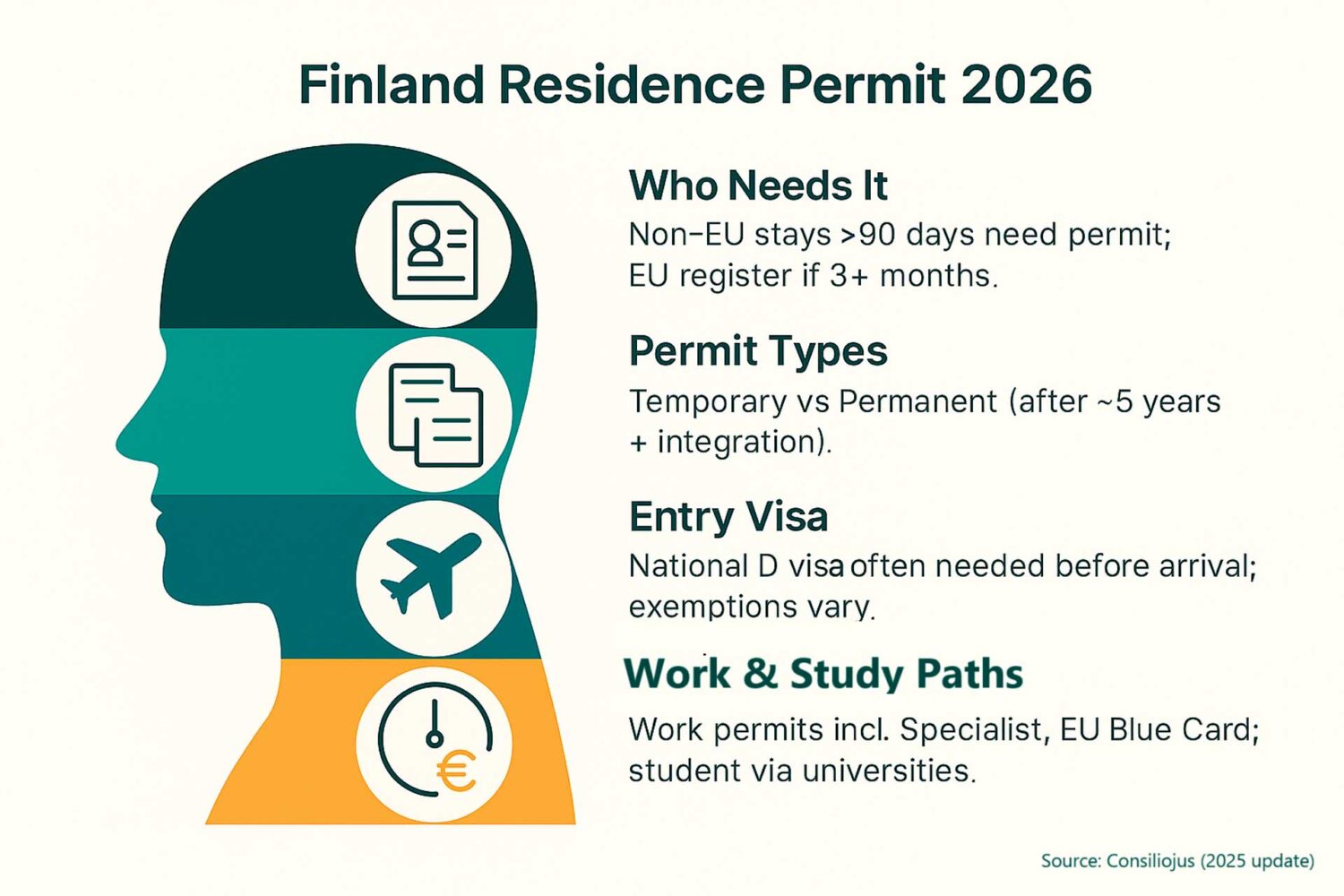
Types of Finland Residence Permits
Finland’s system is easiest to understand in two layers:
- Layer one: permit “type letters” (status format). Fixed-term permits are either continuous (A) or temporary (B); permanent permits are P and P‑EU (also written as P‑EU on Migri pages). A first permit is often granted for up to a year, but students may receive a permit covering the full degree duration. Permanent permits are valid until further notice, but the card must be renewed every 5 years.
- Layer two: the “ground” (why you’re in Finland). The most common grounds are work, studies, family ties, and entrepreneurship.
Work permits
Finland has several work-based permit routes, not “one work permit”. The right route depends on your situation (job type, employer, and any special category you qualify for):
- Standard employment (TTOL / “employed person”). This is for working for an employer operating in Finland, and the permit is granted for a field of employment. It may involve a labour market test (availability of labour in Finland/EU/EEA) depending on the job and situation. In 2026, the gross salary must generally be at least EUR 1,600 per month, while still meeting any applicable collective agreement.
- Specialist / highly skilled routes. These are designed for expert tasks and may come with faster processing options. Examples include the Specialist permit and the EU Blue Card (highly qualified employment with a salary threshold and other conditions). Migri explicitly notes that EU Blue Card applicants can use fast track and may apply for a D visa at the same time.
- Short-season or special categories. Seasonal work, internships, cultural work, ICT transfer, working holiday and other narrower routes exist and have distinct processing times and fees.
Who this suits: people with a Finnish job contract or binding offer; the “best” work category depends on your role, salary level, and whether a faster/less restricted route applies.
Student permits
If your studies in Finland last more than 90 days, non‑EU/EEA citizens generally need a residence permit for studies. This permit is for degree studies, vocational studies, and certain exchange programs in Finland. Migri notes you generally cannot get a student permit if your studies are mainly distance learning and do not require you to stay in Finland. If you are pursuing a higher-education degree, you are generally granted a continuous A permit; some other studies receive a temporary B permit.
Students must generally show independent funds for the first year (work income is not accepted as the primary “first-year” funding plan). In 2026, it`s EUR 800 per month, or EUR 9,600 for the first year, plus private health insurance and proof of admission.
Who this suits: degree students admitted to Finnish institutions and exchange students under eligible programs.
Family reunification permits
Family routes are usually filed “on the basis of family ties” (e.g., spouse/registered partner, child, guardian). Migri publishes different processing time tracks depending on the sponsor’s status (e.g., spouse has a permit vs spouse is a Finnish citizen).
Two points regularly overlooked:
- Family permits often require meeting income thresholds (with some exceptions), and thresholds vary by municipality group due to housing-cost differences.
- Legislative changes took effect for some family situations around 16 June 2025 (Migri separates requirements on its spouse page by submission date). If a detail is case-specific, treat this as “check the timestamped requirement section for your profile.”
Who this suits: spouses/partners and dependent children of residents/citizens, subject to the sponsor’s status and financial rules.
Entrepreneur and startup permits
Finland offers two main entrepreneur tracks:
- Entrepreneur permit (“other entrepreneur”). This is for running a business in Finland under defined ownership/management criteria. Migri notes entrepreneurs usually need to register the business in the Trade Register before a permit can be issued.
- Start-up entrepreneur permit. This route is tied to the “startup” concept and typically involves an eligibility assessment process (commonly linked to Business Finland in practice; Migri’s income-threshold bulletin also references startup entrepreneurs explicitly).
Startup founders must first obtain a positive Eligibility Statement from Business Finland before applying. A first startup permit can be granted for up to 2 years. For startup entrepreneurs in 2026, Migri states that you must have at least EUR 1,210 / 1,090 / 1,030 net per month, depending on municipality cost category, and enough funds for at least one year.
Who this suits: founders and owners moving to Finland to operate a business (startup route is generally the most structured “fast” entrepreneurial channel, with shorter “most cases” processing time).
Permanent and long-term (P and P‑EU)
A permanent residence permit is the long-term route for people already living in Finland with a continuous permit. Finland has two “stay indefinitely” options:
- Permanent residence permit (P). Valid until further notice, but the card is renewed every 5 years. Requirements changed on 8 January 2026, introducing multiple application paths (e.g., 6-year residence path with language + work history; degree-related paths; income path).
- Long-term resident’s EU residence permit (P‑EU). Also valid until further notice and based on an EU directive, with Finland-specific conditions and an explicit 5-year continuous legal residence From 8 January 2026, it additionally requires good Finnish/Swedish language skills (B2).
Who this suits: long-term residents aiming for stability; P‑EU may be attractive if EU long‑term status mobility rules are relevant later, but language requirements in Finland became stricter in 2026.
Other schemes worth knowing
In addition to standard residence permits for work, study, or family reunification, Finland offers several alternative pathways depending on your citizenship and circumstances. Below is an overview of key categories that may apply:
- EU/EEA/Swiss citizens. Citizens of EU/EEA countries and Switzerland do not need a residence permit to live or work in Finland. However, if you plan to stay longer than 90 days, you must register your right of residence with the Finnish Immigration Service (Migri).
- Nordic citizens. Citizens of Nordic countries (Sweden, Norway, Denmark, and Iceland) benefit from even simpler rules due to regional agreements. They do not need a residence permit or registration with Migri. Instead, if staying longer than six months, they must register their residence directly with the Digital and Population Data Services Agency (DVV). Nordic citizens have broad rights to live, work, and access services in Finland with minimal administrative requirements.
- Temporary protection. Temporary protection is a special status granted in exceptional situations, such as mass displacement due to conflict (for example, Ukrainians fleeing war). It is not a traditional residence permit for work or study, but it allows individuals to live in Finland, access basic services, and often work. This status is granted for a limited period and follows separate rules and procedures. It is listed as a distinct category in Migri’s permit type overview and should be considered separately from standard immigration pathways.
Leave your contacts to have an expert contact you shortly.
Finland Residence Permit Requirements
Finland’s requirements are both universal (apply to most permits) and permit-specific (vary by route). The safest preparation approach is: meet universal requirements first, then optimize for your permit type.
Universal eligibility basics
Most applications assume:
- You apply personally (you cannot “file for someone else” as the applicant).
- Identity is verified and biometrics are collected (signature, photo, fingerprints), often at a Finnish mission or VFS Application Centre.
- You remain compliant throughout: Migri can conduct post-decision monitoring, and permits can be withdrawn if requirements are not met.
Financial requirements
Financial thresholds depend on the permit category:
- Student permit: at least EUR 800/month and usually EUR 9,600 available for the first year, plus tuition funds if unpaid. A bank statement covering the past 6 months is required, and the funds must be in the student’s own account (relatives’ sponsorship is not accepted).
- Work permit (TTOL): at least EUR 1,600 gross/month in 2026, plus compliance with collective agreements. For the EU Blue Card, Migri states the 2026 salary threshold is €3,937/month.
- Startup permit: at least EUR 1,210 / 1,090 / 1,030 net/month depending on where you live.
- Family permit: usually enough income for the family unit, based on the sponsor’s and/or applicant’s acceptable income sources. Income is generally calculated from net income, varies by municipality group, and cannot be based on certain benefits (e.g., social assistance, labour market subsidy, basic unemployment allowance). Migri publishes exact thresholds (e.g., in Helsinki metro area: 1 adult €1,210/month net; “second adult” €610/month net; “first child” €610/month net).
- Permanent permit: sufficient resources usually still apply, depending on the basis of your A permit.
Documents required
Most applicants should expect to prepare:
- Valid passport.
- Passport photo.
- Completed application in Enter Finland or on paper.
- Proof of purpose of stay, such as job contract, admission letter, or family relationship documents.
- Proof of income or funds.
- Health insurance for students.
- Legalized and translated documents where required.
Most permits share a core document set, then add purpose-specific evidence:
- Studies. Applicants attach: acceptance/attendance certificate, proof of sufficient funds (including a 6‑month bank statement), insurance certificate, paid tuition fee or scholarship documentation, and (for minors) birth certificate and guardian consent.
- Work (TTOL employed person). Applicants must have confirmed employment and the employer typically supplements the application; Migri also states a supply contract may be required, and labour market testing can apply.
- EU Blue Card (highly qualified work) document pattern. Migri lists a structured set, including passport/photo, proof of legal stay in the application country (for first permits), and may require translations/legalisation depending on document origin.
- Family (spouse with a residence permit). Migri references marriage/registered partnership proof (with legalisation rules) and separates requirements based on the date rules changed, so applicants should use the correct version for their submission date.
- Permanent residence (P) and P‑EU. Applicants must usually provide proof of funds and, after 8 January 2026, language certificates for relevant paths (and work history for some P paths). Migri is explicit that even minor offences/suspected offences can affect outcomes.
The most reliable way to avoid delays is following a “document quality” checklist: clear scans/photos, consistent name spelling across documents, full pages (no cropped corners), translated documents where required, short cover note explaining any unusual situation (gaps, changes, dual citizenship, etc.).
How to Get a Finland Residence Permit
Most applicants experience the process as “online-first, in-person verification.” Finland’s workflow is consistent across permit types, with additional steps for employer/startup assessments.
Step-by-step overview:
- Choose the correct permit route (work vs studies vs family vs entrepreneurship). Using the wrong category is a common cause of delays or refusals.
- Apply online via Enter Finland (recommended) or use a paper form if you cannot use the e-service. Online is normally cheaper and enables faster follow-up.
- Pay the processing fee. Migri notes that online applications are often cheaper; fees rose in 2026.
- Book and attend an identity + biometrics appointment. After you submit online, you must prove identity with a passport/travel document and provide biometrics (signature, photograph, fingerprints) at a Finnish mission or VFS Application Centre (or a Migri service point in Finland in eligible cases).
- Wait and respond quickly to requests for additional documents or interviews if Migri contacts you.
- Decision + residence permit card delivery/collection. If approved, your residence permit card is delivered to the place specified by the process (often the mission/VFS or Finland, depending on the track).
- Optional: D visa for early entry (eligible routes). Finland’s D visa is a 100‑day national visa allowing entry shortly after a positive permit decision in eligible categories.
Process notes: fast track applicants must prove identity within 5 working days after submitting (and must apply online).
Finland Residence Permit Cost
Finland’s official fees depend on permit category and online vs paper submission. They are set in a Ministry of the Interior decree and published by Migri.
| Permit type | Online application (EUR) | Paper application (EUR) |
| Work permit (employed person, TTOL) | 750 | 950 |
| EU Blue Card | 530 | 630 |
| Student permit | 600 | 750 |
| Family permit | 750 | 800 |
| Startup entrepreneur | 650 | 800 |
| Entrepreneur | 750 | 900 |
| Permanent residence permit | 380 | 600 |
| P‑EU (EU long‑term resident) | 380 | 600 |
| D visa (optional, eligible routes) | 95 | 120 |
| Renewal of residence permit card | 60 | 105 |
Finland’s official fees are only part of relocation budgeting. Common non-fee costs include:
- VFS service fees (where VFS is used) and possible travel costs to another country if the nearest mission/VFS is not in your country of stay.
- Translations/legalisation: several permit routes require document legalisation unless issued by Nordic/EU authorities.
- Insurance: students must present a certificate of insurance. The cost varies widely by coverage and provider, so treat pricing as unspecified and budget conservatively.
- Proof-of-funds logistics: students must show funds in their own accessible account and provide a 6‑month bank statement.
- Non-refundable application fees in many scenarios (e.g., rejected/cancelled applications are not refunded per MFA guidance).
- Renewals and extensions: fixed-term permits require extension filings; even with permanent permits, the card renews.
Cost-of-living isn’t an “immigration fee,” but it affects compliance. Migri’s student funding requirement explicitly assumes the funds cover accommodation, food and other needs at €800/month. Real costs vary by city and housing; treat any single “average rent” as unspecified for immigration purposes and rely on the requirement thresholds plus your own market research.
Finland Residence Permit Processing Time
Processing times in 2026 depend on the category:
- Work permit (TTOL): often 1 month in most cases; some take longer. Migri’s current operational data also shows many first decisions being issued within 14 days after identity verification, but not all cases move that fast.
- Student permit: about 1 month in most cases, up to 3 months in a minority of cases.
- Family permit (spouse of permit holder): about 4 months in most cases; 9 months in a minority of cases. Family members of students or researchers have a legal maximum of 3 months.
- Startup permit: often 2 weeks in most cases; up to 2 months in a minority of cases.
- Permanent permit: in 2026, the new application paths range roughly from 6 to 9 months in most cases, depending on the route; longer timelines are possible in more complex cases.
If you need a single planning heuristic: Finland’s work permits are often measured in weeks to 1–2 months for fast-track-eligible categories, while family permits and permanent statuses can take many months, with citizenship typically taking much longer.
If you are comparing “online vs paper” processing time, Migri’s table often shows similar time ranges for both; the main practical advantage of online is faster communication and easier supplementation, not necessarily a shorter published estimate.

Benefits of Finland Residence Permit
A residence permit can offer more than legal stay:
- EU / Schengen mobility. A valid Finnish residence permit allows visa-free travel within the Schengen area for up to 90 days in any 180-day period, although it does not automatically grant the right to work in other Schengen countries.
- Access to Finnish systems. Depending on your permit type and municipality registration, you may access local registration, public services, and practical integration pathways. Students in higher education can also qualify for a municipality of residence in some cases.
- Work rights. Work permit holders can work on the basis of their permit conditions. Students may work in paid employment in any field for an average of 30 hours per week over the year, and family-based permit holders often have an unrestricted right to work after the permit is granted.
- Family pathways. Many permit holders can apply for family reunification, subject to income rules and processing timelines.
- Quality of life and long-term planning. Many people value Finland’s safety, education, and infrastructure, these are not “permit benefits,” but they strongly influence relocation decisions. Also a residence permit can be the first step toward permanent residence and eventually citizenship, especially for people building a long-term life in Finland.
Finland Residence Permit vs Citizenship
A Finland residence permit allows a person to legally stay in the country for a specific purpose, such as work, studies, family reunification, or business. Citizenship, in contrast, represents full legal membership in Finland, granting broader rights including political participation and access to a Finnish (EU) passport. Since 1 October 2024, citizenship requirements have become stricter: most applicants must complete 8 years of residence, although in some cases this can be reduced to 5 years (for example, if language requirements are met). Importantly, only periods of legal residence under a valid permit are counted.
A residence permit is always purpose-based. Its validity depends on the category and may be temporary (B), continuous (A), or permanent (P). Citizenship, on the other hand, is permanent and remains valid unless it is formally renounced or revoked under specific legal conditions.
When it comes to rights, residence permit holders have limited political participation and cannot vote in national elections, while Finnish citizens have full political rights, including voting and running for public office. Similarly, residence permit holders are not eligible for a Finnish passport, whereas citizens gain access to a Finnish passport and full EU mobility rights.
The residence requirement also differs significantly. Residence permits have no single unified duration requirement, as they depend on the purpose of stay. Citizenship, however, generally requires 8 years of residence under the updated 2024 rules, with some exceptions allowing a shorter period.
Language requirements are another key distinction. A residence permit does not always require knowledge of Finnish or Swedish, although language skills may become important when applying for permanent residence under the updated 2026 rules. Citizenship, however, requires proven oral and written proficiency in Finnish or Swedish.
Income requirements also vary. For residence permits, financial thresholds depend on the specific category (for example, work, study, or family). Citizenship applicants must demonstrate stable financial means and a clean record of meeting their financial obligations.
Finally, the role of each status is different in the immigration journey. A residence permit is typically the first step, allowing a person to live in Finland legally. Citizenship is the final stage, granted after meeting stricter requirements related to residence duration, integration, financial stability, and language skills. In 2026, permanent residence has become more focused on integration, while citizenship remains a higher-level status with its own independent criteria.

Common Mistakes When Applying
To improve your chances of approval and avoid delays, it’s essential to be aware of the most frequent mistakes applicants make during the residence permit process:
- Choosing the wrong permit category. A startup founder, employee, student, and spouse all need different applications. Use Migri’s route logic and salary thresholds to choose correctly.
- Applying from the wrong place. First permits usually must be filed from abroad, not after arrival in Finland.
- Submitting incomplete documents. Missing attachments, untranslated records, or unlegalized family documents often slow processing.
- Weak or non-compliant proof of funds, especially for students (funds must be in your own account; sponsorship letters from relatives are not accepted).
- Underestimating the financial requirement. Finland checks that you can actually support yourself. The threshold depends on your permit type.
- Delaying biometrics/identity proof, your application can stall if you don’t complete the in-person step.
- Not meeting income thresholds for family reunification, or misunderstanding that thresholds vary by municipality group.
- Ignoring 2026 rule changes for permanent residence. Permanent residence now has application paths, and some applicants need language proof and work history.
If you are planning to move to Finland in 2026, the best strategy is to match your permit type carefully, prepare your financial proof early, and file a complete online application through Enter Finland. Rules, fees, and permanent residence requirements changed recently, so using current Migri guidance matters more than ever.
If you want a second set of eyes before you submit, consider getting help from a qualified immigration lawyer or a regulated relocation professional, especially for family reunification, entrepreneur/startup cases, or permanent residence after 8 January 2026 (where “application paths” and language/work-history criteria matter). For do-it-yourself applicants, start with Migri’s permit pages, fee tables, and processing-time tables.
Leave a Comment

We have prepared answers to the most common questions about Finland residence permit. If you want to clarify anything, please contact us - we will provide detailed explanations.
Yes, but it depends on the permit type. Work permit holders can work under their permit conditions, students can usually work an average of 30 hours per week, and many family-based permit holders have an unrestricted right to work.
Usually, you apply abroad. Migri notes first permits are usually submitted abroad, with only certain exceptions; if you apply in Finland, you must be residing legally.
No, but you must register your right of residence in Finland.
Fast track can deliver a decision in two weeks for listed categories (specialists, EU Blue Card, startup entrepreneurs, certain ICT/management routes). It requires applying online, paying in Enter Finland, and proving identity within 5 working days.
It depends on the category. A startup permit can be granted for up to 2 years, student permits usually follow the study period, and permanent permits are valid until further notice.
Yes. A residence permit can be a pathway toward permanent residence and later citizenship, but citizenship has separate rules, including residence time, language, payment, and support requirements.
Not for every first permit. But for permanent residence applications filed on or after 8 January 2026, language skills may be required depending on the application path. Citizenship also requires satisfactory language skills.


Comments
No comments found.