

 EU Citizenship
 Slovenian Citizenship
 Romanian Citizenship
 Bulgarian Citizenship
 Austrian citizenship (investments)
 Spanish Citizenship
 Italian Citizenship
 Cypriot Citizenship
 Lithuanian Citizenship
 Portuguese Citizenship
 French Citizenship
 German Citizenship
 Hungarian Citizenship
 Dutch Citizenship
 Belgian Citizenship
 Croatian citizenship


Estonia Residence Permit Guide 2026

Author: Leon Scott
Published: 29.06.2026
Updated: 30.06.2026
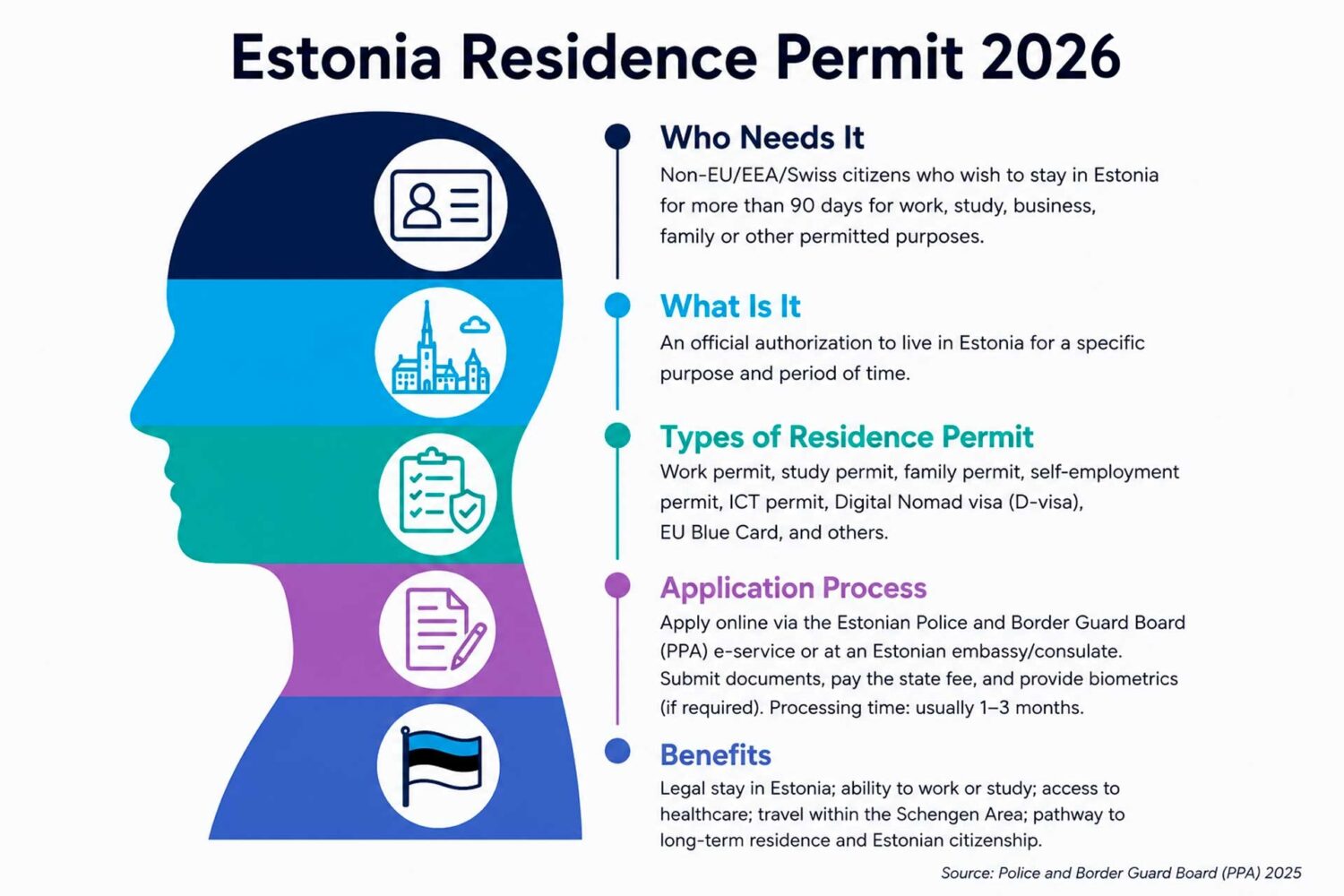
Estonia does not have one universal “residence permit.” Instead, it uses a purpose-based system: non-EU nationals typically choose between temporary residence permits for employment, business or entrepreneurship, study, family reunification, and some special categories such as highly qualified work through the EU Blue Card. If the stay is shorter or the applicant needs a faster entry route, a long-stay D visa can act as a bridge before a residence-permit filing. EU/EEA/Swiss citizens usually do not need a residence permit at all; they rely on EU free-movement rules and, after three months, register residence instead.
For most readers, the practical decision tree is simple. If you have an Estonian job offer for a stay longer than one year, you usually compare a temporary residence permit for employment with the EU Blue Card if you meet the salary and qualification thresholds. If you are moving for university, the student permit is the main route. If you are joining a spouse, child, parent, or other qualifying close relative already living in Estonia, the family route is the main path. If you are founding or scaling a company, Estonia distinguishes between business residence, startup-specific pathways, and a separate official category for major investors.
The most important 2026 nuance, is that Estonia now has two different integration thresholds. A temporary residence permit to live in Estonia permanently now carries new 2026 requirements including completion of the adaptation programme and Estonian language at A2 level. By contrast, the long-term resident route after five years of continuous residence still uses the more established B1 language requirement for most applicants aged 15–65.
Another overlooked distinction is that e-Residency is not immigration status. Estonia’s e-Residency gives a government-issued digital identity and access to many e-services for running a business online, but it does not grant entry rights, residence rights, or automatic tax residency. A Digital Nomad Visa, by contrast, is a temporary stay route for remote workers and can allow up to one year in Estonia, with official income thresholds.
For settlement planning, Estonia offers real long-term prospects, but the route is rule-driven. Temporary residence permits may be granted for up to five years depending on the category; long-term residence is typically available after five years of continuous lawful residence on a residence permit; and naturalization generally requires at least eight years of residence, with the last five on a permanent basis, plus language, civics, income, and loyalty requirements. Estonia is restrictive on dual citizenship in naturalization cases, although people who acquired Estonian citizenship by birth are treated differently in practice and law.
Types of permits and who they suit
Temporary residence permits
For non-EU nationals staying more than a year, the temporary residence permit is the core legal vehicle. Official and quasi-official state-backed sources consistently describe it as a permit that is commonly granted for up to five years, with the exact duration depending on the purpose of stay and the decision in the individual case. Estonia’s official relocation guidance groups the business side into company shareholder, startup business, and major-investor categories, and it also points to employment permits as the main route for employees.
Employment permit
The standard employment route is for non-EU nationals whose work in Estonia will last longer than the period allowed under visa-free stay, a visa, or short-term employment registration. Estonia’s EU Immigration Portal page explains that employment for up to 365 days in a 455-day period can often be handled through short-term employment registration, but longer stays should move to a temporary residence permit for employment. Work authorization is not normally a separate standalone product; it is attached to immigration status.
This route is structured around labor-market and salary logic. Estonia’s Ministry of the Interior states that for long-term employment the employer generally needs permission from the Estonian Unemployment Insurance Fund, and a salary criterion applies. Work in Estonia’s official guidance adds that, in most cases, the salary must be at least the current average annual wage published by Statistics Estonia, unless an exemption applies. The same guidance notes that there is no separate work permit in the classic sense.
EU Blue Card for highly qualified workers
The EU Blue Card is the premium route for highly qualified non-EU professionals. Estonia’s official EU Blue Card page says the applicant must have a work contract or binding offer for at least six months, meet the Blue Card salary threshold, hold the relevant qualifications, and have sickness insurance. The page also gives unusually concrete operational details: the standard validity is 27 months, the decision time is capped at 60 days, the initial fee is €125 abroad or €96 in Estonia, and Estonia reported 36 Blue Cards issued in 2023, including renewals.
A particularly useful 2026 insight is that the Blue Card can be strategically better than the ordinary work permit for some applicants because it is a distinct EU framework designed for highly qualified migration and can be more portable for later EU mobility planning. Estonia’s published 2024 Blue Card salary threshold was €2,748 per month / €32,976 per year, with a lower published threshold of €2,272 per month / €27,264 per year for listed shortage-type professional groups. Applicants should still verify the newest figures before filing, because the page itself frames them as annual thresholds that can change.
Student permit
The study route is straightforward in purpose but often misunderstood in long-term strategy. Estonia’s official student guidance says a residence permit for study may be granted until the end of the nominal study period, but not longer than the estimated duration of study. Student permit holders may work in Estonia without a separate work permit, provided the work does not interfere with studies. After the permit expires, students may remain in Estonia for 270 days if the permit ended by expiry, which gives a practical window to switch basis or extend lawfully.
The key long-term caveat is important. Estonia’s official EU Immigration Portal page says a student cannot move directly to long-term residence on the basis of a study permit alone, and time spent in Estonia on a study permit is counted at half when calculating the residence period later required for long-term resident status if the person switches to another basis. This is a major planning point for international students.

Family reunification
The family route is broader than many short guides imply. Estonia’s family-reunification page for non-EU nationals covers spouses, minor children, adult children unable to cope independently because of health reasons or disability, wards, and certain parents or grandparents needing care. Officially, a spouse can apply together with the sponsor in some cases, and close relatives must normally show legal income and accommodation, subject to route-specific exceptions.
This route has a major advantage over ordinary work-based migration: a non-EU citizen with a residence permit to settle with a spouse or close relative residing in Estonia is permitted to work without restrictions. That makes family reunification one of the most flexible routes once issued, particularly for spouses who may not want to be tied to a single employer from day one.
Business, startup, and investor pathways
Estonia’s official relocation ecosystem distinguishes ordinary entrepreneurship from startup-specific routes. Work in Estonia’s state-backed guidance points applicants to residence permits for company shareholders, startup business, and major investors, while Startup Estonia explains that the Startup Visa helps non-EU founders establish and grow scalable startups in Estonia and helps Estonian startups hire non-EU talent more easily. Startup Estonia also indicates that startup teams with a positive committee decision can expect a response in about 10 working days for the startup-evaluation stage.
For self-employed or enterprise residence permits, Estonia’s EU Immigration Portal states that the applicant can apply abroad at an Estonian embassy or in Estonia if already staying lawfully, and that entrepreneurs must show sufficient resources, a business plan, qualifications, health insurance, housing, and registration compliance. It also specifies one important threshold for the self-employed route: a self-employed person must invest €16,000 in Estonia under their control, while startup companies are exempt from the capital requirement.
Digital Nomad Visa versus e-Residency
Estonia’s official e-Residency page contrasts them directly: e-Residency is a government-issued digital identity for online authentication and business administration, with a typical processing time of 3–8 weeks, while the Digital Nomad Visa gives remote workers the right to stay in Estonia for up to one year and typically takes up to 30 days to process at an embassy. The Digital Nomad Visa requires remote work independent of location, linked to a foreign employer, foreign company, or mostly foreign clients, and the official e-Residency page gives a minimum income threshold of €4,500 net per month.
The tax and compliance distinction matters just as much. Estonia’s Tax and Customs Board explains that e-residents are still non-residents unless tax-residency rules are triggered, and that a person can become an Estonian tax resident if their place of residence is in Estonia or they stay there for at least 183 days in 12 consecutive calendar months. That means e-Residency is a digital tool, not a migration status, and a residence permit does not automatically equal tax residency either.
Permit comparison table
| Route | Best for | Core eligibility logic | Typical validity | Work rights | Key caveat |
| Temporary residence permit for employment | Non-EU employees staying longer than visa/short-term window | Job basis, salary criterion, often Unemployment Insurance Fund permission, quota logic may apply | Up to 5 years | Yes, under permit conditions | May be refused if quota is fulfilled or employer-side conditions fail |
| EU Blue Card | Highly qualified non-EU professionals | 6+ month offer, qualification proof, salary threshold, insurance | 27 months standard in Estonia | Yes | Higher thresholds, but often better long-term mobility logic |
| Study permit | Degree students and qualifying learners | Admission, funds, insurance, language of instruction evidence where relevant | Until end of nominal/estimated studies | Yes, if work does not interfere with studies | Student time counts only half toward later long-term residence calculations |
| Family reunification | Spouses, children, certain dependent relatives | Relationship proof, sponsor link, legal income, accommodation | Up to 5 years | Unrestricted for spouse/close-relative settlement permits | Duration often cannot exceed sponsor’s permit |
| Enterprise / self-employed | Founders, entrepreneurs, business operators | Business plan, funds, qualifications, insurance, housing; €16,000 capital for self-employed, startup exemption | Up to 5 years | Yes, via business basis | Authorities assess reliability of plan, partners, and financing |
| Digital Nomad Visa | Remote workers with foreign economic link | Remote work, mostly foreign employer/company/clients, income threshold | Up to 1 year | For remote work basis | Not a long-term residence permit by itself |
The European Commission’s migrant integration factsheet for Estonia reports that in 2022, 33.7% of residence permits issued were for family reunification, 27.8% for work, and 6.9% for study. A more recent EMN Estonia overview shows that in 2025, third-country nationals still came mainly for employment and family migration, followed by studies and business, while first-time temporary residence permits fell by 24.7% year on year.
Planning to become an Estonian citizen? Understanding the eligibility requirements and citizenship rules is essential before you apply. Our immigration lawyers can assess your case and help you choose the most suitable pathway. Leave a request for a consultation to receive personalized legal advice.
Leave your contacts to have an expert contact you shortly.
Documents Needed
Although Estonia publishes different forms and instructions depending on the immigration category, the same documentary logic generally applies across most residence permit applications. Applicants commonly need to provide:
- Valid passport or identity document. Required for all categories. It serves as proof of identity and lawful entry into Estonia.
- Completed application form. Required for all categories. This formally initiates the residence permit procedure.
- Photograph and/or biometric data. Required for all categories. Used for identity verification and issuance of the residence permit card.
- Proof of the purpose of stay. The required evidence depends on the immigration route: Employment: employment contract, job offer, or employer documentation. EU Blue Card: qualifying employment contract and evidence meeting salary requirements. Study: admission letter, enrollment confirmation, or invitation from an educational institution. Family reunification: marriage certificate, birth certificate, or other documents proving family ties. Business or self-employment: business plan, company registration documents, or evidence of entrepreneurial activity.
- Proof of sufficient income or financial means. Applicants must demonstrate the ability to support themselves during their stay: Employees typically provide salary information. EU Blue Card applicants must meet the applicable salary threshold. Students must show sufficient financial resources. Family applicants may rely on the sponsor’s legal income. Entrepreneurs and self-employed applicants must demonstrate adequate financial capacity.
- Health insurance coverage. Commonly required across most categories. Applicants must show valid health insurance or evidence that coverage will apply during their stay.
- Family information or close-relative documentation. Frequently requested to verify household composition, family relationships, and background information. This is particularly important in family-based applications.
- Evidence of qualifications, education, or professional experience. Often required for employment, EU Blue Card, and business-related applications. Applicants may need to provide diplomas, professional certificates, proof of work experience, or other documents demonstrating their qualifications.
The exact document package varies depending on the legal basis for residence, but these are the core documents most applicants should expect to prepare.
Step-by-Step Application Process
- Choose the correct residence route.
First, determine the legal basis for applying: employment, EU Blue Card, study, family reunification, business, self-employment, or another eligible category. The selected route determines the required documents, filing place, and processing logic. - Check whether you need a visa before applying.
Some applicants may need a visa before entering Estonia. For many non-EU workers, a practical strategy is to first obtain a long-stay D visa, enter Estonia, and then apply for a temporary residence permit inside the country. The D visa does not replace the residence permit; it only helps with lawful entry and stay while the permit process continues. - Prepare the route-specific document package.
Collect the documents required for your category, such as a valid passport, application form, biometrics or photo, proof of purpose, proof of income or funds, health insurance, and any route-specific evidence such as an employment contract, admission letter, family documents, or business plan. - Submit the application at the correct authority.
Applications can usually be filed either at an Estonian embassy abroad or, if the applicant is already lawfully present in Estonia, at a Police and Border Guard Board service point in Estonia. - Provide biometrics if required.
During the application process, the applicant may need to provide fingerprints, a photo, or other biometric data for identity verification and residence card issuance. - Wait for the decision.
The application is reviewed by the competent authority. For employment-based residence permits, the decision is generally made within two months from acceptance of the application. - Collect the residence card.
After approval, the residence card is produced separately. For employment permits, the card is usually issued within 30 days at the foreign representation or service office selected in the application form, although delivery to an embassy abroad may take longer. - Complete post-arrival obligations.
After entering Estonia or receiving the residence card, complete any required local formalities, such as registering your address and keeping your residence status compliant throughout your stay.

Process timeline
The timing above blends official sources: a long-stay visa for students may take 10–30 calendar days at an Estonian foreign representation; a standard temporary residence permit for employment is decided within 2 months; and the residence card is then issued within 30 days, with additional delivery time possible if collected abroad.
Processing times and timeline table
| Route / stage | Official benchmark | Practical note |
| Short-term employment registration | 15 working days | For time-limited assignments up to 365 days in a 455-day period |
| Long-stay D visa | 10–30 calendar days for study cases; up to about a month in state-backed guidance | Embassy practices vary |
| Temporary residence permit for employment | 2 months | Card then issued within 30 days after approval |
| EU Blue Card | 60 days max | More structured than the ordinary work route |
| e-Residency review | Around 30 days | Card generally ready 2–5 weeks after approval |
| Citizenship application processing at PBGB/government stage | Up to 6 months for forwarding and decision flow | Separate from permit process |
Fees table
| Item | Published fee | Important nuance |
| Long-stay D visa | €120; children 6–11 €60 | Exemptions exist for some family and official-status cases |
| EU Blue Card initial application | €125 abroad / €96 in Estonia | Renewal €96; replacement €31 |
| e-Residency | €150 | Paid online when applying |
| Temporary residence permit fee examples on an official embassy schedule | €115 general TRP; €145 work-purpose TRP; €210 entrepreneurship TRP | This embassy schedule is an official Estonian source but explicitly dates from 2020, so applicants should re-check the PBGB or embassy fee page before payment |
Rights and obligations that matter in real life
The rights attached to an Estonian permit depend sharply on category. Students may work without a separate work permit so long as employment does not interfere with their studies. Family permit holders settling with a spouse or close relative may work without restrictions. Employment-permit holders may work under the conditions written into the permit and, in some cases, for several employers concurrently if those conditions are respected. Residence-permit holders also have strong digital-state advantages because the residence permit card can be used for secure access to Estonian e-services.
The obligations are just as important. Estonia repeatedly states across routes that applicants must register their place of residence in the Population Register within one month after arrival or notification, depending on the route. Entrepreneur permit holders must inform the PBGB of material changes affecting the basis on which the permit was issued. And anyone planning to settle long term should think about tax residency early, since spending 183 days in Estonia in any 12-month period can make the person an Estonian tax resident.
Not sure if you qualify for Estonian citizenship? Every applicant’s situation is different. We can evaluate your eligibility, explain the requirements, and guide you through the naturalization process. Book a consultation with our immigration experts today.

Renewal and long-term residence
For most temporary permits, renewal should be planned well before expiry. Estonia’s long-term residence information published through the EU Immigration Portal says that after five years of continuous residence on the basis of a temporary residence permit, applicants may apply for a long-term residence permit if they have a registered address, valid permit, permanent legal income, health insurance, and—if aged 15–65 without restricted active legal capacity—Estonian at B1 level. The application should be filed no later than two months before the temporary permit expires.
There is also a separate 2026 route for a temporary residence permit to reside permanently in Estonia, which now requires at least three years of residence within five consecutive years, completion of the adaptation programme, A2 Estonian, sufficient income, health insurance, and prior compliance with the conditions of the existing permit. This 2026 reform is official and should not be confused with the classic B1 long-term resident route above.
Citizenship pathway and dual citizenship rules
Estonia’s naturalization track is demanding but transparent. The Citizenship Act says an applicant must be at least 15, hold a long-term residence permit or permanent right of residence, have lived in Estonia for at least eight years before applying, including at least five years on a permanent basis, have a registered place of residence, know Estonian, know the Constitution and Citizenship Act, have permanent legal income, be loyal to the Estonian state, and take an oath. The Integration Foundation summarizes the process in six practical steps: establish residence, pass the language exam, pass the citizenship exam, rescind other citizenship, apply, and then apply for Estonian ID documents.
Estonia is not a broadly dual-citizenship-friendly naturalization state. The Ministry of the Interior says Estonian citizenship can be lost by accepting the citizenship of another country, while the Citizenship Act also states that a person who acquires another citizenship by birth in addition to Estonian citizenship must choose one within three years after turning 18. In practice and law, this creates a sharp distinction between people with citizenship by birth and ordinary naturalization applicants. For most residence-permit holders planning naturalization, the safe assumption is that renunciation of previous citizenship is part of the process unless a very specific exception applies.
Common reasons for refusal and appeals
Official sources give a reliable picture of refusal logic. Work permits can be refused if route conditions are not met, if the immigration quota has been fulfilled by the time the decision is made, if the employer has compliance problems, or if there is doubt that the stated purpose of employment matches the real purpose. Entrepreneur permits can be refused for non-compliance with conditions or if the applicant, business plan, business partners, or financing are considered unreliable.
Appeal windows are short. Estonia’s EU Immigration Portal pages repeatedly say that refusals can be challenged before an administrative court within ten days from notification, and in some permit types a formal challenge can be filed first and then taken to court within the same term. That is a very short procedural deadline by international standards, so applicants should treat refusal letters as urgent documents.
Practical tips
- The first practical tip is to choose the right instrument for the first 12 months. If speed of relocation matters and your long-term permit file is still being prepared, Estonia’s own state-backed guidance suggests that a D visa can be the faster bridge.
- The second tip is to keep your long-term plan in mind immediately: the study route is excellent for academics, but it is weaker than many people assume for direct permanent-settlement timing because study time counts only half toward long-term residence if you later switch basis.
- The third tip is to separate digital convenience from immigration status. Estonia’s digital state is a real advantage, but neither e-Residency nor general digital-business access substitutes for a residence permit.
- The fourth tip is to map tax exposure early. A remote worker or founder may enter Estonia because of e-governance or the digital nomad route, but after 183 days they may be treated as an Estonian tax resident. That is not inherently bad, but it should be planned, not discovered late.
If you are comparing Estonia routes and want help choosing the right one for your timeline, employer setup, family structure, or long-term settlement goals, consider booking a consultation with an immigration professional or subscribing to updates on Estonian immigration changes. That is especially worthwhile if your case involves a Blue Card threshold question, a switch from study to work, a family-reunification filing across multiple jurisdictions, or 2026 permanent-settlement planning.
Ready to start your journey to Estonia? Whether you’re relocating for work, business, studies, or family reasons, we’ll help you choose the most suitable residence permit and plan your path to permanent residence and Estonian citizenship. Leave a request for a consultation and receive expert legal guidance tailored to your situation.
Leave a Comment

We have prepared answers to the most common questions about Estonia residence permit. If you want to clarify anything, please contact us - we will provide detailed explanations.
No. e-Residency is a digital identity and business-enablement tool. It does not grant a right of entry, residence, or residence-based work in Estonia.
Yes. Official guidance says student permit holders may work without a separate work permit as long as work does not interfere with studies.
Usually yes on the family route. Estonia’s official family page says a non-EU citizen with a residence permit to settle with a spouse or close relative residing in Estonia is permitted to work without restrictions.
For a standard temporary residence permit for employment, Estonia’s EU Immigration Portal states a decision is made within two months from acceptance of the application, with the card then issued within 30 days.
A D visa is a long-stay visa for temporary stay, generally up to 365 days within 12 months. A residence permit is for longer-term stay based on a defined legal purpose such as work, study, family, or entrepreneurship.
Usually after five years of continuous residence on a temporary residence permit, provided you meet residence-registration, income, insurance, and language conditions.
The Citizenship Act requires eight years of residence before application, including the last five years on a permanent basis, plus language, civics, income, and other requirements.


Comments
No comments found.