

 EU Citizenship
 Slovenian Citizenship
 Romanian Citizenship
 Bulgarian Citizenship
 Austrian citizenship (investments)
 Spanish Citizenship
 Italian Citizenship
 Cypriot Citizenship
 Lithuanian Citizenship
 Portuguese Citizenship
 French Citizenship
 German Citizenship
 Hungarian Citizenship
 Dutch Citizenship
 Belgian Citizenship
 Croatian citizenship


How to obtain Lithuania Residence Permit in 2026
Author: Leon Scott
Published: 08.07.2026
Updated: 09.07.2026
Lithuania offers a relatively structured residence system for non-EU/EEA nationals. In practice, applicants move through one of several distinct tracks: employment-based temporary residence, study, family reunification, business/legal activity, highly qualified employment through the EU Blue Card, and later permanent or EU long-term residence. Applications are generally handled through MIGRIS and the Migration Department, with some filings initiated abroad through external service providers or embassies.
For most ordinary employees, the standard temporary residence permit is the main route. It is employer-linked, usually issued for up to two years, and often requires the employer to register the vacancy and obtain a work permit or labour-market-needs decision from the Employment Service, which is normally issued within seven working days after filing. By contrast, the EU Blue Card is materially more favorable for highly skilled workers: it is typically valid for three years, gives an immediate family reunification advantage, and has faster decision times in the current EU Blue Card materials.
A student residence permit is generally issued for two years or the study period if shorter, doctoral students can receive longer validity, students can usually work up to twenty hours per week during studies, and after graduation they may seek a twelve-month permit for job search or self-employment. Families of master’s and doctoral students receive more favorable rules than many standard family-reunification applicants.
The business/investor route exists, but the official materials distinguish between ordinary legal-activity/company-management cases, innovation/startup-style routes, and larger-investor cases with faster family access and longer validity. For a standard company-management route, the company usually must have operated for at least six months, show at least EUR 28,000 equity, employ at least three full-time Lithuanian or permanent-resident workers, and the applicant usually needs at least EUR 14,000 personally invested while holding a qualifying role in the company. Larger investor thresholds shown in the official EU-linked material include EUR 260,000 and EUR 500,000 variants tied to stronger family-reunification rights and three-year permits.
As of 2026, Lithuania does not clearly present a standalone official digital-nomad residence permit. Instead, remote workers normally need another lawful basis: a Lithuanian employment route, a Blue Card, a family route, study, or a genuine business/startup basis. E-residency is expressly framed for non-residents without a Lithuanian residence permit who want online access and e-signature tools, but it is not a residence status.
The long-term path is coherent but demands patience. A conventional permanent residence path generally starts after five years of legal, continuous stay, subject to continuity, language and Constitution testing, and route-specific requirements. Naturalization generally requires more than ten years of lawful permanent residence, legal means of subsistence, Lithuanian language and Constitution exams, and in most naturalization cases the absence of another citizenship. Spouses of Lithuanian citizens may use a shortened seven-year path.
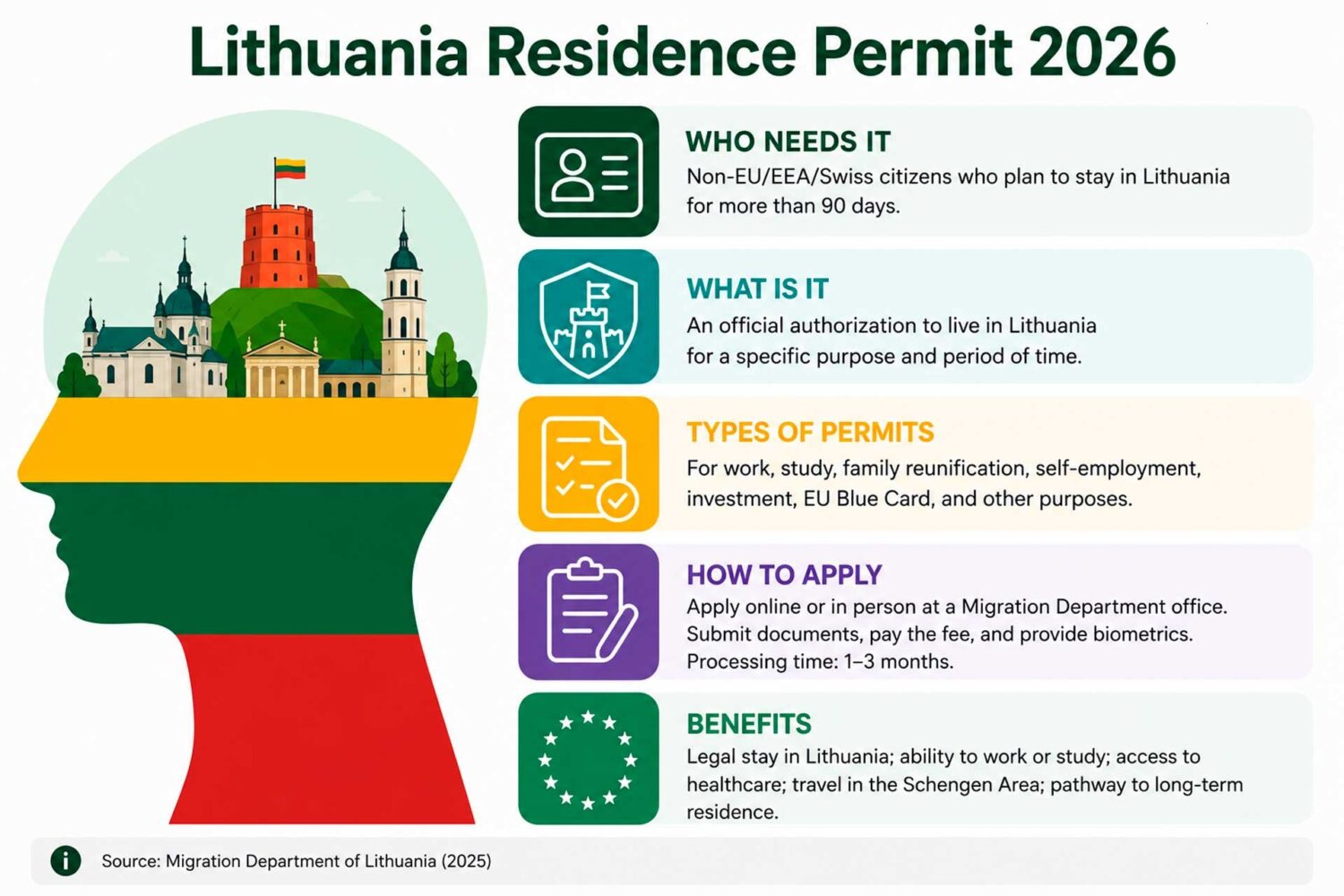
Lithuania Residence Permit comparison
Lithuania’s system works best when read as a ladder: temporary residence first, then permanent or EU long-term residence, then citizenship where eligible. The main practical divide is between routes tied tightly to one sponsor or purpose, and routes that give broader labor-market mobility and family rights.
| Route | Typical applicant | Common validity | Main work position | Key conditions or thresholds | Typical state fee and timing |
| Standard work TRP | Employee of a Lithuanian employer | Up to 2 years | Work is tied to the approved employer; employer change needs a separate approval process | Employer mediation letter; often labour-market-needs decision or work permit; applicant must show funds, accommodation, insurance, criminal-record history for the prior 2 years, and travel history | EUR 160 standard / EUR 320 urgent; many public-facing guides describe roughly 45–90 days end-to-end, while the EU portal still states up to 4 months / 2 months in that route page |
| EU Blue Card | Highly qualified worker | 3 years, or contract term plus 3 months if shorter | Broadly stronger than standard work route, with immediate family reunification and a more favorable long-term path | Salary formula usually 1.2x average gross wage for listed shortage/high-value-added occupations and 1.5x for other eligible occupations; higher-experience or degree-level qualification rules apply | EUR 160 / EUR 320; decisions shown as 1 month standard or 15 days expedited in the Blue Card page |
| Study TRP | Full-time student, doctoral student, traineeship cases | Usually 2 years or study period if shorter; doctoral up to 3 years in public-facing guidance | Usually up to 20 hours/week during studies; no cap for doctoral students in the cited EU page; 12-month post-study job-search/self-employment option | Admission/mediation letter from institution; funds, accommodation, insurance, criminal-record and travel-history documents | Study TRP document-processing fee can be EUR 80 in general order for admitted study/doctoral applicants; decision shown as up to 3 months or 45 days expedited in the EU student page |
| Family reunification TRP | Spouse/partner, children, some parents/dependants | Usually for sponsor’s permit duration; if sponsor is Lithuanian citizen or long-term resident, often 1 year then 2-year renewals | Family-route holders generally do not need a work permit and may change employer freely | Standard sponsors often need 2 years’ legal residence, 1 year permit validity, and prospects of permanent residence; Blue Card holders, researchers, innovators and some investors are exempt from the wait | General TRP fee schedule applies unless a specific exemption applies |
| Business / legal activity TRP | Company manager, board member, qualifying shareholder | Usually up to 2 years; larger-investor variants may get 3 years | Work is tied to the actual company/business basis, not a generic self-support route | Company active at least 6 months; at least EUR 28,000 own capital; at least EUR 14,000 invested by applicant; at least 3 full-time Lithuanian/permanent-resident employees; qualifying role such as manager or qualifying shareholder with at least 1/3 of authorised capital | EUR 160 / EUR 320 in the cited EU-linked material |
| Larger investor track | Foreign investor in state-relevant projects or qualifying enterprise shareholding | 3 years in the cited EU-linked material for EUR 260,000 / EUR 500,000 share variants | Not a passive “buy property and stay” program; tied to actual investment and employment conditions | Immediate family reunification is available in the cited EU-linked materials for EUR 260,000 and EUR 500,000 variants with employment conditions | General TRP fee schedule unless a specific route says otherwise |
| Permanent residence / EU long-term residence | Five-year residents or certain special categories | Card valid 5 years and renewable; status is long-term/permanent in substance | Free access to live and work without temporary-residence procedures; stronger healthcare/social position | Usually 5 years’ legal continuous residence, continuity tests, language and Constitution exam; some categories qualify earlier, including specific family/Lithuanian descent situations | EUR 160 / EUR 320 for issue; renewal EUR 45 / EUR 90 |
| Citizenship by naturalization | Long-term permanent resident integrated into Lithuania | Not a permit; end status | Full citizenship rights | Usually over 10 years permanent lawful residence, language/Constitution exam, legal means, no convictions, and typically no other citizenship; spouse of Lithuanian citizen may naturalize after 7 years in marriage and permanent lawful residence in Lithuania | Naturalization application fee shown as EUR 120 |
Route-by-route guidance
Work-based temporary residence
The ordinary employment route remains the core Lithuanian permit category for foreign nationals who already have, or are about to receive, a real Lithuanian job offer. The employer normally starts by registering the vacancy and then seeking either a work permit or a decision that the foreign worker meets Lithuanian labour-market needs. The Employment Service step is relatively fast on paper, but the full migration case is not: the EU portal still shows up to four months for a standard decision on this route, while practical public-facing migrant guidance often compresses the experience to roughly 45 to 90 days when the file is complete and logistics run smoothly. Applicants should therefore plan conservatively, especially when document legalization, police certificates, or translation are involved.
The main legal weakness of this route is sponsor dependence. The permit is issued for work with a particular employer, and the holder cannot simply switch jobs informally. A change of employer or employment conditions requires a separate Migration Department process, and unemployment can lead to withdrawal of the permit. This is one reason many highly qualified applicants prefer a Blue Card if they qualify.
A typical document stack includes passport, a legal-stay document if filing in Lithuania, the employer’s mediation letter, a work permit or labour-market-needs decision where required, proof of funds, accommodation, private insurance with at least EUR 6,000 coverage for the permit stage, criminal-record certificates covering the previous two years, and a list of trips/stays abroad. If the person first enters with, or relies on, a national D visa during the process, the health-insurance requirement shown for that visa stage is EUR 30,000.
EU Blue Card
The Lithuanian EU Blue Card is the strongest employment-based residence route. It is aimed at highly qualified workers, and the most useful way to read the salary rule is as a formula, not as a fixed euro amount. The official EU Blue Card page for Lithuania explains that the threshold is at least 1.2 times the average gross wage if the occupation is on the official shortage/high-value-added list, or at least 1.5 times the average gross wage for other eligible jobs. The same page also gives historical examples based on then-published average-wage data, but those examples are illustrative rather than permanently current because the wage base is updated on a rolling basis.
Compared with the standard work permit route, the Blue Card is materially better on four points. First, it is usually valid for three years. Second, the current EU Blue Card page shows a faster decision timetable than standard work-route materials. Third, it gives immediate family-reunification access. Fourth, it supports a more favorable long-term-residence calculation: the cited Lithuania page states that an EU Blue Card holder may obtain permanent resident status after five years of legal and continuous residence in the Union, provided at least two of those years were in Lithuania.
Blue Card applicants should still watch the fine print. The highly qualified worker materials note that if the applicant becomes unemployed for more than three consecutive months, or more than once during the validity period, the permit can be cancelled. That makes salary and employer quality just as important as initial eligibility.
Study residence
Lithuania’s study route is clearer – a student enrolled in a recognized higher education institution may use either a national D visa or a temporary residence permit depending on stage and study structure. The first-year students often use a national D visa and then move to residence permit status for later years. The residence permit decision period shown is up to three months, or forty-five days for an expedited process.
Students normally receive residence permission for two years or the full study period if shorter, and in the final year the permit is extended by an additional three months beyond the estimated end of studies. During studies they may usually work up to twenty hours per week, with doctoral students exempt from that cap. After graduation, they may seek a twelve-month permit for job search or self-employment. These are very significant practical rights and should appear prominently in any client-facing article.
Two extra points matter in practice. First, the document requirements are broad: institution mediation letter, funds, accommodation, insurance, police certificates, and travel history still apply. Second, master’s and doctoral students enjoy better family rules than ordinary temporary residents, according to the public migrant guidance reviewed.

Family reunification
Family reunification is one of Lithuania’s more generous routes once the threshold conditions are met. The key distinction is between ordinary sponsors and preferred-category sponsors. In ordinary cases, the sponsor usually must have lived legally in Lithuania for at least two years, hold a permit valid for at least one more year, and show reasonable prospects of acquiring permanent residence. But there are broad exceptions: Blue Card holders, certain researchers, ICT transferees, innovation/startup-type permit holders, and some investors can reunite immediately.
For the family member, this route is substantially more flexible than a standard employment permit. The EU portal states that a family-route holder does not need a work permit, may change employer without restriction, and may study without restriction. That makes it one of the best practical statuses for spouses and adult dependants who want labor-market freedom.
Document requirements typically include passport, proof of family relationship, proof that the sponsor category qualifies, sufficient funds, accommodation, and health insurance with EUR 6,000 cover for the permit stage; first-time cases can also require criminal-record evidence for the previous two years. If the sponsor is a Lithuanian citizen or long-term resident, the temporary residence permit is typically issued for one year and then renewed for two years.
Business, startup, and investor routes
Lithuania does have genuine business-related residence options. The ordinary legal-activity route shown in the EU-linked materials is not satisfied merely by having a registered legal entity. The company normally must have been conducting activity for at least six months, employ at least three full-time Lithuanian or permanent-resident workers, and show own capital of at least EUR 28,000, of which at least EUR 14,000 must be the applicant’s funds or other assets invested. The applicant must also hold a qualifying corporate role, such as manager, supervisory-body member, transaction-authorized participant, or qualifying shareholder holding at least one-third of authorized capital.
This route is therefore real, but it is not a “buy any shelf company and qualify” route. It expects operating business substance. Public migrant guidance also summarizes the same direction more simply: if the company has been lawfully active for more than six months, a two-year renewable permit may be available.
The investor layer is more favorable. The EU-linked material shows that where the applicant’s enterprise share reaches at least EUR 260,000 or EUR 500,000 and the enterprise employs Lithuanian citizens or permanent residents, the permit is issued and renewed for three years, and immediate family reunification is possible. Some official/public-facing materials also refer to investors “directly involved in projects of importance to Lithuania” as enjoying immediate family reunification.
Lithuania’s government-backed startup ecosystem also continues to present a Startup Visa entry route for innovative non-EU founders. That is useful context for article drafting, but the migration-law safest wording is still that startup founders should verify the current MIGRIS route and innovation-evaluation mechanics before filing, because the official migration pages reviewed here do not consolidate every startup-specific evidentiary detail in one English page.
Remote work and digital nomads
The official English migration materials reviewed here do not present a clear standalone Lithuanian digital-nomad permit. The evidence points the other way: the standard work route assumes a Lithuanian employer, the self-employed route is limited to narrow categories such as sportspeople, performers, accredited journalists, lecturers/researchers in specific contexts and certain religious-community cases, while e-residency is explicitly framed for non-residents without a Lithuanian residence permit who want online access and an e-signature.
The practical conclusion is that a remote worker paid by a foreign employer should not assume Lithuania has a Baltic-style digital nomad route equivalent to Estonia or some Southern European schemes. The viable Lithuanian options usually involve a different legal basis: being hired by a Lithuanian employer, qualifying for a Blue Card, creating a genuine startup/business basis, relying on family status, or studying. This conclusion is a legal inference from the official framework reviewed, not a quote from a single state page.
Ready to Obtain a Lithuania Residence Permit in 2026? Leave a request for a consultation, and our immigration specialists will assess your eligibility, recommend the most suitable residence permit pathway, and guide you through every step of the application process — from document preparation to approval.

Permanent residence, EU long-term resident status, and citizenship
For most migrants, permanent or EU long-term residence becomes relevant after five years of continuous legal stay. The Lithuanian migrant guidance states that permanent residence can follow five years with a temporary residence permit, or in some cases five years in an EU country with at least two uninterrupted years in Lithuania. It also states that absences matter: trips outside Lithuania should not exceed six months at a time or ten months in total across the five-year period. Language and Constitution testing are commonly required.
Permanent residence makes a major practical difference. It allows living and working in Lithuania without the extra procedures imposed on temporary residents, gives access to compulsory health insurance, helps with family migration, and places the holder much closer to Lithuanian citizens in social-benefit treatment. The card itself is valid for five years and renewable, although the status can be lost if the person moves out too long, including more than twelve months in a non-EU country or more than six years in another EU member state, according to the reviewed public guidance.
Citizenship by naturalization is a later step, not an automatic continuation of residence. The naturalization materials state that the general rule is more than ten years of lawful permanent residence in Lithuania, plus a legal source of livelihood, Lithuanian-language and Constitution exams, no disqualifying convictions, and typically no other citizenship. For a spouse of a Lithuanian citizen, the period can be reduced to seven years of permanent lawful residence in marriage in Lithuania.
At EU level, long-term resident status is designed for legally resident non-EU nationals after at least five years and is intended to bring a more uniform set of rights, closer to those enjoyed by EU citizens. In other words, the Lithuanian five-year permanent-residence framework does not stand alone; it sits within a wider EU long-term-residence architecture.
Application mechanics, documents, fees, and timelines
The system is now heavily digital at the front end. MIGRIS is the central portal for filing or managing residence-permit applications, and even where an in-person visit is required for biometrics, the digital record is central to the case. Applicants collecting a Lithuanian permit can often declare residence simultaneously at the Migration Department, and otherwise they usually need to declare it within one month after receiving the permit.
Across categories, the recurring documents are strikingly similar: passport, application, proof of legal stay if filing inside Lithuania, route-specific mediation/support letter, proof of accommodation, proof of funds, health insurance, criminal-record material for the previous two years in first-time cases, and a list of foreign trips/stays. The permit-stage insurance figure repeatedly shown in the reviewed sources is EUR 6,000; the national D-visa stage repeatedly shows EUR 30,000. In 2026, the general monthly self-support baseline used in practice is tied to Lithuania’s minimum wage of EUR 1,153, with half that baseline for minors and some science/minor scenarios.

Step-by-step application checklist
| Category | Before filing | At filing | After filing | After approval |
| Work TRP | Employer registers vacancy; employer seeks work permit or labour-market-needs decision if required; applicant gathers passport, police certificates, accommodation, funds, insurance | Submit through MIGRIS / authorized channel with employer mediation letter and route documents | Provide biometrics; monitor MIGRIS; if needed, obtain short bridging national D visa valid up to 5 months while case is pending | Collect card; declare residence; notify Migration Department within 7 days of core data changes |
| EU Blue Card | Confirm job qualifies; check latest wage multiplier; prepare degree/experience evidence and contract of at least 6 months | File Blue Card application with employer-backed documentation | Biometrics; track case; standard decision shown as 1 month, expedited 15 days | Collect card; declare residence; bring family immediately if desired |
| Study TRP | Secure admission; obtain institution mediation letter; prepare finance, accommodation and insurance papers | File D visa or TRP, depending on stage and route | Biometrics; track case; some students use a D visa first and TRP later | Collect card; declare residence; work within allowed limits; consider post-study 12-month permit near graduation |
| Family TRP | Verify sponsor category and whether the 2-year wait applies or an exception exists | File with relationship proof, sponsor documents, funds, accommodation and insurance | Biometrics; track case; in some situations a D visa can bridge the stay | Collect card; declare residence; work permit not required after grant |
| Business / legal activity TRP | Make company operational; reach 6-month activity rule; meet capital, role and employee-count rules; gather company registry evidence | File through MIGRIS/authorized channel with company documentation and personal documents | Biometrics; monitor case; national D visa may bridge in some scenarios | Collect card; declare residence; renew only if the business remains genuine and compliant |
| Permanent residence | Count continuity carefully; check absence limits; pass language/Constitution exams if applicable | File in MIGRIS with evidence of 5-year route or special-category eligibility | Schedule biometrics within 4 months of e-filing; track decision in MIGRIS | Collect card; keep absence limits in mind to avoid loss of status |
| Citizenship | Confirm 10-year or 7-year spouse path; gather permanent-residence proof, language/Constitution exam evidence, income proof | Apply in Lithuanian with full supporting file | Follow the citizenship procedure and oath steps as instructed by authorities | After grant, complete oath and citizenship document formalities |
Typical fee and timing benchmarks
| Item | Benchmark |
| Standard temporary residence permit fee | EUR 160 general / EUR 320 urgent |
| Study-route TRP processing fee for admitted study or doctoral applicants | EUR 80 in general order |
| TRP card personalization / replacement | EUR 45 general / EUR 90 urgent |
| Permanent residence issue | EUR 160 general / EUR 320 urgent |
| Permanent residence renewal | EUR 45 general / EUR 90 urgent |
| Change of employer or job function | EUR 100 |
| E-resident card | EUR 90 state fee plus EUR 80 external-service fee |
| External service provider fee for many TRP filings abroad | Public migrant guidance gives a range of roughly EUR 30–120 depending on country |
Short numeric examples
A standard employee hired by a Lithuanian manufacturer in Kaunas may face a three-part sequence: job-offer acceptance, vacancy registration and labour-market-needs step, then MIGRIS filing with proof of accommodation, funds, insurance, police certificates and travel history. Even if the Employment Service decision arrives in about seven working days, the migration decision can still take months under the route page, which is why employers should not promise a start date based only on the labour-market step.
A Blue Card applicant in an official shortage occupation can use the 1.2x multiplier. The official Blue Card page gives a worked historical illustration based on an average gross wage of EUR 2,110: about EUR 2,532 monthly for listed high-value-added shortage occupations and about EUR 3,165 for other occupations. That is useful as an example, but the page itself also says the threshold is updated regularly, so lawyers should cite the formula first and the euro example second.
A founder seeking the ordinary company-management permit can think in minimums: at least six months of actual business activity, EUR 28,000 company own capital, at least EUR 14,000 invested by the applicant, and at least three full-time Lithuanian/permanent-resident employees, plus a qualifying corporate role. By contrast, a larger investor with a qualifying EUR 260,000 or EUR 500,000 share can move into the more favorable three-year/immediate-family territory described in the EU-linked material.
Rights, restrictions, tax, healthcare, and social security
Rights in Lithuania depend heavily on the underlying permit basis:
- A family-route permit is one of the most flexible because it allows work without a separate work permit and lets the holder change employer freely.
- A standard work permit is much narrower because it is tied to a specific employer, and job loss can trigger loss of status.
- Blue Card holders occupy a middle-to-strong position: they have immediate family rights and a strong long-term-residence path, but prolonged unemployment can still cancel the permit.
On travel, the permit obviously authorizes residence in Lithuania only through its stated validity. Holders should still monitor Schengen rules separately. The European Commission’s short-stay calculator explains that if a person holds an EU residence permit or long-stay visa, the normal 90/180 short-stay rule does not apply to the time authorized by that permit in the issuing state. Related EU material also confirms that persons entering Lithuania with a visa or residence permit issued by another Schengen state may stay in Lithuania for up to 90 days in any 180-day period. In practice, a Lithuanian permit supports residence in Lithuania and short-stay Schengen mobility, but it is not a blank check for settlement in another member state.
Healthcare is partly residence-based and partly insurance-contribution-based. Lithuania’s public compulsory health insurance system covers permanent residents, temporary residents who work in Lithuania, certain self-employed persons, some registered unemployed persons, and several protected categories. A permanent resident joins the public system from the date the permit becomes valid, while a temporary resident working for a Lithuanian employer is normally enrolled through payroll contributions. Third-country nationals with a D visa are not automatically covered by public insurance, and non-EU students are generally not state-covered unless another eligibility basis applies. That makes private insurance and timing of employment commencement extremely important in the first months after arrival.
Public health-insurance contributions also carry a compliance risk. The National Health Insurance Fund states that participation is linked to resident status and ongoing contributions, and the migrant guidance warns that undeclared departure can create public health-insurance debt. For self-insured persons, the cited 2026 minimum monthly PSD contribution shown in migrant guidance is EUR 80.48.
Social-benefit access is not uniform across permit categories. Permanent residents are in the strongest position and are described in migrant guidance as being eligible for state benefits on conditions similar to Lithuanian citizens. Some benefits for foreigners, such as child-benefit access, are specifically tied to permanent residence, EU/EFTA residence plus minimum stay, or international-protection status. Foreign insurance periods can matter for unemployment and pension coordination, but eligibility remains status- and contribution-specific.
Tax residence should be analyzed separately from immigration status. The reviewed tax summary states that a person can become Lithuanian tax resident because Lithuania is the permanent home, because personal/social/economic interests are centered there, by spending 183 or more days in a tax year, or under the two-year 280/90 test. Once Lithuanian tax residence applies, migrant guidance states that annual income earned both in Lithuania and abroad is generally reported in the annual declaration, usually filed via VMI’s EDS system by May 2 of the following year. In other words, obtaining a Lithuanian residence permit does not automatically settle tax residence, but long stays often move in that direction.
Start Your Lithuania Immigration Journey With Confidence. Leave a request for a consultation, and let our experienced immigration lawyers help you secure your Lithuanian residence permit as efficiently as possible.
Leave your contacts to have an expert contact you shortly.
Pitfalls, refusals, appeals, and recent changes through 2026
The most common legal mistakes in Lithuanian cases are practical rather than dramatic: choosing the wrong route, filing too late, assuming a national D visa and a residence permit are interchangeable, underestimating document formalities, and ignoring residence-declaration duties after approval. The public guidance is explicit that filing an application alone does not create a right to remain, that an expired permit makes the stay unlawful unless another valid stay basis remains, and that residence must be declared after collection.
Timing mistakes are especially expensive. Temporary-residence renewals generally need to be filed in advance, commonly at least two months before expiry, and replacement or status-change filings have their own earlier filing windows. Standard work and self-employed pages also warn that if the old status expires before renewal or replacement is properly started, the applicant may have to leave Lithuania and wait abroad.
Appeals do exist, but they do not always preserve the practical value of the permit. The Migration Department’s guidance says the residence permit becomes invalid after the fourteen-day appeal period expires, and the 2024 change means certain cancellation appeals no longer automatically keep the permit alive. Separate official materials say migration decisions can be challenged before the District Administrative Court within fourteen days and further before the Supreme Administrative Court. For client advice, the key point is that appealing may protect legal arguments while still failing to preserve day-to-day residence/work security unless another lawful basis exists.
Several important changes since 2024 deserve explicit:
- First, as of July 1, 2024, Lithuania tightened employment rules so that many foreigners who had previously relied on visa-free stay, Schengen stay, or other looser arrangements could no longer work in Lithuania without obtaining a Lithuanian temporary residence permit, subject to limited exceptions.
- Second, Lithuania tightened who may file through external service providers in third countries, including route-specific restrictions in places such as India and certain other countries.
- Third, by late 2025 the Migration Department had updated the country list again and moved appointment booking for external service providers into MIGRIS.
Lithuania offers multiple residence permit pathways, each designed for a specific purpose, from employment and studies to family reunification, business, and investment. Choosing the right route from the outset is essential, as eligibility criteria, processing times, and long-term benefits vary significantly. Careful preparation of your application and supporting documents can help avoid delays and improve your chances of approval.
Need help obtaining a Lithuanian residence permit? Our immigration specialists can assess your eligibility, recommend the most suitable residence route, prepare your application, and guide you through every stage of the process. Contact us today for a personalized consultation and start your move to Lithuania with confidence.
Leave a Comment

We have prepared answers to the most common questions about Lithuanian residence permit. If you want to clarify anything, please contact us - we will provide detailed explanations.
Processing times depend on the permit category. Standard applications typically take between one and four months, while expedited procedures are available for certain routes.
Yes, although work rights depend on your permit type. Employment permits are usually tied to a specific employer, while family reunification permits generally allow unrestricted access to the Lithuanian labor market.
Yes. Most residence permit categories allow family reunification, although eligibility and waiting periods vary depending on the sponsor's immigration status.
In most cases, you may apply for permanent residence after five years of continuous legal residence, provided you meet language, integration, and other statutory requirements.
Currently, Lithuania does not have a standalone digital nomad residence permit. Remote workers generally need to qualify through another legal basis, such as employment, business, study, or family reunification.


Comments
No comments found.