

 EU Citizenship
 Slovenian Citizenship
 Romanian Citizenship
 Bulgarian Citizenship
 Austrian citizenship (investments)
 Spanish Citizenship
 Italian Citizenship
 Cypriot Citizenship
 Lithuanian Citizenship
 Portuguese Citizenship
 French Citizenship
 German Citizenship
 Hungarian Citizenship
 Dutch Citizenship
 Belgian Citizenship
 Croatian citizenship


How to obtain Austria Residence Permit in 2026

Author: Leon Scott
Published: 02.03.2026
Updated: 02.03.2026
Austria is an attractive destination for international students, skilled professionals, retirees, and families alike. If you plan to stay in Austria longer than six months, you’ll need a residence permit. This comprehensive 2026 guide explains the types of Austrian residence permits, the requirements to qualify, application costs, and a step-by-step application process. We’ll also answer common questions and provide official resources. Whether you’re seeking work opportunities in Vienna’s booming tech scene or joining family in the Alps, this guide will help you navigate Austria’s residence permits in a clear, friendly manner.
Understanding Austria’s Residence Permits
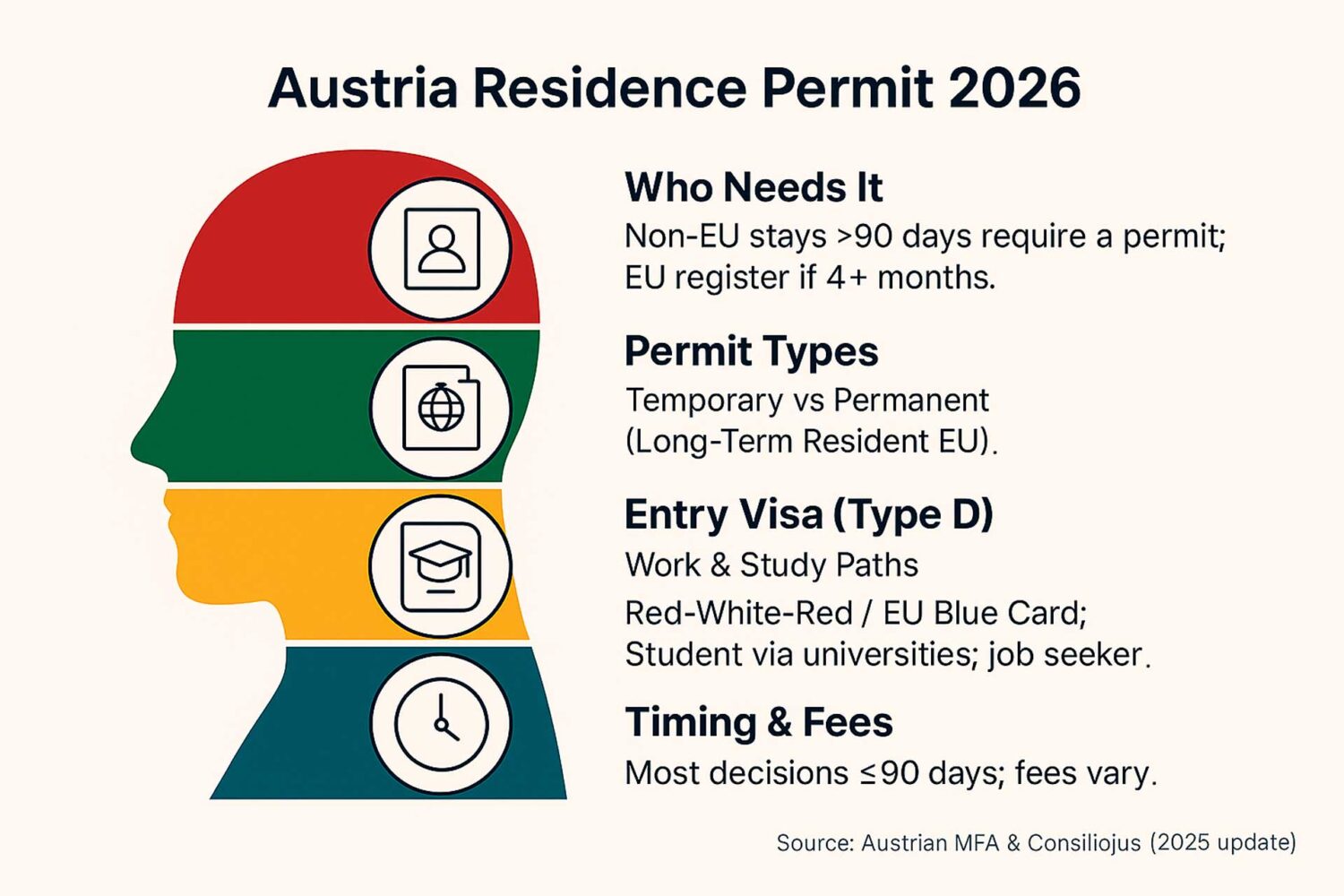
What is a residence permit in Austria? An Austrian residence permit (Aufenthaltstitel) is an official card that allows a non-EU/EEA national to live in Austria for more than six months. (Stays up to 6 months use visas or visa-free entry.) Residence permits are issued for a specific purpose (work, study, family reunification, etc.) and typically have a limited validity (1 or 2 years for temporary permits, with options to renew). They are plastic ID cards separate from your passport. EU/EEA citizens do not need a residence permit due to free movement rights; however, if an EU citizen stays over 3 months, they must register and obtain a “confirmation of registration” instead. In short, for most non-EU immigrants, a residence permit is the key to legally residing in Austria long-term.
Residence Permit vs. Visa: It’s important to distinguish a visa from a residence permit. A visa (e.g. Schengen Visa or national Visa D) is typically for short stays (up to 90 days or up to 6 months) and may be needed to enter Austria. A residence permit, on the other hand, lets you live in Austria beyond 6 months and is often applied for after or alongside an entry visa. In many cases, first-time residence permit applicants must apply from abroad at an Austrian embassy/consulate, then enter Austria once approved. If you’re visa-exempt for entry or already legally in Austria, you may apply directly at the local immigration office in Austria. We will detail this process later.
Types of Austria Residence Permits in 2026
What are the types of Austrian residence permits? Austria offers a range of residence permits tailored to different purposes of stay. The main categories include work-based permits for employment (notably the Red-White-Red Card and EU Blue Card), family reunification permits for joining a family member, study and research permits for students and academics, and special settlement permits for individuals with independent means or retirees. Each permit type has specific eligibility criteria and benefits. Below is an overview of key Austrian residence permit types and their features:
| Permit Type | Purpose & Eligibility | Work Rights | Validity | Key Requirements |
| Red-White-Red Card | Work permit for skilled non-EU workers (criteria-based). Several sub-categories: e.g. Very Highly Qualified, Skilled in Shortage Occupations, Other Key Workers, Graduates, Start-Up Founders. Requires a job offer (except some highly qualified job-seekers). | Tied to specific employer (employment only with the sponsoring employer). After 2 years, can upgrade to RWR Card Plus for free access to job market. | Up to 24 months (2 years) initially. Renewable; after ~2 years of employment, eligible for RWR Card Plus (3-year permit with full work access). | Points-based eligibility (minimum points score varies by category). Job offer matching qualifications. Minimum salary in some categories (e.g. “Other Key Workers” need at least €3,465 gross/month in 2026). Plus general requirements (adequate funds, insurance, etc.). |
| EU Blue Card | Work permit for highly-skilled non-EU professionals with a higher education degree and a high-paying job offer in Austria. Aimed at jobs requiring university qualifications. | Tied to specific employer (similar to RWR Card; can change jobs if new job also meets criteria). Family can get RWR Card Plus. | Up to 24 months (2 years) initially. Renewable; after 2 years can convert to RWR Card Plus with unrestricted work rights. | University degree (3+ year program) or equivalent experience. Binding job offer for ≥6 months in relevant field. High salary threshold (at least the average gross annual income – in 2026 this is €55,678/year). Labor market test (no equally qualified Austrian/EU candidate available). |
| Residence Permit – Student | Temporary residence for non-EU students enrolled in an Austrian university or college program. Also covers school pupils in some cases. | Limited work allowed (e.g. part-time up to 20 hours/week with a work permit). Not for full-time employment. | Typically 1 year (or match academic year) renewable annually until completion of studies. | Proof of admission to an accredited institution. Sufficient financial means for living expenses (students need approx. €600–€1200/month depending on age/status, per official rates). Health insurance coverage (student insurance or private). Accommodation in Austria. Basic German or English skills might be needed for admission. |
| Family Reunification | Permits for family members of Austrian residents or citizens. Spouses, registered partners, and minor children are eligible to join their family in Austria. Specific permit depends on sponsor’s status (see below). | Work access varies: Most family reunion visas for third-country nationals result in a “Red-White-Red Card Plus” for the family member, which grants full employment rights in Austria. (If joining an Austrian citizen, a “Family Member” permit also grants unrestricted work.) | 12 months for initial card (commonly); renewable. After 2 years continuous residence, can often get a 3-year RWR Card Plus. | Sponsor in Austria with valid residence/citizenship, sufficient income, housing, and insurance to support the family. Basic German A1 certificate required for spouses in many cases (exemptions if sponsor is e.g. Blue Card holder). Marriage or birth certificates to prove family ties. |
| Settlement Permit (Gainful Employment Excepted) | Quota-based permit for financially independent persons (retirees or those living on savings/income from abroad) who wish to reside in Austria without working. Often called the “no work” residence permit. | No work allowed (neither employed nor self-employed). Strictly for residence and leisure. | 12 months initially; renewable annually. After 5 years continuous residence, holder can apply for permanent residence (long-term EU permit) if integration requirements met. | Significant financial means – at least double the normal income requirement (e.g. ~€2,600+ per month for a single in 2025). Must have comprehensive health insurance and accommodation. Annual quotas apply (limited number of slots per province each year, first-come first-served early in the year). No employment in Austria permitted. |
| Long-Term Residence (Permanent Residence – EU) | Permanent resident status after 5+ years of legal residence. Allows indefinite stay in Austria and limited mobility in EU. | Unlimited work access (equivalent to a citizen in labor market). | 5 years per card (automatically renewable every 5 years). Status is permanent as long as residency conditions maintained. | 5 years continuous legal residence in Austria (with temporary permits). Compliance with Integration Agreement Module 2 (usually German at A2/B1 level and basic civic knowledge). Stable income, no serious criminal record. This results in a “Daueraufenthalt EU” permit. (Citizenship is a separate process, usually after 10 years.) |
Other Permit Types: Austria’s immigration system has some additional specific permits. For example, “Settlement Permit – Researcher” for scientific researchers, “Residence Permit – Researcher-Mobility” for researchers moving within the EU, “Residence Permit – Special Cases of Gainful Employment” for certain categories like volunteers or missionaries, and “ICT Permit” for intra-company transfers. These are more niche but important if you fall into those categories. There are also “Job-Seeker Visas” for very highly qualified workers – a 6-month visa to hunt for a job in Austria, which can lead to a Red-White-Red Card.
2025/2026 Updates – New Permits: Notably, in December 2025 Austria introduced a new “Residence Permit – Cross-Border Commuter” for non-EU nationals living in neighboring EU countries who work in Austria’s border regions. This frontier worker permit lets someone reside in, say, Slovakia or Hungary, and commute to work in an adjacent Austrian district, for up to two years at a time. It fills a gap for third-country nationals who previously had to juggle Schengen visas for cross-border work. Additionally, Austria is moving towards digitalizing the Red-White-Red Card process in 2026 to speed up approvals – aiming for 8-week processing times instead of the previous 3–6 months. We’ll discuss processing times further below.

General Requirements for an Austrian Residence Permit
What are the requirements to get a residence permit in Austria? While each permit type has specific criteria, there are general baseline requirements that all applicants must meet. Austria wants to ensure that foreign residents can support themselves, are covered by insurance, have suitable housing, and integrate without burdening the state. Here are the key requirements:
- Sufficient Financial Means: You must prove “adequate means of subsistence” – a stable, regular income or savings above Austria’s minimum thresholds so you can live without welfare assistance. As of 2026, a single applicant needs at least €1,308.93 per month available after rent; a married couple needs €2,064.12 per month, plus about €201.88 extra for each child. These figures are based on the Austrian equalization supplement reference rates (Ausgleichszulagenrichtsatz). Evidence can include payslips, an employment contract, scholarship, pension, or sufficient savings. (Note: Applicants for “no-employment” settlement permits must show double these amounts in income, since they won’t be working.)
- Health Insurance Coverage: You are required to have health insurance that is valid in Austria and covers all necessary medical costs. For employed workers, enrollment in Austria’s public health insurance (which happens automatically with a job) is sufficient. Students might get student insurance or travel health insurance initially. If you’re not immediately covered by a public scheme, you’ll need private insurance that meets Austrian standards until you are. Proof of insurance (policy documents or coverage letters) must be submitted with the application.
- Adequate Accommodation: You must show evidence of a legal place to live in Austria – “locally customary accommodation” for you (and any family joining). This could be a rental lease, property deed, or an official sublease agreement. The housing must be considered sufficient by local standards (e.g. having its own facilities) and not overcrowded. Typically, a studio or room is acceptable for a single person, while a family needs a larger apartment. You’ll provide a Meldezettel (registration form, discussed later) or lease as proof. (Certain permit types like RWR Card or Student may not require showing housing upfront, but in practice you should still have an address for registration.)
- Basic Language Skills (for some permits): Austria has an integration policy requiring basic German knowledge for certain immigrants, particularly family members. For example, a spouse coming under family reunification usually must provide a German A1 certificate (basic level) from an approved language test before entry. There are exemptions (if the sponsor has a high-skilled permit or the family member is a minor, etc.). Other permit categories (students, workers) do not require German at the application stage, though knowing German or English can improve your points for an RWR Card. Long-term residents (after 5 years) need A2 or higher German as part of integration requirements. It’s wise to start learning German for easier integration, but initial requirements depend on the permit type.
- Clean Criminal Record & No Security Threat: You should not pose a threat to public order or security in Austria. As part of the process, you’ll usually need to submit a recent police clearance certificate (criminal record report) from your home country (and any country you lived in recently). Serious criminal convictions can lead to denial. Minor infractions may be overlooked, but full honesty is required. Austrian authorities also check that your stay won’t “affect Austria’s relations with other countries” (this mainly refers to not being involved in terrorism or such). Essentially, law-abiding applicants will meet this requirement with the proper police records provided.
- Valid Passport: You must have a valid travel document (passport) that won’t expire immediately. The permit can’t be issued beyond your passport’s validity, so ensure your passport has several years before expiration. Include copies of your passport data page and all visas.
- Passport Photos: A recent passport-sized photo (45x35mm) meeting EU standards is required for the application and the residence card. Often one photo is needed (not older than 6 months, neutral expression, etc.).
- Other documents: Depending on your purpose, additional documents will be needed, such as: Job offer / work contract and an employer’s declaration (for work permits). University acceptance letter or proof of enrollment (for students). Marriage certificate or birth certificates (for family permits). Proof of qualifications (degrees, diplomas for skilled workers). Proof of language proficiency (if required for points or integration). Some authorities may ask for a housing inspection report or proof of adequate housing size.
Translations and legalizations: Any document not in German (or sometimes English) must be accompanied by an official translation into German. Foreign civil documents (birth, marriage certificates, etc.) often need an apostille or diplomatic legalization to be accepted. Plan for these extra steps as they can take time.
Note: Always check the latest document checklists for your specific permit. Austrian authorities (like MA 35 in Vienna or the Bezirkshauptmannschaft in other regions) often provide checklists. A common requirement, for example, is the Integration Agreement – within two years of arrival, some permit holders must complete an integration course/test (basic German and society knowledge). However, initial issuance isn’t usually tied to completing it, except showing the A1 certificate where required.
By ensuring you meet these general conditions – enough money, insurance, housing, clean record, etc. – you set a strong foundation for a successful application. If you have further questions or need personalized assistance, consider reaching out to our immigration professional or the Austrian embassy/consulate in your area. Next, we’ll walk through how to apply step by step.

Austria Residence Permit Application Process (Step-by-Step)
How do I apply for a residence permit in Austria? The application process can be complex, but breaking it down into steps makes it manageable. In general, you must apply in advance of your move. First-timers usually submit their application from abroad, and if approved, travel to Austria to collect the permit. Here’s a step-by-step guide.
Determine the Right Permit Type
Identify which residence permit fits your situation and purpose. Are you going for a job in Austria (work permit like Red-White-Red Card or EU Blue Card)? Studying for a degree (Student residence permit)? Joining a spouse (Family reunification)? Assess your eligibility for the various categories. For work permits, use Austria’s points calculator if applicable to see if you qualify for a Red-White-Red Card category. Choosing the correct category is crucial, as your application must match a specific purpose. If in doubt, consult official resources or an immigration advisor to pinpoint the right permit.
Gather Required Documents
Once your permit type is clear, assemble all necessary documents in advance. This typically includes:
- Application form: Complete the official application form for your permit (available from Austrian embassy websites or migration.gv.at).
- Passport: Valid and copies of any relevant pages.
- Passport photo: One (or more) biometric photo(s) per specifications.
- Proof of purpose: For workers: your employment contract or a binding job offer, and an Employer’s Declaration form completed by your employer (required for RWR Card and Blue Card). For students: university acceptance letter (and payment confirmation of any tuition or entrance exam proof). For family: marriage certificate for spouses or birth certificates for children; plus a copy of the sponsor’s residence permit or Austrian passport. For self-sufficient: proof of pension or income, investment statements, etc.
- Financial proofs: Recent bank statements, payslips, scholarship letters, or income statements showing you meet the monthly income requirement (e.g. >= €1,308.93 for singles). If a family is applying together, show combined resources for everyone.
- Health insurance: A certificate or policy document from your insurer. If your Austrian employer will enroll you in public insurance upon start, a letter or the employer declaration may note that; otherwise provide private coverage for interim.
- Accommodation: Rental contract (Mietvertrag) or home ownership proof in Austria. If staying with someone, a housing affidavit or permission letter plus their lease/ownership proof. Many applications require a Meldezettel after arrival, but initially a lease is ideal.
- Language certificate: If applicable (e.g. ÖSD or Goethe A1 certificate for spouses, or any language certificates you want to claim points for under RWR system).
- Police clearance: Recent criminal record check from your country (and any country you lived 6+ months in recently). This often must be translated and apostilled. Ideally issued within 3 months of application.
- Other specifics: Some categories need special documents (e.g. researchers need a hosting agreement; start-up founders need a business plan and funding proof; artists might need portfolios).
- Copies and translations: Make copies of every document and have certified German or English translations for any non-English documents. Keep originals ready for verification. Ensure all civil documents have an apostille or legalization if required by Austria’s agreements.
It’s wise to double-check the official checklist for your permit type on the Austrian embassy website or migration.gv.at, since requirements can update. Compiling a complete dossier before submission will save time and avoid back-and-forth requests for more papers.

Submit the Application (Location & Timing)
Where and how you submit your residence permit application depends on your circumstances:
- Applying from Abroad: In most cases, first-time applicants must apply in their home country (or current country of residence) at the Austrian embassy or consulate. You’ll need to book an appointment, submit your documents, and provide biometrics (fingerprints) if required. The embassy forwards your application to the authorities in Austria for processing. This is mandatory if you require an entry visa to Austria. Do not move to Austria and overstay a visa-free period expecting to apply later – that can lead to rejection.
- Visa-Free Entry Applicants: If you are from a country that allows you to enter Austria without a visa (e.g. USA, Canada, UK, etc. for short stays), you have the option to apply in Austria during your visa-free stay. This can be practical because you submit directly to the local residence authority (Bezirkshauptmannschaft or Magistrat) and remain in Austria while it’s processed. Important: You must have enough visa-free days left (typically 90) and apply early in your stay. While the application is in process, you cannot overstay your allowed days unless you obtain a specific “confirmed application” status (Notvignette). Many prefer applying via embassy to avoid these complications, but both routes are possible.
- Employer-Sponsored Submission: For work permits like the Red-White-Red Card or EU Blue Card, your employer in Austria can submit the application on your behalf directly to the Austrian authorities. This is often done to speed up processing. The employer files your paperwork with the regional immigration office (with your signed authorization). If approved, you then go to the embassy to pick up a visa to enter and collect the permit. Coordinate closely with your employer if you choose this route.
- Application Timing: Apply as early as possible. Austria allows applications to be filed up to 3 months before your intended start date (and in practice even earlier for some categories). Keep in mind that some permits (like family reunification under quotas or self-sufficiency permits) may only accept applications at certain times due to quotas. For example, quota-based permits often open in January each year and fill up quickly. Plan ahead to secure an appointment and prepare documents well in advance.
Pay the Application Fee
When submitting your application, you must pay the residence permit processing fee. As of 2026, Austria charges a single upfront fee of €218 for most residence permit applications (this covers the handling and the issuance of the card if approved). For a Permanent Residence – EU application, the fee is higher (€275). If applying via embassy, you’ll pay in the local currency equivalent (embassy websites list the fee, often around USD 160–180 or similar). Keep the receipt as proof. Note: This fee is non-refundable, even if your permit is denied or you withdraw. Additional small fees might be charged separately for things like police clearance certification or the “emergency quota” sticker if you apply last-minute for an extension. In North America, a separate $35 fingerprinting fee is sometimes noted. Always check the latest fee schedule.
Await Processing
Once lodged, your application will be processed in Austria. The local immigration authority and in many cases the Public Employment Service (AMS) (for work permits) will review it. Processing times can vary widely. Historically, it could take 1 to 3 months (or more) to get a decision, especially for work permits that require a labor market test. However, Austria is overhauling its system: a fully digital application portal in 2026 is expected to standardize processing to about 8 weeks (two months) for work permits. Some permits might be faster – the AMS has indicated Blue Card or RWR Card decisions often come within 4–8 weeks if everything is in order.
During the wait, the authority may contact you (or your employer) for any missing documents or clarifications. Make sure to respond promptly to any “Nachforderung” (additional document request) to avoid delays. You can check on your application status via your employer or by contacting the authority (or embassy). Tip: If you applied at an embassy, resist moving to Austria until you have an answer – you generally need to wait for the visa/approval from abroad unless you applied visa-free in-country.
Leave your contacts to have an expert contact you shortly.
Receive a Decision
The outcome will be communicated to you or the submitting party:
- Approval: Congratulations! If you applied through an embassy, they will issue you a D visa (entry visa) or ask you to come in and collect your residence permit card (some embassies receive the card and give it to you directly, or more commonly, they issue a visa to enter Austria and pick up the card at the immigration office). The D visa is usually a sticker in your passport allowing a single entry into Austria for the purpose of collecting your permit. If you applied in Austria, you will get a notification (Bescheid) and can pick up the residence permit in person at the immigration office. You’ll need to bring your passport for identification. The card you receive will list the type of permit and its validity dates.
- Rejection: If the application is denied, you’ll receive a written decision with reasons. Common reasons include not meeting financial requirements, insufficient documentation, or the AMS finding an issue (like not enough points for RWR, or a qualified person available locally for the job). You have the right to appeal a refusal or correct the issues and reapply. If you’re outside Austria, do not attempt to enter long-term without sorting this out. It’s often wise to consult a legal expert if you wish to appeal.
Register Your Residence (Meldezettel)
After arriving in Austria and securing housing, there’s an extra mandatory step: residence registration. Within 3 working days of moving into an address, every resident (Austrian or foreign) must register their address with the local authorities by filling out a Meldezettel form. You submit this at the city or municipal Meldeamt (often in the town hall or Magistrat). The Meldezettel must be signed by you and your landlord. Once processed, you receive a Meldebestätigung (registration confirmation). Why? Austria uses this system to keep track of residents. The Meldezettel certificate is crucial – you’ll need it to open bank accounts, get a mobile phone, obtain a driver’s license, etc.. Failing to register (or doing it late) can result in a fine, although a few days delay is usually tolerated. Likewise, when you move out, you must deregister. Keep your Meldezettel documents safe; they are often asked for in bureaucratic processes.
Integration Steps & Next Permits
Once you have your residence permit and are settled, be mindful of any integration requirements tied to your permit. For example, many family migrants will need to enroll in German courses to fulfill the Integration Agreement within 2 years. There may be classes subsidized by the Austrian Integration Fund (ÖIF). Also, note the validity of your permit and mark the calendar to apply for renewal about 3 months before it expires. Renewals (extensions) are done in Austria at the immigration office; you’ll need to show continued eligibility (income, insurance, etc.) but you usually don’t need to leave the country.
After 2 years on many temporary permits, you can transition to a Red-White-Red Card Plus (if you had RWR or Blue Card, etc.) which gives a 3-year permit with open labor market access. After 5 years, you might qualify for permanent residence (Permanent Residence – EU). Keep these milestones in mind and maintain compliance (don’t break any laws, stay employed or financially stable, etc.) to smoothly move towards long-term stability in Austria.
Following these steps diligently will make the process as smooth as possible. Austria’s bureaucracy can be strict, but it’s also very rules-based – if you fulfill the criteria and submit the right paperwork, you have a high chance of success. Next, we’ll cover the costs and then answer some frequent questions you might have.

Costs and Fees for Austrian Residence Permits
How much does an Austria residence permit cost? In terms of government fees, Austria’s residence permits are relatively affordable. The application fee for most residence permits is €218 (effective since 2026). This single fee covers the processing of your application and the issuance of the card if approved. You pay it when you submit your application, and it’s non-refundable. For a “Permanent Residence – EU” permit (long-term 5-year card), the fee is a bit higher at €275.
Here’s a quick breakdown of potential costs:
- Application Fee: €218 for temporary residence permits (e.g. RWR Card, Blue Card, family reunification, student). €275 for long-term EU resident permits. If you are applying as a family, typically each adult pays a fee; children’s fees might be slightly reduced or sometimes waived if under a certain age. (Note: for applications before 2026, Austria used to split the fee into parts – e.g. ~€120 at application + €100 at card pickup – but now it’s a single payment.)
- Residence Card Printing Fee: In many cases, the €218 covers the card itself. There might be a minor fee (around €20) for the physical card in some provinces, but with the new unified fee system, it’s typically included. Always bring some cash (~€20) when picking up your permit in case a local fee is needed for the federal stamp duty or photo reproduction.
- Visa Fee: If you needed an entry Visa D to collect your permit (common if you applied from abroad), that visa may have its own fee. A national visa D is often around €150 (or equivalent). Some embassies combine this with the permit fee or charge separately. Check with the embassy.
- Translations & Legalizations: Not to be overlooked, these can be a significant cost. Certified translations can cost €40-€100 per page. Apostilles or legalizations might cost €20-€100 per document depending on country. Budget for these if applicable.
- Travel and Miscellaneous: Traveling to the embassy (if it’s far from your home), courier costs for documents, notarizations, passport photos, etc., are additional expenses to consider.
- After Arrival Expenses: Upon getting to Austria, you might have to pay for mandatory health insurance (if not already covered) and city registration fees (registration itself is free, but if you later apply for an Anmeldebescheinigung as an EU citizen, that costs ~€15). Also, keep in mind the municipal residence tax (Gebühr) that some cities charge residents quarterly; your landlord often passes this cost to you.
In summary, the direct government fee for the permit is just a couple hundred Euros, but the peripheral costs (documents, visa, etc.) can add a bit more. There are no “investment” or huge fees for standard permits – Austria is not a “golden visa” program country (except via substantial business investment routes which are separate). Always refer to the latest fee schedule provided by BMI or BMEIA (Interior Ministry or Foreign Ministry) for updates. For example, the Ministry of Interior’s official fee table confirms the €218 and €275 fees as of 2026.
Navigating Austria’s residence permit system may seem daunting, but with the right information and preparation, you can successfully obtain the permit that suits your needs. In this 2026 guide, we’ve covered the landscape of Austrian residence permits – from the Red-White-Red Card for skilled workers to family reunion visas and beyond – along with their requirements, costs, and application steps. Now, it’s time to put this knowledge into action.
Austria offers a high quality of life, excellent public services, and a central location in Europe – it’s worth the effort to make it your new home. Whether you’re aiming to study amid the rich culture of Vienna, advance your career in Austria’s growing industries, or enjoy a peaceful retirement in the Austrian Alps, securing the right residence permit is the key step. Stay informed (use the official resources above), remain patient during the process, and soon you could be holding that residence card in your hand.
Plan ahead and start early. Gather your documents, improve your language skills if needed, and reach out to the relevant Austrian authorities or embassy to kickstart your application. If you feel overwhelmed or unsure, don’t hesitate to seek professional guidance. Our immigration consultants and legal experts specialize in Austrian residency matters and can help ensure your application is complete and correct.
Leave a Comment

We have prepared answers to the most common questions about Austrian residence permit. If you want to clarify anything, please contact us - we will provide detailed explanations.
The Red-White-Red Card (RWR Card) is Austria’s main work-and-residence permit for qualified non-EU nationals. It is a points-based permit valid for up to 24 months, allowing you to live and work for a specific employer in Austria. Applicants must meet criteria such as education, work experience, language skills, and usually have a job offer. Categories include Very Highly Qualified Workers, Skilled Workers in Shortage Occupations, Other Key Workers, Graduates, Self-Employed Workers, and Start-up Founders. After 21 months, holders can apply for a Red-White-Red Card Plus, which allows unrestricted access to the Austrian labor market.
The Red-White-Red Card Plus is a upgraded residence permit that grants unrestricted labor market access in Austria. Unlike the initial RWR Card (which ties you to one employer), the RWR Card Plus allows you to work for any employer or be self-employed. Typically, you become eligible for it when you renew/extend your permit after meeting certain conditions.
The EU Blue Card is a residence and work permit for highly qualified non-EU professionals. In Austria, applicants must have a recognized university degree (minimum 3 years) and a job offer with a salary at or above the required annual threshold (e.g. €55,678 in 2026). A labor market test confirms no suitable local candidate is available. The Blue Card is valid for up to 24 months and tied to the sponsoring employer. After two years, holders can apply for a Red-White-Red Card Plus with unrestricted work access. Family members receive full labor market access upon joining.
You must prove sufficient financial means to support yourself without relying on Austrian social assistance. In 2026, the minimum monthly income (after housing costs) is €1,308.93 for a single person, €2,064.12 for a couple, plus €201.88 per child. Income can come from salary, savings, or pensions. For permits without work rights (e.g. financially independent settlement permits), the required amount is roughly double. Exact thresholds are updated annually, so always check the latest official rates.
It depends on the permit type. Work permits (Red-White-Red Card, EU Blue Card) and student permits usually do not require German at the application stage. However, family reunification permits typically require basic German (A1 level) for spouses before entry, unless an exemption applies. After arrival, most newcomers must meet the Integration Agreement, reaching at least A2 German within two years. For permanent residence, A2 or B1 may be required. While not always mandatory at first, learning German is strongly recommended for daily life and long-term stay.
The processing time can vary, but as a rule of thumb, expect around 1 to 3 months for most permits. Austrian law states a decision should ideally be made within 90 days of a complete application.
In most cases, no. You cannot legally start working until your residence/work permit has been approved and issued. Applying from abroad or during a visa-free stay does not grant work authorization. The only exception is if you already hold a valid work permit. A Job Seeker Visa also does not allow employment. Always wait for official approval before starting work, as unauthorized employment can jeopardize your application and future residence in Austria.
A Meldezettel is Austria’s official residence registration form. Everyone living in Austria, citizens and foreigners, must register their address within 3 days of moving in. Once submitted and stamped, you receive a Meldebestätigung (registration confirmation). This document is essential for everyday tasks such as opening a bank account, signing a mobile phone contract, enrolling in health insurance, or completing other administrative procedures.


Comments