

 EU Citizenship
 Slovenian Citizenship
 Romanian Citizenship
 Bulgarian Citizenship
 Austrian citizenship (investments)
 Spanish Citizenship
 Italian Citizenship
 Cypriot Citizenship
 Lithuanian Citizenship
 Portuguese Citizenship
 French Citizenship
 German Citizenship
 Hungarian Citizenship
 Dutch Citizenship
 Belgian Citizenship
 Croatian citizenship


Bahrain Residence Permit: Complete Guide for 2026
Author: Leon Scott
Published: 23.04.2026
Updated: 23.04.2026
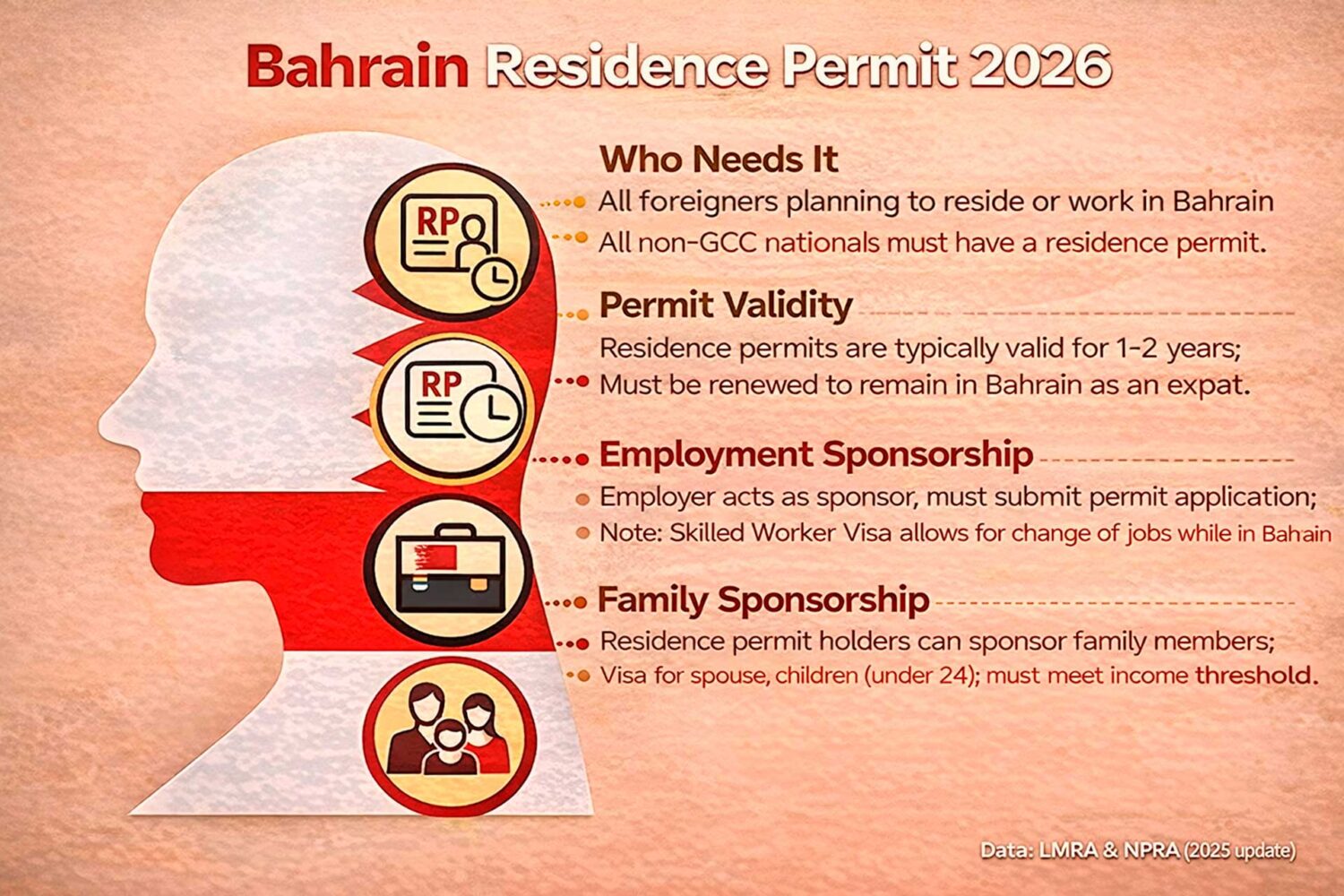
A Bahrain residence permit is the legal status that allows a foreign national to live in Bahrain for a stated purpose such as work, study, family reunification, self-sponsorship, or long-term Golden Residency. In practice, Bahrain uses multiple route-specific permissions rather than one universal residence card for every applicant.
Who can apply depends on the route. Official public services cover foreign employees and their dependants, students enrolled in Bahraini institutions, resident-sponsored family members, foreign employees of GCC companies, investors, retirees, property owners, and foreigners who qualify for Golden Residency through salary, pension, property ownership, or talent nomination.
The main residence categories in Bahrain are employer-sponsored work residence, student residence, family or dependant residence, self-sponsored investor or property or retiree residence, and Golden Residency. Bahrain also publishes a separate route for foreign employees of GCC companies.
There is no single official average processing time across all categories. Published service levels range from same day for some LMRA renewals, to 1 to 5 working days for many student, family, GCC, and Golden Residency services, to 20 to 40 working days for self-sponsored family or self-sponsored investor, retiree, and property-owner routes.
Government fees also vary widely. Based on the latest public official material available on April 16, 2026, common fee points include BHD 40 for the student visa stage, BHD 90 plus BHD 5 admin for spouse or child dependant permits through LMRA, BHD 195 or BHD 390 for certain work-permit services, BHD 200 to BHD 600 for self-sponsored permits depending on validity, and BHD 300 every 10 years for Golden Residency after a BHD 5 application fee. Official pages contain a few inconsistencies, so live portal confirmation is essential.
Types of Residence Permits in Bahrain
Bahrain’s residence system works best when viewed as a route matrix rather than a single permit. The table below compares the main categories most relevant to general information-intent searches. It is especially useful because generic competitor pages often collapse LMRA and NPRA pathways into one simplified narrative, even though Bahrain’s official workflow is split between labour and residence authorities.
| Route | Main authority | Typical duration | Published processing time | Can the holder work? |
| Employer-sponsored work residence | LMRA | 6 months, 1 year, or 2 years depending on service | 2 to 3 working days for several new/related routes; same-day for some renewals | Yes, if work permit is granted |
| Student residence | NPRA | 5 years for local study, 1 year for study abroad route | 3 working days for visa stage, 1 working day for residence stage | No |
| Family or dependant residence | LMRA or NPRA | Varies by sponsor and category | 1 to 7 working days depending on sub-route | Generally no, unless status is changed or work approval is obtained |
| Self-sponsored investor/property/retiree residence | NPRA | 2, 5, or 10 years | 40 working days | Residence is granted; work depends on the specific legal basis |
| Golden Residency | NPRA | Permanent, with BHD 300 admin every 10 years | 5 working days | Working may still require a separate work permit in many cases |
| GCC-company employee residence | NPRA | Route-specific | 1 working day | Route-specific; not a blanket local labour-market work right |
Table compiled from official Bahrain National Portal, NPRA, and LMRA public service pages.
Work Permit and Employer-Sponsored Residence
For most employed expatriates, Bahrain’s closest equivalent to a “single permit” is the employer-sponsored LMRA work-permit ecosystem rather than a formally named EU-style single permit. Official LMRA-linked public pages show that foreigners already authorized to reside in Bahrain can obtain a new work permit through an LMRA process that publishes a fee of BHD 195 for one year or BHD 390 for two years, plus a BHD 5 admin fee, with a stated processing time of 2 working days. The same page also explains that the applicant’s existing residence permit must still have at least 6 months’ validity and that specialized professions need approval from the relevant regulator.
Bahrain also publishes related sub-routes such as an “entrant to work permit” process, where a National Portal page states a processing time of 3 working days and lists a one-year fee example of BHD 172 including health-insurance fees, with higher fee logic tied to the worker’s status and the duration chosen. For renewals, Bahrain’s official eService pages show a much faster path: some work-permit renewals validate immediately after payment and can be printed on the same day if the information is correct.
Student Residence Permit
Bahrain separates the student route into a visa stage and a residence stage. NPRA’s student-visa page states that the applicant must be outside Bahrain when the visa application is filed, and it publishes a 3-working-day processing time with fees of BHD 5 application, BHD 5 visa approval, and BHD 30 visa issuance. It also requires a passport valid for more than 6 months, ID for the applicant or representative, and an official letter from the university or institute.
After entry, the student residence stage is a separate residence-permit service. NPRA states that a student residence permit can be issued or renewed for 5 years for students in local universities or institutes and for 1 year for students enrolled abroad. The public pages also state that students granted this residence are not allowed to work, whether paid or unpaid.
There is one important official fee discrepancy worth flagging because it is exactly the kind of detail many competitor articles miss. The National Portal service page lists BHD 64 for issuing the student residence, while NPRA’s student residence page snippet itemizes BHD 5 application + BHD 60 issuance, with BHD 60 renewal. Applicants should therefore verify the live fee screen at filing rather than treating any single secondary article as definitive.
Family Reunification Permit
Family reunification in Bahrain is not one route. It is several routes.
- For foreign workers sponsoring a spouse or children up to age 24, LMRA publishes dedicated dependant-residency services. The spouse route requires the applicant to be submitted by an authorized person, sets the sponsor’s minimum monthly net income at BHD 400, and lists fees of BHD 90 service fee + BHD 5 admin fee with 3 working days at LMRA plus 7 working days with cooperative entities. The children route follows the same income threshold and fee structure, while adding age, birth-certificate, and custody or no-objection requirements where relevant.
- For dependants not yet inside Bahrain, Bahrain also publishes an entry-permit route for spouse and children of foreign workers. The National Portal page states that employers can apply for an admission permit for the spouse and children up to age 24, again requiring the sponsor’s net income to be at least BHD 400, and listing BHD 90 as the published fee with a 3-working-day processing time. It also requires proof of address such as recent electricity bills and, if necessary, a lease.
- For parents and children above 24, the authority shifts to NPRA rather than LMRA. NPRA’s public residence page for resident-sponsored direct family members states a 1 working day processing time, an application fee of BHD 5, an issuance fee of BHD 50, and a renewal fee of BHD 60. It also lists valid Bahraini health insurance and a salary-insurance document showing monthly salary of not less than BHD 1000 as relevant requirements on the public checklist.
A final rule that users frequently misunderstand: family and student status do not normally allow work in Bahrain. LMRA’s own FAQ states that spouses and grown-up children on a family visa, and students on a student visa, are not supposed to work unless they change to a work permit. LMRA also publishes a dedicated “work approval for dependants” framework for change-of-status situations.
Self-Sponsored Investor Permit
Bahrain has several self-sponsored residence routes under NPRA, and these are among the most important for entrepreneurs, passive-income retirees, and property buyers. They are not permanent residency, but they are long-term residence options.
For foreign investors, NPRA states that self-sponsored residence can be issued or renewed for 2, 5, or 10 years, with a published processing time of 40 working days. The public checklist requires a passport valid for more than 6 months, a certificate of good conduct, residential lease and electricity bill, proof of company ownership or partnership with a share of at least BHD 100,000, valid Bahrain-issued medical insurance, stable income of BHD 500 or more, and recent bank statements. Fees are BHD 5 application, BHD 200 for 2 years, BHD 400 for 5 years, BHD 600 for 10 years, and BHD 250 transfer fee.
For foreign property owners, NPRA publishes the same 2-year, 5-year, and 10-year pattern, the same 40-working-day timeline, and the same fee ladder. The core threshold here is different: the title deed must show property ownership worth at least BHD 50,000, together with valid Bahrain medical insurance, stable income of BHD 500 or more, and recent bank statements.
For retired foreigners, NPRA again publishes 2, 5, or 10 years, 40 working days, and the same fee structure. The route requires certified retirement evidence for at least 15 years in government, private sector, or a GCC setting, valid Bahrain medical insurance, proof of stable income of BHD 500 or more, a social-insurance statement proving service years, and recent bank statements.
The strategic comparison is important. Bahrain’s self-sponsored property route starts at BHD 50,000 in property value, which is much lower than the Golden Residency property threshold. But self-sponsored residence is a fixed-term permit. Golden Residency is permanent. That distinction is more useful to readers than repeating generic “investor visa” language.
Golden Residency and GCC-Specific Routes
Golden Residency is Bahrain’s closest thing to a true long-term premium residence route. NPRA describes it as a permanent residency subject to a standard administrative fee of BHD 300 every 10 years, after a BHD 5 application fee. Public eligibility categories include nonresident retirees earning at least BHD 4,000, property owners with at least BHD 130,000 in Bahrain real estate, talented individuals nominated in specified fields, employees who have worked in Bahrain for at least 5 years with an average salary of at least BHD 2,000 over that period, and Bahrain-based retirees with at least 15 years of work and an average pension above BHD 2,000 during the last five years of residence. Valid insurance is a general condition. NPRA publishes a processing time of 5 working days for the Bahrain-resident employee and retiree route.
Golden Residency is stronger than fixed-term self-sponsorship in one obvious sense: it is permanent. It also covers family enrolment. NPRA’s Golden Residency enrolment page states that a holder’s spouse, children, and parents can be added, subject to passport, insurance, and relationship documents, with a 5-working-day processing time and the same BHD 300 every 10 years administrative structure.
But there is a nuance: Golden Residency does not always eliminate the need for a work permit. Bahrain’s National Portal explicitly states that Golden Residency holders who wish to work can obtain a dedicated work permit, that the work permit is valid for one or two years, and that if the Golden Residency holder is an investor and one of the partners in the establishment, they do not have to apply for that specific work permit. In other words, permanent residence and labour authorization are related, but not automatically identical.
Bahrain also publishes a separate Residence Permit for Foreign Employees of GCC Companies. This route has a 1-working-day processing time and requires items such as a GCC guarantor’s letter, residential lease in Bahrain, the applicant’s GCC resident permit, and valid company registration from a GCC country. The published fees are BHD 5 application, BHD 50 issuance, and BHD 60 renewal.
If the user specifically wants an “EU Blue Card equivalent,” the answer is that Bahrain does not publish an EU-style Blue Card route in NPRA’s current residence-permit catalogue. If you search “blue card,” you may find older LMRA material for the Bahrain flexible work permit. That is a Bahrain-specific labour product, not the EU Blue Card. The EU Blue Card itself is an EU legal-migration instrument for highly qualified work in EU member states, not a Bahrain residence category.
Leave your contacts to have an expert contact you shortly.
Bahrain Residence Permit Requirements
Bahrain’s requirements are route-specific, so we separate universal patterns from category-specific thresholds. That approach is more accurate than pretending there is one generic checklist for every applicant.
General Requirements
Across Bahrain’s official pages, five baseline requirements appear repeatedly.
- First, the passport is almost always expected to be valid for more than 6 months, and many work-related pages recommend substantially longer validity where possible.
- Second, the filing location matters: some visas must be filed while the applicant is outside Bahrain, while many residence-permit services require the applicant to be inside Bahrain.
- Third, many services must be submitted by a sponsor, guarantor, employer, or authorized representative.
- Fourth, some labour-linked or self-sponsored routes impose conduct or administrative-clearance conditions.
- Fifth, several NPRA routes state that payment must be made within 30 days after approval or the application is automatically cancelled.
Documents Needed
The most important document insight is that Bahrain’s official system is evidence-heavy rather than form-heavy. The authorities repeatedly ask for underlying proof of the legal basis for your stay: job, study, family relationship, investment, retirement, or premium long-term eligibility.
Typical core documents by route:
- Work permit: passport, ID or current residence details, employment contract (if applicable), approval from the relevant regulator for specialized occupations.
- Student: passport, applicant or representative ID, official enrollment letter from a university or institute.
- Family / dependants: passport, marriage certificate, birth certificate, sponsor’s ID, custody or no-objection documents (if applicable).
- Self-sponsored (investor / property owner / retiree): passport, good conduct certificate, lease agreement or electricity bill, bank statements, and route-specific proof (property ownership or retirement status).
- Golden Residency: passport, ID, proof of income or pension or property ownership or talent, valid medical insurance in Bahrain, bank statements.
- GCC company employee route: passport, GCC guarantor letter, Bahraini lease agreement, GCC residence permit, GCC company registration documents.
List compiled from official NPRA and Bahrain National Portal service pages.
Financial Requirements
Financial requirements are one of the clearest route filters in Bahrain.
- For employee-sponsored spouse and child dependants through LMRA, the sponsor’s monthly net income must be at least BHD 400.
- For parents and children above 24 under the NPRA resident-sponsored direct-family route, the public checklist includes salary insurance showing monthly salary of not less than BHD 1000.
- For self-sponsored investor, property-owner, and retiree routes, NPRA requires stable income of BHD 500 or more in the published checklist.
- Golden Residency is stricter: the key thresholds include BHD 2,000 average salary for qualifying employees, BHD 2,000 average pension for certain Bahrain-based retirees, BHD 4,000 for qualifying nonresident retirees, and BHD 130,000 in property value for the property-owner pathway.
The student route is different. On the public pages reviewed here, Bahrain does not publish a numeric student income threshold in the same way it does for family, self-sponsored, or Golden Residency routes. Instead, the public checklist centers on enrollment evidence and the later residence-permit service.
Health Insurance
Health insurance in Bahrain is route-specific, not universal in one identical format across every permit. The clearest official insurance requirement appears in self-sponsored and Golden Residency routes, which explicitly require a valid medical-insurance certificate issued in the Kingdom of Bahrain. NPRA’s family route for parents and children above 24 also explicitly asks for valid Bahraini health insurance. Golden Residency family enrolment requires Bahrain-issued valid medical insurance as well.
Work-permit pages look different. On labour-linked work routes, Bahrain’s public pages often publish healthcare or health-insurance fees within the permit fee structure instead of requiring applicants to upload a separate private-insurance document on the same public checklist. That is why work-permit fee pages refer to basic healthcare fees and health-insurance fees, while self-sponsored and premium routes ask directly for the insurance certificate itself.
Proof of Accommodation
Proof of accommodation is one of the most commonly overlooked Bahrain requirements because it is not identical across categories.
- Self-sponsored investor and retiree routes require a residential lease and electricity bill.
- The self-sponsored property-owner route requires an electricity bill plus a certified title deed.
- For employee-sponsored spouse and children entry or dependant permits, Bahrain’s official pages may require recent electricity bills and, if the bill is not in the relevant name, a lease contract.
- GCC-company employee residence also requires a residential lease agreement in Bahrain, while some family-visa pages ask for the guarantor’s residential lease.
How to Apply for a Bahrain Residence Permit
The most accurate Bahrain application model is: choose the correct legal basis first, then file through the correct authority. That is more important in Bahrain than in many countries because the route determines whether you use LMRA’s labour systems, NPRA’s residence systems, Bahrain’s eGovernment portal, or a sponsor-led entry step from abroad.
Step-by-step application process:
- Choose the correct permit type and the correct authority.
Use LMRA-centric workflows for employer-sponsored work and many employee-dependant cases, and NPRA or eGovernment residence services for student, self-sponsored, Golden Residency, GCC-company, and several family routes. - Apply through the right channel.
Bahrain’s official public channels include Residency Services for standard residence issuance, renewal, and cancellation, Self-Sponsor Residency Services for personal sponsorship routes, NPRA’s eGovernment-linked service pages, and LMRA’s Expat Management System or related labour-service pathways. Some visa stages also explicitly require the applicant to be outside Bahrain when filing. - Submit the required documents exactly as the route requires.
Bahrain’s public pages repeatedly require passport copies, attested family documents where relevant, enrollment letters for students, salary or pension evidence for premium routes, route-specific proof of investment or property, and insurance or accommodation evidence in many non-work categories. Passport validity under 6 months is a recurring problem point. - Wait for approval and then pay within the stated payment window.
Several NPRA routes state that payment must be completed within 30 days of approval or the application is automatically cancelled. For many LMRA services, the application moves to verification after admin fees are paid, then final permit fees are paid after approval. - Complete Bahrain’s post-approval formalities.
Bahrain does not publish a Belgium-style “register in the commune” step for the main routes reviewed here. Instead, public pages refer to practical completion steps such as biometric collection, medical appointments on some labour routes, permit printing, and managing active residencies through Bahrain’s online systems.
Bahrain Residence Permit Processing Time and Fees
Bahrain is unusually transparent about route-level service times, which is useful both for applicants and for search rankings because it allows genuine comparison content instead of vague “it depends” language. The downside is that different official pages occasionally show conflicting fee figures, which should be surfaced rather than hidden.
Standard processing time
Here is the practical processing spectrum based on official public service times:
- Same day: some work-permit renewals, if filed correctly and fees are paid.
- 1 working day: student residence, several NPRA family-residence services, GCC-company employee residence.
- 2 to 3 working days: work permit for residents authorized to stay in Bahrain, student visa, dependant spouse or child permits, entry permit for enrolled family members.
- 5 working days: Golden Residency and Golden Residency family enrolment.
- 20 working days: self-sponsored family residence.
- 40 working days: self-sponsored investor, retiree, and property-owner residence.
Fast-track or faster paths
There is no universal “fast-track residence permit” product published across Bahrain’s main 2026 permit routes. The closest equivalent to a fast lane is operational rather than branded: some LMRA work-permit renewals validate immediately after fee payment and can be printed the same day if the application is correct, while several NPRA residence services publish 1-working-day turnaround. So, it is better to say Bahrain has route-dependent fast processing, not a formal all-category fast-track scheme.
Government fees
The fee overview below provides a clear snapshot for readers comparing different routes:
- Student visa: BHD 5 application fee + BHD 5 approval fee + BHD 30 issuance fee.
- Student residence: either BHD 64 (according to one National Portal page) or BHD 5 application fee + BHD 60 issuance/renewal fee (according to NPRA student residence page).
- Wife/Husband dependant permit: BHD 90 service fee + BHD 5 administrative fee.
- Child dependant permit: BHD 90 service fee + BHD 5 administrative fee.
- Resident-sponsored parents / children over 24: BHD 5 application fee + BHD 50 issuance fee + BHD 60 renewal fee.
- New LMRA work permit (for residents already authorized to stay): BHD 195 for one year or BHD 390 for two years + BHD 5 administrative fee.
- Self-sponsored (investor / property owner / retiree): BHD 5 application fee + BHD 200 (2 years), BHD 400 (5 years), or BHD 600 (10 years) + BHD 250 transfer fee.
- Golden Residency: BHD 5 application fee + BHD 300 every 10 years.
- GCC company employee residence: BHD 5 application fee + BHD 50 issuance fee + BHD 60 renewal fee.
Two fee inconsistencies are important enough to mention explicitly.
- The first is the student residence fee discrepancy: one official National Portal page lists BHD 64, while NPRA’s student residence page snippet itemizes BHD 5 + BHD 60.
- The second is the work-permit renewal discrepancy: one official eService page lists BHD 50/100/200 plus BHD 36/72/144 healthcare for 6 months, 1 year, and 2 years, while another official National Portal renewal snippet for the commercial sector lists BHD 52.5/105/210 plus BHD 45/90/180 healthcare. Because these contradictions exist within official materials, the publish-worthy advice is simple: confirm the fee shown in the live application workflow before paying.
Additional costs
Most official fee tables do not include third-party expenditures such as translation, embassy or MOFA attestation, private insurance purchased from a market provider, document couriering, or similar external expenses. However, the official checklists make clear that these external costs can arise because many routes require attested marriage or birth certificates, valid Bahrain insurance, bank statements, electricity bills, or lease documents. Work-permit pages also show route-specific healthcare or insurance charges embedded inside LMRA payment structures.
How to Renew a Bahrain Residence Permit
Renewal rules are route-based. For work permits, Bahrain’s eService pages state that the permit can be renewed 6 months before expiry for 1-year and 2-year permits, and 5 months before expiry for 6-month permits. The same pages also state that if the employee has dependants, their permits are renewed alongside the primary worker’s renewal. When filed correctly through EMS and paid online, the renewal can validate immediately and be printed on the same day.
For self-sponsored family residence, Bahrain’s official page specifically instructs applicants to submit the renewal request before 6 months of expiry and to apply online only through the eGovernment route. Several NPRA self-sponsored and Golden Residency pages also repeat the rule that payment must be completed within 30 days of approval or the application is cancelled.
In practical terms, the renewal file should usually include the current permit, a still-valid passport, ongoing proof of eligibility, and route-specific supporting evidence such as salary, pension, enrollment, relationship, investment, or insurance documents. Bahrain’s public pages repeatedly reserve the authorities’ right to request additional documents at any time, so “same sponsor, same situation” does not mean “no updated evidence.”
Why Residence Permits Get Rejected in Bahrain
Bahrain’s official pages do not publish one master refusal list across all residence categories. The strongest evidence-based way to explain rejection risk is therefore to derive it from the official eligibility criteria themselves.
The most common risk is missing or non-compliant documents: unattested marriage or birth certificates, incomplete passport pages, absent regulator approvals for specialized work, or failure to attach the exact sponsorship or ownership proof the route requires. Bahrain’s public pages are unusually specific about these details.
The second major risk is failing the financial threshold. If the sponsor’s income is below BHD 400 for spouse or child dependants, if a self-sponsored applicant cannot show BHD 500 stable income, or if a Golden Residency applicant does not meet the published salary, pension, or property threshold, the route does not fit.
The third is wrong filing status or wrong location. Some visas must be filed while the person is outside Bahrain, while many residence services require the applicant to be inside Bahrain. Starting on the wrong service page can delay or derail the file before substantive review even begins.
Other recurring issues include passport validity under 6 months, missing Bahrain-valid medical insurance where expressly required, good-conduct problems on self-sponsored routes, and failing to pay within 30 days after approval on NPRA services that impose that deadline.

Expert Tips for Getting Approved
- The first expert tip is strategic: choose by legal basis, not by label. If you are a salaried professional who has averaged more than BHD 2,000 for the last 5 years in Bahrain, Golden Residency may offer a much stronger long-term position than a standard fixed-term residence. But if you intend to keep working, Bahrain’s own public pages show you may still need the Golden-Residency-holder work permit. That combination is often overlooked in generic content.
- The second tip is to compare property thresholds carefully. If your priority is entry at a lower capital level, Bahrain’s self-sponsored property-owner route starts at BHD 50,000. If your priority is permanent status, Golden Residency now uses a BHD 130,000 property threshold after the official reduction announced by NPRA in late 2025. Those are related routes, but they are not substitutes.
- The third tip is authority mapping. Many delays happen because applicants do not realize that foreign-worker spouse and child dependants under 24 often sit with LMRA, while parents and over-24 children sit with NPRA. That split changes not only the fee and timeline, but also the financial threshold and the type of supporting documents.
- The fourth tip is document precision. Bahrain’s public pages repeatedly specify passport-page conventions, embassy or MOFA attestation, spouse-name or father-name page requirements for certain nationalities, and proof-of-address rules tied to electricity bills and leases. In other words, Bahrain rewards clean documentation more than persuasive narrative.
- The fifth tip is status discipline. If you are in Bahrain on family or student status and want to work, do not assume residence automatically gives labour rights. LMRA’s published guidance is explicit that these holders need a work-permit change or work approval, depending on the route. That single misunderstanding causes a large share of avoidable compliance problems.
Use the route comparison and fee information above as your planning checklist, then verify the live Bahrain portal fee screen on the day you file. That advice is especially important because the official ecosystem sometimes shows more than one fee figure for similar-looking services.
Navigating Bahrain’s residence permit process can be complex — from choosing the right visa type to preparing documents and meeting eligibility requirements. Mistakes or missing details can lead to delays or even rejection. That’s where professional legal support makes a real difference. Our experienced immigration specialists can guide you through every step — whether you’re applying for a work permit, investor visa, family residency, or long-term Golden Residency. We ensure your application is accurate, compliant, and optimized for approval.
Leave a Comment

We have prepared answers to the most common questions about Bahrain residence permit. If you want to clarify anything, please contact us - we will provide detailed explanations.
It depends on the route. Student residence is published as 5 years for local study and 1 year for study abroad. Self-sponsored permits can be issued for 2, 5, or 10 years. Many work permits run for 6 months, 1 year, or 2 years. Golden Residency is permanent, subject to a BHD 300 administrative fee every 10 years.
Only if your status allows it. Employer-sponsored work routes do. Student and family routes generally do not. LMRA explicitly states that dependants on family visa and students on student visa are not supposed to work unless they change to a work permit. Golden Residency holders may still need a work permit to work, unless they fall into the investor-partner exception described on Bahrain’s National Portal.
Bahrain is administratively clearer than many countries because it publishes route-specific services, timelines, and fee pages online. But approval is still document-driven and threshold-driven. If your sponsor income, insurance, attested documents, location at time of filing, or investment basis do not match the exact route, approval is not automatic.
Often yes, but the route depends on who the family members are. Foreign workers can sponsor spouse and children up to age 24 through LMRA, while parents and children above 24 move into NPRA’s family-residence framework. Golden Residency holders can also enroll spouse, children, and parents.
Yes, through Golden Residency if you meet the published criteria. Fixed-term self-sponsored permits of 2, 5, or 10 years are not the same as permanent residency.
Official public times range from same day for some work-permit renewals, to 1 to 5 working days for many standard residence categories, to 20 or 40 working days for self-sponsored routes. There is no single universal average.
Yes, in many cases. Bahrain’s National Portal publishes Residency Services for issuance, renewal, cancellation, and enquiry, and separately publishes Self-Sponsor Residency Services for personal-sponsorship cases. LMRA work and labour-linked services also use digital systems such as EMS and eSupport.


Comments
No comments found.