

 EU Citizenship
 Slovenian Citizenship
 Romanian Citizenship
 Bulgarian Citizenship
 Austrian citizenship (investments)
 Spanish Citizenship
 Italian Citizenship
 Cypriot Citizenship
 Lithuanian Citizenship
 Portuguese Citizenship
 French Citizenship
 German Citizenship
 Hungarian Citizenship
 Dutch Citizenship
 Belgian Citizenship
 Croatian citizenship


Canada Residence Permit: Complete Guide for 2026
Author: Leon Scott
Published: 18.05.2026
Updated: 18.05.2026
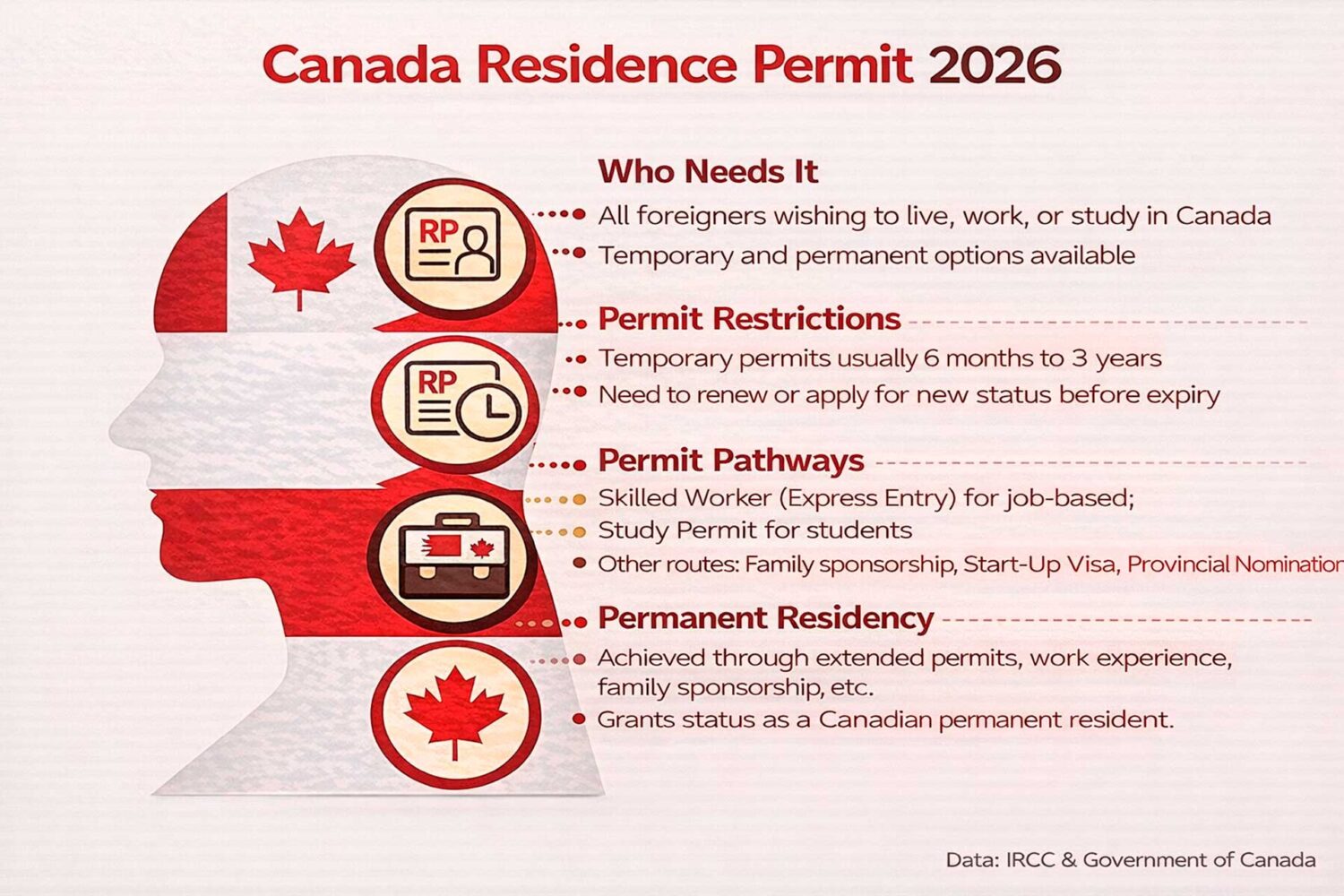
Canada does not issue one universal “residence permit” in the way some European countries do. In practice, the term usually refers to a bundle of Canadian immigration documents and statuses that let foreign nationals live in Canada temporarily or permanently: work permits, study permits, visitor records for extended stay, permanent residence status, and refugee/protected-person status documents. IRCC itself distinguishes between entry documents and status documents, and it defines permits such as work permits and study permits as written authorizations for eligible foreign nationals.
For international applicants in 2026, the main Canada “residence permit” routes are: work permits, study permits, permanent residence through Express Entry or a Provincial Nominee Program, family sponsorship, and protected-person/refugee pathways. Which route fits best depends on what is driving the move to Canada: employment, study, family reunification, long-term skilled immigration, or humanitarian protection.
Processing times in Canada remain highly stream-specific. IRCC’s live processing-time tool updates regularly and should be checked before filing, but the most reliable general benchmarks available on static official pages are these: temporary residence applications are modeled on historical windows of roughly 8 to 16 weeks, permanent residence applications on roughly 6 months, most Express Entry applications are processed within 6 months or less after a complete application is submitted, and new spouse/partner/child sponsorship applications are expected to take about 12 months.
Costs also vary sharply by route. In 2026, official government fees start at CAD 150 for a study permit, CAD 155 for a work permit plus CAD 100 for the open-work-permit holder fee where relevant, CAD 85 for biometrics per person, CAD 1,590 for many economic permanent residence applications including the right of permanent residence fee, CAD 1,260 for spousal sponsorship applications including the right of permanent residence fee, and CAD 660 for protected-person permanent residence applications, which do not require the right of permanent residence fee. Private costs such as medical exams, certified translations, insurance, and legal representation are extra.
The most important 2024–2026 updates to understand before applying are these: Canada’s 2026–2028 Immigration Levels Plan reduces temporary resident arrival targets and stabilizes permanent resident admissions; most study-permit applicants still need a PAL/TAL, but master’s and doctoral students at public DLIs became PAL/TAL-exempt from January 1, 2026; most eligible international students can work up to 24 hours per week off campus while classes are in session; the federal Self-Employed Persons Program remains paused; and for 2026 IRCC froze the PGWP field-of-study list rather than adding or removing eligible fields.
Types of Residence Permits in Canada
Canada’s system works best if you choose the right legal route first. The biggest mistake applicants make is treating all residence authorization as interchangeable. In reality, Canada has separate systems for temporary work, temporary study, family reunification, skilled permanent migration, and humanitarian protection.
| Route | What it allows | Typical end-state | Official fee starting point |
| Work permit | Temporary work in Canada | Temporary stay, sometimes transition to PR | CAD 155, plus CAD 100 for open work permits where applicable |
| Study permit | Study at a DLI in Canada | Temporary stay, often with later PGWP/PR path | CAD 150 |
| Family sponsorship | Permanent residence for eligible relatives | Permanent residence | CAD 1,260 for spouse/partner sponsorship incl. RPRF |
| Economic PR / PNP | Skilled worker permanent residence | Permanent residence | CAD 1,590 incl. RPRF |
| Business immigration | Start-up visa / business routes | Permanent residence | CAD 2,495 incl. RPRF |
| Protected person route | PR after recognized protection in Canada | Permanent residence | CAD 660; no RPRF |
Sources for the table: IRCC fee list, work-permit pages, study-permit page, family sponsorship page, Express Entry page, self-employed/business immigration fee page, and protected-person PR pages.
Work Permit
Canada does not use the term “single permit” in the European sense. The closest Canadian distinction is between employer-specific work permits and open work permits. An employer-specific work permit ties you to the employer, work location, and occupation shown on the permit. In many cases, the employer must first obtain a positive Labour Market Impact Assessment (LMIA), although some work permits are LMIA-exempt.
An open work permit is more flexible: it lets you work for almost any employer in Canada, and you generally do not need a job offer, LMIA, or employer compliance fee to apply. But open work permits are only available in specific categories, such as certain spouses, family members of some PR applicants, post-graduation work permit applicants, and some refugees, asylum claimants, or protected persons.
From a strategic perspective, work permits are often the fastest way to get lawful residence and income in Canada, but they are not all equal. Employer-specific permits are stronger when you already have a job offer and a compliant employer. Open permits are stronger when you qualify through relationship-based or status-based categories and want labour-market flexibility.
Study Permit
A study permit is the written authorization that allows most foreign nationals to study at a designated learning institution in Canada. The official fee is CAD 150, and IRCC advises applicants to apply before travel. In 2026, most applicants still need a PAL/TAL, but public master’s and doctoral students are exempt as of January 1, 2026.
As a study-led residence strategy, Canada remains attractive because study can transition into work and then permanent residence. But the 2026 version of this route is more regulated than older internet guides suggest. Eligible students can generally work up to 24 hours per week off campus while classes are in session, and PGWP access now needs to be checked more carefully at both the DLI level and, where applicable, the field-of-study level. For 2026, IRCC froze the PGWP field-of-study list rather than changing it again.
Family Reunification
Family sponsorship is not a temporary permit route. It is a permanent residence pathway for eligible relatives, including spouses, partners, dependent children, parents, and grandparents in the appropriate streams. For spouses, partners, or children, the sponsor typically files a sponsorship application alongside the family member’s permanent residence application.
For spouse, partner, and dependent-child sponsorship, one of the most important user-friendly rules is financial: in most cases there is no minimum income requirement. The main exceptions arise when the sponsored person includes a dependent child who has dependent children of their own, and Quebec has separate provincial undertaking rules that can also matter.
This route is slower than many temporary permit routes but far more stable if the relationship is genuine and well documented. IRCC’s own infographic says new spouse/partner/child sponsorship applications are expected to take about 12 months to decision.
Self-Employed and Entrepreneur
This is the area where applicants most often rely on outdated content. In 2026, the federal Self-Employed Persons Program is paused, and IRCC states that it stopped accepting applications for that program on April 30, 2024. That means many older “self-employed Canada residence permit” articles are no longer current.
Entrepreneurial residence strategies still exist, but the route has shifted. Applicants now more often look at Start-Up Visa, provincial entrepreneur streams, or other work-permit-plus-PR sequencing. IRCC also announced in early 2026 that it is no longer accepting new optional work permit applications for Start-Up Visa applicants, except for certain in-Canada extensions held by existing SUV work-permit holders.
For blog readers, the practical takeaway is simple: if your plan is “I want to move to Canada because I run a business,” you should not assume a federal self-employed route is open. In 2026, the entrepreneur route requires much more case-by-case strategy than work, study, or standard economic PR pathways.
Provincial Nominee Program and Permanent Residence Pathways
Canada’s core skilled-worker permanent residence system is Express Entry, which manages the Canadian Experience Class, Federal Skilled Worker Program, and Federal Skilled Trades Program. If you qualify and get invited, IRCC says it processes most complete Express Entry applications within 6 months or less.
The Provincial Nominee Program is a major alternative or complement. If a province nominates you through an Express Entry-aligned stream, you get 600 extra CRS points, which usually transforms your invitation odds. If you do not qualify for an Express Entry federal program, you may still immigrate through a non-Express Entry PNP stream and then apply for PR through the PR Portal.
This is also where Canada’s 2026 policy direction matters. The 2026–2028 Immigration Levels Plan explicitly says the government is increasing admissions under federal high-skilled and PNP categories while reducing temporary resident arrival targets overall, showing that economic PR remains the center of long-term immigration planning even during broader system recalibration.
Refugee and Protected Person
If the Immigration and Refugee Board of Canada or IRCC has recognized you as a protected person or Convention refugee in Canada, you can apply for permanent residence from within Canada using the protected-person application package. This is a distinct humanitarian route, not a standard economic or family application.
Protected persons are also relevant in 2026 because Canada’s Levels Plan includes a one-time, two-year initiative in 2026 and 2027 to recognize eligible protected persons in Canada as permanent residents and process applications for people already recognized as needing protection. IRCC states that approximately 115,000 such applications are expected to be handled over two years.
This matters because it signals a more favorable system environment for people already on a protection pathway. It does not eliminate the need to file correctly, but it does mean protected-person transitions to PR are a live national priority, not a neglected side category.
If you are planning to apply for permanent residence in Canada, professional guidance can help you avoid procedural mistakes and strengthen your case. Leave a request for a personal consultation and our specialists will help you choose the right strategy for your situation.
Leave your contacts to have an expert contact you shortly.
Canada Residence Permit Requirements
General Requirements
Across most Canadian streams, the pattern is consistent even when the forms differ. IRCC typically checks: identity and travel documents, admissibility, fees, biometrics where required, stream-specific eligibility evidence, and whether the file is complete. For permits and PR pathways, missing documents or late responses can delay or derail the case.
The stream-specific trigger document is often what defines the case: a job offer and LMIA/LMIA-exempt support for an employer-specific work permit, a letter of acceptance and often PAL/TAL for a study permit, sponsorship and relationship evidence for family PR, a provincial nomination for PNP, or a formal protection decision for protected-person PR.
Documents Needed
The exact checklist depends on your immigration pathway, but the following documents are the ones most commonly required in Canadian residence applications:
- Valid passport or travel document.
Required for almost all immigration streams. The validity of your permit may be limited by the expiry date of your passport. - Application forms or online portal application.
Required for all streams. Most Canadian immigration applications are now submitted online or through the PR Portal. - Biometrics.
Required for many temporary and permanent residence categories unless the applicant qualifies for an exemption. - Proof of funds or income.
Commonly required for study permits, many permanent residence programs, and some temporary residence routes. Financial evidence is especially important for student applications and economic immigration streams. - Job offer and employer documents.
Required for employer-specific work permits. This may include an LMIA or LMIA-exempt employment documentation. - Letter of acceptance from a Designated Learning Institution (DLI).
A core requirement for study permit applications. - Provincial Attestation Letter (PAL/TAL) or proof of exemption.
Required for most study permit applications. Public master’s and doctoral students are exempt from this requirement from January 1, 2026. - CAQ (Québec Acceptance Certificate).
Required for study-related immigration cases in Quebec. - Sponsorship and relationship proof.
Necessary for family sponsorship applications. Evidence may include marriage certificates, proof of common-law partnership, birth certificates, or dependency documents. - Provincial nomination certificate.
Essential for Provincial Nominee Program (PNP) permanent residence applications. - Language test results, Educational Credential Assessment (ECA), and police certificates.
Frequently required for Express Entry and many permanent residence programs, depending on the immigration category. - Medical examination results.
Required for some temporary residence categories and many permanent residence pathways. Medical exams must be completed with an approved panel physician. - Certified translations.
Any document not issued in English or French must usually be accompanied by a certified translation. This is a major technical requirement in Canadian immigration processing, and informal or uncertified translations can lead to delays or refusals.
Sources for this section include IRCC supporting-document guidance, study permit document pages, Express Entry requirements, Provincial Nominee Program guidance, biometrics and medical instructions, work permit checklist guidance, and protected-person application materials.
Financial Requirements
Canada does not have one universal financial threshold for every residence route. Instead, the amount depends on the stream. For Express Entry, proof of funds is required for the Federal Skilled Worker Program and Federal Skilled Trades Program unless the applicant qualifies for an exemption such as authorized work in Canada plus a valid job offer. IRCC’s table updated on July 7, 2025 sets the minimum settlement funds at CAD 15,263 for one family member, CAD 19,001 for two, CAD 23,360 for three, and CAD 28,362 for four.
For study permits, IRCC requires proof that you can cover first-year living expenses, and it explicitly says its chart is updated every year and does not include tuition or transportation. Because the exact study-fund amounts differ by timing and province, especially Quebec versus the rest of Canada, applicants should verify the current official chart immediately before filing rather than relying on old blogs or screenshot tables.
For family sponsorship of a spouse, partner, or dependent child, there is usually no minimum income requirement, except in the dependent-child-with-dependent-children scenarios described by IRCC. That makes family sponsorship financially more accessible than many people assume.
For International Experience Canada, applicants must show they have at least CAD 2,500 on arrival for their initial expenses. That number is not a general work-permit rule, but it is a good reminder that some temporary categories do impose specific liquid-funds checks.
Health Insurance and Medical Exam
Health insurance is not a universal IRCC filing requirement for every Canadian permit. IRCC’s general supporting-documents page says only some programs need proof of health insurance, and it specifically names examples such as International Experience Canada and the super visa. For IEC, IRCC requires health insurance for the entire time you are in Canada, and the policy must cover medical care, hospitalization, and repatriation.
Medical exams are a different issue. For temporary residents, IRCC says you generally need an immigration medical exam if you plan to stay for more than 6 months and either lived in a listed country/territory for 6 months or more in a row in the year before coming to Canada, or you will work in certain public-health-sensitive jobs, or you are applying for a super visa. The exam must be done by an IRCC-approved panel physician, not your own doctor.
IRCC also makes clear that applicants must pay the medical-exam-related fees directly to the clinic or provider, including physician/radiologist charges and any extra tests or specialists. In the private market, published panel-physician sources commonly show costs in roughly the CAD 200–400+ zone depending on age, location, tests, and clinic structure, but this is not an IRCC fee and varies significantly.
Proof of Accommodation
Unlike some countries, Canada usually does not impose a single universal “proof of accommodation” document across all permit categories. IRCC’s core supporting-documents guidance focuses more heavily on funds, health insurance where applicable, relationship proofs, education, employment, and identity documents than on a stand-alone housing certificate. That suggests housing proof is often supporting evidence rather than a universal threshold requirement.
In practice, however, proof of accommodation can still help. For example, students often strengthen their file with campus housing confirmations, lease drafts, or host letters, particularly if they are also trying to show realistic settlement planning. The key is not to treat housing evidence as a substitute for funds, acceptance, nomination, or sponsorship documents. It is secondary context, not the legal center of the file. This is an inference from IRCC’s structure of required documents rather than a universal statutory rule.
How to Apply for a Canada Residence Permit
The mechanics differ by stream, but the broad process is surprisingly consistent. What changes is the triggering basis of the application: school admission, job offer, family sponsorship, nomination, or protective status.
- Choose the correct route, not just the desired outcome.
Decide whether your case is fundamentally about work, study, family, economic PR, or protection. This choice determines the forms, evidence, fees, and portal you will use. - Secure the route-defining document first.
For work, that may mean a job offer and LMIA or LMIA-exempt support. For study, it means a DLI letter of acceptance and often a PAL/TAL. For family, it means sponsor eligibility and relationship evidence. For PNP, it means a provincial nomination. - Use the official checklist and prepare a complete digital file.
IRCC repeatedly warns that incomplete files are returned, delayed, or refused. This includes missing forms, missing translations, unpaid fees, and missing supporting evidence. - Submit through the right platform.
Temporary permits are generally filed online through IRCC accounts, while many permanent residence categories use the PR Portal. Non-Express Entry PNP applications must be filed online through the PR Portal, and protected-person applications follow their dedicated inland package and workflow. - Pay the applicable fees, then complete biometrics and medical steps as directed.
Biometrics are often required unless exempt. Medicals may be upfront or requested later depending on the stream. For faster doctoral-student processing, IRCC specifically says biometrics should be completed within 2 weeks of the instruction letter. - Track the file and answer requests quickly.
IRCC’s status pages repeatedly note that delays increase when information is outdated, additional checks are needed, or the applicant is slow to respond to document requests. - If approved, activate and maintain status correctly.
Approval is not the end. Many applicants still need to travel with the correct document set, activate the permit or PR status, or comply with conditions after arrival.
Canada Residence Permit Processing Time
The most accurate live number for your application is always the current IRCC processing-time tool. Still, for planning purposes, the official static evidence supports a few solid benchmarks and a clear lesson: temporary permits vary by country and stream, while permanent-residence timelines depend heavily on program design and annual capacity.
Standard Processing Time
Processing times for Canadian immigration applications vary significantly depending on the immigration stream, the applicant’s location, application completeness, and IRCC workload levels. The following timelines reflect the main official benchmarks and how they are generally interpreted in practice:
- Work permit applications.
IRCC states that processing times vary depending on the type of work permit and the country or region where the application is submitted. Broader temporary residence calculations have historically ranged between 8 and 16 weeks. In practice, these figures should be treated as planning estimates rather than guarantees. - Study permit applications.
Processing times depend heavily on the applicant’s country of residence and application volume. Historical temporary residence benchmarks commonly fall within an 8–16 week range, but country-specific differences can be substantial. - Express Entry permanent residence.
IRCC states that most complete Express Entry applications are processed within 6 months or less. This remains one of the fastest and most predictable pathways for skilled-worker permanent residence. - Spouse, partner, and child sponsorship.
Current official guidance indicates that most new family sponsorship applications are expected to take around 12 months. This is generally considered the standard benchmark for family reunification processing. - Provincial Nominee Program (PNP) — non-Express Entry streams.
IRCC does not publish a single fixed national processing time for these applications. Timelines vary depending on the province, application category, completeness of the file, verification procedures, and annual admissions capacity. In practice, non-Express Entry PNP cases are often slower and less predictable than Express Entry streams. - Protected person permanent residence applications.
No consistent national benchmark is currently published in the static IRCC guidance reviewed for this topic. Processing is highly case-specific, and applicants are generally advised to use IRCC’s live processing-time tools for updated estimates.
Sources for this section include IRCC processing-time guidance, Express Entry processing pages, spouse sponsorship materials, and Provincial Nominee Program resources.
A useful 2026 context signal comes from IRCC’s inventory data. As of February 28, 2026, IRCC reported backlog rates of about 11% for federal high-skilled Express Entry files, 40% for Express Entry PNP files, 46% for study permits excluding extensions, and 27% for work permits excluding extensions. That does not equal your personal processing time, but it shows which product lines were under more strain.
Expedited options and faster pathways
Canada does not offer a universal premium-processing lane for every residence route. However, there are faster-processing pockets. The clearest official 2026 example is for doctoral students applying for a study permit from outside Canada online: IRCC says they and accompanying family members may get faster processing if they submit a complete application and give biometrics within 2 weeks when instructed.
There is also a broader policy-level acceleration signal in the 2026–2028 Levels Plan: the government announced a one-time initiative in 2026 and 2027 to fast-track permanent residence for select skilled temporary workers already in Canada, alongside a protected-person stabilization initiative. That does not create a general public shortcut for everyone, but it confirms that the system is prioritizing in-Canada transition cases in defined categories.
Factors affecting time
IRCC is unusually transparent about what slows cases down. The recurring official reasons include: incomplete applications, complex cases, security screening, the need to verify information, slow applicant responses, and situations where application volumes exceed annual admissions space. Quebec can also add its own processing element in some streams.
That is why “average processing time” is useful only as a navigation tool. The real determinant is whether your file is a complete, low-friction case in a priority-ready stream.
Canada Residence Permit Fees
Government fees
The official 2026 fee picture is straightforward once you separate temporary permits from permanent residence. The biggest practical update is that many PR-related fees increased on April 30, 2026, so applicants should be especially cautious with older fee guides.
| Fee item | Official 2026 amount |
| Study permit | CAD 150 |
| Work permit | CAD 155 |
| Open work permit holder fee | CAD 100 |
| Biometrics individual | CAD 85 |
| Biometrics family max | CAD 170 |
| Economic immigration / Express Entry principal applicant incl. RPRF | CAD 1,590 |
| Economic immigration / Express Entry without RPRF | CAD 990 |
| Business immigration / self-employed / start-up visa incl. RPRF | CAD 2,495 |
| Spouse/partner sponsorship incl. RPRF | CAD 1,260 |
| Spouse/partner sponsorship without RPRF | CAD 660 |
| Dependent child in spousal sponsorship | CAD 180 per child |
| Protected person PR | CAD 660 |
| Right of permanent residence fee | CAD 600 |
Sources for the table: IRCC fee list and fee-table find views.
A note on the “visa fee” requested in the outline: Canada’s fee structure separates visitor visas from study/work permits in its fee list. A stand-alone visitor visa is CAD 100, but permit applicants should not automatically assume this will always appear as a separate extra line on top of their permit fee in every case, because the travel-document mechanics depend on application context and nationality.
Additional Costs
Government fees are only part of the total cost of a Canadian immigration application. In practice, applicants often face additional private or semi-private expenses related to biometrics, medical examinations, translations, insurance, police certificates, and optional legal assistance.
The most common additional costs include:
- Medical examinations.
Immigration medical exams are usually performed by approved panel physicians and are paid directly by the applicant. In the private market, costs often range from approximately CAD 200–400 or more depending on the country and clinic. - Certified translations.
Any document not issued in English or French may require a certified translation. Typical prices often begin at around CAD 25 per page or approximately CAD 0.10+ per word, although urgent processing, notarization, or rare language pairs can significantly increase costs. - Private health insurance.
Insurance requirements depend on the immigration stream. For example, IEC participants are required to maintain insurance covering medical care, hospitalization, and repatriation. Newcomer-oriented guidance often estim.ates annual insurance costs at around CAD 1,000. - Legal assistance and representation
Immigration legal fees vary substantially depending on complexity and the service provider. Public pricing examples from Canadian immigration law firms commonly show: approximately CAD 2,000–3,000 for LMIA work permit assistance; approximately CAD 5,000–8,000 for spousal sponsorship representation. These are private-market legal fees and are separate from government charges.
Sources for this section include IRCC medical/insurance rules and published private-market examples from panel-physician, translation, newcomer-support, and law-firm pricing pages.
The strategic lesson is simple: a file that looks “cheap” at the government-fee level can still become expensive once medicals, travel to VACs, translations, insurance, and legal remediation work are added. Budgeting realistically is one of the easiest ways to avoid last-minute submission mistakes.

How to Renew a Canada Residence Permit
Renewal in Canada is really about extension or restoration, and the rules differ between workers and students. The most important habit is filing before expiry, because that protects continuity of status.
When to apply
For work permits, IRCC says you should apply to extend at least 30 days before the current permit expires. For study permits, IRCC says you must apply at least 30 days before expiry if you want to keep studying. In both cases, applying before expiry can preserve your ability to remain in Canada while the application is processed.
For students, there is an extra timing nuance: a study permit often remains valid for the length of the study program plus 90 days. If you finish studies earlier than expected, the permit effectively expires on the earlier of the date printed on the permit or 90 days after completion.
What happens if you apply before expiry
If a worker applies to extend before the permit expires, IRCC says they are legally allowed to stay in Canada while the extension is processed. In many situations they may also keep working under the same conditions as the current permit, which for employer-specific permits means the same employer, job, and location.
If a student applies to extend before the permit expires, they can continue studying under the same conditions until IRCC makes a decision, as long as they remain in Canada.
What if your permit already expired
If your work permit or study permit has expired, the next question is no longer “extension”; it becomes restoration. IRCC says workers can apply to restore status if they apply within 90 days of losing status, and if they do so they must stop working until restoration is approved. Students likewise must apply to restore status within 90 days and cannot continue studying until status is restored and a new study permit is issued.
A narrow 2026 exception exists for certain foreign workers backed by participating provinces or territories under specific PNP-related open-work-permit support situations: IRCC says some of those restoration applicants do not have to meet the usual 90-day limit. That is a specialist exception, not the default rule.
Documents commonly needed for extension or restoration
For workers, extension files often need the current permit, a valid passport, updated employer documents, and LMIA or employer-compliance materials where applicable. For students, renewal files commonly need the current permit, a valid passport, updated school evidence such as an LOA or enrolment letter, and any required supporting documents. If you are restoring, IRCC also expects the restoration selection and fee, and typically an explanation note.
Common extension and renewal refusal triggers
Renewal files are often refused or derailed for routine reasons rather than dramatic ones: expired passports that limit validity, late filing, wrong status route, missing school or employer updates, or failure to pay the correct combination of extension/restoration fees. Students who change post-secondary institutions without following the post-November-2024 new-permit rule are also exposed to compliance problems.
Why Applications Get Rejected
The phrase applicants use is usually “rejected,” but in Canadian practice the file may be returned, delayed, or refused depending on what went wrong. It matters, because a returned incomplete application is different from a substantive refusal on eligibility or admissibility.
- The first major refusal pattern is incompleteness. IRCC explicitly warns that incomplete study, sponsorship, and PNP files can be returned or delayed. This includes missing forms, missing document uploads, missing fees, and missing mandatory supporting material.
- The second is financial weakness or mismatch. Express Entry applicants who need proof of funds must submit written proof if invited. Students must show financial support according to IRCC’s official chart and tuition/transport realities. Sponsored-family cases are less income-driven in most spouse/partner/child cases, but funds still matter where income rules do apply or where overall credibility is in doubt.
- The third is medical, criminal, or security inadmissibility, or any other issue that requires deeper checks. IRCC lists criminal/security problems, extra background checks, and the need to verify information among the causes of significant delay and difficulty in permanent residence files.
- The fourth is non-compliance with permit conditions. Students who no longer follow the conditions of their study permit can lose status. IRCC now also requires a new study permit to change post-secondary DLIs rather than simply updating the online account, which means old online advice on this point can actively harm an application.
- The fifth and most serious refusal trigger is false or fraudulent documents. IRCC’s work-permit checklist guidance states that false statements or fraudulent documents can cause refusal and may make the person inadmissible to Canada for 5 years. That is one of the most severe avoidable risks in the whole system.
The best avoidance strategy is boring but effective: use the official checklist, submit certified translations, pay the exact updated fees, file early, and keep your account information current so IRCC can contact you.
If you want to avoid common immigration mistakes and choose the right pathway to Canada, leave a request for a personal consultation and our specialists will help you build the best strategy for obtaining a Canadian residence permit.

Expert Tips for Getting Approved
The strongest Canada applications are not the ones with the most paperwork. They are the ones where every document points to the same story. If your goal is long-term settlement, choose the entry stream that best supports that objective instead of chasing the first route that looks available. For example, a student should think about DLI quality, PAL/TAL, PGWP eligibility, and the likely PR path before paying tuition, not after.
For students, the most overlooked 2026 tip is this: check both the DLI and, where relevant, the PGWP field-of-study logic before you apply. IRCC explicitly says that graduating from a DLI does not automatically make you PGWP-eligible, that applicants should verify the DLI list, and that for 2026 the PGWP field-of-study list is frozen rather than updated.
For workers, file renewals early and protect continuity. IRCC recommends applying around 30 days before expiry, and maintained status is one of the most valuable procedural protections in the system. But maintained status is only helpful if you file on time and keep working within the same conditions where required.
For PR applicants, treat every invitation or nomination as a moving target rather than a guarantee. PNP Express Entry gives a major 600-point boost, but profile changes can still reduce eligibility, and IRCC warns that score changes, expired language tests, or the loss of a nomination can cause refusal if the applicant proceeds anyway.
A practical document tip that beats many “expert hacks” is this: always build your file for an officer who knows nothing about you. Use clean filenames, consistent dates, certified translations, and short explanation letters where the timeline is not obvious. Canada’s system is unusually document-driven, and IRCC repeatedly flags incomplete or unclear files as a delay and refusal risk.
Real-world case patterns that matter
Composite student case pattern: an applicant is accepted by one college, receives a study permit, then decides to move to another post-secondary school after reading an older private guide that says updating IRCC is enough. That advice is now outdated. Since November 8, 2024, IRCC requires a new study permit to change post-secondary DLIs. This is exactly the kind of update gap that can create status problems.
Composite skilled-worker case pattern: a candidate is borderline for Express Entry, then secures a provincial nomination. Under the Express Entry-linked PNP route, that nomination adds 600 points, often flipping the case from uncertain to highly competitive. But the applicant still has only 60 days to file the PR application after invitation, with accurate and current documents.
Composite sponsorship case pattern: a sponsor assumes their file will be refused because they do not earn a high salary. In many spouse/partner/dependent-child cases, that fear is misplaced because IRCC says there is usually no minimum income requirement, though there are exceptions and Quebec rules can matter. The real decisive issue in these files is often relationship evidence and application completeness, not salary.
If you want professional support with a Canada residence permit, work permit, study permit, family sponsorship, or PR pathway, legal help can be most valuable before you submit rather than after a refusal. A well-structured file, correct stream choice, updated fee check, and clean evidence package usually cost less than fixing a refused application later.
Leave a Comment

We have prepared answers to the most common questions about Canadian residence permit. If you want to clarify anything, please contact us - we will provide detailed explanations.
It depends on the document. A work or study permit is valid only for the period approved on the permit, often capped by passport validity and the underlying job or study program. A study permit is often issued for the length of studies plus 90 days, while permanent residence is not time-limited in the same way, though PR cards expire and must be renewed separately.
Only if your status allows it. A work permit authorizes work. A study permit may allow limited off-campus work if you meet the conditions, generally up to 24 hours per week while classes are in session. Permanent residents can work without a work permit.
Canada is accessible, but not “easy” in a generic sense. It is easier when your route is document-strong and clearly matches a recognized category, such as a compliant work offer, a DLI admission, a genuine family-sponsorship case, or a competitive economic PR profile. It is harder when applicants start with the wrong stream or rely on outdated internet advice.
Often yes, but the mechanism differs. Some work- and study-linked categories allow family members to accompany or later seek open work permits or study authorization. Family sponsorship is the more direct permanent-residence route for eligible relatives. Doctoral students can also include eligible family members in the faster-processing framework if they apply together.
Very often, yes. Canada’s system is deliberately designed to let many temporary residents transition into permanent residence through Express Entry, PNPs, and other programs, especially if they gain Canadian work experience or receive a nomination. The 2026–2028 Levels Plan also emphasizes transition to permanent residence for people already in Canada.
Sometimes. Canada’s fee list treats visitor visas and permits as separate items, and travel-document requirements depend on nationality and travel mode. Applicants should not assume the permit alone is always the travel document.
You may need a new or amended document. Students at the post-secondary level generally need a new study permit to change DLIs under the current rules. Workers with employer-specific permits cannot simply switch employers and start new work without the correct new authorization.


Comments
No comments found.