

 EU Citizenship
 Slovenian Citizenship
 Romanian Citizenship
 Bulgarian Citizenship
 Austrian citizenship (investments)
 Spanish Citizenship
 Italian Citizenship
 Cypriot Citizenship
 Lithuanian Citizenship
 Portuguese Citizenship
 French Citizenship
 German Citizenship
 Hungarian Citizenship
 Dutch Citizenship
 Belgian Citizenship
 Croatian citizenship


Cyprus Residence Permit: Complete Guide for 2026

Author: Leon Scott
Published: 03.06.2026
Updated: 03.06.2026
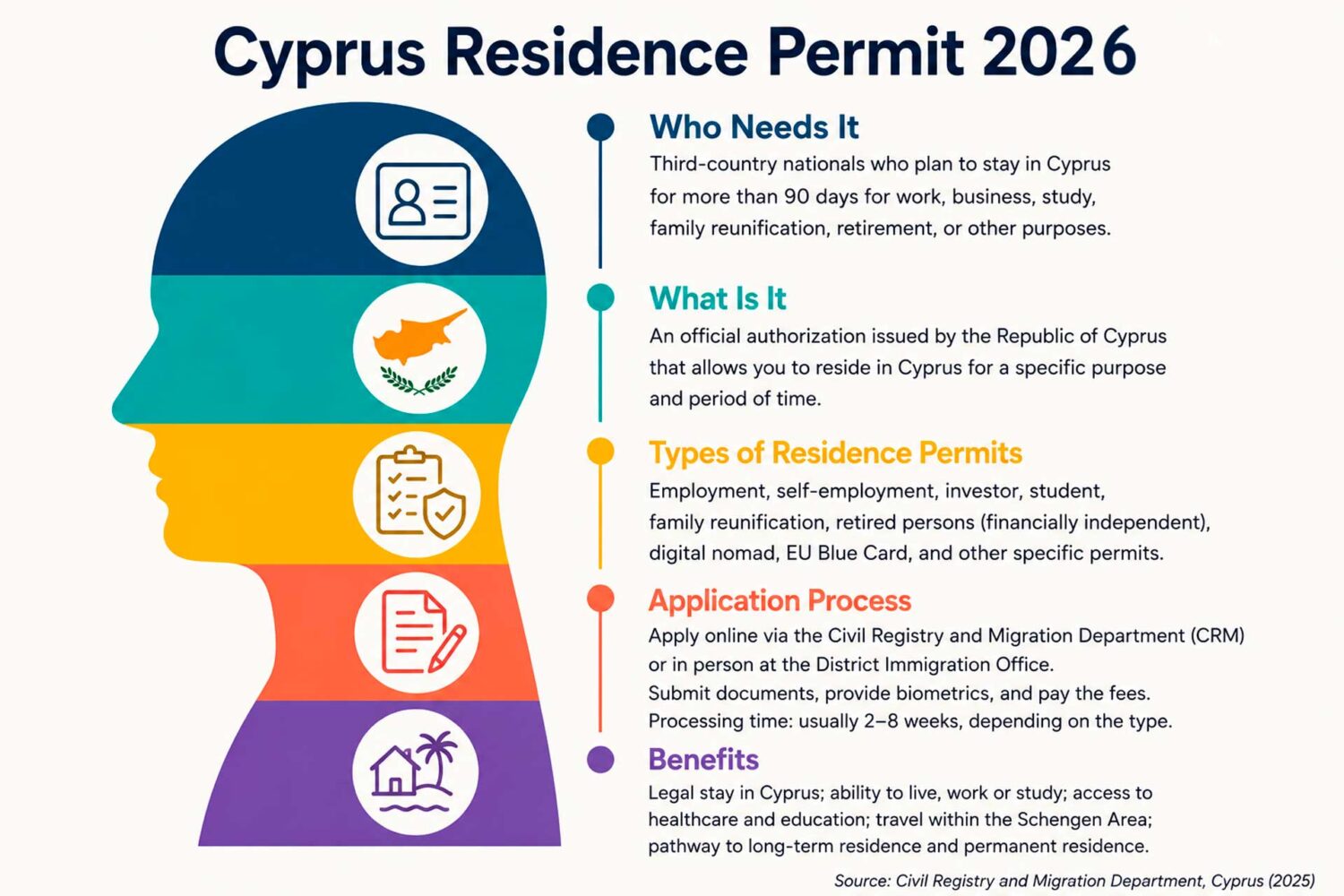
A Cyprus residence permit is the legal authorization that allows a non-EU national to live in Cyprus for more than a short tourist stay, usually for a specific purpose such as work, studies, family reunification, self-employment, or long-term residence. In many cases, the process is split into two stages: first a visa or entry permit, then a residence-permit application after arrival in Cyprus.
For most non-EU nationals, the practical routes fall into five core clusters: employer-sponsored work permits, student permits, family reunification, self-employed or immigration-permit routes, and the newer EU Blue Card / longer-term settlement pathways. Long-term resident status is available after qualifying years of legal residence. EU/EEA/Swiss nationals are mostly outside this framework because they usually rely on EU registration rights rather than the third-country permit categories covered here.
Processing time varies sharply by route. A standard employer-sponsored work application can be examined within one month if complete; visitor permits are usually processed within four months; student permits commonly take around three to four months operationally; EU Blue Card applications have a 90-day benchmark; family reunification can take up to nine months; and long-term resident status can take six to twelve months.
Costs also vary by route. Verified official fees run from about €30 for long-term resident applications, to €55–€140 for many student filings, €70 for visitor permits, €200 for family-reunification / certain entry-and-residence applications, and €500 for the broader immigration-permit category published by the Migration Department. Where a first registration is needed, the Aliens Registration Certificate is commonly €70 extra. If you also need a Cyprus visa, the official harmonized short-stay visa fee is currently about €90 for adults, with lower fees for children aged 6–12.
This article focuses on the highest-confidence findings from official Cyprus government pages, the EU Immigration Portal, and a small number of reputable Cyprus legal sources. It explains how to obtain a Cyprus residence permit in 2026, including the main immigration routes, eligibility requirements, application procedures, government fees, processing timelines, renewal rules, and practical expert tips to help applicants avoid common mistakes and choose the most suitable residence option.
Types of Cyprus Residence Permits
Cyprus does not operate a single universal residence-permit product. Instead, it publishes separate form packs, supporting-document lists, procedures and fee tables by purpose of stay. Below we synthesizes the core routes most relevant to non-EU applicants in 2026.
Work Permit
For ordinary employed work, Cyprus uses a labor-market-first structure. The employer normally starts with the District Labour Offices, which test whether the vacancy can be filled by suitably qualified local or EU labor. If that test is passed, the employer can move forward with the non-EU worker’s employment, entry and residence application. The EU Immigration Portal summarizes the worker-side requirements as an employment entry permit plus a temporary residence and employment permit, supported by a medical exam, criminal-record certificate, passport, and a stamped employment contract. The employer must also secure reasonable accommodation and a bank guarantee for possible repatriation costs.
For the current official Cyprus work pages, one important 2026 nuance is timing and duration. The published work-procedure page says duly completed applications can be examined within one month, and the residence permit can be issued for up to three consecutive years, depending on contract length. The older but still current EU Immigration Portal page states that temporary employed-worker permits are granted for a maximum of four years, with exceptions for sectors such as agriculture, domestic work, chefs, priests and tourist representatives. The safest reading is that Cyprus distinguishes between the length of a particular issued permit and the broader stay cap that can apply to some employment categories.
Another practical point: general work permits are usually tied to a specific employer. The EU Immigration Portal states that a worker may change up to three employers in the same sector and occupation under defined conditions, but repeated employer changes can end renewal eligibility. That makes the work route viable, but less flexible than the Blue Card or some foreign-interest-company routes.
Student Residence Permit
The student route applies to non-EU nationals enrolled in recognized higher-education institutions or other recognized study organizations in Cyprus. The EU Immigration Portal says students must usually obtain a visa or entry permit before traveling and then obtain a temporary residence permit after arrival. The current rules publicly listed on the portal require proof of admission, sufficient financial resources, health insurance, a criminal-record certificate and a passport; students must also register after arrival and complete medical checks. Student permits are normally granted for one year and renewed annually, and they are issued only for full-time students.
Cyprus is relatively attractive for international students because the route also comes with limited work rights. The EU Immigration Portal states that students may work up to 20 hours per week under specific conditions and in defined sectors, with the employment contract certified by the Department of Labour. The Cyprus Department of Labour separately notes that third-country student employment is governed by a current decree, and in its 2026 page it lists updated permitted sectors and occupations for students already in Cyprus by 1 December 2024.
Student fees are unusually transparent on the current official page. The Migration Department’s 2025/2026 student page shows: €70 for entry permit plus residence permit; €140 for entry permit plus residence permit plus ARC; €55 for change of status; €55 for issuance/renewal of a residence permit; €70 for first registration in the Aliens Register; and €125 for residence permit plus ARC. University support offices in Cyprus currently describe the operational processing time as about 3–4 months, which is useful because the public Migration Department snippet does not expose a single clear student decision benchmark in the same way it does for work and family routes.
A strong but often overlooked extra benefit is the post-study bridge. The Migration Department says graduates may stay in Cyprus for up to 12 months after completing studies in order to seek employment or set up a business, subject to the legal criteria of that route.
Family Reunification Permit
Family reunification in Cyprus is available to certain non-EU sponsors who have already been legally resident in Cyprus for at least two years and who have a reasonable prospect of remaining. The EU Immigration Portal defines the core beneficiaries as the spouse over 21 whose marriage existed at least one year before the application, plus unmarried minor dependent children. The sponsor must prove the family relationship, suitable accommodation and sufficient financial resources.
The official family-reunification timing is one of the slowest in the system. Cyprus’s current gov.cy page states that family-reunification applications are examined within nine months, or 90 days in the case of intra-corporate transferees or researchers. If approved, family members receive a residence permit valid for one year, renewable, but not longer than the sponsor’s own permit. The EU Portal also notes that access to employment for family members can be restricted for up to 12 months, because a labor-market test may apply during the initial period.
Public fee data for this route are now visible on the official family-process page. Cyprus lists €200 for issuance of entry permit and residence permit, €200 for issuance of residence permit, €200 for renewal, €200 for renewal due to employer change where relevant, plus €70 for first registration in the Aliens Register. Employment contracts, where applicable, must also be stamped, with the amount depending on contract value.
Self-Employed Permit
This is one of the most misunderstood routes in Cyprus. The EU Immigration Portal makes clear that a self-employed non-EU national in Cyprus does not usually obtain a simple temporary self-employment permit. Instead, the applicant applies for an immigration permit, which is a type of permanent residence permit. The application is submitted to the Migration Department, which consults other ministries and checks whether the proposed business harms the economy, what activity is intended, labor-market conditions, job creation impact and foreign capital levels.
The route is divided into sub-categories. The publicly listed capital thresholds are high: €427,000 unencumbered capital for agricultural/livestock activity, €342,000 for mining, and €256,000 for business-sector self-employment. For professional or science-based activity, the test is whether the applicant has adequate funds and whether there is demand for additional members of that profession or science in Cyprus. Because of those thresholds, this is not a casual freelancer route; it is closer to an economic-establishment route.
The permit, once granted, is permanent unless the applicant fails to take up residence within one year, fails to begin activity, or remains outside Cyprus for two years or longer. Cyprus’s public immigration-permit forms page confirms that these permanent-route applications sit under the MIP2 framework for categories including C, D, E and F, and the broader immigration-permit page lists a €500 application fee plus €70 if an ARC is needed. Because the public snippet does not separate every permanent category neatly, applicants should verify the exact fee for their specific self-employed category before filing.
EU Blue Card and Long-Term Residence
The EU Blue Card is Cyprus’s most important recent development for highly qualified migration. Although the European Commission’s EU Immigration Portal still displayed a 1 April 2025 note saying admission volumes were zero and no Blue Cards were being issued, Cyprus officially announced on 4 July 2025 that applications would open from 7 July 2025. KPMG Cyprus separately notes that the legislative reform of the Blue Card framework became effective from 1 August 2024. In other words, private guides that rely on older portal snapshots can now be materially out of date.
Cyprus’s current official Blue Card page is quite detailed. It states that applications are submitted only in Nicosia, processing is 90 days if the file is complete, long-term-mobility applications are processed in 30 days, and the minimum gross annual salary is €43,632. The designated highly qualified sectors are ICT, pharmaceutical research, and maritime services excluding ship captains and crew. Cyprus also says there are no maximum admission quotas for Blue Cards where the employment falls within the defined sectors.
The Blue Card also matters because of mobility and rights. Cyprus’s FAQ states that Blue Card holders may move within the EU for business-related short-term mobility of up to 90 days in any 180-day period, and after 12 months of legal residence in the first member state, they may use the long-term mobility framework for entry and residence in a second member state for highly qualified employment. The same page emphasizes that Blue Card family members can obtain permits of equal duration, and that Blue Card holders enjoy equal-treatment rights in employment conditions, education and training, social security, and access to goods and services. Cyprus also specifically notes that the usual “absence for more than 3 months cancels the permit” rule does not apply to a valid EU Blue Card.
Long-term residence is the settlement stage after ordinary legal stay. Cyprus’s long-term resident page says applicants must have resided legally and continuously in government-controlled areas of Cyprus for the last five years, subject to generous but defined absence limits: absences do not break continuity if they are shorter than six consecutive months and do not exceed ten months in total during the relevant five-year period. The official page also lists who is excluded, including asylum seekers, some temporary-only categories such as seasonal workers, and certain diplomats. The application fee is €30, the examination period is 6–12 months, and the initial permit is valid for 5 years.
If you are planning a long-term move to Cyprus and want to understand whether permanent residence is the right option for your situation, leave a request for a consultation. Our specialists will assess your eligibility, compare available immigration routes, and help you choose the most suitable strategy for relocating to Cyprus or another EU country.
Leave your contacts to have an expert contact you shortly.
Cyprus Residence Permit Requirements
Cyprus publishes requirements by permit family rather than as one universal list. Still, the same documentary logic repeats across most routes: identity, legal entry, purpose of stay, financial means, medical / insurance evidence, accommodation, biometrics, and translated / authenticated documents.
General Requirements
For work routes, you should expect a valid passport, criminal-record certificate, medical examination, stamped employment contract, and employer-side documents such as accommodation and repatriation guarantee. For students, the standard package includes admission evidence, sufficient funds, health insurance, criminal-record certificate and passport. For family reunification, Cyprus checks the family relationship, accommodation and financial resources. For self-employed or longer-term routes, it adds business viability, capital sufficiency, and, for long-term resident status, lawful and continuous residence history.
Biometrics are a cross-cutting requirement. Cyprus states that residence-permit biometrics include a facial image and fingerprints, and the applicant’s signature is also captured. The current Department pages repeatedly note that biometrics are required both for first issue and for many renewals.
Documents Needed
The document checklist below reflects the common denominator across the main 2026 routes. Individual form packs remain decisive and should always be checked first.
| Document | Work | Student | Family | Self-employed / Immigration | Blue Card / Long-term |
| Valid passport | Yes | Yes | Yes | Yes | Yes |
| Application form | Yes | Yes | Yes | Yes | Yes |
| Passport photos / biometrics | Yes | Yes | Yes | Yes | Yes |
| Criminal-record certificate | Common | Yes | Common | Common | Common |
| Medical examination | Common | Common after arrival | Often route-specific | Route-specific | Route-specific |
| Proof of purpose | Employment contract | Admission letter | Marriage / birth / dependency proof | Business plan / category proof | Highly qualified employment / residence history |
| Proof of finances | Salary contract | Funds for living costs | Sponsor funds | Capital / funds | Income stability |
| Health insurance | Yes / route-specific | Yes | Yes / route-specific | Yes | Yes |
| Proof of accommodation | Yes | Yes | Yes | Usually yes | Often yes |
This checklist is synthesized from the official work, student, family, self-employed and long-term-resident pages.
Financial Requirements
Financial evidence is one of the biggest differentiators between routes. Workers usually prove funds through the salary and employment contract. Students must show sufficient resources for living expenses and health insurance. Family sponsors must show sufficient financial resources for the family unit. Self-employed applicants face explicit capital thresholds depending on category. Blue Card applicants must satisfy the much higher salary threshold of €43,632 in the designated sectors.
The self-employed route is the clearest example of a route-specific financial test. Cyprus says category A applicants need €427,000, category B €342,000, and category C €256,000 in unencumbered capital, while category D applicants must show adequate funds and professional demand. That structure is much closer to an economic-establishment route than to gig-economy freelancing.
A practical compliance point from Cyprus legal practitioners is that authorities care not only about the amount of money shown, but also about coherence and traceability. Public Cyprus legal guidance stresses that foreign documents should be apostilled or consularized and translated, and that common errors include incomplete financial backups, inconsistent names, and expired certificates. That practical warning aligns closely with the Migration Department’s own insistence on certified / ratified documents and complete files.
Health Insurance
Health insurance appears in almost every major route. The EU Immigration Portal explicitly lists health-insurance proof for students, self-employed applicants and long-term residence. For visa-stage applications, Cyprus embassy guidance says applicants must generally show valid travel medical insurance with minimum coverage of €30,000 for emergency medical treatment, hospitalization and repatriation.
Cyprus also uses medical screening in several first-permit categories. Official supporting-document lists indexed on the government site show that some first permits require blood tests for hepatitis B and C, HIV, syphilis, plus a chest X-ray for tuberculosis, completed in Cyprus and certified by a specialist doctor. Because these checks appear in route-specific lists rather than a single universal page, applicants should treat them as common but not necessarily identical across all categories.
Proof of Accommodation
Accommodation proof is a standard part of a strong Cyprus file. For family reunification, the sponsor must show accommodation meeting general health and safety standards. For work permits, the employer must provide reasonable accommodation. Visitor-style and family-linked form packs on the public Migration Department pages also include hosting declarations and related supporting forms, showing that Cyprus accepts more than one type of accommodation evidence depending on the route.
In practice, acceptable proof can include a lease agreement, university housing confirmation, employer-arranged accommodation, title deed evidence, or a formal hosting / assumption-of-responsibility document. The exact format should match the route’s current supporting-document list, not a general checklist from another category.

How to Apply for a Cyprus Residence Permit
At a high level, Cyprus uses a purpose-based sequence: choose the correct route, secure the right entry basis, file the residence application with the relevant supporting documents, give biometrics, then wait for either card collection instructions or a refusal letter with reasons. Cyprus also provides an SMS-based status-checking option through the Migration Department homepage. Application Steps:
- Choose the correct permit type.
This sounds obvious, but in Cyprus it is critical. A worker route, student route, family route, self-employed route and Blue Card route are run through different forms and document lists. Using the wrong form set can get your file rejected or returned. As of 2026, Cyprus accepts only the revised forms published by the Migration Department. - Confirm whether you need a visa or an entry permit before travel.
Cyprus states that entry for residence purposes can happen with an entry permit issued by the Migration Department, with a visa issued by the diplomatic / consular authorities, or with other route-specific documentary bases. Student and work routes often require a pre-entry stage. Cyprus also says its visa procedures, required documents, fees and visa sticker are harmonized with Schengen-member procedures, even though Cyprus’s residence and border regime remains its own system. - Prepare your documents carefully.
Cyprus requires official translations into Greek or English where needed, and it expects certification / ratification of copies. This is one of the most common failure points in practice. - Submit to the correct authority.
The office depends on the route. Some applications go through a Cypriot embassy or consulate abroad; some go directly to the Migration Department in Nicosia; some can be filed through district Aliens and Immigration units. The Blue Card is especially centralized: Cyprus says Blue Card applications are submitted only at the Department’s headquarters in Nicosia. - Pay fees and, where relevant, stamp duties.
Cyprus currently accepts cash for transactions up to €10,000, bank cards via POS, and bank cheques / banker’s drafts, while personal cheques were discontinued from 1 January 2026. Some employment contracts must also be stamped, with the amount depending on the contract value. - Give biometrics and complete registration after arrival.
The current government pages state that facial image, fingerprints and signature are captured for residence-permit issuance, and often for renewal as well. For first registrations, the ARC step may also apply. - Track the file and collect the card if approved.
Cyprus says applicants can track residence-permit progress through its SMS status mechanism using the application number on the fee receipt. If approved, the Department sends collection instructions; if refused, it sends a letter with reasons.
Thinking about settling in Cyprus for the long term? Leave a request for a consultation, and our experts will help you evaluate your options, navigate the residence requirements, and identify the most effective path to securing legal status in Cyprus or another European destination that matches your plans.

Cyprus Residence Permit Processing Time and Fees
Processing Time
Cyprus has no single “average processing time” because the routes differ so much. The best way to plan is to think in route clusters:
- Fastest standard route: certain employer-sponsored work filings can be examined within 1 month if complete.
- Common middle range: student and visitor-style filings often take about 3–4 months in practice.
- Formal longer routes: EU Blue Card is 90 days, family reunification is up to 9 months, long-term residence is 6–12 months.
Cyprus does not publish a single universal “fast-track” residence-permit lane for all categories, but some categories are plainly faster than others. Three examples stand out. First, the ordinary work route can have a one-month benchmark if complete. Second, the Startup Visa scheme has a published five-week initial approval stage by the Deputy Ministry of Research, Innovation and Digital Policy, after which entry and residence formalities follow. Third, Blue Card long-term mobility cases have a 30-day examination window. On top of that, the Migration Department launched a pilot electronic renewal service on 22 May 2026 for selected permit renewals, which may gradually improve renewal logistics even though physical filing remains available.
The biggest factors that slow cases are not mysterious: missing documents, insufficient translations, route mismatch, and incomplete supporting evidence. Cyprus says incomplete long-term-resident files will not even be accepted for consideration, and legal practitioners report that expired certificates, wrong forms, inconsistent names and non-apostilled foreign documents are recurring causes of delay.
Fees
The table below groups the main publicly verified official fees by route. Because permit pages expose fees unevenly, the figures shown here are limited to amounts that could be independently verified from current public sources.
| Fee item | Verified amount |
| Student: entry permit + residence permit | €70 |
| Student: entry permit + residence permit + ARC | €140 |
| Student: issuance / renewal of residence permit | €55 |
| Student: residence permit + ARC | €125 |
| Visitor: issuance or renewal of residence permit | €70 |
| First registration in Aliens Register / ARC | usually €70 |
| Family reunification: entry permit + residence permit | €200 |
| Family reunification: issuance of residence permit | €200 |
| Family reunification: renewal | €200 |
| Long-term resident application | €30 |
| Broader immigration permit page | €500 |
| Short-stay Cyprus visa for adults | about €90 |
| Short-stay visa for children aged 6–12 | about €45 |
Beyond government fees, most applicants should budget for:
- official translations and certification / apostille costs;
- medical tests for routes that require Cyprus-issued screenings;
- private or travel health insurance at the entry stage;
- contract stamp duties in work-related cases;
- legal-representation costs if using a lawyer or authorized representative.
How to Renew a Cyprus Residence Permit
Cyprus’s general residence-document FAQ says you should apply for renewal at least one month before expiry of the current residence permit. That is the main rule for most ordinary temporary-permit holders. The Department also notes that if passport data change, you should apply for renewal or re-issuance with the new passport details and complete the relevant fee and biometric procedure again.
Long-term resident status uses a different timetable. Cyprus says renewals of long-term status should be filed three months before the expiry of the initial permit, the application fee is €30, and the usual required document publicly listed for renewal is a copy of the passport pages for the last five years showing arrivals and departures. A 7 July 2025 Migration Department press release also confirms that long-term resident card renewals open three months before the current card expires and require a valid passport copy, the previous card, payment proof and fresh biometrics.
Blue Card holders also have a specific renewal clock. Cyprus’s official FAQ says the renewal application should be submitted within 3 months prior to expiry of the current EU Blue Card.
A useful 2026 update is the pilot e-renewal service launched on 22 May 2026. According to the Migration Department, it currently covers selected renewals: remunerated employment with the same employer, domestic employment with the same employer, certain employees of foreign-interest companies, some family-reunification dependants of those employees and long-term residents, and long-term residence permits. Physical filing continues in parallel for now.
One rule many applicants miss is the travel rule. Cyprus says a valid temporary residence permit allows re-entry only if the holder has not stayed outside Cyprus for more than three months. If a temporary-permit holder stays abroad beyond three months, the permit is cancelled even if the printed expiry date has not yet passed, and the person must restart the relevant entry procedure. The current official Blue Card FAQ states that this specific cancellation rule does not apply to valid Blue Card holders.

Why Residence Permits Get Rejected in Cyprus
The official pages consistently say that if an application is rejected, Cyprus sends a written letter stating the reasons. While refusal grounds vary by route, the public-source pattern is clear. The most common rejection risks are:
- Missing or incomplete documents. Cyprus repeatedly warns that incomplete files increase processing time, and for long-term residence it says applications lacking all required documents will not be accepted for consideration.
- Weak financial evidence. Students must show sufficient funds, family-reunification sponsors must show sufficient financial resources, self-employed applicants must meet capital tests, and Blue Card applicants must meet the official salary threshold. If the financial proof does not correspond to the route, the application becomes fragile.
- Incorrect translations or authentication defects. The Migration Department requires Greek or English documents, with official translations and proper certification / ratification. Cyprus legal practitioners say this is one of the most common practical failure points.
- Using the wrong form or an outdated form. This became more important in 2026 because only revised forms have been accepted since 2 April 2026.
- Route mismatch. A typical example is trying to use a visitor-style route where a work route is actually needed, or assuming that a self-employed applicant can use a light freelance-style filing when Cyprus actually routes most self-employment through permanent immigration-permit criteria.
- Travel or continuity breaches. Family members seeking long-term residence, long-term applicants generally, and ordinary temporary-permit holders all face continuity rules, especially around time spent outside Cyprus.
Expert Tips for Getting Approved
The best Cyprus applications are not the thickest ones. They are the most internally consistent ones. Your passport spellings, translated civil-status documents, proof of funds, accommodation evidence, and purpose-of-stay documents should all point to the same narrative. This matters even more in 2026 because Cyprus has revised its forms and is clearly tightening administrative compliance.
A second expert tip is to separate route eligibility from route convenience. For example, many applicants think “self-employed” sounds simpler than employer sponsorship, but in Cyprus it normally means an immigration-permit route with very substantial capital thresholds. Likewise, some highly qualified workers still see outdated private guides describing the Blue Card as inactive or citing lower salary thresholds, while the current official Cyprus page says applications are open, the threshold is €43,632, and the sectors are restricted. Always let the latest official Cyprus page override older summaries.
A third tip is to treat travel, renewal and post-arrival compliance as part of the original application strategy. Ordinary temporary-permit holders can lose status by staying outside Cyprus for more than three months, while long-term residents and immigration-permit holders face their own absence rules. If you travel frequently for work, that can change which route is best for you.
Because public case files are not normally published, the most honest “case” examples are route-based scenarios rather than individual personal files. A common successful pattern is the student applicant whose file is complete from day one: recognized admission letter, local accommodation proof, medicals completed promptly in Cyprus, and renewal filed one month before expiry. A common difficult pattern is the family or permanent-route applicant who qualifies in principle but arrives with non-apostilled civil documents, inconsistent name spellings, or outdated forms. Those are exactly the issues Cyprus legal practitioners warn about publicly.
If you are planning a Cyprus residence application and want to maximize approval odds, legal support is most valuable in three cases: when the route is not obvious, when your documents come from multiple countries and require authentication, and when your long-term plan matters just as much as first approval. Good legal support should help you choose the right category, audit the document chain, align visa-entry-residence steps, and prevent avoidable delays caused by form errors or weak translations.
If you need professional help obtaining a Cyprus residence permit, legal guidance can make the process materially safer and faster. An immigration lawyer can review route eligibility, prepare a compliant document pack, coordinate translations and certifications, handle family-member filings, and support renewals or upgrades to long-term residence. For applicants with complex work histories, cross-border family documents, or self-employed / Blue Card profiles, that support is often worth the cost because Cyprus applications are highly formal and errors can trigger long delays or refusals.
Leave a Comment

We have prepared answers to the most common questions about Cyprus residence permit. If you want to clarify anything, please contact us - we will provide detailed explanations.
It depends on the route. Student permits and many family permits are usually issued for one year and renewed; work permits depend on contract length and route, with some official work pages allowing up to three consecutive years per issuance; long-term resident status is a deeper settlement category after five years of qualifying residence; and immigration permits are permanent unless lost through absence or other legal grounds.
Some permits allow work, some do not. Work permits obviously do, student permits allow limited work up to 20 hours per week under specific conditions, family-reunification dependants may face an initial labor-market test for up to 12 months, and visitor-type residence generally does not authorize local employment.
Cyprus is not “easy” in the sense of being informal, but it is relatively transparent when you match the correct route and submit a clean file. The country publishes detailed form packs, fee tables and supporting-document lists. The real difficulty is procedural precision: choosing the right category, preparing correctly translated documents, and proving finances, insurance and accommodation in the exact format the route requires.
Usually yes, but only under the route’s conditions. For ordinary family reunification, the sponsor generally needs two years of legal residence in Cyprus, a spouse over 21 in a qualifying marriage, and dependent minor children, plus suitable accommodation and sufficient resources. Blue Card holders also have a family route with permits of equal duration to the Blue Card.
Yes. There are at least two broad ways relevant to this intent: settlement after five years of legal and continuous stay through long-term residence, and permanent immigration-permit routes such as self-employed / immigration categories or investment-linked immigration permits. These should not be confused with Cyprus citizenship. A residence permit gives lawful stay in Cyprus under the conditions of that permit; it does not itself make you a Cypriot citizen or grant full EU free-movement rights.
In almost all meaningful routes, yes. Students, family routes, self-employed applicants and long-term applicants all encounter health-insurance requirements, and visa-stage applications typically require travel medical insurance with minimum coverage of €30,000.
Often part of the process happens before entry, and part after entry. Students and many workers typically need a visa or entry permit first, then they complete residence formalities and biometrics in Cyprus. Some permanent and Blue Card applications are centralized in Nicosia. The correct answer depends on the route you are using.


Comments
No comments found.