

 EU Citizenship
 Slovenian Citizenship
 Romanian Citizenship
 Bulgarian Citizenship
 Austrian citizenship (investments)
 Spanish Citizenship
 Italian Citizenship
 Cypriot Citizenship
 Lithuanian Citizenship
 Portuguese Citizenship
 French Citizenship
 German Citizenship
 Hungarian Citizenship
 Dutch Citizenship
 Belgian Citizenship
 Croatian citizenship


German Residence Permit: A Complete Guide 2026 for Non-EU Immigrants

Author: Leon Scott
Published: 06.11.2025
Updated: 17.12.2025
Moving to Germany is exciting, but if you plan to stay longer than a short visit, you’ll need to understand the German residence permit. This guide will explain what a German residence permit is, how to get a German residence permit, how long it lasts, how to renew it, and other important details. We’ll answer common questions (like “how do I get a German residence permit?”) in a clear, friendly way. Whether you’re coming for work, study, or family reunion, this article provides step-by-step instructions, real examples, and tips to help non-specialists navigate the process with confidence.
This article is written for non-EU citizens planning to relocate to Germany (or those who have just arrived). It focuses on temporary residence permits – the permits you need for your initial years in Germany – and also touches on permanent residence for the long run.
What Is a German Residence Permit
A German residence permit (Aufenthaltstitel) is an official document (now a biometric card) that allows non-EU/EEA citizens to live in Germany for a specified duration and purpose. In other words, if you’re not from the EU/EEA or Switzerland and you want to stay in Germany for more than 90 days, you must obtain a German residence permit after you arrive. This permit grants you legal permission to reside in Germany beyond a short-term visa stay.
Residence Permit vs. Visa: It’s important to know the difference between an entry visa and a residence permit. A visa (usually a Type D national visa for Germany) is typically what you obtain before traveling – it’s the entry permission for coming to Germany for long-term purposes (study, work, etc.). The residence permit is what you apply for once you’re in Germany to continue living there long-term beyond the visa’s initial validity. Think of the visa as a ticket to enter Germany, and the residence permit as the authorization to stay and participate in life in Germany beyond 3 months. For example, you might get a 90-day work visa from the German embassy in your country, move to Germany, then convert that into a work residence permit at the local immigration office.
Who needs a German residence permit? Essentially, all non-EU/EEA/Swiss citizens who plan to stay in Germany longer than 3 months (90 days) need a residence permit. This includes people moving to Germany for work, study, research, family reunification, or other long-term purposes. (There are a few exceptions: citizens of certain countries like the USA, Canada, Australia, and some others can enter Germany without a visa and apply for the residence permit from inside Germany within 90 days of arrival. We’ll explain that in the application steps.) EU/EEA and Swiss citizens don’t need residence permits thanks to free movement rights – they can live and work in Germany without special permission, only needing to register their address.
Alternative EU immigration programs are available in countries such as Romania, Bulgaria, and Slovenia. These streamlined procedures offer a faster and easier path to obtaining an EU passport, granting you the lifelong right to live and work freely across the European Union. With professional legal assistance, you can relocate to the EU and secure citizenship in as little as 14 months. Leave a request for a consultation, and our experts will help you choose the most suitable program and guide you through every step of the process.
Types of German Residence Permits
Germany offers two main categories of residence permits for non-EU citizens: temporary and permanent. Within these categories, there are specific permits for different purposes (work, study, family, etc.). Understanding the types will help you determine which one you need and plan your path in Germany.
Temporary Residence Permit (Aufenthaltserlaubnis)
A temporary residence permit is the most common type for newcomers. It allows you to live in Germany for a limited period and is tied to a specific purpose. Common purposes include studying at a German university, working for a German employer, job-seeking, conducting research, or joining a family member in Germany. Key points about temporary permits:
- Validity.
Usually issued for 1 to 3 years at a time (up to a maximum of 4 years in some cases). Often the duration matches your reason – for example, a work permit might last as long as your work contract (up to 4 years), and a student residence permit might be 1-2 years (renewable if your studies take longer). - Purpose-Bound.
The permit is linked to why you’re in Germany. You generally can only do the activities that your permit allows. For instance, a student residence permit lets you study and work part-time (with limits), but if you finish studying and want to start full-time work, you’d need to switch to a work permit. Similarly, a work permit may name your employer or job; changing jobs or fields might require an update to your permit. - Renewable.
Temporary permits can be renewed or extended as long as you still meet the requirements and your purpose continues. Many people hold successive temporary permits over several years (we’ll discuss how to renew a German residence permit later). For example, if you originally came as a student and then find a job, you can transition to a work permit; or if your 2-year work permit expires and you’re still employed, you can extend it. - Leads to Permanent Residence.
A temporary residence permit is usually the first step toward settling in Germany permanently. After spending enough time in Germany (typically 5 years in many cases), and meeting other conditions, you can become eligible for a permanent residence permit (also known as a settlement permit). We’ll cover how to get a German permanent residence permit in detail below.
Examples of temporary residence permits:
- Work Permit. For non-EU nationals with a German job offer. Often valid for the length of the job contract (up to 4 years) and can be renewed if you continue working. Allows full-time work (sometimes restricted to a specific employer or role).
- Student Residence Permit. For those admitted to a German educational institution. Usually valid for 1-2 years at a time and renewable until you finish your studies. Allows limited part-time work (e.g., 120 full days per year) under German law.
- Job-Seeker Visa/Opportunity Card. For those coming to Germany to look for a job. A job seeker visa is a temporary permit (generally up to 6 months) that lets you reside in Germany while searching for employment. In 2023, Germany also introduced the Opportunity Card (Chancenkarte) – a new points-based residence permit that lets qualified individuals come to Germany for up to 12 months to seek work or training opportunities. The Opportunity Card has specific eligibility criteria (like education, work experience, language skills, etc.) but is another pathway for job seekers to reside temporarily in Germany while they look for a job. If you find a job during this period, you can convert the job-seeker permit into a work permit. (If not, you would normally have to leave when it expires.)
- Family Reunion Permit. For spouses or children of a person legally residing in Germany. Usually issued for 1-3 years and renewable; it often allows the family member to work as well. Requirements include sufficient living space and financial support for the family.
Those are just a few examples; there are also permits for researchers, trainees, asylum seekers, etc. But no matter the subtype, they fall under the temporary permit category with the above general characteristics.

Permanent Residence Permit (Niederlassungserlaubnis)
A permanent residence permit (Niederlassungserlaubnis, also called a settlement permit) allows you to live and work in Germany indefinitely. Unlike temporary permits, a permanent permit has no expiration date – it’s essentially valid for life, as long as you continue to reside in Germany. With a permanent residence permit, you are no longer tied to a specific purpose or employer; you have complete freedom to take up any employment, become self-employed, or study in Germany without needing further permission.
However, you cannot get a permanent residence permit right away as a new arrival (with a few exceptions). You must first spend a certain number of years in Germany on temporary permits and meet specific requirements. Here are the typical requirements to obtain a German permanent residence permit:
- 5 Years of Residence. In most cases, you must have lived in Germany for at least five years with a valid temporary residence permit. During those years, you should not have significant gaps or violations of your permit.
- Financial independence. You need a secure livelihood – e.g. a stable job or sufficient income/savings – so that you’re not relying on welfare. Proof of regular income and sometimes savings or pension contributions is required.
- Contributions to Pension. Typically, you must have paid into the German statutory pension scheme for a certain period (usually 24 to 60 months, depending on your case). Being employed with social security or voluntarily contributing counts.
- Language and Integration. You should have at least intermediate German language skills (level B1) and basic knowledge of German society and laws. Often you’ll need to pass an integration test or course (known as the “Living in Germany” test) to demonstrate this.
- Accommodation. You must have adequate living space for yourself and any family members joining you (for example, your own apartment of reasonable size).
- No Criminal Record. While not explicitly listed in all sources, in practice you shouldn’t have serious criminal convictions that could jeopardize your status.
- Stayed within Germany. If you left Germany for long periods during those years, it might reset the clock. Generally, once you have permanent residence, leaving Germany for over 6 months without permission can lead to losing it, but during the qualifying period for permanent residency, you should primarily reside in Germany.
Meeting all these conditions allows you to apply for a permanent settlement permit. One big advantage of a permanent permit is that it eliminates the need for renewals – no more frequent trips to the Ausländerbehörde for extensions. It also makes certain things easier, like bringing family over (family reunion is simpler) and eventually applying for German citizenship (time on a permanent permit counts toward the years required for naturalization).
Special fast-track (EU Blue Card). If you came to Germany on an EU Blue Card, you can qualify for permanent residency faster. The EU Blue Card is a type of temporary residence permit for highly skilled workers with a university degree and a sufficient salary. Blue Card holders can apply for permanent residence after as little as 21 months (under two years) if they have B1 German language proficiency, or after 33 months without B1. This is a significant reduction from the usual 5 years. The Blue Card also allows easier mobility to other EU countries. We’ll discuss the Blue Card more shortly, but it’s good to know it provides a shortcut to permanent status.
EU Blue Card
The EU Blue Card deserves a mention as a distinct category of residence permit in Germany. It’s technically a temporary residence permit (valid up to 4 years initially), but it’s designed for university-educated professionals and comes with extra benefits. To get a Blue Card for Germany, you need a job offer that pays at least a minimum salary (for instance, about €48,300 per year in 2025, with a slightly lower threshold for shortage occupations like IT or engineering at around €43,800). You also need a recognized university degree.
Benefits of the Blue Card include a faster path to permanent residence (as mentioned, potentially 21–33 months) and immediate work permission for your spouse (your spouse can work in Germany without restrictions from day one). Blue Card holders also have some flexibility to move to other EU countries after 18 months on the card. If you qualify for a Blue Card, it’s often the best option for skilled workers due to these advantages.
Other specialized permits (just for awareness) include the ICT Card (intra-company transfer for managers/employees), Freelance/Self-Employment permits for entrepreneurs or freelancers, and the Researcher visa. But for most people, the main types are covered above.
Below is a quick comparison of temporary vs. permanent residence permits (and where the EU Blue Card fits in):
| Aspect | Temporary Residence Permit (Aufenthaltserlaubnis) | EU Blue Card (temporary work permit) | Permanent Residence Permit (Niederlassungserlaubnis) |
| Initial Validity | Usually 1–3 years (up to 4 years max), depending on purpose (study, work contract length, etc.). | Up to 4 years (or length of job contract + 3 months). | Indefinite (no expiry date) – permanent. |
| Purpose Restrictions | Yes – tied to a specific purpose (job, study, family, etc.). You must continue to meet that purpose to maintain the permit. | Yes – tied to highly skilled employment. Changing jobs in first 2 years may require approval. | Not tied to any purpose. You can work in any field or study freely. |
| Work Rights | Vary by permit: e.g. work permit allows employment (possibly specified employer), student permit allows limited part-time work, family permit usually allows work. Check your permit for any restrictions. | Full employment in the qualified job that the Blue Card is issued for. Spouses of Blue Card holders can work without restriction. Mobility to other EU countries after 18 months. | Full access to the job market. You can work for any employer or be self-employed with no permit-related restrictions. |
| Renewal Needed | Yes – must be renewed before expiry if you are staying longer. For example, extend your work permit if you extend your contract, etc. (We cover how to renew a German residence permit below.) | Yes – if you haven’t transitioned to permanent residence by the end of the Blue Card’s validity, you would renew it. (Many Blue Card holders transition to permanent after ~2–3 years.) | No regular renewals required. However, if you leave Germany for >6 months (or >12 months with permission), the permit can lapse. Otherwise it remains valid indefinitely. |
| Time to Permanent Eligibility | Generally 5 years of continuous residence (with contributions, etc.) to be eligible for permanent residence. Some cases like marriage to a German or former German graduates may have slightly reduced time (e.g. 2-3 years) under certain conditions. | 21–33 months (under 2–3 years) if conditions are met (21 months requires B1 German skill). This is a fast-track route to permanent residency. | You already have permanent status. After typically 8 years (or less in some cases) in Germany, including time with permanent residency, you could be eligible for citizenship, but that’s another topic. |
As you can see, most newcomers will start with a temporary residence permit in one form or another. Next, we’ll explain how to get a German residence permit – the application process you’ll go through after arriving in Germany.
How to Get a German Residence Permit (Step-by-Step)
If you’re wondering how to get a German residence permit, the process can be broken down into clear steps. In Germany, residence permits are handled by the local immigration authority called the Ausländerbehörde (Foreigners’ Office) in the city or district where you live. Below is a step-by-step guide on how to apply for a German residence permit once you are in Germany.
1. Enter Germany with the Right Visa (if required)
Before you can apply from within Germany, you need to have entered legally. Depending on your nationality, this means either:
- obtaining a long-term visa (national visa) from a German embassy/consulate in your home country for your purpose (e.g. work visa, student visa). This visa usually grants entry and is valid for the first 3-6 months of your stay. How do you get a German residence permit in this case? You convert this visa into a residence permit after arrival.
- Or, if you are a citizen of certain visa-exempt countries (e.g. USA, Canada, Australia, UK, Japan, South Korea, Israel, New Zealand, etc.), you can arrive in Germany without a visa and apply for the residence permit directly in Germany within 90 days.
2. Register Your Address (Anmeldung)
Once you arrive and have a place to stay, your first bureaucratic task is the Anmeldung – registering your local address at the citizen’s office (Bürgeramt or Einwohnermeldeamt). This is required for everyone, and you’ll receive a Meldebescheinigung (registration certificate). You must do this before applying for the residence permit. The Anmeldung certificate is a required document for the permit application. (Tip: You’ll need a rental contract and a form from your landlord for this registration.)
3. Gather All Required Documents
Prepare the necessary paperwork for your residence permit application. Having everything in order will make the process smoother. Common required documents include:
- Completed Application Form – The official application for a residence permit (Antrag auf Aufenthaltstitel). You can usually download this from your local Foreigners’ Office website (some offices also offer an online application). Fill out the form carefully with all your personal details, purpose of stay, etc. Be thorough and accurate; incomplete or incorrect forms can cause delays.
- Valid Passport – Your passport (valid for the entire duration of your stay) plus photocopies. The permit will be a separate card, but your passport is still your primary ID.
- Biometric Photos – Passport-sized photos that meet the German biometric specifications (neutral expression, light background, specific size). Usually two photographs are required.
- Proof of Accommodation – Evidence that you have a place to live in Germany. This is typically your rental contract (Mietvertrag) and a landlord confirmation form(Wohnungsgeberbestätigung) signed by your landlord. (The landlord confirmation is a form your landlord signs to confirm you live at that address – it’s required for address registration as well.)
- Address Registration Certificate (Anmeldung) – The certificate you received when you registered your address (as mentioned in step 2).
- Proof of Financial Means – You need to show you can support yourself financially. What counts as proof depends on your situation: if you’re working: an employment contract and recent pay stubs. If you’re a student: a blocked bank account (Sperrkonto) with the required funds, a scholarship letter, or a sponsor’s formal undertaking (Verpflichtungserklärung). If job-seeking: proof of savings, or a blocked account showing funds (Germany requires roughly €1,000 per month available, so about €12,000 for a year). If joining family: proof your sponsor in Germany has sufficient income.
- Proof of Health Insurance – Germany mandates health insurance for all residents. You must have valid German health insurance coverage (public or private) by the time you get your permit. Travel insurance won’t suffice for long-term. Students under 30 often have public student insurance; employees usually have public or private insurance via their job; others (like job seekers) may need to purchase private insurance. Provide your insurance policy or certificate as proof.
- Proof of Purpose – Additional documents depending on your permit type: Students: University enrollment certificate or admission letter (Immatrikulationsbescheinigung). Workers: Job contract and possibly a job description from your employer. Sometimes proof of qualifications or professional license if required for the job. Job seekers: Your university degree certificate (since job seeker visas often require a university degree). Family reunion: Marriage certificate (for spouses) or birth certificates (for children), etc., plus usually proof of the family member’s residence status in Germany. Self-employment: a business plan, financial proof (capital or funding), and any necessary permits or professional authorizations.
- Application Fee – Be prepared to pay the fee (around €75–€100 for most permits) at the appointment, usually by EC card or cash. We’ll detail the costs below.
Tip: It’s wise to bring both originals and copies of all documents to your appointment. The officer will want to see originals but will often keep copies for their file. Having copies ready speeds things up.
Leave your contacts to have an expert contact you shortly.
4. Book an Appointment at the Ausländerbehörde
In most places in Germany, you cannot just walk in to apply; you need to schedule an appointment with the immigration office. Large cities often have an online booking system (on the city or Ausländerbehörde website). Appointments can be scarce, so try to book early – in cities like Berlin or Munich, wait times of several weeks or even months are common. If appointments are fully booked, check the website daily for new slots or contact them for advice. (If your visa will expire soon and you can’t get an appointment in time, don’t panic – see the note on step 6 about the Fiktionsbescheinigung.)
5. Attend the Appointment & Submit Your Application
On the day of your appointment, arrive on time (or a bit early) at the Ausländerbehörde. Bring all the documents you gathered (from step 3), plus your passport. A staff member (case officer) will review your application:
- They will check the forms and documents, ask any clarifying questions about your purpose of stay (e.g., your study plan or job), and ensure everything is in order.
- You will typically have your biometric data taken: fingerprints and a digital photograph, which will go on your residence permit card.
- If any document is missing or they need additional proof, they might give you a form or later letter asking you to send/bring that document. It’s best to be fully prepared to avoid this.
- Pay the Fee: During or after the appointment, you’ll need to pay the application fee. So, how much does a German residence permit cost? For most temporary permits, the fee is usually between €75 and €100. For example, a student or work permit might cost ~€100 or slightly less. If you are applying for a permanent residence permit or an EU Blue Card, the fee is a bit higher (often in the range of €113 to €147 for a settlement permit). Fees can vary slightly by location and situation, but those are typical ranges. (Tip: some offices accept only giro/EC cards or require a “Girocard” payment, not credit cards, so check payment methods in advance or bring cash just in case.)
6. Wait for Processing
After submission, the Ausländerbehörde will process your application. The waiting time can range widely. On average, expect anywhere from about 4 to 8 weeks to get a decision. In some cases it might be faster (for straightforward renewals or in smaller towns), or it could be longer (8-12 weeks) especially in busy cities or complicated cases. During this time, the office may perform background checks, verify your documents (sometimes consulting the Federal Employment Agency for work permits), etc.
Temporary permit during processing: If your current visa or permit is about to expire while you are waiting, don’t worry. As long as you submitted the application before expiry, you are allowed to stay in Germany legally. The office can issue a Fiktionsbescheinigung – a “fictional certificate” that serves as proof that you are in a pending application status. This is a paper that states your legal stay is extended until a decision is made. Essentially, it’s a bridge document so you won’t be illegal if your visa expires during the wait.
It’s important not to travel outside Germany while your application is in process unless you have that Fiktionsbescheinigung that explicitly allows re-entry. (Some types of Fiktionsbescheinigung allow travel, some don’t, so clarify this with the officer.)
In most cases, how long it takes to get a German residence permit approved depends on the local office’s workload. Major cities = longer waits on average. Always apply as early as allowed (usually you can apply as soon as you have all documents, often within the first few weeks of arriving).
7. Collect Your Residence Permit (eAT card)
Once your application is approved, you will be notified (by mail or email) to pick up your electronic residence permit card, known as eAT (elektronischer Aufenthaltstitel). The residence permit in Germany is issued in the form of a biometric plastic card, similar to an ID or credit card. You’ll usually have to go in person to collect it, as you’ll need to show your passport for verification.
Let’s recap the timeline: Many people ask “how long to get a German residence permit?” In summary, from the time you submit your application at the appointment, it typically takes a few weeks up to a couple of months to actually get the card. However, the total process includes waiting for an appointment (which could add extra weeks) and preparation time. So, it’s best to start the process early. On average, try to have your permit in hand within 3 months of arriving if possible (since most entry visas are 3 or 6 months). If delays occur, use the interim solutions like the Fiktionsbescheinigung so you remain in status.
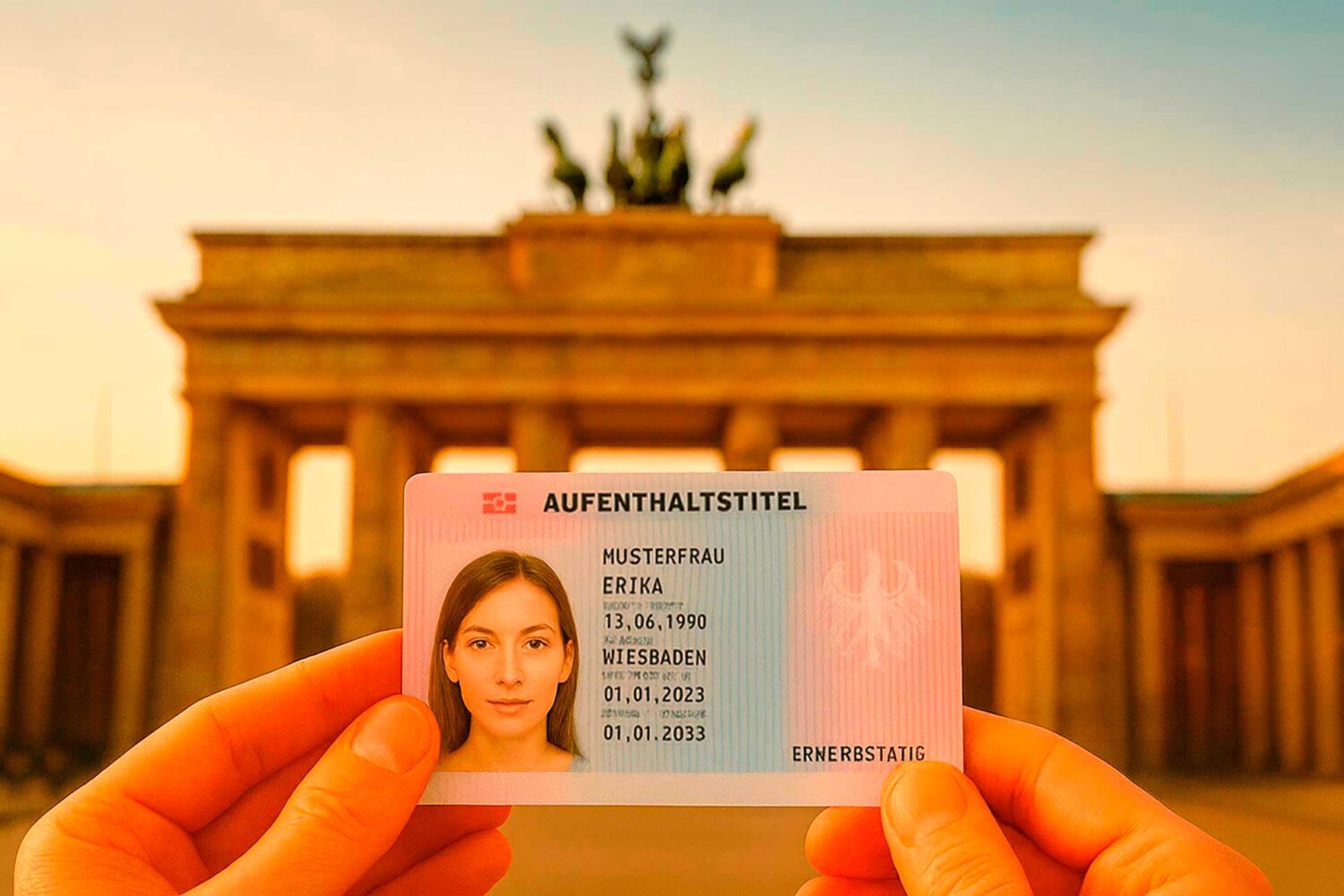
What Does a German Residence Permit Look Like?
By now, we’ve talked a lot about the residence permit card (Aufenthaltstitel). If you’ve never seen one, you might be curious – what does a German residence permit look like?
A German residence permit is issued as a biometric ID card (credit-card sized plastic card with an embedded chip) since 2011. It actually looks quite similar to a German ID or driver’s license in size and material, with some unique features:
- The card has a multi-color design with a pink-blue gradient background when looked at from a distance. It’s quite pretty – a mix of light pink, blue, and pastel tones with fine guilloche patterns (those swirly security lines).
- Most of the text on the card is in German. The only English you’ll see on it is the literal phrase “RESIDENCE PERMIT” printed on the front, underneath the German word “AUFENTHALTSTITEL”.
- On the front side of the card, you will find: a small biometric chip symbol and the German eagle emblem, your photo (a biometric photograph), personal details: your surname, given name(s), your birthdate and place of birth, the validity dates of the permit: “from [start date] until [expiry date]” – or “unbefristet” if it’s permanent. The type of permit: e.g. “AUFENTHALTSERLAUBNIS” (temporary residence permit) or “NIEDERLASSUNGSERLAUBNIS” (permanent settlement permit) – this is usually indicated in a field on the front. A note about work authorization if applicable. Often, if work is allowed, the card will state “Erwerbstätigkeit gestattet” (employment permitted). If there are restrictions, sometimes it says “siehe Zusatzblatt” (see supplementary sheet), meaning you have a separate paper with details – but nowadays most important notes are on the chip or back. Your document number (an alphanumeric ID of the card) and an access number for the chip. Your signature (digitally imprinted).
- On the back side, the card lists: your nationality, sex, height, eye color. Your address in Germany (postal code and city) – sometimes this is included. The issuing authority info and date of issue. A machine-readable zone (those lines of text and numbers you see on passports too) for scanning purposes.
- The card also has an embedded RFID chip that stores your fingerprints (two finger prints) and a digital copy of your photo, and any electronic information. This chip is similar to those in biometric passports.
- Security features: the residence permit card has various anti-forgery features: holograms, optical variable ink elements, and microtext. It’s a high-tech document to prevent fraud. The surface might reflect light in patterns, and certain info is laser-engraved.
When you receive your card, it will usually come with a PIN/PUK letter (sent by mail) for the electronic functions. There’s an online identification function on the chip (for example, you can use your eAT card to login to German e-government services if you activate it with your PIN). Many people ignore this feature, but it exists.
In short, the German residence permit looks like a pinkish-blue smart ID card with your photo and details on it. It’s plastic and about the size of a credit card. It does not have a chip visible (it’s embedded inside), but on the outside you’ll see the gold chip symbol indicating it’s electronic.
You should carry this card whenever you might need to prove your legal residency status (for example, when dealing with authorities, or sometimes even landlords or employers want to see it). Within Germany, you won’t be asked for it randomly, but you must have it available. When traveling in/out of Germany, you definitely need to have it alongside your passport to show to border control.
🧑⚖️ Facing a Complicated Case? Get expert help from a licensed immigration lawyer at Consiliojus. Avoid costly mistakes and delays — let a professional handle your application. 👉 Schedule a consultation.
Processing Time: How Long Does It Take to Get a Residence Permit?
One of the most common questions is how long does it take to get a German residence permit approved and issued. As mentioned above, processing times can vary. Here’s what to expect:
- Average Processing Time. Typically 4–10 weeks after your appointment. Many applicants receive a decision and their permit within about 1 to 2 months. This is an average; it’s not a guarantee.
- Factors Affecting Time. The timeline can be shorter or longer depending on: location. Big city immigration offices (Berlin, Hamburg, Munich, etc.) handle thousands of applications and often have backlogs. In such cities, it might lean towards the longer side (8+ weeks). Smaller towns or less busy offices might be quicker. Also, some permit types might undergo extra checks. For work permits, the office may consult the Federal Employment Agency to approve the job terms (this is usually quick if your job meets criteria). For family permits, they might verify marriage or birth certificates. Students are usually straightforward if all documents are fine. If your application is complete and all documents are satisfactory, it goes faster. If the officer asks you to provide an additional document, the clock may pause until you submit it. Time of Year just anecdotal, but around academic enrollment season (late summer) student applications surge; end of year holidays can slow things; etc.
- Appointment Waiting Time. Remember, the wait to get an appointment is separate from processing time. In some cities, just getting an appointment might take 4–8 weeks. So factor that in. Always book the appointment well in advance (some people literally book an appointment for a month after arrival as soon as they land in Germany).
- If it’s taking long. As long as you applied before your current status expired, you’re safe to remain in Germany. Use the Fiktionsbescheinigung if needed to show you’re in process. If you haven’t heard anything for, say, 10-12 weeks, you can follow up with the office. In very rare cases (no answer after 3+ months), one can seek legal help (there’s a concept of an “absence of decision” appeal), but 99% of the time it won’t come to that – almost all applications are approved as long as you meet the requirements.
So, plan for a few months overall from arrival to card-in-hand. To reduce stress, start early and ensure your documents are in order, and you’ll likely have your permit by the time you need it.
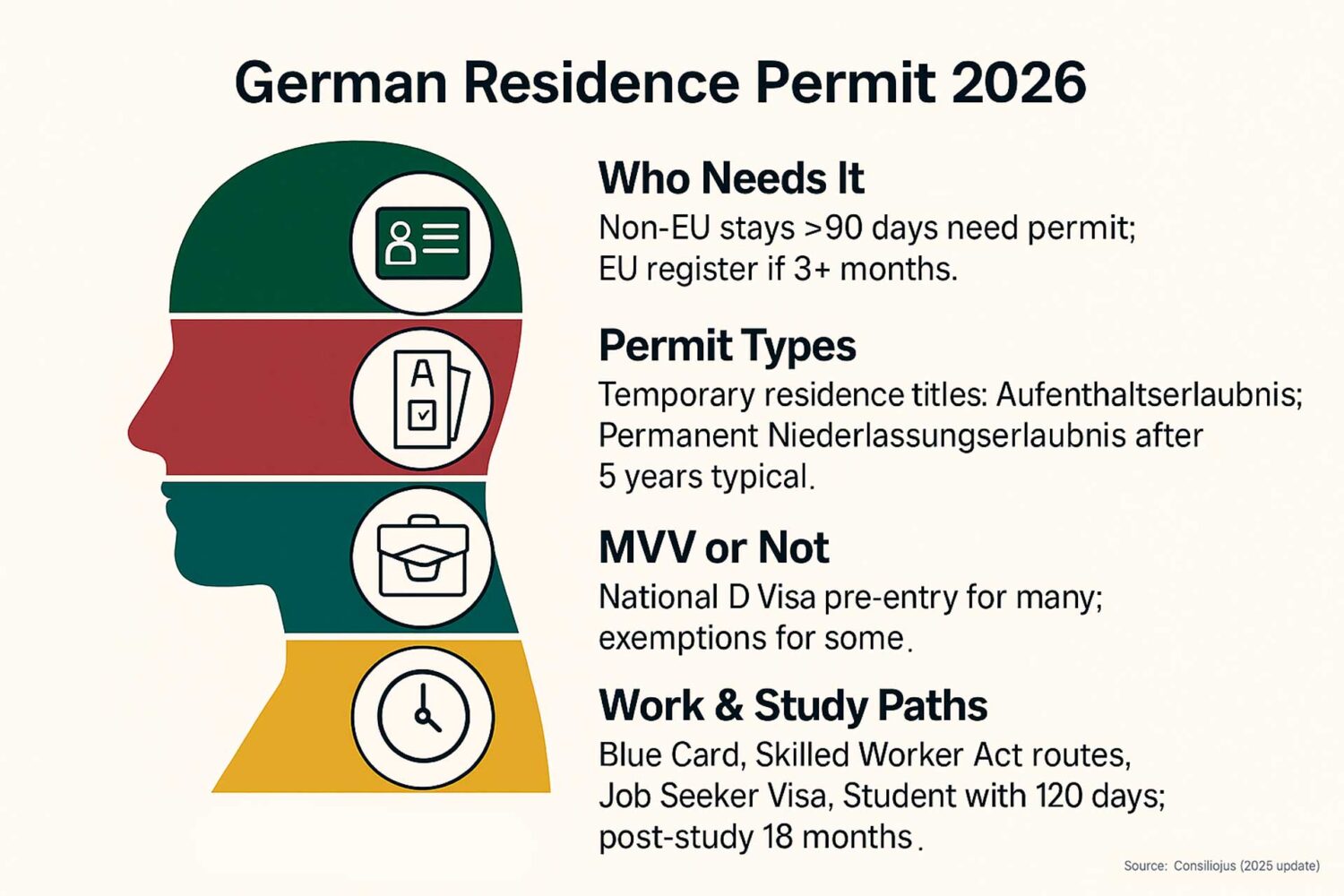
How Long Does a German Residence Permit Last?
The validity (duration) of a German residence permit depends on what type of permit it is and why it’s issued.
Temporary Residence Permits
These expire after a set period. The exact length is usually linked to your situation.
- Employment Permit often valid for the length of your job contract, up to a maximum of 4 years on the first issuance.
- EU Blue Card valid up to 4 years on initial issue (or if your contract is shorter, contract length + 3 months). Many Blue Card holders transition to permanent residence before renewing the Blue Card.
- Student Permit often 1 or 2 years at a time. If your study program is e.g. 3 years, they might give 2 years and then you renew for the remaining time. They usually don’t issue for full program length if it’s long, to check progress.
- Job-Seeker Visa/Opportunity Card usually 6 months for the standard job-seeker visa; the Opportunity Card (new) can be up to 12 months. These are shorter since they’re just for looking for work.
- Family Reunion Permit typically 1 year for the first issue (especially for spouses) and then renewable. Sometimes longer if tied to the sponsor’s status.
- Others. Research visas might match the research project duration; freelance permits might be 1-3 years.
After expiry, you must renew the permit if you’re still eligible to stay (more on renewal below). A temporary permit does not automatically renew; action is required on your part.
Permanent Residence Permit
A permanent (settlement) permit does not expire. In the field for expiration date on the card, it usually says “unbefristet” (meaning unlimited). So in theory, it lasts forever without renewal. However, you can lose a permanent residence permit in certain scenarios:
- If you leave Germany and remain outside the country for longer than 6 months (or 12 months with prior permission), the permit can become invalid. The idea is that the permit is “permanent” as long as Germany remains your main country of residence.
- If you obtained it by fraud or your situation changes in a way that would have disqualified you (very rare, e.g., a fraudulent marriage case).
- Other than that, it’s yours for life. Many people hold a permanent residence permit indefinitely, especially if they don’t opt for German citizenship.
What the Card Shows. The residence permit card will show the valid-until date for temporary permits. For example, “gültig bis 30.09.2025” would mean it expires on that date. For permanent ones, it might show “Expiry: unbefristet” or sometimes a far-future date plus a note that it’s a Niederlassungserlaubnis. Always check your card so you know when to renew if applicable.
To summarize, a German temporary residence permit lasts only as long as stated on the card (commonly 1-4 years, depending on permit type). A German permanent residence permit lasts indefinitely, with no expiration, although staying outside Germany too long can invalidate it.

How to Renew a German Residence Permit (Extension)
Residence permits are not issued forever (unless you have permanent residency). So if you have a temporary permit and plan to stay beyond its expiry, you’ll need to renew (extend) your German residence permit. Here’s how to do that and important tips to avoid problems.
When to start the renewal process. Don’t wait until the last minute. It’s recommended to start preparing for an extension about 3 to 4 months before your permit expires. In fact, many experts suggest at least 12 weeks (3 months) in advance. This is because, as we saw, getting an appointment can take time. Large cities can have appointments booked out months ahead. Mark your calendar for a date a few months before expiry to start gathering documents and book an appointment.
How to renew (steps): renewing a permit is in many ways similar to the initial application:
- Gather Required Documents. Generally, you’ll need all the same documents you submitted the first time. This includes: Passport (still valid), Current residence permit card (you’ll show this), New biometric photos, Updated application form for extension, Proof of continued accommodation (if you moved, new rental contract and address registration), Updated financial proof (e.g., recent payslips if working, or new blocked account statement if you continued studies, etc.), Health insurance proof (ongoing coverage), Purpose-specific documents: e.g., if you’re renewing a student permit, show that you are still enrolled and perhaps a transcript to show you’ve been studying; for work, an updated contract if it was extended or a letter from employer; for family, proof the family status continues (marriage still valid, etc.).
- Book an Appointment. Same process – schedule with the Ausländerbehörde. Many offices allow booking renewal appointments well in advance.
- Attend Appointment & Pay Fee. At the appointment, you’ll submit the documents. The fee for renewing is similar to first application (often around €80-100 again, sometimes slightly less for extensions).
- Processing & Fiktionsbescheinigung. If your renewal isn’t processed by the time your old permit expires, the Fiktionsbescheinigung (temporary extension certificate) becomes crucial. Usually, when you apply for a renewal, the office will issue you a Fiktionsbescheinigung on the spot or shortly after, which extends your current permit’s validity until a decision is made. This lets you continue working or studying without interruption. Always ask about this if they don’t automatically provide one.
- New Permit Issued. Once approved, you’ll get a new card with a new expiration date.
How can I renew my German residence permit? – by following the above steps diligently. The key is timing and completeness. It’s essentially a repeat of the application process, so treat it with equal importance.
What if you forget or delay and your permit expires? Do NOT let that happen. If your residence permit expires and you haven’t submitted a renewal, you are immediately staying illegally in Germany, which has serious consequences:
- You could face fines or penalties.
- It could jeopardize future immigration applications (any overstay is a black mark and might make getting permits or visas in the future harder).
- You might be asked to leave the country and go through the visa process again from scratch.
- Travel becomes impossible – if your permit is expired, you cannot re-enter Germany (or any Schengen country) because you have no valid status.
In short, failing to renew is not an option you want to consider. Even a short lapse can cause big headaches. The good news is the authorities do allow some flexibility if you have applied for renewal in time – hence the importance of the Fiktionsbescheinigung which legally maintains your stay in the interim.
⚖️ Need help switching your permit type, renewing on time, or appealing a rejection? Our qualified migration expert can represent your interests and guide you through the process. 📞 Talk to a migration lawyer.
Helpful tips for renewal
Many offices allow you to apply up to 6 months before expiry. Check your local office’s rule; some Berlin resources say not earlier than 6 weeks, but others suggest 2-3 months. To be safe, around 3 months ahead is a good target unless instructed otherwise.
If you change purpose (e.g. student to work, or switch employers), you might actually be applying for a new type of permit rather than a straight “renewal”. The process is similar but make sure to mention the change. Sometimes a new purpose means a new application (not just an extension of the old one). For example, finishing studies and finding a job – you switch to a work permit.
Always keep track of your permit’s expiry date. Put a reminder in your phone or calendar a few months prior. It’s ultimately your responsibility.
If you cannot get an appointment in time, at least contact the Ausländerbehörde by email or phone* before expiry to explain. If you have an email confirming you tried, they might be more understanding. In many places, simply booking the next available appointment (even if it’s after expiry) and printing that confirmation will protect you – because it shows you acted. You would then definitely need a Fiktionsbescheinigung to cover the gap.
Renewing a German residence permit isn’t difficult if you’re prepared. Treat it as an annual/biennial administrative chore and it should go smoothly. As long as you stay eligible (e.g., continue your studies or keep your job), the extension is usually a formality – the authorities just want to update your documents and ensure nothing major changed.

Travel Rights: Where Can I Travel With a German Residence Permit?
If you have a German residence permit, you not only can reside in Germany, but you also enjoy some travel privileges. People often ask, “where can I travel with a German residence permit?” – especially if they want to explore Europe. The good news is that a German residence permit allows you to travel quite freely in certain regions:
- Schengen Area. A German residence permit (temporary or permanent) allows visa-free travel to all 26 countries in the Schengen Area for short stays up to 90 days in any 180-day period. This means you can hop on a flight or train and visit France, Italy, Spain, the Netherlands, Austria, and so on, without needing a tourist visa – just carry your passport and your residence permit card. For example, if you live in Germany and want to spend a week in Paris or a weekend in Rome, you can do so with just your passport and your German residence card at the border. The German Foreign Office explicitly states that foreign nationals with a valid German residence title may travel to other Schengen states for 90 days within 180 days without a visa. Essentially, your residence permit plus passport functions like a Schengen visa for short visits.
- Other EU Countries (non-Schengen). Some EU countries that are not in Schengen still allow holders of Schengen visas or residence permits to enter without an additional visa, under certain conditions.
- UK/Ireland. Having a German residence permit does not give you entry to the UK or Ireland, since they have separate immigration systems. You’d still need a visa for those if your nationality normally requires one (e.g. an Indian citizen with a German permit would still need a UK visa to visit London).
- Other Countries. A few non-European countries have policies that honor Schengen visas or residence permits. For instance, some Balkan countries like Serbia, Montenegro, North Macedonia, Albania have allowed travelers with a valid Schengen visa or residence permit to enter visa-free for limited days. This is subject to change and specific conditions, so check each country’s rules. It’s more of a bonus and not guaranteed for all. (For example, Turkey does not simply accept a German residence permit; you’d need a Turkish visa if required by nationality.)
- Travel within Germany. Obviously, within Germany you can travel anywhere freely with your permit. Domestic flights or trains usually just require ID (your passport or German ID if you later get one). Your residence permit card is more for proving legal residency rather than travel inside the country.
Important. When traveling, always carry your passport along with the residence permit card. The card itself is not a travel document; border control will want to see your passport, and the residence permit just shows that you have the right to return to Germany. If your passport is from a country that normally requires visas, the residence card is what spares you from needing separate visas for Schengen countries.
Also note the 90/180-day rule. After you spend 90 days in other Schengen countries (cumulatively), you’d need to stay out until 180 days from your first entry have passed. This usually isn’t an issue for casual tourism (it’s more for people who try to spend extended time outside of Germany). Your days in Germany don’t count to that 90, since Germany is where you reside legally. But say you went to France for 2 weeks, Italy for 1 week, Spain for 1 week – that’s 4 of your 12 allowed weeks in Schengen outside Germany.
Obtaining a German residence permit is a crucial step for any non-EU national who wants to live in Germany. The process might seem daunting, but by understanding the requirements and following the steps outlined – from entering with the correct visa, registering your address, gathering documents, to applying at the Ausländerbehörde – you can navigate it successfully. Remember to keep an eye on your permit’s validity and renew timely, and soon enough you may qualify for permanent residency in Germany, giving you even more security and freedom.
Germany offers tremendous opportunities for work, study, and quality of life, and the residence permit is your ticket to fully participate in those opportunities. We hope this guide demystified the process of how to get a German residence permit, how long it takes, how to renew it, and other common questions.
If at any stage you feel overwhelmed or uncertain — whether during the application, renewal, or transition to permanent residence — don’t hesitate to seek help from a qualified immigration lawyer. They can guide you through complex cases, help resolve delays, check your documents, and even represent you in dealings with the Ausländerbehörde (immigration office). Legal support can be especially helpful for those with non-standard cases, changes in status, or rejected applications.
Remember, successful immigration isn’t just about paperwork — it’s about having the right information and support when you need it.
🛡️ Not Sure What to Do Next? Whether you’re changing jobs, applying for permanent residency, or facing bureaucratic delays — our legal expert can help you stay safe and on track. ✍️ Book a legal check-up now.
Leave a Comment

We have prepared answers to the most common questions about German residence permit. If you want to clarify anything, please contact us - we will provide detailed explanations.
It’s an official document that allows non-EU citizens to live, work, or study in Germany legally.
Usually from 1 to 3 years, depending on your visa type and purpose of stay. It can be renewed.
Yes, if your permit includes work authorization. Most employment and Blue Card holders can work freely.
After 5 years of continuous residence (or 3 years for Blue Card holders), you can apply for permanent status.
Yes. Spouses and children can apply for family reunification if you have sufficient income and housing.
You can travel within the Schengen Area for up to 90 days without an additional visa.


Comments
No comments found.