

 EU Citizenship
 Slovenian Citizenship
 Romanian Citizenship
 Bulgarian Citizenship
 Austrian citizenship (investments)
 Spanish Citizenship
 Italian Citizenship
 Cypriot Citizenship
 Lithuanian Citizenship
 Portuguese Citizenship
 French Citizenship
 German Citizenship
 Hungarian Citizenship
 Dutch Citizenship
 Belgian Citizenship
 Croatian citizenship


Hungary Residence Permit in 2026

Author: Leon Scott
Published: 17.06.2026
Updated: 17.06.2026
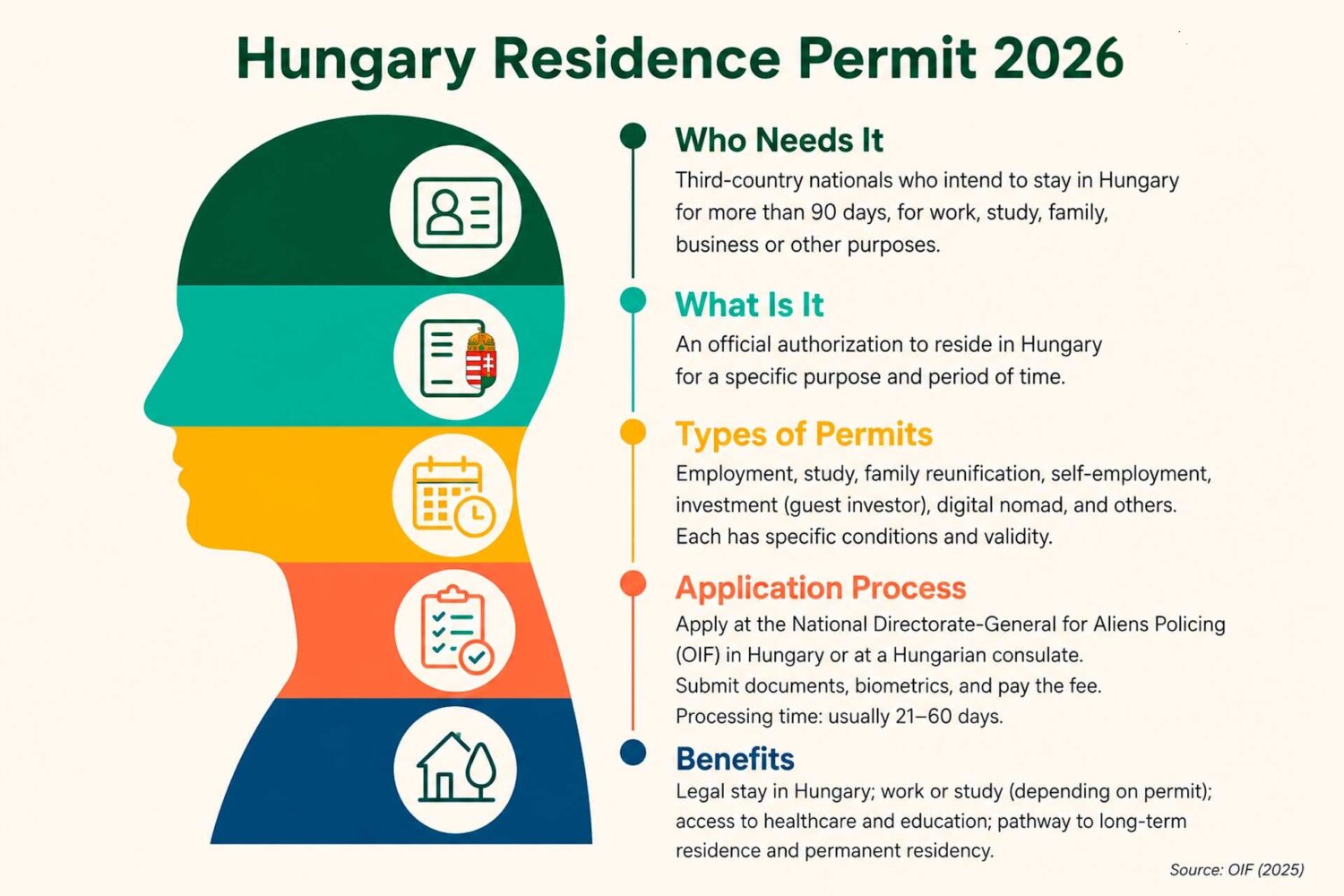
A Hungary residence permit is the authorization most non-EEA nationals need to stay in Hungary for more than 90 days, and the correct permit depends on the purpose of stay. In 2026, the main routes are employment, EU Blue Card, studies, family reunification, guest investor, guest self-employment, research, seasonal work, White Card for remote workers, and humanitarian or asylum-based protection.
Processing is often listed as 15 to 21 days of procedural administration, but many categories allow up to 30, 60, or 70 days for a merits decision; standard fees are typically EUR 110 at a consulate, HUF 39,000 for in-person filing in Hungary, and HUF 26,000 via Enter Hungary. The key strategic issue is not only getting the permit, but choosing one that matches your long-term goal, because several Hungarian permits either restrict family reunification or do not lead to long-term residence.
Hungary’s residence system changed materially when Act XC of 2023 entered into force from 1 January 2024, with application in practice from 1 March 2024. Since then, Hungary has used more segmented permit categories, stricter purpose-based rules, and more explicit limits on switching status, family reunification, and access to long-term residence for certain permits. In addition, the rules for guest workers changed again in June 2026: the National Directorate-General for Aliens Policing says that, from 6 June 2026, new guest-worker applications are no longer possible because no third countries are currently eligible under the amended scheme, although ongoing cases and existing permits are treated under transitional rules.
This guide clearly tells readers which permits do not lead to long-term residence, which routes block family reunification, what the 2026 fees and thresholds are, and what changed recently.
Which permit fits which applicant
The best Hungary residence permit depends entirely on your long-term goal. If you want a standard employer-sponsored route, the basic residence permit for the purpose of employment is the entry point, but it is restrictive: the official factsheet says it usually lasts up to 2 years, can only reach 3 years from first issuance, does not allow an in-country switch to another permit type during validity or after expiry, does not support family reunification, and does not qualify for a National Residence Card.
If you are highly qualified, the EU Blue Card is often better, because it lasts up to 4 years, has a clearer link to EU long-term status, and is designed for highly qualified work. If your income comes from abroad and you want to live in Budapest while working remotely, the White Card is Hungary’s digital nomad route, but it is a bad choice if you want to settle long term or bring family, because the official rules block both. If you are wealthy and want the most flexible route, the guest investor permit is currently the strongest premium pathway, with up to 10 years of validity, unrestricted work rights, and family reunification.
Work permits and employment-based routes
Hungary’s work-residence system is now divided into several tracks. NDGAP’s employer guidance groups them into lower-skilled or general work permits, highly qualified work permits, nationality-based cards, intra-corporate transfer routes, and related family routes.
Residence permit for the purpose of employment
The standard employment-purpose permit is the basic route for many non-EU workers. The official guidance describes it as a single residence permit allowing the holder to live in Hungary and work for the specific employer and position approved in the application. Processing is listed as 21 days of procedural administration, but a merits decision can take up to 70 days. The permit is generally valid for up to 2 years, and extension cannot take the total period beyond 3 years from first issuance.
This permit has serious strategic downsides. The official factsheet says that during validity and even after expiry, the holder cannot submit an application in Hungary for another residence permit under a different legal title. It also says family members cannot generally obtain family reunification based on this permit, and holders may not be granted a National Residence Card. That makes it workable for short- to medium-term employment, but weak for settlement planning.
Guest worker route
The guest worker route was already highly restrictive, and it became even more unstable in 2026. The official NDGAP news notice says that, from 6 June 2026, new applications for a guest-worker residence permit are no longer possible because no third countries are currently designated as eligible under the amended decree. Existing permit holders and already-filed applications are treated under transitional rules, but this is plainly a moving target.
EU Blue Card
For highly qualified workers, the EU Blue Card is one of the strongest employment routes in Hungary. NDGAP defines it as a residence permit that allows a highly qualified third-country national to reside and work in a role requiring high professional qualifications. The permit is valid for up to 4 years and can be renewed for up to 4 years at a time. Applications use the single application procedure; the formal procedural administration period is 21 days, but a merits decision may take up to 70 days, or 30 days for applicants already holding an EU Blue Card from another EU member state.
NDGAP’s 2026 factsheet says the minimum monthly remuneration rises to HUF 1,001,048 in 2026, with a lower threshold of HUF 800,838 for the listed shortage occupations such as general practitioners, pharmacists, physiotherapists, district nurses, ambulance officers, tertiary-education nurses, and midwives. The same page also notes that all valid Blue Card holders will need to meet the increased 2026 amount.
The Blue Card is also better for long-term planning. NDGAP says an EU residence card may be granted to a Blue Card holder who has resided lawfully and continuously in Hungary for at least 2 years before applying and has resided lawfully in the EU for at least 5 years holding an EU Blue Card or certain related statuses. The underlying EU legal framework for the Blue Card is Directive (EU) 2021/1883.
Special work subtypes worth naming
NDGAP’s employer guidance also highlights the Hungarian Card, National Card, intra-corporate transfer, and posting routes. The National Card is specifically flagged for Ukrainian and Serbian citizens in the official guidance, while ICT and posting routes apply in very specific cross-border corporate scenarios.

Study, student mobility, and post-study transition
A residence permit for studies may be issued to a third-country national accepted by a higher education institution or coming for a preparatory course organized by a higher education institution. The official student page requires admission, language ability, valid travel document, accommodation, sufficient resources, and health insurance. The formal processing period is 15 days, while the authority may take up to 60 days on the merits. The permit is valid for a minimum of 1 year and up to 3 years, with extension for 1 to 3 more years.
Student work rights are one of the most snippet-friendly parts of the entire topic. The European Commission’s EU Immigration Portal states that third-country nationals with a Hungarian study permit may work up to 30 hours per week during the study period, and full-time for a maximum of 90 days per year outside the study period. That is a concrete rule worth surfacing high in the student section.
Students should also understand the limitations. The official materials say holders of study permits generally cannot be the basis for family reunification, except for a child born in Hungary during the permit’s validity, and they may not be granted a National Residence Card. If the student wants to remain after graduation, the official route is the residence permit for the purpose of seeking a job or starting a business, which is valid for up to 9 months and cannot be extended. During that period, the holder can later apply in Hungary for a Hungarian Card, EU Blue Card, or guest self-employment permit.
Research and scientist route
Hungary has a dedicated researcher route for applicants with a hosting agreement from an accredited research organization. NDGAP says the formal procedural administration period is 15 days, with a merits decision within 60 days. The research permit is valid for at least 1 year and up to 2 years, and it can be extended for the same purpose up to another 2 years. The research mobility framework also includes long-term and short-term mobility options for researchers already admitted in another EU member state, with rules for accompanying family members.
This route is particularly useful because it sits inside an EU-law architecture designed for mobility. Directive (EU) 2016/801 covers both students and researchers, and the official Hungarian factsheet reflects that structure with mobility permits and mobility certificates.
Family reunification
A family reunification permit is available, but only if the sponsor’s status allows it. The official family guidance covers spouses, registered partners under Hungarian law, minor children, certain dependent children, and dependent parents. The key legal trap is that many sponsor categories are excluded. The European Commission’s Hungary page says family reunification cannot generally be based on sponsors who hold a seasonal permit, investment-purpose employment permit, guest-worker permit, White Card, study permit, training permit, traineeship permit, or voluntary-service permit; guest self-employed sponsors generally need to hold that status for at least a year first.
Validity depends on the sponsor’s status. The official NDGAP family page says the general validity is up to 3 years, but it can rise to 4 years if the sponsor holds an EU Blue Card or Corporate Card, 5 years if the sponsor is a Hungarian citizen and a holder of an EC permanent residence permit or an EU residence card, and 10 years if the sponsor holds a guest investor permit. If employment is also intended, the applicant must handle the employment side through the relevant single application mechanism.
For investors, the family angle is especially favorable. NDGAP’s guest investor FAQ says family members may file for family reunification in parallel with the main investor’s application, and that both the investor permit and the related family-reunification permit allow unrestricted employment in Hungary. That is a major competitive advantage over White Card, studies, standard employment, and seasonal routes.
Leave your contacts to have an expert contact you shortly.
White Card for digital nomads and remote workers
Hungary’s White Card is the dedicated remote-work route. It is only for third-country nationals who either work for a company outside Hungary or own a profitable company outside Hungary and manage or work for that company remotely from Hungary using digital tools. The White Card cannot be granted to someone doing gainful activity in Hungary or holding a share in a Hungarian company. It also excludes people who qualify for several other residence categories.
NDGAP says the applicant must show net monthly legal income of at least EUR 3,000 for at least 6 months prior to entry, and must maintain that level during the stay. The route usually requires six months of bank statements or employer/tax certificates, plus accommodation and health-insurance proof. Processing is listed as 21 days, with a merits decision within 30 days. The permit is valid for 1 year and may be extended once for one more year.
The White Card is excellent for a narrow use case and poor for nearly everything else. The official factsheet says no other residence permit may be applied for during or after White Card validity for another purpose, family members cannot generally join through family reunification, and White Card holders may not be granted a National Residence Card. NDGAP also says the authority will withdraw the permit if the holder works for a Hungarian employer or acquires a share in a Hungarian company. In plain English, this is a mobility permit, not a settlement permit.
Investor and business routes
Hungary currently offers two very different business-oriented residence options: guest self-employment for entrepreneurs building or running an activity in Hungary, and guest investor for applicants making a qualifying investment.
Guest self-employment
The guest self-employment permit is the more operational business route. NDGAP says it is valid for up to 1 year, and can be extended for the same purpose up to 2 more years, with a 3-year cap from first issuance. Holders face a regular reporting obligation to the immigration authority. This is not a passive residence route, and the compliance burden matters.
This permit also comes with route-planning constraints. NDGAP says that for 1 year from the date of issue, family members may not generally be granted family-reunification residence permits on the basis of the holder’s guest self-employment status, except limited re-issue situations. The status is also excluded from the National Residence Card route. For applicants who care about family mobility or a cleaner settlement pathway, that can make this route inferior to Blue Card or guest investor even if the business case is viable.
Guest investor
The guest investor route is the premium route in Hungary’s residence system. NDGAP says this permit may be granted where the applicant’s entry and stay are in Hungary’s national economic interest due to qualifying investments. The official qualifying investments are currently: acquisition of an investment fund share of at least EUR 250,000 issued by a real estate fund registered by the Hungarian National Bank, or a financial donation of at least EUR 1,000,000 to a qualifying higher education institution for educational, research, or artistic activities. The factsheet also imposes technical conditions on the structure of the fund investment, including a five-year holding requirement and a minimum residential-real-estate exposure.
The strategic advantages are unusually strong. The permit is valid for up to 10 years and may be extended once for up to another 10 years. NDGAP’s FAQ says there is no statutory minimum stay rule for holders, family members can file for family reunification in parallel, and both investors and their related family members may work in Hungary without restrictions. Processing is listed as 21 days, although NDGAP notes that the clock excludes the period needed to submit proof that the promised investment was completed.
Seasonal work
The seasonal employment permit is a narrow route that should be explained clearly because users often confuse it with ordinary work residence. NDGAP says it is for guest workers undertaking seasonal work specified in legislation. It is valid for up to 6 months, and can be extended within a 12-month period for a period not exceeding 6 months. Processing is usually 21 days, or 15 days in certain repeat-compliance cases, with a merits decision within 70 days.
This permit is highly restrictive. The official factsheet says it cannot serve as the basis for family reunification, the holder cannot be granted a National Card, and an in-country application under another legal title may not be submitted during validity or after expiry. If the employment ends, the permit becomes invalid on the sixth day after the employer notifies the termination. This is a temporary labor tool, not a bridge to settlement.
Permanent residence and settlement
Hungary’s long-term residence system is not a single endpoint. For third-country nationals, two of the most important long-term statuses in current English materials are the National Residence Card and the EU residence card. There is also an Interim Residence Card for people who already hold EU long-term resident status in another member state and want to reside in Hungary for work, business, studies, training, or other certified purposes.
National Residence Card
NDGAP says a National Residence Card may be granted to a third-country national who already holds a residence permit, interim permanent residence permit, or interim residence card and has resided in Hungary legally and without interruption for at least 3 years, or fits one of several special categories such as being the spouse of a Hungarian citizen or long-term resident, a dependent ascendant in a qualifying family community, a former Hungarian citizen, a person of Hungarian ancestry, or certain minor children of long-term residents or refugees. The card document itself is issued for up to 10 years and can then be extended by 10 years.
The crucial warning is that many temporary permits do not qualify. NDGAP explicitly says a National Residence Card cannot be granted if the applicant holds permits such as guest self-employment, seasonal employment, employment-purpose residence, guest-worker residence, study residence, training, medical treatment, White Card, posted-work, traineeship, or voluntary-service permits.
EU residence card
The EU residence card is Hungary’s long-term resident style route for third-country nationals. NDGAP says it may be granted to a person who has resided legally in Hungary for at least 5 years before applying, or to an EU Blue Card holder meeting the special combination rule of 2 continuous years in Hungary plus 5 years of legal residence in the EU on an EU Blue Card or certain related statuses. The document is issued for up to 10 years and extended by 10 years at a time. The underlying EU legal framework is Council Directive 2003/109/EC on long-term residents.
This route is also subject to exclusions. NDGAP says it may not be granted to people residing in Hungary to pursue studies or vocational training, to seasonal or voluntary-service residents, to people under diplomatic immunity, to temporary-protection beneficiaries, or to certain applicants in active asylum or tolerated-status situations. Again, the settlement result depends not only on years spent in Hungary, but on what permit you used while accumulating those years.
Humanitarian, asylum, and protection-based statuses
Hungary’s asylum framework distinguishes refugee status, subsidiary protection, temporary protection, and tolerated status, and it also has a humanitarian residence permit context for stateless persons. NDGAP’s asylum materials define refugee and subsidiary protection in the standard international-protection way, say the first asylum procedure is cost-free, and note that asylum seekers can receive reception conditions and assistance during the procedure.
For people fleeing Ukraine, Hungary’s English-language materials state that temporary protection applies to eligible Ukrainians and certain others connected to Ukraine, and NDGAP’s 2026 notice says the validity of residence documents for beneficiaries of temporary protection is extended until 4 March 2027, regardless of the expiry date printed on the document.
NDGAP also states that a humanitarian residence permit is granted to a person recognized as stateless if the ordinary residence-permit conditions are absent, and that the humanitarian permit is valid for 3 years, extendable by 1 year at a time. This is a niche route, but including it broadens the article beyond investor-and-worker audiences and improves completeness for information-rich search intent.

Processing times, fees, and the real document burden
Official Hungarian sources distinguish between the formal procedural administration time and the longer period within which the authority may decide the case on the merits. In practice, that means applicants should not treat the lower number as the actual end-to-end processing time. For instance, work and Blue Card cases list 21 days of procedural administration but up to 70 days for a merits decision; White Card lists 21 days and 30 days; studies and research list 15 days and 60 days; long-term residence cards list 70 days.
The fee structure is also more nuanced, NDGAP’s current procedural-fees page says a residence-permit application filed at a diplomatic mission costs EUR 110. If filed in Hungary, the fee is HUF 39,000 in person or HUF 26,000 via Enter Hungary. Extension of a residence permit is HUF 26,000. Issuing an interim, national, or EU long-term residence document is also HUF 26,000, with HUF 20,000 for extension of a long-term-status document. The general fee for lodging an appeal in Hungary is HUF 47,000, while refusal appeals lodged at consular posts for residence permits are listed at EUR 160.
The practical document burden is usually heavier, although the exact attachments depend on the permit, the recurring core set is: valid passport, purpose-specific proof, accommodation, funds or income, health insurance or capacity to cover healthcare, and where relevant, employment or hosting documents. For some long-term residence applications, NDGAP adds a significant formalization burden: foreign public documents may need apostille and certified Hungarian translation.
The table below is designed for snippet extraction and reader decision-making. It synthesizes current official time-and-fee information and highlights the rights users ask about most often.
| Route | Procedural administration | Merits decision | Standard fee pattern | Work rights | Settlement potential |
| Employment purpose | 21 days | Up to 70 days | EUR 110 abroad / HUF 39,000 in person / HUF 26,000 via EH | Tied to approved job | Weak |
| EU Blue Card | 21 days | Up to 70 days, or 30 days for eligible EU Blue Card movers | Same residence-permit fee structure | Highly qualified approved work | Stronger |
| Studies | 15 days | Up to 60 days | Same residence-permit fee structure | Up to 30 hours weekly during studies | Weak directly |
| Research | 15 days | Up to 60 days | Same residence-permit fee structure | Research under hosting arrangement | Moderate to stronger |
| White Card | 21 days | Up to 30 days | Same residence-permit fee structure | Remote work for foreign employer/company only | No |
| Seasonal work | 21 days, or 15 days in certain cases | Up to 70 days | Same residence-permit fee structure | Only for approved seasonal employer | No |
| Guest investor | 21 days excluding proof-of-investment interval | Variable because investment-proof period is excluded | Residence permit plus investor-visa fee where relevant | Unrestricted | Potentially strong |
| National Residence Card | 70 days | 70 days | HUF 26,000 issuance / HUF 20,000 extension | Indefinite residence status | Yes |
| EU residence card | 70 days | 70 days | HUF 26,000 issuance / HUF 20,000 extension | Long-term resident rights framework | Yes |
Applicant checklist
If you want a document checklist that actually reflects Hungarian practice in 2026, start with this baseline set and then add the route-specific documents required by your permit type:
- valid passport;
- completed application and relevant appendix for the permit category;
- proof of purpose, such as job offer, hosting agreement, admission letter, family documents, or investment certificate;
- proof of accommodation in Hungary;
- proof of means of subsistence or qualifying income;
- proof of health insurance or ability to cover healthcare;
- facial photograph where required;
- fee payment confirmation;
- certified translation or apostille where the route or document class requires it.
A practical editorial addition is this: the “fit” of the permit matters more than getting any permit approved quickly. A remote worker who plans to settle with a spouse should not default to the White Card; a professional who qualifies for the Blue Card should think twice before choosing a more restrictive ordinary employment permit; and an entrepreneur who wants family mobility in year one should compare guest self-employment with the investor route rather than looking only at total cost.
Common refusal reasons and appeals
Refusals usually arise from the same recurring issues across permit types: inaccurate or false information, insufficient proof of the stated purpose, criminal-record or public-security problems, missing financial or accommodation evidence, and applications filed for a category whose legal criteria do not actually match the applicant’s facts. Long-term residence documents have additional exclusion grounds such as criminal record, SIS alerts, expulsion or entry bans, and residence histories built on excluded permit categories.
Appeals are time-sensitive. Across the residence-permit factsheets, NDGAP states that a refusal may generally be appealed within 8 days of delivery or notification, submitted to the first-instance authority or the relevant Hungarian diplomatic or consular mission. The same factsheets also warn that the authority will dismiss the appeal without examining the merits if it is late, filed by an unauthorized person, based on facts already known before the decision, or filed without grounds. That makes a sloppy appeal worse than no appeal: the filing has to be targeted, timely, and legally reasoned.
Practical pitfalls that deserve their own subsection:
- One recurring pitfall is assuming that any permit can be converted once you are in Hungary. Official pages repeatedly say the opposite for several categories, including ordinary employment, White Card, guest self-employment, and seasonal employment.
- Another is assuming that living in Hungary for several years automatically creates a path to permanent residence. The National Residence Card and EU residence card pages show that permit type matters, not only elapsed time.
- A third pitfall is underestimating document formalities for foreign certificates, especially in permanent-residence cases.

Citizenship and dual citizenship
Hungarian consular guidance confirms that dual citizenship is permitted under Hungarian law. That is the easy part. The harder part is the route to naturalization: the immigration factsheets do not spell out ordinary naturalization in detail, because citizenship is governed by the Hungarian Citizenship Act rather than residence-permit rules.
A recent legal summary by the Hungarian Helsinki Committee states that ordinary naturalization is generally based on eight years of continuous residence, with shorter periods for some categories such as refugees. That means a residence permit may be the beginning of a citizenship path, but only if the residence history is the right kind of lawful residence and later transitions successfully into long-term status where needed.
Hungary still offers many legitimate residence routes in 2026, but the system is now much more segmented. The key to a successful application is not only submitting a complete file. It is choosing the route that actually matches your facts and your end goal. In Hungary, that matters because work, study, family, digital-nomad, investor, and long-term routes now have sharply different consequences for switching status, bringing family, and moving toward settlement.
If you want to work in Hungary long term, compare ordinary employment with the EU Blue Card before filing. If you want flexibility, family mobility, and long validity, compare the investor route with self-employment instead of looking only at price. If you want a remote-work lifestyle in Budapest, treat the White Card as a short-term mobility solution, not as a settlement strategy. And if your case involves protection, temporary protection, or statelessness, use current official guidance rather than generic migration blogs, because those areas are especially sensitive to legal change.
If you need help choosing the right Hungary residence permit, preparing the document pack, or checking whether your current route can lead to permanent residence or citizenship, contact us for a tailored consultation. We can review your facts, flag legal risks before submission, and help you choose the route that best matches your timeline, budget, family plan, and long-term residence strategy.
Leave a Comment

We have prepared answers to the most common questions about Hungary residence permit. If you want to clarify anything, please contact us - we will provide detailed explanations.
It depends on the permit type. Current official timings range from 15 days of procedural administration for studies and research to 21 days for many work routes, but the merits decision may take 30, 60, or 70 days depending on the category.
Yes, but not without limits. The European Commission’s Hungary student page says students may work up to 30 hours weekly during studies and full-time for up to 90 days per year outside the study period.
No. NDGAP says White Card holders may not be granted a National Residence Card, and the route also blocks family reunification.
Sometimes. It depends on the sponsor’s exact status. Family reunification is not generally available for several sponsor categories, including White Card, studies, seasonal employment, and some guest-worker-related categories.
The most important fresh change is the June 2026 suspension of new guest-worker applications under the current designated-country system, according to NDGAP’s official notice.


Comments
No comments found.