

 EU Citizenship
 Slovenian Citizenship
 Romanian Citizenship
 Bulgarian Citizenship
 Austrian citizenship (investments)
 Spanish Citizenship
 Italian Citizenship
 Cypriot Citizenship
 Lithuanian Citizenship
 Portuguese Citizenship
 French Citizenship
 German Citizenship
 Hungarian Citizenship
 Dutch Citizenship
 Belgian Citizenship
 Croatian citizenship


Italian Residence Permit (Permesso di Soggiorno): What It Is and How to Get One in 2026
Author: Leon Scott
Published: 08.12.2025
Updated: 09.04.2026
The Italian Residence Permit (Permesso di Soggiorno) is Italy’s official registration document for non-EU citizens who plan to stay in the country for more than 90 days. Issued by the Italian Immigration Police (Questura), this biometric, credit-card-sized permit proves you have legal authorization to reside in Italy for work, study, family reunification, or other long-term purposes. Whether you’re moving to Italy for a new job, academic program, investment, retirement, or to join loved ones, this permit is a mandatory step after entering with the appropriate visa.
In this comprehensive guide, we explain what the Italian residence permit is, who needs it, how to apply and renew it, processing times, fees, and key details like benefits, travel rights, and types of permits available. You’ll find answers to the most common questions about the Italy residence permit process – with clear, updated steps and real examples to help you navigate Italian immigration confidently.
What Is an Italian Residence Permit?
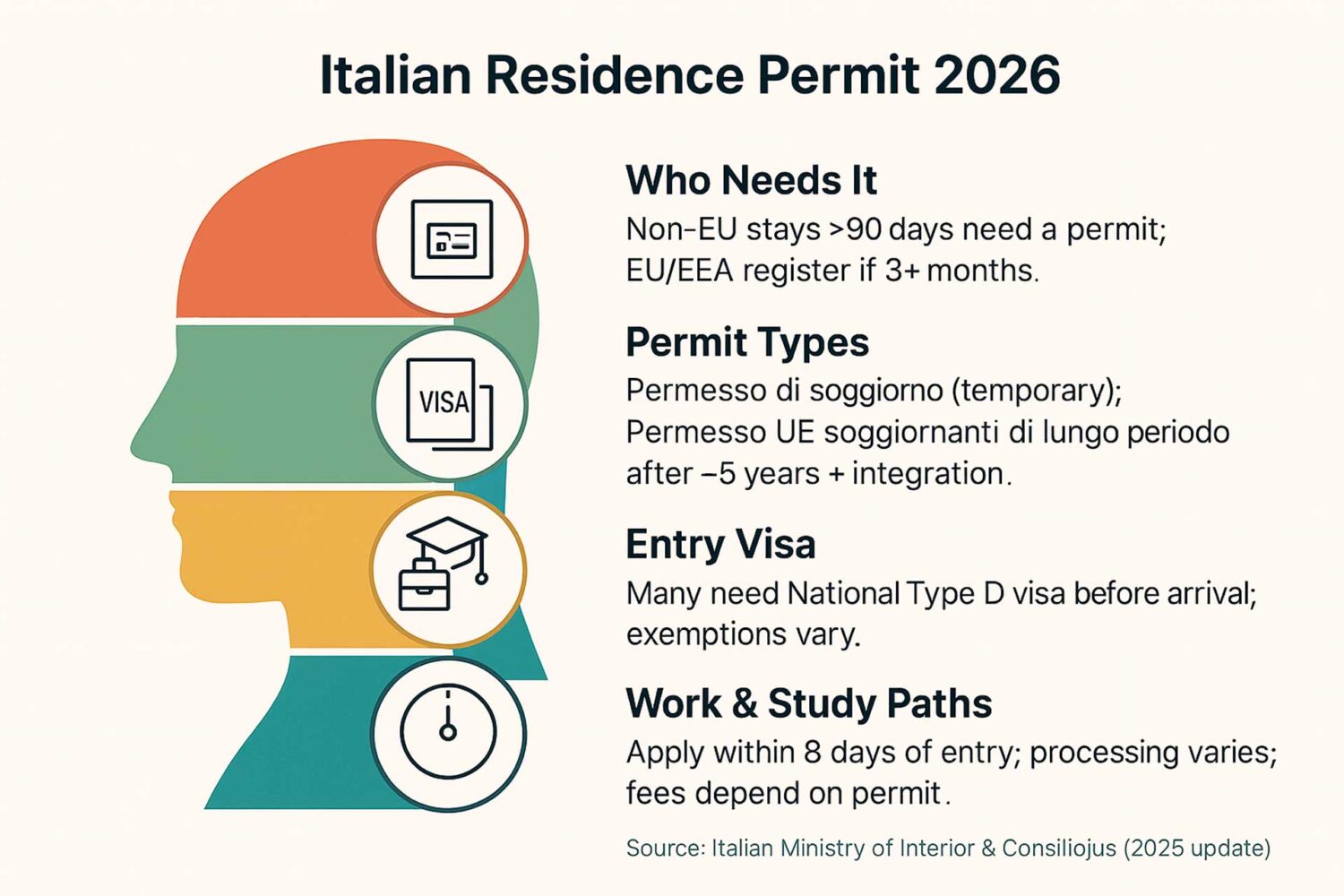
An Italian residence permit – in Italian, permesso di soggiorno – is an official card that authorizes a non-EU/EEA citizen to live in Italy legally for an extended period (over 90 days). Essentially, it is your permit to stay in Italy long-term, after entering on the appropriate visa. The permit is issued by the local immigration police (Questura) and is mandatory for anyone from outside the EU who stays in Italy beyond a short visit. (EU citizens have a different process – more on that later.)
Key points about the Italian residence permit:
- It is not the same as a visa. A visa (issued by an Italian consulate) allows you to enter Italy. The residence permit is obtained after you arrive in Italy and is what legitimizes your continued stay beyond 90 days.
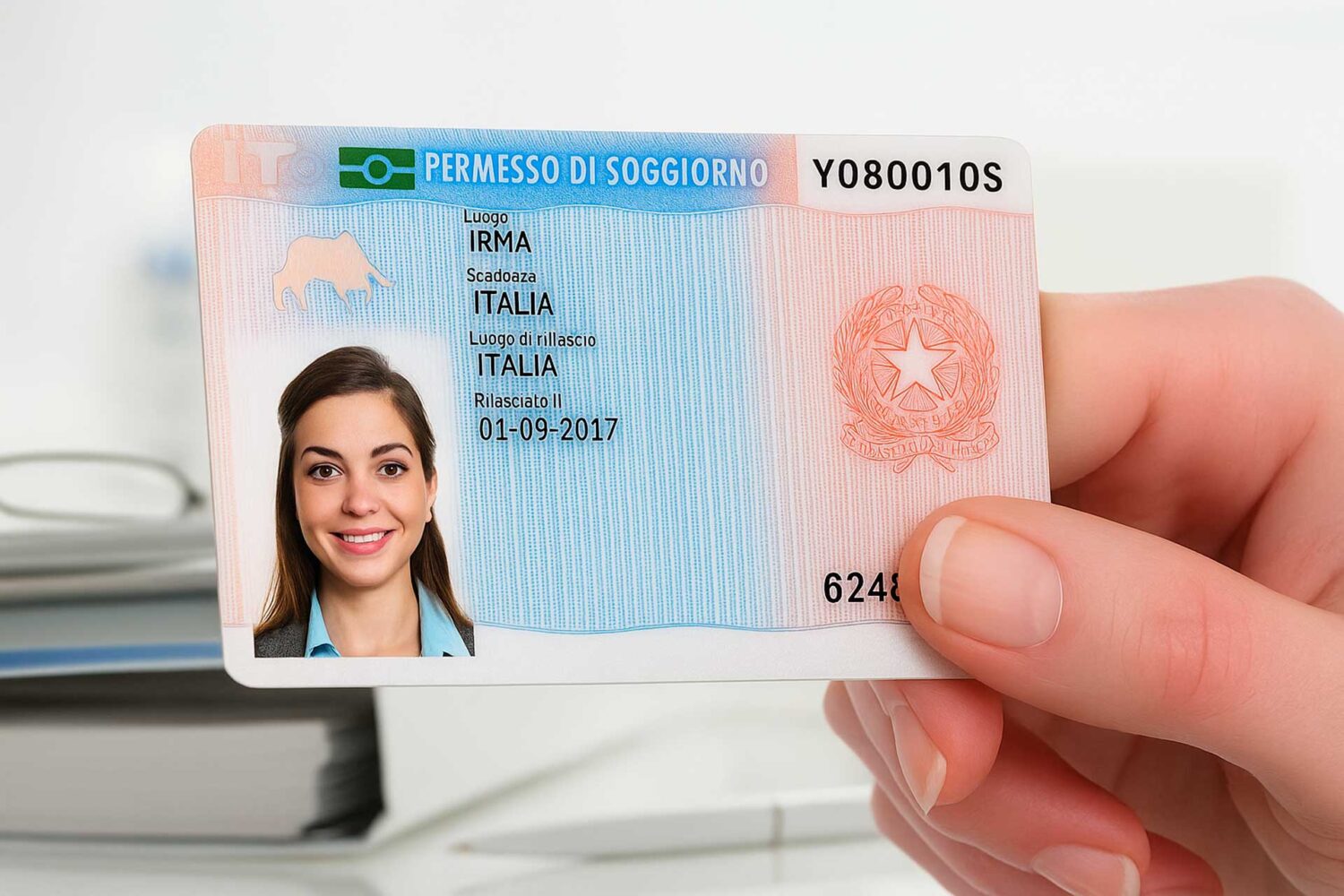
- It comes in the form of a biometric card – similar to an ID card or driver’s license – with your photo, personal details, and a microchip/magnetic stripe containing your data. This Italian residence permit card is electronic and secure.
- You must apply within 8 days of arriving in Italy (with your visa or visa-free entry) to stay legally. Failing to do so can put you out of status.
- Validity: The permit’s validity depends on your purpose of stay and visa type – it can range from a few months up to 2 years for a temporary permit, and it’s renewable. A permanent residence permit (long-term EU resident status) is available after 5 years of continuous legal residence (more on that below).
In short, the Italian residence permit is the document that allows you to reside in Italy legally, access services like healthcare, sign rental contracts, work (if the permit type allows it), and generally live life in Italy beyond the tourist timeframe. If you’re wondering “what is an Italian residence permit and why do I need it?”, the answer is that it’s your ticket to enjoying la dolce vita in Italy on a long-term basis.
Temporary vs. Permanent Residence Permits in Italy
Italy offers two broad categories of residence permits: temporary and permanent. Understanding the difference is important.
Temporary Residence Permits. These are permits issued for a specific purpose and a limited duration. Most newcomers start with a temporary permit. Depending on your situation, a temporary (non-permanent) permesso di soggiorno is typically valid for 1 year or 2 years at a time. For example: a student’s permit is usually 1 year (renewable yearly for the length of studies), while a work or family permit may be 2 years (if you have a longer-term contract or family tie). Temporary permits can be renewed or extended as long as you still meet the requirements (e.g. your employment continues, you remain enrolled in school, etc.).
Common types of temporary permits (see next section for details) include permits for work, pending employment, study, family reunification (including marriage), elective residence (retirees), investment (Investor Visa), research, seasonal work, humanitarian protection, and the new digital nomad/remote worker permits. Each has its own validity period (usually 6 months to 2 years) and renewal conditions.
Permanent Residence Permit. Often referred to as the EU long-term residence permit, this is essentially Italian permanent residency. After 5 years of legally living in Italy with temporary permits, non-EU citizens can apply for a long-term EU residence permit (formerly called carta di soggiorno). To get this Italian permanent residence permit, you must have:
- 5+ years of continuous residence: You cannot have significant gaps in your stay – no absence longer than 6 consecutive months, and no more than 10 months total outside Italy in those 5 years.
- Sufficient income and stable resources: You need to show an income at least equal to Italy’s annual social allowance threshold (circa €7,000 per year in recent years), ensuring you won’t need public assistance.
- Basic Italian language knowledge: Passing an Italian language test at A2 level is required.
- No serious criminal record.
A permanent permit has no expiration (it may require a simple renewal stamp or card update every 5 years, but it’s indefinite) and grants enhanced rights. With it, you enjoy almost the same rights as Italian citizens in terms of work, education, social benefits, etc.. You can also live and work in other EU countries more easily under certain conditions. Essentially, it provides long-term stability and removes the hassle of frequent renewals.
Comparison: A temporary Italian residence permit is a fixed-term authorization linked to a specific reason (and you must keep meeting that reason, like holding a job or attending school). The permanent Italian residence permit (EU long-term residence) is achieved after integrating in Italy for 5+ years, and it’s not tied to a single reason anymore – it allows you to stay indefinitely in Italy. Many immigrants aim for permanent residency as a step toward Italian citizenship (which becomes possible after 10 years of residence, or sooner if married to an Italian).
Leave your contacts to have an expert contact you shortly.
Types of Italian Residence Permits by Purpose
Italy’s immigration law provides different categories of residence permits (permesso di soggiorno) depending on the purpose of your stay. Here are the main types of Italian residence permit and who they’re for:
- Work Permits (Employment or Self-Employment). If you have a job offer in Italy or plan to run a business or freelance, you will need a work-based residence permit. Work permits fall under Italy’s annual quota system (decreto flussi) for most non-EU workers. Your Italian employer must sponsor you by obtaining a work authorization (nulla osta) before you can apply for a work visa and permit. There are sub-categories: subordinate employment, self-employment, seasonal work, EU Blue Card for highly skilled, etc. The initial validity usually matches your contract length (up to 1 year for fixed-term, 2 years for open-ended). Italy also exempts some professions from the quotas (e.g. researchers, managers, certain professionals) making it easier for those roles.
- Study Permit (for Students). International students admitted to an Italian educational institution (university, etc.) get a student residence permit. This Italian residence permit for students is typically valid for 1 year at a time (or the length of the academic year/program) and can be renewed each year until you finish your studies. It allows limited work hours (usually up to 20 hours per week during term). After graduation, you may convert a student permit to a work permit if you find a job in Italy.
- Family Reunion or Marriage Permit. If you have family ties in Italy, you may qualify for a family reasons residence permit. This includes joining a spouse or parent who is an Italian resident/citizen. For example, Italian residence permit by marriage – if you marry an Italian citizen (or an EU citizen residing in Italy) – entitles you to a family permesso. Spouses of Italian citizens can apply for a permesso di soggiorno per motivi familiari without quota and usually with fewer requirements; these are often issued for 2 years at a time and renewable. (If your spouse is an EU citizen, you actually get a 5-year residence card as an EU family member under EU free movement law.) Other family permits cover reunification with children, parents, etc., provided you meet income/housing criteria and prove the family relationship. Family members of a non-EU resident in Italy typically apply for a family reunification visa, then a permit.
- Elective Residency (Retirement). Italy offers an elective residence visa for those who are financially independent (retirees or individuals with passive income) and want to live in Italy long-term without working. This requires proving a high stable income and substantial savings. It leads to a 1-year elective residence permit, renewable annually. Important: This permit does not allow you to work in Italy. It’s popular among retirees seeking to enjoy Italy’s lifestyle.
- Investor Visa (Italy Golden Visa). For high-net-worth individuals, Italy’s Investor Visa (“Golden Visa”) program allows you to obtain a residence permit by investment. You must invest a significant sum in Italy (such as €250,000 in an Italian startup, €500,000 in an Italian company, €2 million in government bonds, or donate €1 million to a public-interest project). Approved investors (and their close family) get a 2-year residence permit which can be renewed for 3 more years. After 5 years, the investor can apply for permanent residence. The Italian residence permit card for investors is the same permesso di soggiorno but annotated with “investor” status. Note: if the investment is withdrawable, you must not withdraw funds before getting permanent status, or you lose the temporary permit.
- Digital Nomad / Remote Worker. Italy has introduced a Digital Nomad Visa for remote workers (non-EU citizens who work for foreign companies or freelance online). This new visa (2024) allows one to live in Italy while working remotely. Successful applicants will get a temporary residence permit for remote work (usually 1 year, renewable). Specific requirements include proof of adequate income, health insurance, and that you work remotely for a company outside Italy or are self-employed in a foreign country. (This is a recent development aimed at attracting talent; check the latest criteria as they evolve.)
- Humanitarian and Protection Permits. Italy may grant special permits for asylum seekers, refugees, and other humanitarian cases. For example, a permesso di soggiorno per protezione speciale or for asylum is given to those who are under international protection. These allow the individual to reside in Italy and often to work. The rules on duration and renewal depend on the protection status (usually 2 years for refugees, etc.). There are also permits for cases like medical treatment, unaccompanied minors, victims of violence or trafficking (social protection) – these are issued “visa-free”, meaning even if the person entered illegally or on a short visa, Italian authorities can still grant a permit due to the special situation.
This is not an exhaustive list, but it covers the major categories. Regardless of type, any non-EU national staying over 90 days needs a residence permit tailored to their purpose. Choose the category that fits your plans – and note that permits are generally not interchangeable. If your purpose changes (say, you finish studying and get a job), you must convert your permit to the new type.
Residency for EU/EEA Citizens in Italy
If you are a citizen of another EU member state (or EEA/Switzerland), you do not need an Italian residence permit to live in Italy. EU citizens have the right to free movement. However, there is a different requirement: you must register your residence with the local authorities if you stay in Italy longer than 90 days.
Here’s how it works for EU citizens (and their family members):
- No entry visa or permesso di soggiorno needed. You can enter Italy with your passport/ID card and stay freely for up to 3 months.
- If staying more than 3 months, you must go to the Anagrafe office of the Comune (town hall) where you live and apply for residenza anagrafica (official civil residence registration). This should be done within 90 days of arrival.
- Documents for EU registration usually include: your EU passport/ID, proof of address in Italy (rental contract or a declaration of hospitality), proof of sufficient financial means or employment (e.g. work contract or evidence of income), and proof of health coverage (e.g. European Health Insurance Card or private insurance).
- The comune will register you and later issue a Certificate of Residence (Certificato di Residenza). This is basically your proof of legal residence in Italy as an EU national.
- Once registered, you can also sign up for the national health service (SSN) and get a tax code (codice fiscale) if you haven’t already.
Note: EU citizens do not get a permesso di soggiorno card – that is only for non-EU nationals. Instead, your anagrafe registration and certificate serve as evidence of your right to live in Italy. The process is much simpler than for non-EU citizens. (Family members of EU citizens who are non-EU may receive a 5-year residence card under EU rules, which is a similar credit-card style permit but governed by EU directive 2004/38.)
In summary, if you’re an EU/EEA citizen, what an “Italian residence permit” means for you is just registering locally. You enjoy visa-free entry and just need to complete local formalities to stay beyond 90 days.
How to Apply for an Italian Residence Permit (Step by Step)
For non-EU citizens, obtaining an Italian residence permit is a two-stage process: first, you secure a long-stay visa from outside Italy, then you apply for the residence permit in Italy. Assuming you already have the appropriate visa (or you are exempt for certain family cases), here is how to get an Italian residence permit once you arrive.
Enter Italy with your visa. Make sure you enter within the visa’s validity. Upon entry, the border police will stamp your passport, which is important as proof of your entry date.
Pick up the application kit at the Post Office. Within 8 days of arriving in Italy, go to a designated post office (poste italiane) that has a “Sportello Amico” counter. Request the residence permit application kit (it’s a large yellow-and-white envelope). This kit contains the application forms (in Italian) you need to fill out. The forms are generally standardized (Form 209, etc.) – sometimes people ask for the Italian residence permit application form, but it comes in this kit and isn’t a downloadable online form in most cases.
Complete the application forms. Fill out the forms in clear block letters (in Italian). The form will ask for personal details, address in Italy, visa info, and the reason/type of permit you are requesting. If you’re not confident in Italian, it may be wise to get help or use a translation guide, since the forms must be accurate. Do not sign the form yet – you’ll sign in front of the postal officer when submitting.
Gather required documents. Along with the completed forms, you need to include copies of required documents. Italian residence permit requirements vary by permit type, but generally you should prepare:
- Passport – photocopies of the main identity page and the visa page (and any pages with entry stamps).
- Visa or entry clearance – a copy of your long-stay visa or other proof of legal entry.
- Passport-sized photos – usually 4 identical photos (Italy passport photo size ~35×45 mm) for your permit card.
- Proof of purpose – e.g. for work: copy of your work contract or employer’s nulla osta; for study: a letter of enrollment from your school; for family: marriage or birth certificates, etc. (Basically, any document that proves the reason you’re entitled to the permit).
- Proof of adequate finances – sometimes required for certain permits (e.g. elective residence must show income/savings; family reunion sponsor must show income above a threshold).
- Health insurance – if you are not automatically covered by Italian healthcare, you may need private health insurance or registration in the national system (students often need insurance, for instance).
- Housing proof – a rental contract or hospitality declaration, or similar proof that you have an address in Italy.
- Application fee receipts – see next step (bollo and postal fees).
Tip. Make photocopies of everything. Do not include original documents in the kit (only copies), except the passport copy. You’ll show originals later at the Questura.
Buy a “marca da bollo” stamp. Before submitting, you need a €16 revenue stamp (marca da bollo). These stamps are sold at most tobacconists (tabacchi) with a “T” sign. Ask for a “marca da bollo per il permesso di soggiorno”. Attach this stamp in the designated spot on the application form.
Pay the application fees at the Post Office. Take your filled kit (in the open envelope, unsigned forms), documents, and go back to the Sportello Amico counter. The postal worker will review your papers. If all is in order, you will pay the required fees. Typical fees include:
- Application processing fee (service fee): €30,00 paid to the post office.
- Electronic permit card fee: €30,46 for the issuance of the electronic residence permit card.
- Permit “contribution” fee: This is a tax based on the permit’s duration – €40 for permits valid 3–12 months, €50 for 12–24 months, and €100 for a long-term EU permit. For example, if you’re getting a 2-year work permit, the fee is €50. (Certain categories like minors, asylum seekers, family reunification with EU citizens, etc., are exempt from the contribution fee.)
- €16 marca da bollo: (which you already attached).
The postal officer will total it for you; expect roughly €70–€130 in fees for most first-time permits (e.g. ~€116 for a 1-year permit when you add all parts).
Submit the application. The post office will take your forms and documents and officially lodge the application. You will be given two important things:
- A receipts slip (ricevuta) – this paper has a tracking number (the “assicurata” 12-character code or an ID starting with 05…). It serves as proof you applied. Keep this receipt safe! It temporarily acts as your legal stay document until the permit card is ready. With the receipt, you can demonstrate you’re in process. (Important: The ricevuta plus your passport allows you to remain in Italy. However, traveling abroad with just the receipt can be tricky – see “Travel” section below.)
- An appointment notice for the Questura – a letter or note with the date and time you must go to the Questura (Immigration Police Office) for fingerprinting. The appointment is usually a few weeks to a couple of months later, depending on local backlog.
Attend the Questura appointment. On the scheduled date, go to the Questura immigration office (Ufficio Immigrazione) with the originals of all documents you submitted (passport, photos, etc.), plus the postal receipt and appointment letter. At this biometrics appointment, they will:
- Take your fingerprints and photos (if not already provided).
- Verify the originals of your documents.
- Ask any clarifying questions about your application or status (usually brief if paperwork is in order).
After this, you will be told that your application is under review and the permit card will be issued in due time.
Wait for processing. Now comes the patience part. Italian residence permit processing time can vary. By law, the Questura should issue the permesso within 60 days. In practice, expect around 1 to 3 months for the permit to be ready, depending on the region and workload. In some busy cities, it could be longer. Use the time to settle in, get your codice fiscale (tax ID) if you haven’t, maybe even register your residency at the Comune if required (some places let you use the receipt to register).
Track the status. You can check your Italian residence permit status online while you wait. The Polizia di Stato has a tracking portal – you enter the code from your postal receipt (the 12-character registered mail code or file number) and it will show if your permesso is ready for pickup. Status updates might be in Italian (e.g. “documento in trattazione” means in process; “pronto per la consegna” means ready for delivery). If there are delays beyond 60 days, you or your lawyer can even file a sollecito (inquiry/complaint) but usually just waiting a bit longer is normal.
Collect your permit card. When the status shows ready (or you receive an SMS/notification if you gave a number, or simply after the estimated time), go to the Questura to pick up your residence permit card. Bring your passport and the original receipt. They will hand over the plastic card after a final identity verification or signature. Congratulations – you now hold your Italy residence permit card! Make sure all info on it is correct (name, dates, etc.). This card is what you will use going forward to prove your legal residency in Italy.
By following these steps, you’ve navigated how to apply for an Italian residence permit. It might seem bureaucratic, but Italy has been streamlining some processes. In fact, a new 2025 law aims to cut some work permit processing times to 30 days, and digital systems are gradually improving.
Remember: as long as you have your postal receipt and your application is in progress, you are allowed to stay in Italy legally, even if your visa expires during the wait. Just be mindful of travel limitations with the receipt (discussed next).

Renewal and Extension of Italian Residence Permits
Italian temporary residence permits are renewable if you continue to meet the conditions. A residence permit renewal (or extension) involves a similar procedure through the post office, and you should start it before your current permit expires.
Key points on renewing an Italian residence permit:
- You can submit a renewal application within 60 days before the permit’s expiration date (and no later than the date it expires, to be safe). For example, if your permesso expires on 30 June, you can apply for renewal from early May. Don’t wait last-minute – give time for processing.
- The renewal kit and process is essentially the same as the first application: get the kit, fill forms (there’s a section to indicate it’s a renewal), attach documents (updated ones like new work contract, latest proof of enrollment or income, etc.), pay fees and bollo again, and get a new Questura appointment.
- Documents: For renewals, you show continuity of your reason in Italy. For instance, a student provides a certificate of enrollment for the new academic year; a worker provides an employer’s letter or new contract; a family permit holder shows the family tie still exists (e.g. marriage still valid, etc.). You also need to show you have not been outside Italy beyond the allowable period (generally not more than half the time for most permits).
- While renewal is in process, the postal receipt extends your legal stay, even past your old card’s expiry. If your employer or school asks, that receipt plus expired permesso shows you’re awaiting renewal.
- Extension vs Renewal: These terms are often used interchangeably regarding Italian permits. Essentially, you are applying for a renewed validity period. (Some say “extension” when it’s short-term prolonging of the same permit and “renewal” when getting a new card – but legally it’s the same procedure.)
- Most permits can be renewed indefinitely as long as you maintain the requirements. Exceptions: some permits are non-renewable (for example, a seasonal work permit for 9 months typically cannot be renewed back-to-back; you must depart and reapply next year). Also, a permit for job-seeking (attesa occupazione) is usually a one-time, non-renewable permit for a limited period after a job loss.
Important: If you plan to transition to a different permit type (e.g. from study to work, or from work to family), this is done as a conversion (conversione) rather than a simple renewal. The application is slightly different (often requiring additional authorization, like obtaining a nulla osta for converting student to work without waiting for quotas, if applicable). Consult with the immigration office or a legal expert in such cases to follow the proper steps.
Finally, once you reach 5 years and qualify for permanent residency, you won’t need to do these frequent renewals – you can apply for the Italian permanent residence permit (long-term EC resident permit). That permit, once granted, only requires a simple renewal of the card every 5 years for biometric updates, not a re-evaluation of your status.

Traveling with an Italian Residence Permit (Visa-Free Travel)
One great benefit of holding an Italian residence permit is the ability to travel within the Schengen Area without a separate visa. Italy is part of the Schengen Zone, so if you are a legal resident of Italy, you can visit any of the 26 Schengen countries (e.g. France, Germany, Spain, etc.) for up to 90 days in a 180-day period for tourism or business, visa-free, using your passport and Italian permesso. This is true regardless of your nationality, thanks to Schengen rules.
Additionally, several other European countries (EU members not in Schengen and some nearby states) allow holders of a Schengen residence permit to enter without an additional visa. With a valid Italian residence permit (and passport), you can typically travel to:
- EU countries not in Schengen: Bulgaria, Cyprus, and Romania recognize Schengen residence permits. You can visit these countries short-term without a visa if you have an Italian permesso.
- Nearby countries in the Balkans: Albania, Bosnia and Herzegovina, Montenegro, Serbia, North Macedonia – these countries allow visa-free entry for Schengen visa or residence permit holders (often for 90 days). For example, Albania explicitly permits it. Holders of an Italian permesso have visited these without visas.
- Georgia: Georgia also allows travelers with a Schengen residence permit to enter visa-free, typically for up to 90 days.
- Others: Dominican Republic is a surprising one – it allows entry with a Schengen visa or residence permit in lieu of its tourist visa. Some other countries in the Caribbean or Pacific occasionally have similar rules. Always double-check each destination’s policy before travel.
However, do note limitations: An Italian residence permit does NOT grant you the same travel privileges as an Italian/EU passport. For instance, it doesn’t let you enter the UK, Ireland, USA, etc. without a visa. For the UK and Ireland (which are not Schengen), you will need a visa unless your nationality is visa-exempt. (Example: An Indian national living in Italy still needs a UK visa to visit London.) The only exception was for certain EU family members, but since Brexit the UK has removed recognition of EU residence cards in most cases.
Travel on the receipt: If your permit is still processing and you only have the postal receipt, travel is more complicated. Within Italy, the receipt is fine to carry as proof of status. For international travel, Italian authorities allow you to return to Italy from your home country with just the receipt and expired permit in some cases, but you must fly directly (no layovers in other Schengen countries), and some airlines might not let you board without a valid visa or card. It’s risky. It’s generally advised to avoid travel until you have the physical permit card or to return to your home country only and back, carrying documentation of your renewal in process.
Once you have the Italian residence permit card in hand, you can confidently enjoy visa-free trips to explore Europe! Just remember to always carry your passport and permesso when you travel, and respect the 90/180-day rule in other Schengen countries.
Rights and Responsibilities of Permit Holders
Holding an Italian residence permit comes with important rights: you can live in Italy, of course, and depending on the type of permit, you may work (permits for work or family allow employment; student permits allow part-time work). You can access national healthcare by registering with the SSN (sometimes free, or for a modest fee for students). You can open bank accounts, sign leases, enroll in school, etc., since the permesso and your codice fiscale serve as the documents needed by various institutions.
There are also responsibilities: you must abide by Italian laws and the conditions of your permit. For example, if you have a study permit, you shouldn’t work more hours than allowed or drop out of school. If you have an elective residency permit, you must not take up employment. It’s also required to update your address with the authorities if you move (usually through the Comune registration). Keep your permit renewed on time. Also note, if you leave Italy for more than 12 consecutive months (with a temporary permit) or if you relocate out of Italy permanently, your permit can lapse. Permanent residents can stay outside Italy up to 12 months (or up to 6 years if moving to another EU country with that status) without losing the status in many cases, but it’s best to verify rules if you plan a long absence.
If your permit is lost or stolen, report it to the police and apply for a duplicate. And if any personal details change (name, marital status, etc.), inform the Questura.
Obtaining a residence permit for Italy may seem bureaucratic, but it is a critical step to make Italy your new home. With the permesso in hand, you can fully enjoy all that Italy offers – from working or studying to traveling around Europe. We’ve covered the essentials of how to get an Italian residence permit, the different types of permits in Italy (temporary vs permanent), requirements and documents, and answers to popular questions like permit renewal, status checking, and travel privileges. This in-depth information is designed to answer the most common queries (from “how to apply for Italian residence permit” to “visa-free countries for Italian residence permit holders”) in one place.
If you’re feeling overwhelmed or have a unique situation, you’re not alone. Italian immigration procedures can be complex, especially for those unfamiliar with the language or local laws. It’s often helpful to consult with an immigration professional or lawyer for personalized guidance. An experienced immigration lawyer can assist with your Italian residence permit application, ensure your documents meet all Italian residence permit requirements, and even communicate with authorities on your behalf. They can also advise on strategic matters, like switching permit types or applying for permanent residence and citizenship down the line.
Our team is here to help. As immigration law specialists, we have helped clients from all over the world successfully obtain permits to live in Italy – from students and professionals to retirees and investors. We understand the latest laws and the “unwritten rules” of the local Questura offices. If you have questions or need assistance with your Italian residency process, don’t hesitate to reach out for a consultation. We aim to make your Italian journey as smooth as possible, so you can focus on settling into your new life under the Tuscan sun (or wherever in Italy you choose to call home)!
Leave a Comment

We have prepared answers to the most common questions about Italian residence permit. If you want to clarify anything, please contact us - we will provide detailed explanations.
To get a residence permit in Italy (permesso di soggiorno), non-EU citizens must first obtain a national visa (type D) for their purpose of stay—such as work, study, or family reunification. Within 8 days of arrival in Italy, they must apply for the permit at a post office using the official application kit and later complete the process at the local Questura (Immigration Police), where they submit biometrics. Once approved, they receive a biometric residence permit card valid for the duration of their stay.
Getting residency in Italy is manageable if you meet the specific requirements for your category—such as a valid visa, income, housing, and health insurance. The process involves paperwork and can take a few months, especially in larger cities. It’s not difficult for those with proper documentation, but Italian bureaucracy can be time-consuming. Assistance from immigration professionals is recommended for smoother processing.
Use the Polizia di Stato’s immigration portal or the Portale Immigrazione tracking system. Enter the 10-digit file number (or 12-digit registered mail code) from your receipt. It will show if your permesso is being processed or ready. Alternatively, you can text certain numbers or use the Poste Italiane tracking for the registered mail. Your immigration lawyer can also check with the Questura if there’s a delay.
While the law says 60 days for issuance, delays are common. If it’s been over 90–180 days, you can inquire (sollecito) at the Questura. In extreme delays, there are legal remedies – contacting higher authorities or filing an appeal (TAR) – but those are rarely needed. Most times, waiting a bit longer or asking the office suffices. Always keep your receipt safe; it keeps you legal during the wait.
Yes, short trips up to 90 days in any 180-day period are allowed throughout the Schengen Area with your passport + Italian residence permit. You can also visit some non-Schengen countries as explained above (Balkans, etc.). For longer stays or moving to another EU country, you might need to apply for a new permit there, unless you have a permanent EU residence permit which grants some mobility rights.
Indirectly, yes. After holding legal residency in Italy for 10 years (for non-EU citizens) you can apply for Italian citizenship by naturalization. Time in Italy on a permit counts toward this. There are faster paths if you have Italian ancestry or marry an Italian (marriage to an Italian allows citizenship after 2 years of marriage with residency in Italy, or 3 years if living abroad). But simply having a permit doesn’t automatically give citizenship – you must apply and meet requirements (including language at B1 level and integration). Many immigrants first obtain the permanent residence permit at 5 years, then later pursue citizenship at 10 years.
It refers to the electronic residence permit card – which is what all modern permits are. Since 2006, Italy issues the permesso as a plastic smart card with a chip. Older paper permits are obsolete except in a few cases. The electronic card contains your fingerprint data and photo digitally, and it’s also an identity document (though your passport is still your primary travel ID).
Yes, if you live in Italy long-term, you should also register your address with the local City Hall (Comune). This is separate from the permesso. It’s called iscrizione anagrafica. For non-EU permit holders, once you get your first permesso (or at least the receipt), you bring proof of address to the Anagrafe and establish official residency. This helps with things like health care enrollment, getting an ID card from the municipality, etc. Some Questuras require proof of this for certain renewals. EU citizens only do this step (as discussed earlier) since they don’t need a permesso.
Common reasons include: providing false documents, lack of sufficient income (for the category that requires it), serious criminal convictions, or not actually fulfilling the permit’s purpose (e.g. not attending school on a study permit). Overstaying your visa without applying can also lead to denial. If you lose your job, Italy often allows you to keep the permit until expiry and even get a temporary job-seeker permit, but if you remain unemployed long-term and don’t meet criteria, renewal could be refused. Always comply with the permit conditions and Italian laws to avoid issues.
You can apply for permanent residency in Italy after 5 years of continuous legal residence under a temporary permit. This leads to the EU long-term residence permit, which offers indefinite stay and greater rights. To qualify, you must have stable income, housing, and pass an A2-level Italian language test. Absences from Italy must not exceed 6 months at a time or 10 months total over the 5 years.


Comments