

 EU Citizenship
 Slovenian Citizenship
 Romanian Citizenship
 Bulgarian Citizenship
 Austrian citizenship (investments)
 Spanish Citizenship
 Italian Citizenship
 Cypriot Citizenship
 Lithuanian Citizenship
 Portuguese Citizenship
 French Citizenship
 German Citizenship
 Hungarian Citizenship
 Dutch Citizenship
 Belgian Citizenship
 Croatian citizenship


Latvia Residence Permit Complete Guide for 2026
Author: Leon Scott
Published: 05.05.2026
Updated: 05.05.2026
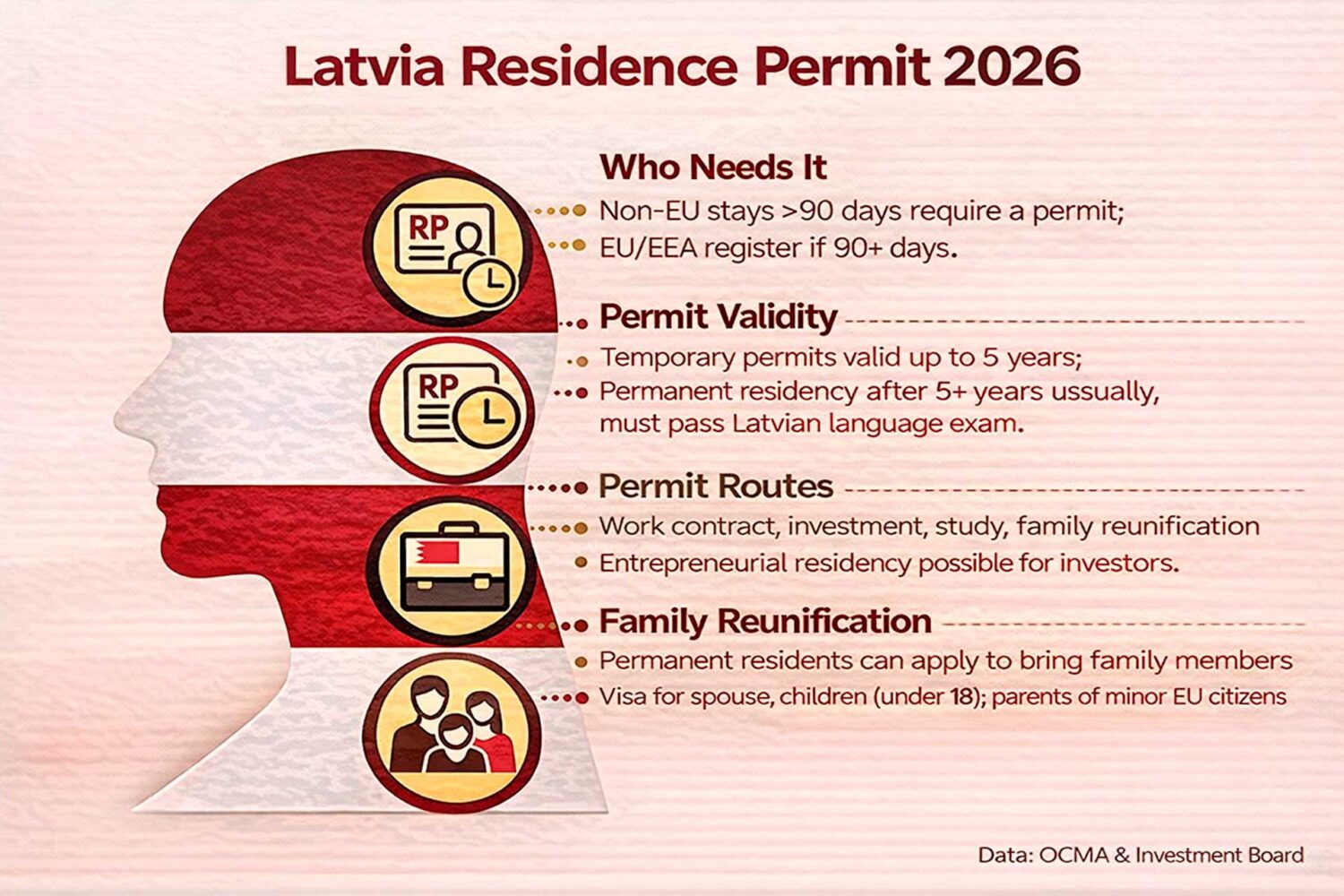
A Latvia residence permit is the document that allows a foreign national to live in Latvia either temporarily or permanently. OCMA describes it as the document that gives a foreigner the right to reside in Latvia for a definite period of time as a temporary resident, or permanently as a permanent resident. Latvia requires a residence permit when someone plans to stay for more than 90 days within half a year from the first day of entry.
Who can apply depends on the legal basis for the move. In practice, third-country nationals most often apply because they have a Latvian job offer, admission to an accredited educational institution, a qualifying family link, a self-employment or business activity plan, or a highly qualified job that fits the EU Blue Card rules. EU, EEA, and Swiss citizens follow a different registration regime rather than the standard third-country residence-permit route.
The main permit families in Latvia are temporary residence permits for employment and commercial activity, study and research, family reunification, self-employment and business activity, investment-related routes, and the EU Blue Card. After lawful residence over time, applicants may move toward permanent residence or EU long-term resident status if they meet continuity, income, and language criteria.
Official decision windows are often faster than many applicants expect on paper, but the real-world timeline is longer because it can include sponsor approval, embassy transmission, a D visa, travel to Latvia, biometrics, and card production. For most first-time temporary residence permits, OCMA lists 30 days, 10 working days, or 5 working days for review; for long-stay visas, the Ministry of Foreign Affairs lists 15 calendar days, extendable up to 60 days; after approval, residence-card production is 10 working days or 2 working days depending on the chosen track. A straightforward end-to-end case often lands in the roughly one-to-three-month range when these steps are combined, though extra scrutiny can extend that timeframe. This end-to-end estimate is an inference from the official component timelines, not a formal government “average.”
Typical official costs start around EUR 205 for a standard first-time in-country application if no embassy forwarding or D visa is needed, because that combines the EUR 160 review fee and EUR 45 residence-card fee. A standard from-abroad route that requires embassy forwarding and a D visa commonly starts around EUR 475 and can rise near EUR 982 for faster processing and the higher consular-forwarding bracket, before translations, legalization, health insurance, and any local declaration fee are added.
Types of Residence Permits in Latvia
Latvia’s system is broad, but most applicants fall into five practical clusters. The official OCMA migration portal groups initial residence permits under family, employment and commercial activity, investments, studies and research, and other grounds. That makes Latvia relatively straightforward to navigate once the applicant identifies the real legal basis of stay rather than searching for a generic “immigration permit.”
Work Permit and Temporary Residence Permit With Right to Employment
In Latvia, long-term work for a third-country national is usually handled through a temporary residence permit with the right to employment rather than a casually used “single permit” label. OCMA’s employment guidance explains that the employer typically registers a vacancy with the State Employment Agency, submits a sponsorship request to OCMA for long-term employment, and then the foreigner applies for the residence permit and right to employment. The permit is the core long-stay document for long-term work cases.
A major Latvia-specific detail is salary compliance. For many general employment cases in 2026, the required remuneration is linked to the average gross monthly wage in the relevant sector, or the minimum wage established by the sector’s general agreement where applicable. OCMA separately lists higher thresholds for some employment or commercial categories, including EUR 3,630 for certain clauses of the Immigration Law tied to employment or commercial activity, and sector-specific wage rules for other employed-worker cases. Because of that structure, applicants should not rely on a single generic “minimum salary” figure for every work permit category.
Student Residence Permit
Latvia offers residence permits for studies in accredited universities and accredited educational institutions, and OCMA’s study pages list study agreement documents plus subsistence proof as central items. For standard student routes, the official document lists currently reference EUR 780 in necessary means of subsistence and EUR 234 for a minor where relevant. If the application is filed from abroad, embassy guidance also indicates that documents issued abroad generally need legalization and translation into English or Latvian before submission.
A useful long-term planning point is that study time does not always convert cleanly into long-term settlement time. For EU long-term resident status in Latvia, only half of the period spent studying in Latvia counts toward the five-year residence requirement, and a person studying only for education is not yet eligible for that status on a pure student basis. That matters for students who intend to transition into long-term work and settlement later.
Self-Employed Residence Permit
Latvia does have a genuine self-employment route, but it is more document-heavy than the work and study pathways. OCMA’s additional-document lists require a business plan verified by a certified auditor for the planned activity period, proof of personal funds to launch the activity, any necessary permit or licence, and, from later years onward, evidence that the business plan has been fulfilled and that required taxes have been paid. For self-employed renewals, the published threshold includes tax payments not below EUR 9,960 in the previous reporting year, or at least EUR 800 per month in the first incomplete reporting year on average.
This means Latvia’s self-employed route is realistic for genuine consultants, founders, and professionals, but weakly prepared “paper business” applications are much more exposed than a standard employment case. The route works best when the business case already exists on paper, the licensing position is clear, and the tax projections are realistic. That last point is partly an inference from the official documentary design, which places repeated emphasis on business-plan credibility, financial means, and tax history.
EU Blue Card and Long-Term Options
The EU Blue Card is Latvia’s premium route for highly qualified employment. Official Latvian materials define it as a temporary residence permit for a third-country national performing highly qualified work under an employer with either higher education qualifications or qualifying higher professional experience. Latvia’s current subsistence page sets the Blue Card salary threshold at EUR 2,723 per month from 1 April 2026, or EUR 2,178 for shortage occupations covered by Cabinet Regulation No. 108.
For applicants thinking beyond the first permit, Latvia offers two long-term tracks worth separating. A permanent residence permit is generally available after at least five years of residence with a temporary residence permit, with A2-level official-language knowledge and sufficient financial means as key requirements. The EU long-term resident status route also requires five years of continuous lawful residence, stable and regular income, and at least A2 Latvian, but it adds EU-level mobility advantages and applies a special continuity rule under which absences usually cannot exceed six successive months or ten months in total during the five-year period.
Latvia Residence Permit Requirements
Latvia’s requirements are category-driven, but the official sources show a highly consistent core package: application form, passport copy, photo, subsistence proof, category-specific evidence, fee payment, and then post-approval steps such as health insurance, biometrics, and local address declaration. The strongest applications are the ones that treat the process as a document audit rather than as a narrative request.
General Requirements
Most first-time applicants need to show a valid travel document, the correct questionnaire, a photograph, lawful purpose of stay, sufficient means of subsistence, and payment of the relevant fee. Category pages on the OCMA migration portal consistently add the purpose-specific anchor document, such as a study agreement, kinship proof, an employer basis, or a business plan. Where the applicant has stayed in a country of citizenship or residence for more than 12 months, criminal-record documentation can also appear among the required items, depending on the category page.
Foreign documents issued abroad often require both translation and legalization. A Latvian embassy guide explains that documents issued abroad must be legalized and that the document-legalization process includes translation into English or Latvian together with legalization at the Ministry of Foreign Affairs.
Documents Needed
The list below condenses the most common document layers that recur across Latvia’s official guidance:
- Residence-permit questionnaire. Core application form. Embassy guidance notes that incomplete or false information can lead to refusal.
- Passport copy. Confirms identity and travel status. OCMA consistently requires a valid travel document copy.
- Needed for physical document issuance. Standard requirement across categories.
- Category-specific proof. Demonstrates the legal basis for staying in Latvia (e.g., study agreement, proof of kinship, employment contract, business plan).
- Financial proof. Shows that the applicant can legally support themselves. Required amount depends on the specific application route.
- Criminal record certificate. Used for background screening in many categories. Typically required if the applicant has lived long-term in another country.
- Payment document. Confirms that the application fee has been paid. OCMA emphasizes that official budget-system confirmation is required, not just a bank receipt.
- Health insurance. Required at registration and often during the visa stage. Must cover at least €42,600 for D visa or residence permit applications.
- Translation and legalization. Ensures foreign documents are valid for use in Latvia. Embassy guidance specifically highlights the need for both translation and legalization where applicable.
A highly practical official rule that applicants often miss is document validity. OCMA’s FAQ says documents proving subsistence and the planned place of residence in Latvia are valid for three months after issue; statements, letters, and similar documents are usually valid for six months; and an X-ray or fluorography result is valid for one year. That rule alone explains many late-stage document refresh requests.
Financial Requirements
Latvia’s financial rules are among the most important parts of the file because they shift by category. From 1 April 2026, OCMA’s published necessary-subsistence page lists EUR 780 for standard cases not covered by special subparagraphs, EUR 234 for a minor child, EUR 2,340 for certain investment-related grounds under Section 23(1)(29), EUR 2,723 for the EU Blue Card, EUR 2,178 for shortage-occupation Blue Card cases, and sector- or law-specific thresholds for many work-based routes. For some clauses tied to employment or commercial activity, the figure is as high as EUR 3,630.
For family and study routes, the published category pages commonly reference the same EUR 780 adult figure and EUR 234 for a minor child. For family-member cases, those figures appear repeatedly in the OCMA migration portal’s English document lists. For study cases, the same baseline appears in the student document pages.
For work permits, the safest interpretation is not to use the generic EUR 780 amount unless the category truly falls under the standard-rule bucket. OCMA’s 2026 guidance makes clear that many employment and Blue Card cases are anchored to salary thresholds that are substantially higher than the general minimum. That is why applicants and employers should check the exact category page, not a general forum summary.
Health Insurance
Health insurance is not a secondary formality in Latvia’s process. OCMA states that when requesting a D visa or a residence permit, the insurance policy must cover emergency medical care, hospital treatment in a critical situation, transportation to the nearest treatment institution, and return transportation to the home country in the case of serious illness or death. The minimum insurer liability limit must not be below EUR 42,600, and the policy period must not be shorter than the expected period of stay in Latvia.
OCMA’s residence-permit registration page also shows that a valid health insurance policy must be presented when registering the temporary residence permit, while the policy is not required for registration of a permanent residence permit. That detail matters because an applicant can have a positive decision but still delay final registration if the insurance document does not meet the rules.
Proof of Accommodation
Latvia’s official guidance treats accommodation in two related ways. First, OCMA’s FAQ states that documents confirming the planned place of residence in Latvia are valid for three months after issue. Second, after arrival and during local settlement, a third-country national with a Latvian residence permit must declare the place of residence either through OCMA or the relevant local-government registration authority. Electronic declaration is free, while in-person declaration costs EUR 4.27.
That means accommodation proof should be understood in both application and post-arrival terms. During the file stage, it supports the planned place of stay; after arrival, it becomes part of the address-declaration obligation that integrates the resident into Latvia’s registry systems.
Leave your contacts to have an expert contact you shortly.
How to Apply for a Latvia Residence Permit
Latvia’s official process is more structured than complicated. The core sequence is: identify the legal basis, prepare the sponsorship or call if needed, collect the document set, submit through the correct channel, wait for the OCMA decision, travel if necessary, then complete local registration and address declaration in Latvia. Latvia also allows electronically signed document submission in many cases, and postal filing remains possible where e-signature is not available.
Step-by-step application process:
- Choose the correct permit type. Start by matching the move to the legal basis actually recognized by OCMA: work and commercial activity, study and research, family, self-employment, Blue Card, or long-term routes. Many application problems start when applicants pick a broad life narrative instead of the correct statutory category.
- Prepare the sponsorship or call if your route requires it. OCMA’s migration portal states that before submitting documents for an initial residence permit, the applicant should prepare the call via the e-service for invitation or call approval. For long-term employment, OCMA’s employment guidance specifically says the employer submits a sponsorship request.
- Collect and check the full document package. At minimum, that usually means the questionnaire, passport copy, photograph, proof of legal basis, financial proof, and fee payment. Depending on the route, it can also mean kinship documents, criminal-record certificates, study agreements, employer documents, business plans, or licence evidence. If documents were issued abroad, embassy guidance says they generally need legalization and translation into English or Latvian.
- Submit documents through the correct channel. OCMA’s document-submission guidance says foreigners can submit properly e-signed documents electronically, send them by mail if e-signature is not possible, or, if residing outside Latvia, submit through a Latvian embassy abroad. Embassy pages also state that the embassy forwards the documents to OCMA, and that the processing clock starts when OCMA receives the file in Latvia rather than when the document packet is physically handed over at the embassy.
- Wait for the OCMA decision. The decision timing depends on the track selected. Standard and accelerated processing options exist for many categories, and extra scrutiny can slow the case, especially at the visa stage.
- If applying from abroad, obtain the travel document needed to enter Latvia. Embassy guidance says that after a positive residence-permit decision, the applicant then applies for a long-stay visa valid for 90 days in order to travel to Latvia and obtain the residence-permit card. In practice, this is the bridge between approval and physical relocation for many overseas applicants.
- Register the permit, give biometrics, and collect the card in Latvia. OCMA’s migration portal states that when submitting the documents specified in the decision, the foreigner appears at the territorial unit, gives biometrical data, pays the state fee for production of the residence permit, and then receives the document.
- Declare your place of residence in Latvia. A third-country national who has received the residence permit may declare the address through OCMA or the local government. In-person declaration costs EUR 4.27, while the e-service is free.

Latvia Residence Permit Processing Time and Fees
Latvia has one of the clearer pricing and timing frameworks in the region because the state publishes review tracks openly. The challenge is that applicants often focus only on the permit-review fee and ignore the rest of the chain: embassy forwarding, the D visa, card production, translations, legalization, insurance, and local registration.
Latvia Residence Permit Processing Time
For most first-time temporary residence permits, OCMA’s current price list gives three review tracks: within 30 days, within 10 working days, and within 5 working days. For the EU Blue Card, the review tracks are within 10 working days and within 5 working days. For permanent residence and EU long-term resident status, OCMA also publishes formal review windows, though those routes are relevant later in the migration cycle.
For the travel stage, Latvia’s Ministry of Foreign Affairs says that long-stay visa applications may be filed no earlier than three months before the intended visit, that a decision is normally made within 15 calendar days, and that the visa process can extend up to 60 days if additional information or scrutiny is required. After a positive permit decision and arrival-stage formalities, residence-card production is published by OCMA as 10 working days or 2 working days depending on the chosen service.
Factors affecting processing time
The fastest files are usually not the fastest fee track alone. They are the files where the legal basis, document validity, and translation package are all clean from day one. Latvia’s official guidance highlights several timing risks: the embassy-forwarded process only starts once OCMA actually receives the file; foreign documents may need legalization and translation; some visas or residence routes can trigger prior consultation or extra scrutiny; and certain documents expire in three or six months, forcing refreshes if the case drags.
For employment cases specifically, corporate immigration advisers have also noted that changes to Latvia’s foreign-employment framework increased process complexity for employers by adding more vacancy-publication and justification steps. That does not replace official OCMA guidance, but it supports the practical conclusion that employer-side preparation can materially affect how quickly a work-based case becomes submission-ready.
Latvia Residence Permit Fees
The 2026 official-fee picture is best understood in layers.
- First, OCMA charges a review fee for the residence-permit application itself. For a first-time temporary residence permit, that is EUR 160 within 30 days, EUR 280 within 10 working days, or EUR 560 within 5 working days. Blue Card review is EUR 160 within 10 working days or EUR 280 within 5 working days. The residence-card production fee is separate: EUR 45 within 10 working days or EUR 80 within 2 working days.
- Second, if the applicant applies through a Latvian diplomatic mission abroad, the Ministry of Foreign Affairs states that from 1 May 2026 the fee for receiving and forwarding residence-permit documents through diplomatic missions is EUR 180 or EUR 252 depending on the purpose of the residence-permit application. If a D visa is then needed for travel to Latvia after approval, the current long-stay visa fee is EUR 90.
- Third, there are the supporting-cost items that are not always described as “permit fees” but are still part of the real budget: translations, legalization, insurance, and local address declaration if done in person. For D visa and residence-permit insurance, the minimum liability limit is EUR 42,600. In-person address declaration in Latvia costs EUR 4.27, while the e-service is free.
| Cost item | Amount | Notes |
| First-time temporary residence permit review | EUR 160 / 280 / 560 | 30 days / 10 working days / 5 working days |
| EU Blue Card review | EUR 160 / 280 | 10 working days / 5 working days |
| Temporary residence permit registration review | EUR 75 / 140 / 290 | For registration of temporary residence permit |
| Permanent residence application review | EUR 160 / 280 | 30 days / 10 working days |
| Residence-card production | EUR 45 / 80 | 10 working days / 2 working days |
| Long-stay visa fee | EUR 90 | Standard MFA fee page |
| Embassy forwarding of residence-permit documents | EUR 180 or 252 | Depends on purpose; effective from 1 May 2026 |
| Address declaration in person | EUR 4.27 | Free if completed electronically |
A useful planning range is this:
- Standard in-country first-time route:EUR 205 minimum official charges, based on EUR 160 review plus EUR 45 card production.
- Accelerated in-country first-time route:EUR 640 maximum official charges, based on EUR 560 review plus EUR 80 accelerated card production.
- Standard from-abroad route with lower embassy fee:roughly EUR 475, based on EUR 160 review + EUR 180 embassy forwarding + EUR 90 D visa + EUR 45 card production.
- Higher-end from-abroad route:roughly EUR 982, based on EUR 560 review + EUR 252 embassy forwarding + EUR 90 D visa + EUR 80 card production.
How to Renew a Latvia Residence Permit
OCMA’s migration portal has a dedicated repeated-residence-permit track. If the foreigner is in Latvia, renewal documents may be submitted electronically with a secure signature, or to territorial divisions; if abroad, they may also be submitted electronically or otherwise through the available channels listed by OCMA. Repeated applications typically require the passport copy, a document confirming necessary means of support, fee payment, and a questionnaire where required.
Renewal timing matters. OCMA’s public document page explains that if a repeated temporary residence permit is requested later than 90 days after expiry of the previous permit, or if the investment object changes, the case may be treated under the rules for an initial temporary residence permit. That can make the file more burdensome than the applicant expected.
For long-term paths, permanent residence and EU long-term resident status effectively require a five-year lawful-residence history plus financial and language compliance. For EU long-term resident status, the continuity rule is specific: absence ordinarily may not exceed six consecutive months or ten months in total over the five-year period, subject to limited exceptions.
Why Residence Permits Get Rejected in Latvia
Latvia’s official sources do not publish a simple public “top reasons for refusal” leaderboard, but they do identify the rejection patterns very clearly through requirements, FAQ guidance, and step logic.
- A first frequent cause is incomplete or inaccurate documents. Embassy guidance explicitly warns that an incomplete application form or false information may lead to denial. OCMA’s document-submission rules likewise insist that electronic documents be properly formatted, legally signed, and correctly certified where copies are used.
- A second common cause is financial non-compliance. Since Latvia uses route-specific subsistence and salary thresholds rather than a single universal amount, many refusals or document requests likely happen because the applicant uses the wrong benchmark. This conclusion is an inference, but it is strongly supported by OCMA’s category-specific thresholds and wage rules.
- A third cause is expired or stale supporting documents. OCMA’s FAQ gives short validity windows for key papers, including the three-month validity of documents proving subsistence and planned place of residence. Applicants who prepare too early and submit too late can end up with a formally weak file even if the underlying facts are valid.
- A fourth cause is poor post-approval follow-through. Latvia separates approval from registration. Applicants may still need to provide biometrics, pay the card-production fee, show valid health insurance at registration, and declare a Latvian address. OCMA even notes administrative liability for failure to register the residence permit.

Expert Tips for Getting Approved
The strongest Latvia files usually succeed because they are technically clean rather than rhetorically persuasive. Based on the official sources, the best practical habits are straightforward.
- First, build your file backward from the category page. Latvia’s system is highly segmented. A Blue Card case, a general work case, a student case, and a self-employed case can all use different financial logic. Start from the matching OCMA category page and only then build the checklist.
- Second, treat money rules as route-specific, not universal. A standard family or study applicant often relies on the EUR 780 baseline, but employment and Blue Card cases can require far more. If the salary, sector, or occupation is misread, the file can fail even when every other document is correct.
- Third, watch document expiry dates before you submit. In Latvia, proof of subsistence and proof of planned address have short validity periods. If you collect those documents too early, the file can become stale before it reaches OCMA.
- Fourth, do not assume a bank payment screenshot is enough. OCMA’s updated fee page states that internet-bank printouts and similar documents are not treated as confirmation that the service has been paid; the effective confirmation is the budget payment system. This is the kind of technical issue that delays otherwise approvable files.
- Fifth, plan the post-approval stage before you get the decision. Successful applicants still need health insurance, biometrics, residence-card production, and address declaration. If you wait until the approval email to think about those steps, you lose time and may even risk non-compliance.
To make those tips concrete, here are three representative scenarios based directly on Latvia’s official permit design:
- A studentwith admission to an accredited Latvian university, valid translated documents, and the required subsistence proof is structurally aligned with the student route. The case becomes much riskier if the study agreement is clear but the foreign civil or police documents are untranslated or not legalized as required by embassy guidance.
- A highly qualified employeemay fit the Blue Card route very well, but only if the salary threshold is checked against the current 2026 OCMA figures rather than an older article. Using a 2022 or 2024 salary benchmark in a 2026 filing is a classic avoidable error.
- A self-employed applicantcan succeed where the business activity is real, funded, and documentable. The same route becomes weak if the business plan is generic, the licensing issue is unresolved, or the applicant lacks evidence of tax compliance for renewals.
If you want tailored legal support with obtaining a Latvia residence permit, professional help can reduce risk at the exact points where applications most often go wrong: choosing the correct legal basis, matching the latest salary or subsistence threshold, preparing translated and legalized foreign documents, structuring employer sponsorship, and handling renewal or appeal strategy after a refusal. For applicants who want a smoother process and a second pair of eyes before submission, working with an experienced immigration lawyer or regulated legal adviser can be especially valuable in work, Blue Card, family reunification, and self-employed cases.
Leave a Comment

We have prepared answers to the most common questions about Latvian residence permit. If you want to clarify anything, please contact us - we will provide detailed explanations.
As long as the permit remains valid and the category conditions continue to be met. For travel outside Latvia but within Schengen, a residence permit or long-stay visa issued by a Schengen state generally allows short stays in other Schengen states for up to 90 days in any 180-day period.
Only if your immigration basis includes the right to employment or your status otherwise authorizes work. OCMA’s employment guidance makes clear that for third-country nationals, employment and residence are linked but distinct legal elements, and long-term work cases are handled through sponsorship plus a residence permit with the right to employment.
It is more accurate to call Latvia a rule-driven system than an easy one. The formal process is transparent, official fees and review tracks are published, and multiple routes exist, but the document discipline is high, the wage and subsistence rules are category-specific, and foreign-document formalities can be strict. Applicants with a clean legal basis and a complete file usually do much better than those who try to generalize from non-official online summaries.
Often yes. OCMA’s family routes cover spouses, minor children, some parents, and other qualifying relatives depending on the exact legal basis. Family-member cases still require the correct kinship proof and subsistence evidence.
Yes, in many cases after at least five years of residence with a temporary residence permit, provided that continuity, language, and financial requirements are met. Latvia also offers EU long-term resident status, which has its own five-year continuity and A2 language rules.
No. MFA FAQ guidance states that a Latvian residence permit does not authorize employment in other Schengen states. It can support short-term travel, but not automatic cross-border labor-market access.
Yes. OCMA’s FAQ says the inviter, or a foreigner who does not need an invitation, may contest a refusal to the Head of OCMA within 30 days after the decision enters into force. The Head’s decision may then be appealed to court according to the law.


Comments
No comments found.