

 EU Citizenship
 Slovenian Citizenship
 Romanian Citizenship
 Bulgarian Citizenship
 Austrian citizenship (investments)
 Spanish Citizenship
 Italian Citizenship
 Cypriot Citizenship
 Lithuanian Citizenship
 Portuguese Citizenship
 French Citizenship
 German Citizenship
 Hungarian Citizenship
 Dutch Citizenship
 Belgian Citizenship
 Croatian citizenship


Netherlands Residence Permit 2026: Requirements, Types, and How to Apply
Author: Leon Scott
Published: 02.12.2025
Updated: 17.12.2025
The Netherlands residence permit (verblijfsvergunning) is an official document issued by the Dutch Immigration and Naturalisation Service (IND) that allows non-EU/EEA nationals to legally live in the Netherlands for more than 90 days. Often required for purposes such as work, study, family reunification, or entrepreneurship, the Dutch residence permit proves your legal status and includes important information like your V-number and work rights.
In this comprehensive guide, we explain what a Dutch residence permit is, who needs it, the different permit types, and how to apply for a residence permit in the Netherlands. You’ll learn about eligibility requirements, processing times, costs, permit renewal, and more. Whether you’re relocating temporarily or aiming for permanent residence, this guide provides step-by-step, up-to-date information to help you navigate the Dutch immigration system with clarity and confidence.
What Is a Dutch Residence Permit and Who Needs One?
A residence permit is an official card that allows you to legally live (and sometimes work) in the Netherlands for longer than 90 days. If you are not an EU/EEA or Swiss citizen, you must have a Dutch residence permit to stay in the country beyond 90 days. In contrast, EU/EEA and Swiss citizens have freedom of movement – they do not need a residence permit to live or work in the Netherlands. However, EU citizens staying more than four months must register at the local municipality (gemeente) and will receive a BSN (citizen service number) upon registration. Family members of EU citizens (who themselves are non-EU nationals) can usually join their EU relative in the Netherlands and apply for a residence document under EU law (verification against EU law).
Short stays (up to 90 days). If you plan to visit the Netherlands for 90 days or less, for tourism or short business, you do not need a residence permit. Depending on your nationality, you might need a short-stay Schengen visa, but not a residence permit. For example, a Canadian or American can stay visa-free up to 90 days. There’s no “residence permit in Netherlands” needed for such short visits.
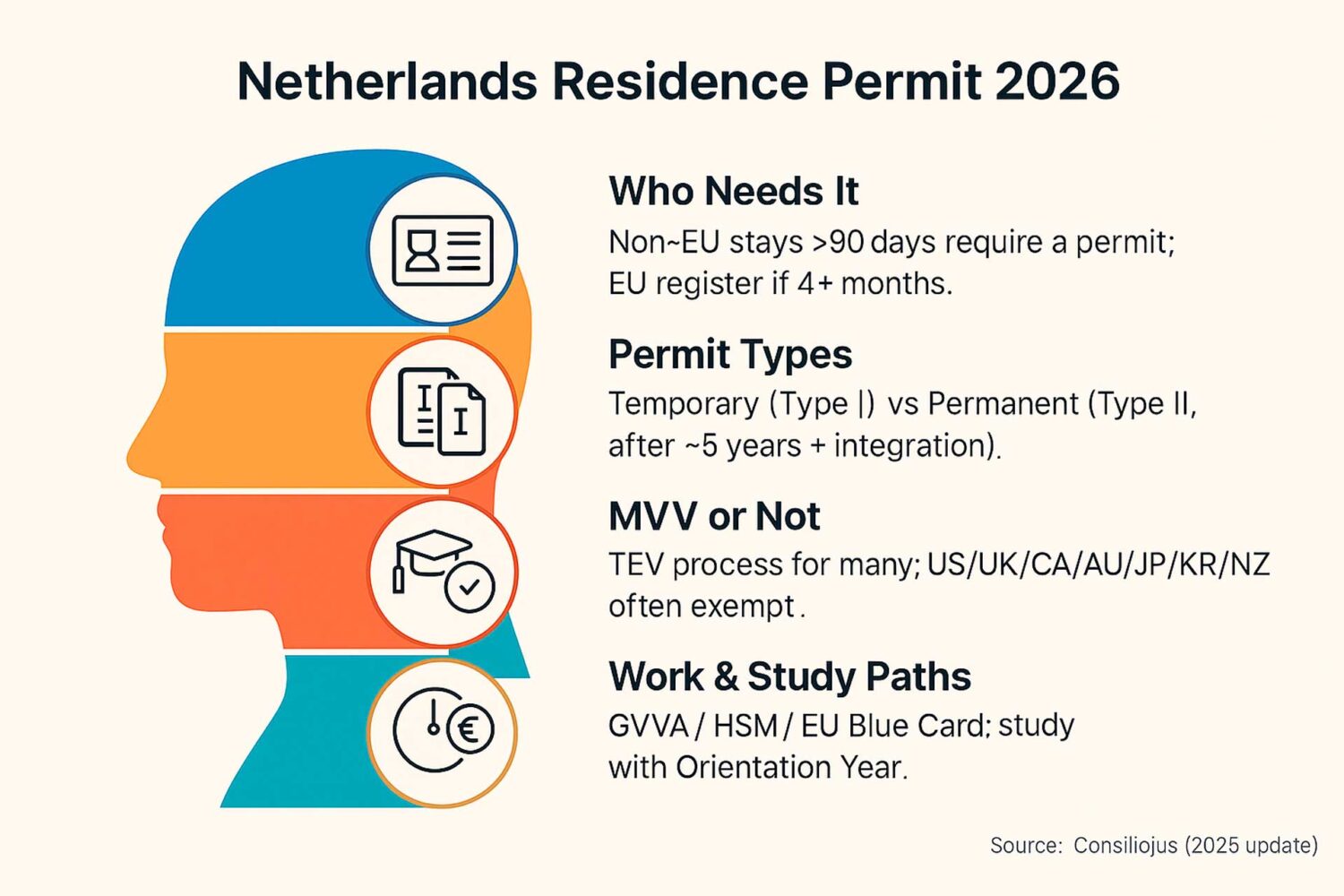
Long stays (over 90 days). For any stay longer than 90 days, a residence permit is required for non-EU nationals. This applies to most expats, workers, students, and family members moving to the Netherlands. In many cases, you may first need a temporary entry visa called an MVV (Machtiging tot Voorlopig Verblijf) to enter the Netherlands for long-term stay. We’ll explain the MVV process in the application section, but note that some nationalities are exempt from the MVV requirement (e.g. citizens of the US, UK, Canada, Australia, Japan, South Korea and a few others can apply for a residence permit Netherlands without an MVV).
⚠️ Summary: If you’re an EU citizen, you won’t need a residence permit Netherlands for EU citizens – just register locally if staying >4 months. Everyone else (non-EU) needs a Dutch residence permit to live in the country beyond 3 months. Now, let’s explore the types of permits available.
Temporary vs. Permanent Residence Permits
Dutch residence permits come in two broad categories: temporary (type I) and permanent (type II). A Netherlands temporary residence permit is what most newcomers receive initially. It’s tied to a specific purpose (e.g. work contract, study program, family reunification) and is valid for a limited duration, usually 1 year at a time (sometimes up to 5 years, depending on the purpose). Temporary permits require you to continue meeting the conditions of your stay – for example, if your purpose was employment, you must keep your job; if it was study, you must remain enrolled.
In contrast, a permanent residence permit (Netherlands) allows you to stay in the Netherlands indefinitely without tying you to a specific purpose of stay. You can apply for a Dutch permanent residence permit after 5 consecutive years of legally living in the Netherlands on temporary permits (fewer years in some cases, such as for refugees or those with EU Blue Card history). Permanent residency (often called a Dutch national residence permit) gives you a more secure status: you won’t need a sponsor, and you get unrestricted work access in the Dutch labor market (no separate work permit required). To qualify, you must have a non-temporary purpose of stay at the time of application (e.g. a work or family permit, not something like a working holiday), and meet integration requirements (passing the civic integration exam, unless exempt). We’ll discuss permanent residence more later, but keep in mind you generally need 5 years of continuous residency, stable income, and integration to obtain it.
Comparison of Temporary vs Permanent Permits
| Aspect | Temporary Residence Permit (Type I) | Permanent Residence Permit (Type II) |
| Validity | Limited (e.g. 1 year, renewable; up to 5 years max) | Indefinite (card itself renews every 5 years) |
| Purpose Requirement | Yes – tied to a specific purpose (work, study, etc.) | No specific purpose needed after granted (flexible stay) |
| Sponsor Needed | Often required (employer, school, family, etc.) | No sponsor required (you qualify based on 5-year residence) |
| Work Access | Depends on permit type (may be restricted or require work permit) | Free access to work (no additional work permit needed) |
| Key Eligibility | Valid reason for stay + meet that permit’s conditions | 5+ years continuous legal stay + integration and income requirements |
Note: Some temporary permits are labeled non-temporary purpose in Dutch law (e.g. work, family reunification) which count toward the 5-year requirement for permanent residence. Others are truly temporary (au pair, seasonal work, etc.) and do not count toward permanent residency or allow family reunion. Always check if your permit is considered “temporary” or “non-temporary” for long-term purposes.
Leave your contacts to have an expert contact you shortly.
Types of Dutch Residence Permits (By Purpose of Stay)
The residence permit types in the Netherlands reflect the different reasons someone might immigrate. Each residence permit Netherlands type has its own specific requirements, but we can group them into several major categories.
Residence Permits for Work and Employment
If you plan to work in the Netherlands, there are a few permit routes, depending on your job and qualifications:
- Single Work & Residence Permit (GVVA). Many non-EU workers in regular jobs get the Single Permit (GVVA – gecombineerde vergunning voor verblijf en arbeid). This combined permit includes authorization to reside and work for a specific employer. Your employer must usually prove they attempted to hire within the EU first, unless exceptions apply. The employer acts as your recognized sponsor, handling much of the application. A GVVA is typically issued for the duration of your work contract (up to 1 year, renewable).
- Highly Skilled Migrant (Kennismigrant). The Highly Skilled Migrant scheme is designed to attract talent. If you have a job offer with a qualifying Dutch employer (one that is an IND recognized sponsor), you may get a faster work/residence permit without the employer needing to prove a EU hiring search. To qualify, you must earn at least a set minimum gross salary (indexed yearly). For example, as of 2025 a highly skilled migrant over 30 needs a salary of €5,688 per month, while younger talents under 30 need €4,171 (gross) per month. These figures give an idea of the income level required for this category. The permit is tied to that employer; changing jobs means the new employer must also be recognized by IND and often requires a new application.
- EU Blue Card. This is an EU-wide work permit for highly qualified non-EU professionals. The Dutch EU Blue Card also requires a university degree and a higher salary threshold (around €5,688 in 2025, same as the over-30 HSM level). One advantage is that the employer does not need to be a recognized sponsor for a Blue Card. However, in practice many opt for the Dutch highly skilled migrant permit because the salary requirement can be lower for younger workers and the process is very straightforward in NL. The Blue Card can be useful if you plan to leverage it to move to other EU countries after 18 months, due to its EU mobility provisions.
- Entrepreneur / Self-Employment Permit. If you aim to start your own business or work as self-employed, the Netherlands has options. Generally, you must present a solid business plan and demonstrate that your enterprise will serve Dutch interests (through a points-based system assessing your experience, business innovation, and investment). However, U.S. citizens have a special route: under the Dutch-American Friendship Treaty (DAFT), an American entrepreneur can get a Dutch residence permit for self-employment by investing a substantial amount in a new Dutch business. In practice, that minimum investment is €4,500 in capital contribution, which is quite accessible. This DAFT visa is a two-year work/residence permit for running your own business. (Japanese citizens have a similar treaty arrangement as well.) Other nationalities can still apply for a self-employed permit but must score sufficient points or make a larger economic contribution. There’s also a one-year Start-up Visa for innovative entrepreneurs, which requires working with an approved facilitator and meeting innovation criteria (e.g. your product or service is new to the Netherlands) – after one year you can extend via the self-employed permit if progress is made.
- Intra-Company Transfer (ICT). Employees of a multinational company can be transferred to the Dutch branch under the ICT permit (EU Directive 2014/66). This is for managers, specialists, or trainees and is arranged by the employer (no separate work permit needed). It’s temporary and tied to the posting duration.
- Seasonal Work & Other Work Permits. For certain short-term work (e.g. agriculture seasonal work up to 6 months, internships, au pair, etc.), there are specialized permits. These are truly temporary and usually cannot be extended beyond their short timeframe or converted into permanent residency tracks.
⚠️ Working with a Dutch residence permit: Note that having a residence permit doesn’t always mean you can freely work. The back of your Dutch residence permit card will state your work rights. Some permits allow work without a separate work permit (indicated by “Arbeid vrij toegestaan” on the card), while others forbid work (“Arbeid niet toegestaan”) or require a work permit (TWV) in addition to the residence permit. For example, a spouse on a family permit may or may not have work rights depending on the sponsor’s status, and a student is limited in work hours. Always check the remarks on your residence permit or IND letter to know your work eligibility.
Residence Permits for Study
International students (non-EU) accepted into a Dutch educational institution need a study residence permit to live and study in the Netherlands. The university or college acts as the sponsor and will typically handle the application on the student’s behalf. Requirements include proof of enrollment, sufficient financial means to support yourself (per IND’s set amount), and sometimes a TB test after arrival (if from a high TB-risk country). Study permits are usually valid for the duration of your study program (up to a maximum of 5 years for a bachelor’s + master’s, for instance).
Work during study: Students are allowed to work part-time (usually up to 16 hours per week during the semester, or full-time in summer) with a separate work permit obtained by the employer. The residence permit for study itself does not give free access to the labor market (it will state a restriction on work). After graduation, good news – the Netherlands offers an Orientation Year (zoekjaar) permit. This is a one-year residence permit (no sponsor needed) that allows graduates of Dutch universities (and recognized foreign top-200 universities) to live in the Netherlands and work freely while job-hunting or starting a career. You must apply for it within 3 years of graduating. It’s a popular bridge to a work permit, as any job you find in that year won’t require the employer to get a work permit due to your open work status.
Residence Permits for Family Reunification
If you have a spouse, registered partner, or close family member in the Netherlands, you may qualify for a family reunification residence permit (also called partner or family permit). The Dutch resident (or citizen) acts as your sponsor in this case. Here are key points for partner/spouse permits:
- You must prove a long-term exclusive relationship with your partner. For married couples, a marriage certificate suffices; for unmarried partners, you need evidence of a durable, exclusive relationship (often 1+ year of cohabitation or correspondence).
- Both the applicant and the partner usually must be at least 21 years old (18 if married and the marriage was legally recognized before coming).
- The partner in the Netherlands must have sufficient income to support the family – meeting a minimum income threshold (typically at least the level of social assistance or a percentage of minimum wage, depending on circumstances).
- The partner in NL must hold either Dutch/EU nationality or a valid non-temporary residence permit. Notably, you cannot get a partner permit to join someone who is on a temporary purpose like a student or working holiday visa. But joining a highly skilled migrant, Blue Card holder, researcher, or permanent resident is possible (and in those cases, the family members usually get work rights).
- If you are coming from abroad to join a Dutch citizen or resident, you may need to pass a Civic Integration Exam Abroad (Basisexamen Inburgering) before getting the entry visa. This tests basic Dutch language and culture knowledge. Some are exempt (e.g. if you have certain diplomas or nationalities).
Family reunification permits are typically issued for 1 or 2 years at first and can be extended as long as conditions (relationship and income) remain met. After 5 years, if the relationship is still in place, the family member can often apply for permanent residence or even citizenship (assuming integration requirements are met).
Rights of family members: If you come on a partner permit, your right to work depends on your partner’s status. For instance, if your partner is a Dutch national or a highly skilled migrant, your residence card will usually say work allowed freely (no permit needed). If your partner is a non-EU on a regular work permit (GVVA), then you might need to get a separate work permit to take up a job. If your partner is a foreign student, unfortunately you cannot work (as their spouse) during the duration of their study permit. Always check the remarks on your permit for any work restrictions.
Other Residence Permit Categories
- Refugee/Asylum Permits. People who obtain asylum in the Netherlands receive a temporary asylum residence permit (type III). Family reunification for refugees has its own procedures. After 5 years, refugees can apply for permanent asylum residence (type IV).
- Exchange and Working Holiday. The Netherlands has working holiday agreements with countries like Canada, Australia, New Zealand, etc. under which young people (usually 18–30) can get a one-year residence permit (Working Holiday Program/Scheme) to travel and work casually. There are quotas and specific conditions (no long-term work, mainly cultural exchange). Au pairs also get a one-year permit (requiring a recognized au pair agency as sponsor).
- Permanent Residence for EU Citizens. EU/EEA citizens living in NL for 5+ years can apply for a permanent residence document for EU citizens, which isn’t required but can be handy to prove long-term residence rights. This is different from the national permanent residence; it’s essentially confirmation of EU treaty rights.
- Brexit – UK Citizens: UK nationals who were living in NL before 2021 fall under the Withdrawal Agreement and have special residence permits (temporary and then permanent) under that agreement. New UK arrivals post-Brexit are treated as non-EU nationals (but note: UK citizens are exempt from MVV visa).
- There are some niche categories (e.g. orientation year for graduates we covered, permits for former Dutch nationals returning, medical treatment, retired persons of Dutch origin, etc.). The IND (Immigration and Naturalisation Service) provides a full list of Dutch residence permit types and their requirements. Most likely, your situation will fall into one of the major categories above.
Not sure which Dutch residence permit applies to you? No matter your country of origin, we can help you understand the rules and start your journey to life in the Netherlands. 💬 Reach out now for tailored support — our immigration team is here for you.
General Requirements for a Netherlands Residence Permit
While each permit has specific conditions, there are general Netherlands residence permit requirements that almost every applicant must meet:
- Valid Passport: You need a passport (or travel document) valid for the duration of your stay. You’ll submit copies of your passport, and it must not expire soon.
- No Criminal Record / Public Order: You must not pose a danger to public order or national security. Applicants over age 12 are required to sign an antecedents certificate (a form declaring any past criminal offenses). Minor infractions usually aren’t an issue, but serious crimes can result in denial.
- Tuberculosis (TB) Test: If you are from a country with a higher TB risk (the IND has a list of exempt countries), you will need to undergo a TB screening in the Netherlands within 3 months of getting your permit. This involves a simple chest x-ray at the municipal health service (GGD). Many nationalities (EU, US, Canada, Australia, Japan, etc.) are exempt from the TB test.
- Sufficient Income or Funds: *Almost all residence permits come with an income requirement. This means either you or your sponsor (like your employer or partner) must show independent, sufficient, and sustainable income. The exact amount depends on the permit type: for a work permit, obviously a salary meets this; for a partner permit, the sponsor must typically earn at least the government’s minimum required income (which in 2025 is roughly €1,934 gross per month for a couple without children, as an example). Students must show enough funds to cover living expenses (around €960 per month plus tuition, roughly, in recent IND guidelines). These numbers change regularly, so always check the latest IND norms.
- Health Insurance: Everyone living in the Netherlands is required to obtain Dutch health insurance within 4 months of registering at the municipality. For some visa processes, you might sign a declaration that you will get health insurance. (EU citizens can use an EHIC initially; non-EU typically buy a private insurance for visa, then switch to Dutch basic insurance once resident.)
- Other Purpose-Specific Documents: Depending on your purpose, you’ll need additional documents (e.g. an employment contract, university enrollment letter, marriage certificate, birth certificates for children, etc.). Foreign documents must often be legalized or apostilled and translated by a sworn translator into Dutch or English. The IND is strict about proper legalization of foreign civil documents.
Keep in mind that each dutch residence permit type will have its own requirements on top of these general ones. For example, a highly skilled migrant needs to meet salary thresholds, a startup visa applicant needs an approved facilitator, and a family reunification applicant needs a proven relationship and a passing grade in a basic integration exam abroad (in many cases). Always check the IND website or official guidelines for the specific permit you seek.

How to Apply for a Residence Permit in the Netherlands
So, how to get Netherlands residence permit in practice? The application process can be broken down into clear steps. All applications are handled by the Dutch Immigration and Naturalisation Service (IND). The procedure and whether you apply from abroad or from within the Netherlands will depend on your situation.
1. Determine if you need an MVV (provisional visa)
If you are outside the Netherlands and from a country that requires an MVV (entry visa), you will follow the TEV (Entry and Residence) Procedure, applying for both the MVV and the residence permit together before traveling to NL. The MVV is essentially a sticker visa in your passport that allows you entry as a prospective resident, valid for 90 days. You will pick up the actual residence permit card after arriving in the Netherlands.
You do not need an MVV if you are a citizen of certain countries exempt from this requirement. For example, if you hold a passport from the USA, Canada, Australia, New Zealand, Japan, South Korea, UK, or an EU country, no MVV is needed – you can apply directly for a residence permit and even travel to the Netherlands visa-free in the meantime. Also, family members of EU citizens and holders of certain EU residence permits (like a long-term EU resident status from another country) may be exempt. If you don’t need an MVV, you can either have your sponsor start the application while you’re abroad or enter the Netherlands and apply for the permit from inside (since you’re allowed visa-free entry).
If an MVV is required, you generally must wait in your home country for approval. The IND strongly advises not to enter on a tourist visa to wait for a decision. You’ll submit your MVV application at the Dutch embassy/consulate, or your sponsor applies to IND directly, and once approved you pick up the MVV visa to travel.
2. Prepare the Application (Sponsor vs Self)
Who submits the application? In many cases, your sponsor in the Netherlands applies on your behalf. For example, for work permits, the employer (sponsor) files the application; for student permits, the university does it; for family reunion, the Dutch spouse/partner often must file the application to IND. The IND requires sponsors (especially employers and schools) to be recognized sponsors in many categories, which simplifies and speeds up processing. According to official guidelines, your sponsor usually submits the application if you are applying for: partner/family reunification, single work permit (GVVA), highly skilled migrant, EU Blue Card, intra-company transfer, researcher, or student permit. On the other hand, you can apply on your own (self-submit) for categories like: self-employed entrepreneur, start-up visa, or orientation year after graduation. In any case, you’ll need to coordinate with the sponsor to gather all required documents.
Collecting documents: Gather all the necessary supporting documents before applying: passport copies, birth or marriage certificates, employer or school letters, financial statements, etc. Check IND checklists for your permit type. If documents are from outside the Netherlands, make sure they are legalized/apostilled and translated if not in English, Dutch, French, or German.
3. Submit the Application & Pay Fees
You or your sponsor will submit the application to the IND. This can often be done online through the IND portal (if the sponsor has an account and the ability to apply online) or by mailing in a paper application. When applying from abroad with MVV, the application for MVV + permit is usually submitted in one go (TEV) – the Dutch embassy will forward it to IND if you apply via the embassy. If applying from within the Netherlands, once the application is received and if your current stay is legal, the IND can place a sticker in your passport (Residence Endorsement sticker) to prove you are allowed to stay during processing. This sticker may also indicate if you are allowed to work while waiting (often no, unless your permit type would allow work).
You must pay the application fee to IND. The cost depends on the permit type (for example, in 2024 a family reunification or work permit cost around €210, a student permit ~€192, orientation year €210, etc., and permanent residence is €243). Payment is typically done directly online via credit card or Dutch iDEAL if applying digitally, or via invoice if on paper. Fees are not refunded if your application is denied.
Tracking your application: When your application is logged, IND will issue a V-number (VNR), which is your 10-digit foreign national identification number in their system. This V-number appears on all letters from IND and on the back of your residence permit card (after the letters “VNR”). You can use it to call IND for status updates or to create a My IND account to follow your case. The IND’s decision timeline for most regular applications is up to 90 days (3 months) by law, though many straightforward cases are decided faster. Don’t panic if it takes several weeks; that’s normal. For permanent residence and more complex cases, the law allows up to 6 months for a decision.

4. Decision and Entry
The IND will send a written decision letter. If approved, the letter (or a separate notification) will explain how to collect your residence permit card. If you were abroad and applied through TEV, you’ll be instructed to collect your MVV visa at the Dutch consulate to travel to the Netherlands. Upon arrival in the Netherlands, you usually must pick up your residence permit card within 2 weeks at an IND Desk or expat center. If you applied from within the country, you can often directly go to an IND office to get the permit card once you’re notified it’s ready. An appointment is required for pick-up (and to provide biometrics like fingerprints and photo if you haven’t already).
In case of denial, the IND letter will state the reasons and your options to appeal or file an objection. If that happens, consult an immigration lawyer for advice.
5. After Arrival: Municipal Registration and More
Once you have your residence permit (or even while it’s in process), there are a few critical next steps:
- Register at the Municipality: If you’ll be in NL for more than 4 months, you must register at your local town hall in the BRP (Basisregistratie Personen) – the population registry. Upon registration, you’ll receive a BSN (Burger Service Number), which is like a social security/tax number. A BSN is needed for things like opening a bank account, working, and health insurance.
- Get Health Insurance: Dutch law requires residents to enroll in a Dutch health insurance plan within 4 months of becoming a resident. (If you’re a non-EU/EEA student under 30 and not working, you might be exempt from Dutch public insurance and can use private insurance.) Failing to get insurance can lead to fines, so mark this on your to-do list shortly after moving.
- TB Test: If your visa/permit conditions included a TB test requirement, schedule an appointment with the Municipal Health Service (GGD) for a tuberculosis screening within 3 months of arrival. It’s a quick process – they take an X-ray and you usually get results immediately.
- Civic Integration: If you came on certain permits (e.g. family reunification or certain long-term stays), you may be required to complete an integration program. This usually means passing the inburgering exams in Dutch language and society within a few years. You’ll be notified by mail from DUO (education ministry) if this applies to you. (This requirement does not apply to temporary workers or students, only to those on pathways to settlement like family or some work categories.)
By completing these steps, you’ll be set up to legally live in the Netherlands under your new residence permit.
Need help navigating the Dutch residence permit process? Just send us a quick message. We’ll review your situation and explain your best options whether it’s for work, study, family, or something else. 👉 Let’s simplify your next steps — request your consultation now!
Extending or Renewing a Dutch Residence Permit
Nearly all temporary residence permits have an expiration date (often 1 year or up to the length of a work contract/study program). It’s critical to renew (extend) your Dutch residence permit on time if you plan to stay longer. The IND typically sends a reminder letter and form about 3 months before your permit expires, but even if you don’t receive it, the responsibility is yours to take action.
How to extend: You can apply to extend your residence permit (verlenging) up to 3 months before expiry (but no later than the expiration date!). If you apply in time, your stay remains legal while IND processes the extension. If you miss the expiration and apply late (within 4 weeks after expiry), IND may still accept it but you will have a “residence gap” – a break in continuous residency that can reset the clock for permanent residence and citizenship. For example, a gap will mean waiting longer to accumulate 5 uninterrupted years. If more than 4 weeks have passed since expiration, you usually cannot extend and must start a new application (possibly requiring an entry visa again). So, do not let your permit expire without action.
When applying for an extension, you must still meet the requirements of your original permit (e.g. still have a valid job offer or still married and meeting income criteria). If your circumstances changed (new employer, different study, etc.), you may need to file for a change of purpose instead of a simple extension. Some permits like working holiday or orientation year are non-extendable – they are by nature once-off permissions.
Example: You came as a skilled worker with a 1-year contract, and your permit is expiring. To renew, you’ll need a contract extension or new job; your employer (if a recognized sponsor) can apply to extend your permit. If you lost your job, you generally cannot extend that work permit – you’d have to find another sponsor or switch status (there are short unemployment grace periods in some cases).
Cost: Extensions usually cost the same fee as the initial application. The procedure is similar: fill out the form (or online application), submit updated documents (like a new work contract, recent pay slips, etc.), pay the fee, and wait for IND’s decision. During this time, you can continue to reside (and work, if your new application is under the same conditions) as long as you applied before the old permit expired.
If your extension is approved, the new residence card will have a new end date. Often, after the first renewal, IND may issue a longer validity. For instance, a spouse permit might be extended for two years, or a work permit might be given for the length of a permanent contract (up to 5 years max on a temporary permit card). Remember, 5 years is the maximum on any temporary permit – by then you’re expected to either qualify for permanent residence or continue renewing if allowed.
Lost or stolen permit: If you lose your residence permit card or it gets stolen, don’t panic – but do act quickly. You should report the loss/theft to the police and get an official police report (certificate of loss). Then you must notify IND and apply for a replacement card. The police report copy is required for the replacement application. There is a fee (around €140) for a replacement permit card. Importantly, once you’ve reported a permit lost, that card is canceled and can’t be used if found later – you would need to turn it in to IND if you recover it. If your permit was close to expiring (less than 3 months validity left), IND might let you just apply for an extension early instead of a separate replacement.
Changing circumstances: If you, for example, change employers while on a work permit, both you and your employer should notify IND. In some cases (highly skilled migrant, Blue Card, etc.) a simple notification is enough as long as new conditions are met. In other cases (single permit GVVA), a new application is required for the new job. Similarly, if you divorce when on a partner permit or drop out of school on a study permit, those are changes that can affect your right to stay. It’s often possible to switch to another permit category if you qualify (for instance, a spouse who separates might seek a work permit; a student who finds a job can have an employer sponsor them). The key is to inform IND of changes and apply for a change of purpose if needed, rather than staying on a permit whose conditions you no longer meet.
Permanent Residence in the Netherlands
After building a life in the Netherlands, many expats aim for permanent residence – a more secure status that is not tied to a job or study. As mentioned, you can apply for a permanent Dutch residence permit after 5 years of continuous legal stay on valid residence permits. “Continuous” means no gaps in renewal and not spending more than 6 consecutive months (or 10 months in total) outside the Netherlands during those 5 years (short vacations don’t count against you). Time spent on certain temporary permits (like exchange programs, studies, or as an au pair) might not count toward the 5 years, whereas time on work or family permits does count – IND will check this (they require your current permit to be non-temporary in nature when you apply).
Other requirements for permanent residency include:
- Stable income: You must show you have sufficient, long-term income at the time of applying for permanent residency. This could be employment income, self-employed earnings, pension, etc., meeting at least the minimum threshold for your household.
- Integration: You need to pass the civic integration exam (inburgering) at A2 level or higher, or be officially exempt. If you’ve completed 5 years on a highly skilled migrant permit or studied to a degree in NL, you might be exempt or already meet it through education. Most people on family permits will have done this exam as part of their ongoing integration requirement.
- Long-term stay intent: Permanent residence is for those who intend to make the Netherlands their home. You should be registered in the municipality (BRP) and not have your main residence abroad.
When you apply, IND will actually first consider granting you the **Long-Term Resident – EU ** status (sometimes called Type V permit) if you meet the criteria. This is almost identical to Dutch national permanent residence, but has an EU designation that can help if you later move within the EU. IND will give you whichever status you qualify for; either way you get a permanent residence card if approved. The fee for permanent residence is about €240 and the processing time can be a few months.
Once you have permanent residency, you no longer need to worry about renewing every year based on a job or study. The permanent residence card is valid for 5 years at a time and can be renewed with a simple application (no re-evaluation of requirements, just a new card). However, permanent residency can be lost if you live outside the Netherlands (or EU in case of EU-LTR permit) for too long (usually more than 1 or 2 years continuous outside, depending on the permit), or if you commit serious crimes. It’s also not a passport – if you want to become a Dutch citizen eventually, that’s a separate process with its own requirements (e.g. 5 years residency, integration at B1 level, renouncing your old citizenship, etc.).
Tip: If you’re eligible, consider applying for permanent residence or Dutch citizenship as a long-term security measure. These give you peace of mind and more rights (like voting in national elections for citizens, or easier travel). Permanent residence in particular is a great fallback if, say, you lose a job – you won’t have to leave the country because your status is no longer tied to employment.
Ready to move forward with your Dutch residence permit? Whether you’re relocating for work, joining a partner, or starting university — we’ll help you choose the fastest, most secure route. 👉 Click here to start your free consultation today.
Staying Informed and Final Tips
Dutch immigration laws can change, so staying updated with Netherlands residence permit news and official announcements is wise. For example, the Dutch government periodically amends policies: recent news included the decision to close the investor visa program (residence permit for foreign investors) as of January 2024. This means that wealthy investor permits (which required €1.25 million investment) are no longer available for new applicants. Such changes underscore why keeping an eye on immigration news is important – rules for certain permit types or requirements (like integration levels or income thresholds) can shift with new policies.
To conclude, the immigration Netherlands residence permit process may seem daunting, but with the right information it is absolutely navigable. Here are a few parting tips:
- Start early: Begin preparing your documents and application well in advance. Some paperwork (like legalizing foreign birth certificates or marriage licenses) can take time.
- Use official resources: The IND’s website and the Dutch government sites have detailed guides – when in doubt, check the official source or contact the IND. They even have a helpdesk you can call (with English menus) for basic queries.
- Consult experts if needed: For complex situations or if you’re unsure, consider consulting a reputable immigration lawyer or advisor. For example, complicated cases like appeals, or figuring out a work-to-entrepreneur permit switch, may benefit from expert help. Dutch immigration law can be complex, and a professional can guide you.
- Keep documents safe: Your residence permit card is literally your ID in the Netherlands (along with your passport). Always carry it when traveling abroad and returning to NL. If you lose it, report and replace it quickly as described earlier.
- Mind the conditions: Every permit has conditions – e.g. main residence in NL (you cannot live mostly in another country while holding a Dutch permit), or working only if authorized. Abiding by your permit’s rules will keep you out of trouble.
- Renew on time: Mark your calendar for at least 3-4 months before your permit expires to start the extension process. Avoiding any residence gap will protect your path to permanent residency and citizenship.
We hope this guide has demystified the process of obtaining a residence permit in the Netherlands. By understanding the Netherlands residence permit requirements, knowing the types of permits and which fits your situation, and following the application process step-by-step, you’ll be well on your way to moving to the Netherlands legally and successfully.
Applying for a residence permit in the Netherlands doesn’t have to be stressful. If you’d like expert guidance tailored to your case, we’re here to help. 📩 Submit a consultation request, and we’ll get back to you with clear answers and a personalized plan.
Leave a Comment

We have prepared answers to the most common questions about Dutch residence permit. If you want to clarify anything, please contact us - we will provide detailed explanations.
The BSN (Burgerservicenummer) is not printed on the Dutch residence permit card. It is issued separately by the municipality (gemeente) when you register in the BRP (Basisregistratie Personen). You’ll receive the BSN in a confirmation letter after registering your address in the Netherlands. This number is essential for taxes, banking, and healthcare.
The V-number (V-nummer) is the 10-digit foreign national identification number used by the IND. On the Dutch residence permit card, it is printed on the back side, typically under the label “V-nummer”. It also appears in IND correspondence, and is used for tracking applications.
The document number (sometimes referred to as an ID number) is located on the front of the Dutch residence permit card. It usually appears near the top right and is labeled as “document number” or “documentnr.” This number identifies the card itself and is different from your V-number or BSN.
No, a Dutch residence permit does not automatically grant entry to Ireland, as Ireland is not part of the Schengen Area. You may need to apply for an Irish visa depending on your nationality. Always check the Irish Naturalisation and Immigration Service (INIS) website for visa rules.
To get a Dutch residence permit, you must apply to the Immigration and Naturalisation Service (IND), usually through a recognized sponsor (e.g. employer, university, or family member). The process typically involves: • Proving your purpose of stay (work, study, family, etc.) • Meeting financial, legal, and health requirements • Submitting documents (passport, contracts, etc.) • Paying the application fee Depending on your nationality, you may need an MVV (entry visa) before traveling to the Netherlands. After approval, you collect your permit card from the IND.
No, a Dutch residence permit only allows you to live and work in the Netherlands. To legally work in Belgium, you would need a Belgian work/residence permit unless you are an EU/EEA/Swiss citizen. Even though both countries are in the EU, residence rights do not automatically transfer between member states.
No, your Dutch residence permit does not allow you to work in Germany. It only permits residence and (if applicable) employment in the Netherlands. To work in Germany, you must apply for the appropriate German residence or work permit, unless you are an EU/EEA/Swiss citizen.


Comments
No comments found.