
 EU Citizenship
 Slovenian Citizenship
 Romanian Citizenship
 Bulgarian Citizenship
 Austrian citizenship (investments)
 Spanish Citizenship
 Italian Citizenship
 Cypriot Citizenship
 Lithuanian Citizenship
 Portuguese Citizenship
 French Citizenship
 German Citizenship
 Hungarian Citizenship
 Dutch Citizenship
 Belgian Citizenship
 Croatian citizenship


Norway Residence Permit 2026 – Requirements, Types, and Application
Author: Leon Scott
Published: 29.12.2025
Updated: 09.04.2026
Norway is a highly desirable destination for work, study, and living thanks to its high quality of life, stunning nature, and robust social benefits. If you plan to stay in Norway for more than 90 days – whether to work, study, or join family – you will need a Norway residence permit. This comprehensive guide explains how to get a residence permit in Norway, covering the various types, eligibility requirements, application process, costs, and what to expect after you arrive. We’ll also compare Norway’s residence permit rules with other Nordic countries and answer common questions about Norwegian residence permits.
Short Stays vs. Residence Permits in Norway
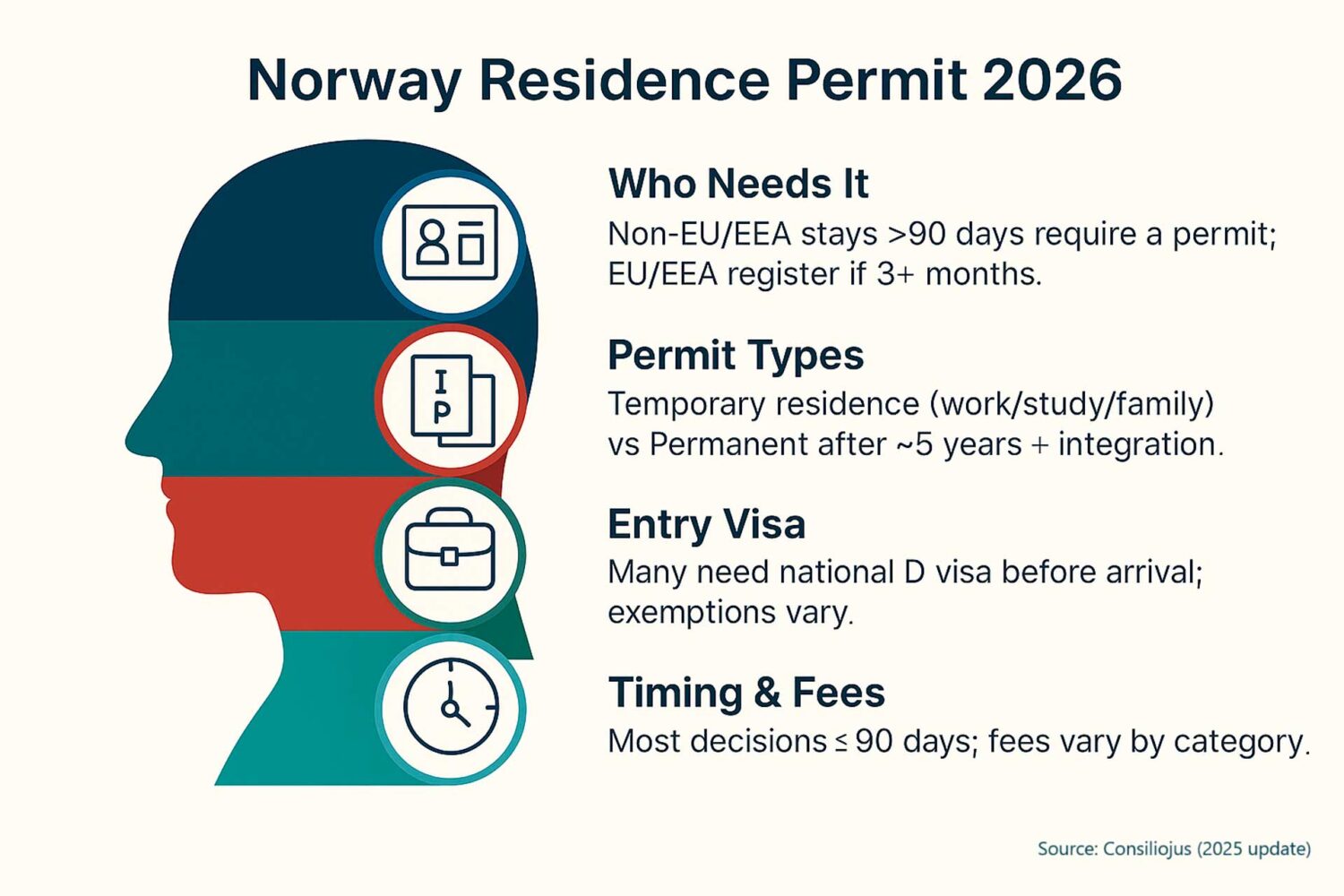
For short stays (up to 90 days in any 180-day period) Norway follows the Schengen Area rules. This means tourists and business visitors from Schengen-visa-exempt countries can visit Norway without a visa for up to 90 days. Visitors from countries that are not visa-exempt must obtain a Schengen visitor visa for short stays. However, any stay over 90 days (or any work) requires a residence permit.
- EU/EEA Citizens. If you are from an EU or EEA country (or Switzerland), you do not need a residence permit to live or work in Norway. You can enter freely, and if staying more than 3 months you simply register with the police to document your right of residence. Nordic citizens (from Sweden, Denmark, Finland, or Iceland) have even more streamlined rights – they can live and work in Norway without any permit or registration (though they must register in the population register for an ID number).
- Non-EU/EEA Citizens (third-country nationals). You must obtain a Norwegian residence permit for any work or stay longer than 90 days. Unlike EU citizens, you cannot simply arrive and register; you need to apply and be granted a residence permit (usually before traveling to Norway). The type of residence permit will depend on your purpose (work, study, family, etc.), as detailed below.
In summary, a residence permit in Norway is the key authorization that allows non-EU citizens to reside in Norway beyond short visits. Next, we’ll look at the different Norway residence permit types and their requirements.
Types of Norway Residence Permits
Norway offers several types of residence permits (midlertidig oppholdstillatelse) depending on your purpose of stay. The main categories include permits for work, study, family immigration, and a few others (such as permits for au pairs or refugees). Most initial permits are temporary residence permits (granted for a limited duration, often 1–3 years). After fulfilling certain conditions, many temporary residents can qualify for a permanent residence permit (permanent oppholdstillatelse) which allows indefinite stay. Below we outline the major residence permit types in Norway and their key requirements.
Residence Permits for Work in Norway
If you intend to work in Norway as a non-EU/EEA citizen, you will typically need a work residence permit. The most common route is the Skilled Worker permit, but there are also categories for seasonal work, job seekers (with strict conditions), and others. Key points for work permits:
- Skilled Worker Permit: This is the primary work visa for professionals. To qualify, you must have completed higher education or vocational training and have a concrete job offer in Norway that matches your qualifications. The job must be full-time and at a salary level at least comparable to Norwegian standards for that role. In practice, this means the pay should be no less than the average Norwegian salary for similar jobs, ensuring you can support yourself. You also need to meet any professional licensing requirements if applicable (for example, foreign nurses or teachers must have their credentials approved in Norway).
- Seasonal and Unskilled Work: Norway has permits for seasonal workers in agriculture, tourism, etc. Seasonal work permits require a job offer for a seasonal job (and sometimes have quotas). Recent updates effective 2025 tightened criteria for seasonal visas – applicants must have a registered Norwegian employer job offer and meet accommodation and insurance requirements. Seasonal permits are short-term and do not lead to permanent residence.
- Job Seeker Permit: Unlike some countries, Norway generally does not allow foreign job seekers to come without a job offer unless they fall under specific exceptions. Only certain individuals can get a short-term job seeker residence permit – for example, foreign students who graduate in Norway or researchers finishing a Norwegian assignment may apply for a 6-12 month permit to remain and job hunt. They must show proof of financial means (at least NOK 27,116 per month, which is NOK 325,400 for the year) to support themselves while searching. Generally, other foreigners must secure a job first and apply for a work permit before moving to Norway.
- Other Work Categories: Norway offers some specialized work permits, such as for Researchers, Athletes, Religious workers, and Working Holiday visas (for youth from certain countries). An Au Pair permit allows young people (ages 18–30) to live with a Norwegian host family for cultural exchange while helping with childcare. These categories have their own specific rules (e.g. au pairs must take Norwegian courses and cannot have children of their own).
Keep in mind that work permits are usually employer-specific. Changing jobs may require a new application or at least notifying immigration authorities. Also, your family members (spouse and children) can usually apply to join you on a family reunification permit if you have a work permit (more on family permits below).
Validity: Work permits for skilled workers are often granted for 2–3 years at a time, tied to the job contract. Seasonal permits might be 6 months. You can renew your work permit as long as you still meet the conditions (e.g. you still have a job) – we cover renewal procedures later. After three years on a skilled worker permit (and meeting other requirements), you become eligible to apply for permanent residence.
Student Residence Permit (Study Permit)
Non-EU/EEA students admitted to a Norwegian educational institution must obtain a student residence permit (often called a study permit) to live in Norway during their studies. Key requirements for a Norway student residence permit include:
- Admission to an Approved Program: You must have a letter of admission from a Norwegian university, college, or vocational school. The studies must be full-time. (Exchange students in an approved program also qualify.) The school/program must be accredited in Norway.
- Sufficient Funds: You must show you have enough money to support yourself in Norway for the duration of your studies. As of 2025, this means at least NOK 166,859 per year (about NOK 15,200 per month) available for living expenses. This amount is updated annually; check current UDI guidelines. Funds can be in the form of personal savings, student loans, or scholarships, and often must be deposited in a Norwegian bank account or the university’s deposit account. If you have to pay tuition (most public universities in Norway are tuition-free for international students, but private institutions or certain programs have fees), you must also show additional funds to cover the tuition amount.
- Housing and Insurance: You need to have arranged a place to live (e.g. student housing or other accommodation). Additionally, you must have health insurance coverage. Students from countries that don’t have a social security agreement with Norway may need private health insurance for the first few months until they become eligible for Norwegian National Insurance.
- Intention to Return: You should intend to leave Norway after studies unless you pursue further permits (UDI will want to see that your stay is genuinely for education). Often, a statement that the circumstances in your home country indicate you’ll return (like family ties or a return ticket) is needed.
A student permit allows part-time work of up to 20 hours per week during semesters (and full-time in holidays) so you can earn extra money. Note that time spent in Norway on a student permit does not count towards permanent residence. Students are expected to leave Norway or transition to another permit (for example, a work permit) after graduation. However, as mentioned, if you complete a degree in Norway you may qualify for a one-time job seeker permit to stay and find work.
Leave your contacts to have an expert contact you shortly.
Family Immigration Residence Permits
Norway permits family reunification for certain family members of people who are either Norwegian citizens or who hold valid Norwegian residence permits. A family immigration permit allows the family member to live (and usually work) in Norway. Here are the main scenarios:
- Spouse or Cohabitant: If you are married to or in a long-term cohabitation with a person in Norway (either a Norwegian citizen or a foreign resident), you can apply for a residence permit to join them. For cohabitation, you generally must document that you have lived together for at least two years or have a child together, and both be over a certain age (often 24 years old to prevent forced marriages). Fiancés can also get a short-term permit to come to Norway and marry within 6 months, after which they can apply for a spouse permit.
- Children: Minor children (typically under 18) can join a parent who is living in Norway. If one parent is staying in Norway and the other parent is abroad, the consent of the non-resident parent is usually required for the child’s relocation. For Norwegian or EU citizen parents, children under 21 (for EU) or under 18 (for non-EU) can get permits relatively easily. Adult children generally do not qualify unless there are special circumstances (e.g. the adult child is disabled and dependent on the parent).
- Parent joining Child: This is more difficult – elderly parents of adult Norwegian residents are usually not granted residence except in exceptional humanitarian circumstances. Norway does not have a broad visa category for parents of immigrants, unlike some countries. Exceptions might be made if the parent has no one to care for them in the home country and the family in Norway can support them, but such cases are rare.
Requirements: Family immigration applications have an important requirement: the financial guarantee (income requirement). The person in Norway (the sponsor) typically must earn above a certain income threshold to prove they can support the family member. As of 2024-2025, the required income for a spouse/child sponsorship was around NOK 416,700 per year pre-tax. (This corresponds to the annual pay of about a full-time job at ~NOK 35,000/month; it is adjusted annually.) The sponsor must also not have received social welfare benefits in the past 12 months. Additionally, the sponsor needs to have appropriate housing (enough space) for the family member. There are some exemptions or relaxations of the income rule for refugees and Norwegian citizens who have lived abroad, etc., but generally income proof is crucial.
Work Rights and Duration: A family immigration permit typically gives the right to work in Norway (spouses can work in any job). The permit is usually granted for one year at a time and can be renewed annually as long as the conditions still exist (e.g. the marriage is intact and the income requirement is met each year). After living in Norway for (usually) 3 years on a family permit, the family member can qualify for permanent residence (if other criteria like language skills are met). One exception: if you are family of a person who held a temporary protection/asylum permit, you might need 5 years for permanent (see Permanent Residence section). But family of Norwegian or EU citizens and of foreign skilled workers generally fall under the 3-year rule for PR.
One must also note that marriages of convenience are not tolerated – the authorities can investigate if they suspect a marriage was contracted just for immigration. If a relationship ends (divorce), a spouse’s residence permit may not be renewed unless certain conditions are met (for instance, if the marriage lasted at least 3 years with one year in Norway, or if there’s a common child and custody arrangements).
Fees: Family visas involve a substantial application fee. Currently the fee for a first-time family immigration application is NOK 11,900 for most adult applicants. (Children are often free or lower cost.) Renewals are cheaper (around NOK 4,400). These fees are paid to UDI when applying and are non-refundable even if the visa is denied.
Residence Permit by Investment or Business Establishment
Norway does not have a “golden visa” or direct citizenship-by-investment program like some countries. However, entrepreneurs and investors may still obtain a residence permit by investment in the sense of starting or investing in a Norwegian business. Essentially, this falls under the skilled worker category as a self-employed person or business owner. Key points for this pathway:
- There is no predefined minimum investment in law, but in practice Norwegian immigration expects a substantial capital investment and business plan. Commonly cited guidelines suggest investing at least €100,000 (approximately NOK 1.1 million) into a new or existing Norwegian business. The business must create jobs or contribute to the Norwegian economy in meaningful ways. Priority sectors include IT, shipping, oil and gas, green energy, fishing, maritime, etc., as these are areas Norway considers valuable.
- The investor must be an active participant in the business (this is not a passive real-estate investment scheme). You’d typically apply as a self-employed skilled worker who is going to run a company in Norway. You must be over 18 and have no criminal record. Funds invested must be your own (and legally sourced) and you need a solid business plan. The Norwegian Directorate of Immigration (UDI) will review the viability of the business when assessing the application.
- If approved, an investor/entrepreneur gets a temporary residence permit (usually 1 or 2 years, renewable) to run the business. After three years of continuous residence, the person can qualify for permanent residence just like other workers. Indeed, a successful business investor is treated similarly to any skilled worker in terms of settlement: permanent residence after 3 years, and eligibility for Norwegian citizenship after 7 years of living in Norway (Norway began allowing dual citizenship in 2020, so investors can maintain their original citizenship if they later naturalize in Norway).
In summary, while Norway’s route is not a straightforward “pay money, get visa” scheme, it is possible to obtain a residence permit by starting or investing in a Norwegian company and meeting the skilled worker criteria. For those willing to invest and contribute economically, Norway offers an appealing environment, though this path requires careful preparation and typically the help of legal advisors. (Tip: As of 2025, Norway has no direct real estate investment visa – simply buying property does not grant residency. Business activity is the main investment route.)

Other Types of Residence Permits
A few other residence permit categories in Norway include:
- Asylum and Humanitarian Protection: Individuals who seek asylum in Norway can be granted a residence permit if they are refugees or in need of protection. This is a complex process handled by a separate asylum system. Those granted asylum receive a renewable residence permit (usually 1–3 years at a time) and can later get permanent residence after five years in Norway. (Refugee status requires five years for PR, unlike work/family which require three, as noted earlier.) Norway also sometimes grants residence on humanitarian grounds (for example, medical treatment or if it’s not safe to return to home country) – these are case-by-case.
- Permit for EU/EEA Nationals’ Family (Residence Card): Citizens of EU/EEA countries don’t need permits themselves, but their third-country-national family members can get a residence card under EU rules. This is separate from the normal family immigration permit and has no fee. For instance, an Indian spouse of a German who moves to Norway would get a residence card as an EU dependent. This confers similar rights to a family permit (including work).
- Permanent Residence Permit: This is not a separate entry visa but the upgrade after fulfilling requirements (discussed in detail later). It gives an indefinite right to stay and work. We include it here as a “type” in the sense of immigration status.
- Temporary Residence for Specific Purposes: Norway can issue permits for research scholars, working holiday youth, interns/trainees, and even medical treatment (if you need to stay for a long treatment). There’s also a special permit for victims of domestic abuse who are divorcing a Norwegian spouse – allowing them to remain independently. These have narrow qualifying criteria and often limited duration.
As you can see, Norway residence permit types range across many life scenarios. Next, we will discuss the general requirements you must meet, regardless of permit type, and then the steps to apply for a residence permit in Norway.
Requirements for a Norwegian Residence Permit
While each category of residence permit in Norway has specific criteria, there are some common requirements and documents needed for any residence permit application:
- Valid Passport: You must have a passport that is valid for at least the duration of the permit you seek (often beyond). A copy of your passport (all pages) is required with the application. Norway will not grant a permit extending past your passport’s expiry.
- Clean Criminal Record: Applicants are usually asked to provide a police clearance certificate from their home country (and any country you’ve lived in for a long time). Serious criminals can be refused permits. Honesty on your application is important; background checks may be done.
- Specific to Purpose: You must meet the specific requirements of the permit type. For example, work permit requires a job offer and relevant qualifications; student permit requires an admission letter and proof of funds; family permit requires proof of relationship (marriage certificate, birth certificate) and your sponsor’s income/housing documentation; investment-based permit requires business plans and proof of investment funds, etc. Each category has a checklist of documents on UDI’s website that you should follow.
- Financial Ability: In most cases, you need to show you can support yourself (or be supported by your sponsor or employer). Norway does not want residents to immediately rely on welfare. Work visa applicants meet this via their job salary (the employment contract showing salary suffices as proof). Students must show savings or income as described earlier. Family reunification sponsors must show income. Essentially, financial self-sufficiency is a core requirement.
- Health Insurance: If you are not immediately covered by the Norwegian National Insurance scheme, you might need private health insurance. For example, students often need insurance for the first year. Visitors converting to some permits might also need to show insurance coverage until they become eligible for the national system.
- Accommodation: You may be asked to provide an address in Norway or proof of accommodation. Family immigration specifically requires that the sponsor has adequate housing for the family (e.g. not a one-bedroom apartment for a family of five). For other categories, simply having a place to stay suffices, but it’s wise to have a rental contract or housing guarantee letter.
- Age and Identity: You must prove your identity (passport, birth certificates). For certain permits there are age requirements (au pairs must be 18-30, spouses must usually be 18 or sometimes 24 for both parties, etc.).
- Obligation to Obey Norwegian Laws: By applying, you implicitly agree to abide by Norwegian laws. Certain conduct (like violations of immigration rules or committing crimes) can lead to rejection or later revocation of permits.
Finally, all documents not in Norwegian or English must be translated by an authorized translator. Always check UDI’s document checklist for your specific case – providing all required documents greatly improves your chance of a smooth approval. Missing documents or incomplete information is a common cause of delays or rejections.
How to Apply for a Norway Residence Permit (Application Process)
Applying for a residence permit in Norway involves several steps. The process is managed by the Norwegian Directorate of Immigration (UDI), often in cooperation with Norwegian foreign embassies or consulates if you apply from abroad. Below is a step-by-step overview of the Norway residence permit application process:
- Determine the Correct Permit Type. First, identify which category you fall under (work, study, family, etc.). UDI’s website has a guide where you input your nationality and purpose, and it tells you what options you have. It’s crucial to apply for the correct permit type, as the requirements and procedures differ.
- Gather Required Documents. Once you know your permit type, use the specific document checklist from UDI. Common documents include your passport, passport photos, proof of purpose (e.g. work contract or university admission letter), proof of funds or income, insurance, accommodation details, and any required certificates (marriage, birth, diplomas). Make sure to prepare every document and get official translations if needed. Also be ready to pay the application fee – for example, NOK 6,300 for work permits, NOK 5,400 for student permits, NOK 11,900 for family reunification (first time), and NOK 4,000 for permanent residence.
- Submit an Online Application. Most residence permit applications are started online through the UDI application portal. You create an account, fill in the application form, and pay the fee online. After submission, you’ll receive a confirmation and a cover letter (PDF) by email. Print the cover letter – you will need to sign it and submit it with your documents.
- Appointment for Document Submission and Biometrics. After the online step, you (and any family applicants) must submit your documents and provide biometrics (fingerprints and photo). If you are abroad, this is typically done at a Norwegian Embassy or a Visa Application Center (VFS) in your country. If you are already in Norway (and allowed to apply from Norway), you’ll book an appointment with the local police or Service Centre for Foreign Workers (SUA). Important: Some nationalities are not allowed to apply from Norway if they came as visitors, so most people will apply from their home country before travel. At the appointment, bring your passport, the signed cover letter, and all the original documents plus copies as per the checklist. The official will collect your fingerprints and take your photo for the residence card. After this, your application is officially in process.
- Processing Time. Now comes the waiting period. Norway residence permit processing time varies by permit type and workload. UDI provides estimates – for example, work permits and study permits often take around 1 to 3 months (up to ~12 weeks) to get a decision. Family reunification cases can take longer, commonly 4–6 months (20 weeks or more), especially if background checks or interviews (sometimes required for marriages) are needed. As of late 2025, Norwegian police and UDI statistics indicated median processing times for work permits around 2–3 months. In complex cases, it could be longer. Tip: Apply well in advance and do not book travel before approval – it’s risky, as decisions can be delayed. You can check UDI’s case processing portal online for status updates or estimated wait times.
- Decision and Receiving Your Permit. You will be notified by email or through the application portal when a decision is made. If the application is approved, you may need to get an entry visa (D-visa) stamped in your passport to travel to Norway (if you are from a country that normally requires a visa to enter Schengen). The embassy will inform you about this. Once you arrive in Norway, or if you applied in Norway, you will need to pick up your Residence Permit Card.
The residence permit approval letter will usually instruct you to book a time with the police to obtain the residence card (if you gave biometrics already, the card is ordered automatically). The card is an ID plastic card proving your Norwegian residence permit. It typically takes 10–15 working days after approval to be produced and delivered. In Norway, the card is often mailed to your registered address or you get a notice to collect it at the police station. If you applied from abroad, you will report to the police after arrival in Norway for registration and the card process.
Do not travel out of Norway before you have your residence card (unless you have to and have no choice). Without the card, airlines and border control may not recognize your status, causing difficulties. The approval letter itself is not sufficient for travel. As UDI advises, you should wait until you have the physical card in hand before any trips. The card, when presented with your passport, also allows you visa-free travel throughout the Schengen area for up to 90 days in 180 days. - Registering in Norway. After moving to Norway on a residence permit, there are a few formalities. If your stay is intended to be at least 6 months, you must register with the National Population Register to get a Norwegian personal identity number (personnummer). This is usually done at the tax office (Skatteetaten). The identity number is crucial for opening bank accounts, accessing healthcare, etc. Your residence permit card has a “UDI number” or case number, but the national ID number will be a separate number you receive upon registering your address. Make sure to also get a Norwegian SIM card and bank account, and update your address whenever you move.
- Follow Permit Conditions. Once you have the permit, ensure you follow any conditions attached. For instance, if you have a work permit, you should only work in the job/field authorized (if it’s employer-specific, don’t change employer without notifying UDI). Students must make progress in studies and not work more hours than allowed. Family members should reside with the sponsor. Breaching conditions (like working more hours than allowed on a student permit, or quitting a job that was the basis of your permit without obtaining a new one) can jeopardize your status.
By understanding and following these steps, the Norway residence permit application process can go smoothly. Always refer to official guidance for the most accurate instructions, and don’t hesitate to contact qualified immigration lawyer, UDI or the nearest Norwegian Embassy if you have questions during the process.

Renewing a Residence Permit in Norway
If you hold a temporary residence permit in Norway, you will likely need to renew it at least once (unless you leave Norway or obtain permanent residence). A Norway temporary residence permit is typically issued for 1 or 2 years and has an expiration date. Renewal (fornyelse) is critical to maintain your legal status and continue living in Norway. Here’s what to know about renewing a residence permit:
- When to Apply for Renewal: You should apply to renew at least 1–3 months before your current permit expires. UDI allows renewal applications up to 3 months before expiry. Don’t apply too early (earlier than 3 months), but definitely don’t wait until the last minute. If you apply late and your permit expires, you risk a gap in your legal stay. In fact, if your permit lapses and you apply after expiry, your residence continuity may be broken, which can reset the clock for permanent residence. Also, you would technically be staying illegally until the new permit is granted.
- How to Renew: The renewal process is similar to the first application: you apply online via UDI’s system (select “renewal” option) and then attend an appointment, usually at the police station in Norway, to submit updated documents. For work permits, you’ll need a new work contract or confirmation your employment is ongoing (and meets salary requirements). For family permits, you’ll show that the income requirement was met in the past year and is likely to be met in the future, and that the family relationship still exists. Students must show they are still enrolled and have made reasonable progress in their studies, plus have the required funds for the next year. Essentially, you must still meet all the conditions of your permit category.
- Documents and Fee: Provide any updated documents (like new rental contract if you moved, updated financial documents, etc.). You will pay a fee again for renewal (fees for renewals are often the same as first-time for work/study, or slightly less for family). For example, renewing a work permit costs NOK 6,300 and renewing a student permit NOK 5,400 (as of 2025); renewing a family permit for a spouse costs around NOK 4,400.
- Continuation of Work Rights: If you submit a renewal application in time (before expiry), you are typically allowed to continue working or studying even after your old permit expires, while the renewal is being processed. The police receipt or application confirmation serves as proof. For instance, a work permit holder who applies for renewal a month before expiry can keep working past the expiration date, during the waiting period, legally. However, if you apply late (after expiry), you cannot work until it’s resolved, and you might be in an overstay situation. Always keep documentation of your renewal application and the appointment.
- Biometrics and New Card: Upon renewal approval, you will get a new residence permit card. Even for renewals, you may need to provide fingerprints and photo again if it’s been more than 2 years or if the system requires an update. Generally, every time you get a new permit, a new card is issued (with a new expiry date). The card production and delivery works the same way as for the first permit.
- Changing Conditions: If anything about your situation changes, inform UDI or the police. For example, if you are on a work permit and you change employer or job position, you might need to update or apply for a new permit. If you divorce while on a family permit, you should inform authorities; you may be eligible in some cases to continue on a permit in your own right (if you meet certain conditions like having spent several years in Norway or if there were abuse circumstances). Do not attempt to “hide” major changes during renewal – it can lead to complications.
In short, renewing a residence permit in Norway is usually straightforward if you plan ahead and continue to meet the requirements. Most permits can be renewed indefinitely until you qualify for permanent residence. Always apply before expiry; as UDI emphasizes, this ensures your residence is counted as continuous and you avoid any legal stay issues.
Applying for a Norway residence permit can be straightforward — if your documents, strategy, and timing are correct. Mistakes or missing details often lead to delays or refusals. If you want clarity and confidence at every step, our immigration specialists are here to help. Submit a consultation request and get expert advice on your residence permit.
Permanent Residence Permit in Norway
After spending a certain period in Norway on a qualifying residence permit, you can apply for a Permanent Residence Permit (permanent oppholdstillatelse). A permanent residence permit allows you to live and work in Norway indefinitely without needing further renewals. It also gives stronger legal rights – for example, a permanent resident is far more protected from deportation than a temporary permit holder. Here are the key aspects of obtaining permanent residency in Norway.
Residence Period Requirement: Most applicants must have lived in Norway continuously for at least 3 years on residence permits that provide the basis for permanent residence. This three-year rule applies to the majority of work and family immigration permits. However, if you have held a residence permit that was granted for refugee protection, asylum, or humanitarian reasons, the required period is 5 years. (Also, family members of refugees usually need 5 years if their permit is tied to the refugee’s status.) The rule can be summarized:
- 3-Year Rule: Applies to work immigration permits (skilled workers, self-employed, etc.), family immigration with a Norwegian or Nordic citizen, family immigration with a foreign resident (who is not a refugee), and other regular categories.
- 5-Year Rule: Applies if you have a refugee status or humanitarian permit, or you’re a family member of someone with such status.
Additionally, the residence must be continuous. You cannot have large gaps or long absences. Norway’s rules say you cannot have been outside Norway for more than 7 months in total during the last 3 years (for the 3-year track), or 10 months in 5 years (for the 5-year track). And you cannot have been without a valid permit for over 3 months during the period – so again, renewing on time is critical.
Self-Sufficiency Requirement: As of 2021, Norway introduced an additional requirement that the applicant must have not received certain social welfare benefits in the year prior to applying, and have the ability to financially support themselves. This generally means you should not have been dependent on full-time social assistance. (Unemployment benefits or parental benefits from NAV are usually fine, but economic social assistance is not.) This rule ensures that new permanent residents have been contributing or at least not burdening the welfare system. The exact details can vary, but be prepared to show income or support for yourself for the recent period.
Norwegian Language and Social Studies: Norway places importance on integration for permanent residents. Recently, the requirements for language and societal knowledge have been tightened (but also simplified) in 2025. Starting 1 September 2025, to get permanent residence you must have:
- Passed an oral Norwegian language test at A2 level or higher, and
- Passed a social studies test (Norwegian society knowledge test) in a language you understand.
Previously, attending a certain number of hours of Norwegian language classes (usually 250 hours) and 50 hours of social studies course was required. Now the requirement is to actually pass the tests. If you apply before September 2025, only A1 level was required in speaking (and just completing courses if that was your situation). But from September 2025 onward, A2 level speaking ability is mandatory for ages 18–67. A2 is a basic conversational level (above beginner A1, but not quite intermediate). Many immigrants take Norwegian classes or practice on their own to reach this level. The social studies test covers basic facts about Norway’s history, culture, laws, and values; it can be taken in English or other languages. There are exemptions possible for both tests (for example, documented disabilities, or for language test if you have studied in Norwegian or are over a certain age, etc.), but most people will need to meet these.
No Serious Criminal Record: If you have a criminal record, it can delay or bar you from permanent residence. Minor fines (like a traffic ticket) usually don’t count, but anything that led to jail time will impose a “waiting period” of some years before you become eligible. For instance, a suspended sentence might mean you must wait some extra years; a serious conviction can disqualify entirely. Essentially, you should be of good conduct.
Application Process for Permanent Residence: You apply online through UDI (select permanent residence). You will need to document that you meet all the conditions – this includes providing proof of your Norwegian language test result and social studies test pass, proof of income/self-support, and documentation of stays abroad if any (to show you didn’t exceed limits). You also pay a fee of NOK 4,000 for adults (no fee for children under 18). Processing can take a few months; UDI’s service goal for permanent applications is often up to 4–6 months due to thorough checks.
With a permanent residence permit, you get a new residence card that usually is valid for 2 years at a time (the card’s physical validity) but you don’t need to go through immigration renewal – just renew the card when it expires, which is a simple fee and biometrics, no re-evaluation of your status. As a permanent resident, you can live and work in Norway indefinitely. You can also leave Norway for longer periods if you want, but note: If you stay outside Norway for more than 2 years continuously, you can lose your permanent residence status. There are exceptions if you had to stay abroad for an employer or education – you can apply to keep it – but generally, avoid long absences beyond 2 years.
Path to Citizenship: Permanent residence is a stepping stone to Norwegian citizenship for those who want it. Norway now allows dual citizenship (since 2020) and typically requires 7 years of residence (with some periods possibly not counted, and shorter if married to a Norwegian) to be eligible for naturalization. You also need to meet stricter language requirements (currently B1 oral and A2 written, or similar, for citizenship). But you don’t need to become a citizen – many people live in Norway long-term with just permanent residence. Permanent residents enjoy most of the same rights as citizens, except voting in national elections and holding certain government jobs. They are fully part of Norwegian society in terms of work, education, healthcare, and benefits.
Benefits of Permanent Residence: To summarize, having a permanent residence permit in Norway means no more worrying about renewal deadlines or permit conditions tied to employment. You can work in any occupation (not just the field your old permit was in), start a business, or do nothing at all – your status in Norway is secure. You are protected from expulsion except if you commit serious crimes or in very exceptional cases. Permanent residents also find it easier to get loans (banks prefer the stability), and it’s the final step before citizenship. It’s a milestone that many immigrants in Norway look forward to as it grants peace of mind and the freedom to truly call Norway a long-term home.

Benefits of Having a Norway Residence Permit
Obtaining a Norwegian residence permit comes with many benefits, both practical and qualitative:
- Legal Right to Live and Work: First and foremost, a residence permit (temporary or permanent) gives you the legal right to reside in Norway and, for most permit types, to work as well. Norway has a strong labor market with high wages and good working conditions, and a permit lets you participate in it. Even family and student permits often allow some work hours. You are protected by Norwegian labor laws just like citizens.
- Access to Healthcare and Social Services: Once you are a resident, you can enroll in Norway’s National Health Insurance scheme. Healthcare in Norway is universal – residents get access to heavily subsidized medical care. You’ll be assigned a fastlege (GP/primary doctor). You also gain access to other social services; for example, if you work and pay taxes, you accumulate rights to unemployment benefits, parental leave, and so on. Children of residence permit holders can attend Norway’s excellent public schools for free.
- High Quality of Life: Norway consistently ranks high in quality of life, happiness, and safety indices. As a resident, you benefit from clean environment, low crime rates, and generally high living standards. For families, Norway is extremely supportive with benefits like child allowance and nearly free education including universities (even for international students, many programs have no tuition).
- Travel in Schengen: A Norway residence permit allows you to travel freely within the Schengen Area (most of Europe) for tourism or short visits. Your residence card plus passport enables visa-free travel up to 90 days in other Schengen countries. For those from countries with otherwise limited travel freedom, this is a significant perk. (Note: You can’t settle in another country with a Norwegian permit, but you can visit easily.)
- Family Reunification: Having a residence permit (and stable income) means you can bring close family members to Norway on family immigration permits, as described. Your spouse and children can join you, and they too get the rights to work and live in Norway. Reuniting families is a core part of Norway’s immigration policy.
- Education and Personal Development: Residents can attend Norwegian universities and educational programs. Notably, public universities in Norway are tuition-free even for foreign students, so as a resident you could pursue further studies at minimal cost. There are also free Norwegian language classes provided by many municipalities to new immigrants (especially those on work or family permits) – often 550 hours of language and social studies classes are offered to help you integrate.
- Permanent Residence and Citizenship Prospects: A temporary residence permit is the gateway to permanent residence (after 3-5 years) and eventually Norwegian citizenship (after 7 years, if you choose). Achieving these gives even more security and rights – including voting rights (permanent residents can vote in local elections; citizens can vote in all elections). Norway allowing dual citizenship now means you don’t necessarily have to renounce your original citizenship when naturalizing.
- Social Equality and Protection: As a resident, you are protected by Norwegian law. Discrimination is unlawful; you have access to the justice system and can join trade unions, etc. Norway’s society emphasizes equality and respect, so foreign residents are generally treated fairly in workplaces and communities. Additionally, if you face hardship, there are support systems (for example, NAV can assist with employment services and welfare if eligible).
- Children Born in Norway: If you have a child while on a residence permit in Norway, the child will generally receive a residence permit as well (linked to the parents). Children who grow up in Norway enjoy bilingual opportunities and can integrate fully; after certain years, they too could get permanent residence or citizenship. Essentially, your residence permit benefits your whole family’s future.
- Quality Public Services: Residents can use Norway’s extensive public services – libraries, sports facilities, public transport (often at subsidized rates), etc. The permit gives you an ID number that opens up access to everything from signing a mobile phone contract to using BankID for online banking. Life in Norway becomes accessible and convenient once you’re “in the system” as a resident.
Overall, the benefits of a Norwegian residence permit reflect the strengths of Norway itself: economic prosperity, social welfare, security, and the ability to build a good life. Many expats also mention the benefit of Norway’s natural beauty and work-life balance – a full-time job is typically 37.5 hours/week with ample vacation time, meaning you can enjoy the fjords and mountains on your time off. As a resident, you truly get to experience all that Norway offers, not just as a visitor but as part of the society.
Norway vs. Other Nordic Countries: A Comparison
It’s often interesting to compare Norway’s immigration framework with those of its Nordic neighbors (Sweden, Denmark, Finland, and Iceland). All Nordic countries share some similarities – high living standards, part of the Schengen zone, and a mix of needing skilled foreign labor while regulating immigration strictly. But there are also differences in residence permit requirements and processes:
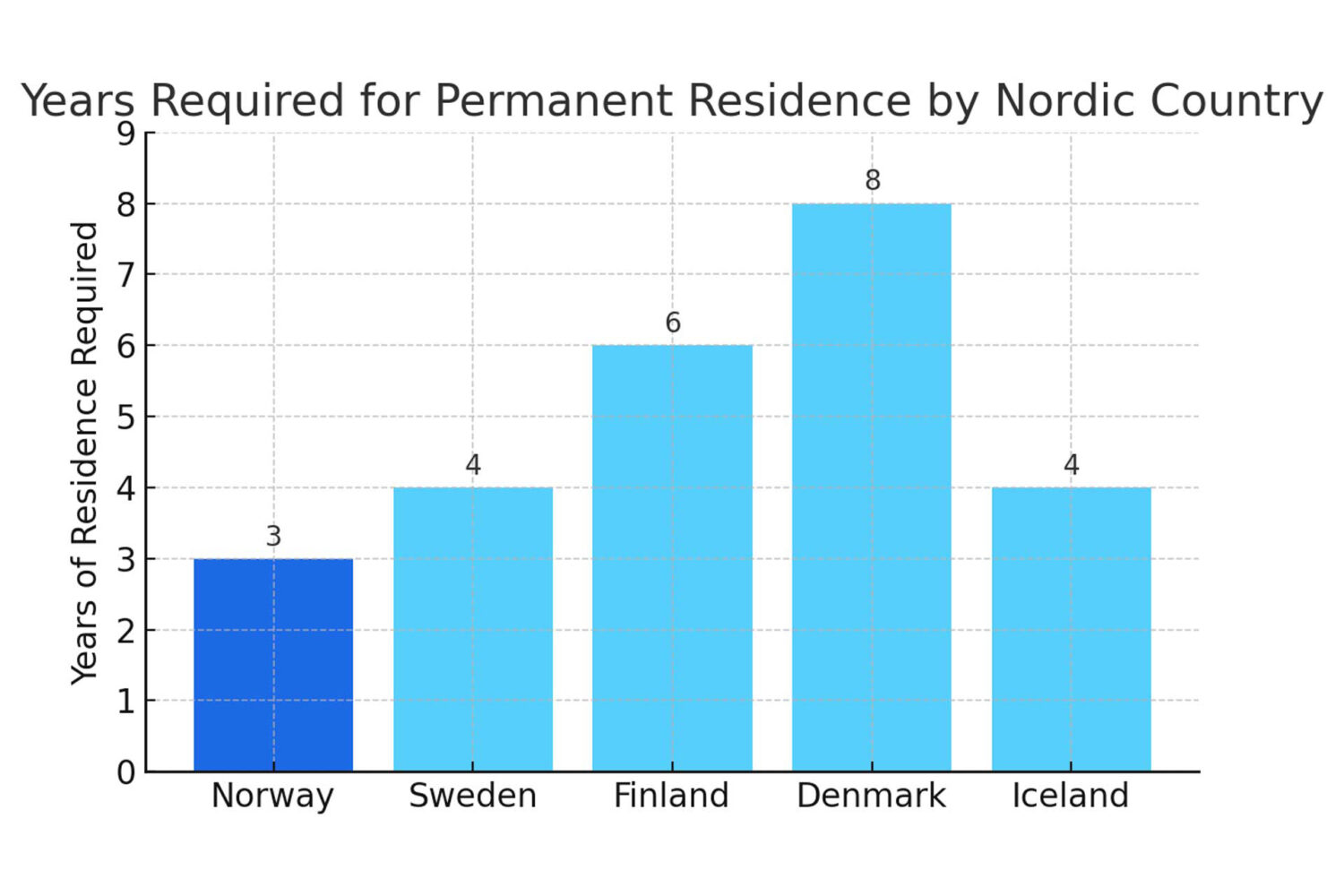
- Time to Permanent Residence: Norway stands out for its relatively short residence period required for permanent residency – typically 3 years. In Sweden, the standard is 4 years of work permits before you can get permanent residence (and Sweden recently added maintenance and support requirements for PR). Iceland also allows PR after 4 years of continuous residence. Finland historically was 4 years, but is now extending to 6 years as of 2026, with new requirements for language and employment. Denmark is known for the strictest rule – normally 8 years of legal residence are needed, though if you meet a bunch of supplementary integration criteria, it can be reduced to 4 years. This means an immigrant can become a permanent resident of Norway much faster than in Denmark, and also faster than the EU average of 5 years.
- Language Requirements: All Nordic countries emphasize learning the local language, but the level required differs. Norway’s A2 oral requirement for PR is modest. Sweden (as of 2022–2023) was discussing introducing a language test for permanent residence or citizenship, but it’s not yet as formalized. Denmark requires a higher Danish language level (and also an active employment requirement) for PR – in fact, to get PR in 4 years in Denmark you must pass Danish language test 2 or 3 and meet all supplementary criteria. Finland is introducing a requirement to demonstrate Finnish/Swedish language for PR (likely A2 level). In short, Norway’s integration requirements are becoming more robust, but are still reasonable relative to Denmark’s very tough standards.
- Work Permit Ease and Processing: Norway, Sweden, and Denmark all need skilled workers and have work visa schemes, but Sweden in recent years became notorious for long processing times and some bureaucracy issues. By comparison, Norway’s work permit processing is somewhat faster. In 2022, the average processing time for a first-time work permit in Norway was ~87 days (median ~63 days). Sweden’s was much longer – average 116 days (with many cases taking far more). Denmark was quite fast (median 21 days, average 44 days), and Denmark even allows certain applicants to start work immediately upon arrival before the permit is fully done (for visa-free nationals). Norway doesn’t have an equivalent “start work immediately” scheme; you must wait for approval. Each country’s policies evolve, but generally Denmark has tried to streamline high-skilled immigration more aggressively in recent years, while Sweden has tightened rules to prevent abuses (and that led to backlogs). Norway is somewhere in between – a fairly straightforward process, not as fast as Denmark, but not as slow as Sweden.
- Family Reunification Rules: All Nordics allow family reunification but Denmark is famously strict for spouses – it has an age 24 rule, requires the couple to meet certain integration “points”, and even asks for a bank deposit guarantee from the sponsor. Norway’s family reunification requirements (age 18, income around NOK 416k/year, housing) are considered more manageable. Sweden’s rules for family reunion were relaxed when it had more open asylum policies, but have since tightened (now Sweden also requires the sponsor to have an income and housing in many cases). Finland and Iceland have their own income requirements too. So, Norway sits in a moderate position – not as easy as Sweden was historically, but easier than Denmark’s famously high bar.
- Citizenship and Dual Citizenship: Norway and Sweden now both allow dual citizenship (Norway since 2020, Sweden has for years). Denmark started allowing dual citizenship in 2015. Finland and Iceland also allow it. For citizenship timelines: Norway is 7 years residence (with some reduction if married to a Norwegian); Sweden is typically 5 years (and only 3 for spouses of Swedes in certain cases); Denmark requires 9 years and an Act of Parliament to grant citizenship, plus very strict language and knowledge tests – Denmark’s citizenship process is perhaps the toughest among the Nordics. All require clean criminal record and proof of integration.
- Overall Immigration Climate: The Nordic countries each have political debates around immigration. Denmark has taken a more restrictive approach (even relocating asylum seekers to third countries, etc.), whereas Norway and Finland are somewhat strict but still accept refugees under UN quotas and need skilled migration. Sweden traditionally was very welcoming (especially to refugees) but is now tightening rules after experiencing integration challenges. If you are a skilled professional looking at options, Norway is often seen as attractive for its high salaries and quick permanent residency, Sweden for its larger job market and eventual EU long-term residence possibility, Denmark for its fast-track process (if you qualify) but you must be prepared for a longer haul to settlement, Finland for a balanced approach with a slightly longer path to PR (soon 6 years) but high quality of life as well, and Iceland for a small but interesting market (PR in 4 years but it’s a very small country with limited job openings in specialized fields).
In conclusion, compared to its Nordic peers, Norway’s residence permit system is notable for a relatively short route to permanent residence and a strong emphasis on work or study ties. All Nordics offer a safe and prosperous environment for immigrants, but the exact rules and hurdles vary. It’s wise to research each country if you’re undecided – for instance, a tech professional might consider both Sweden and Norway, weighing things like income (Norway often higher) vs. ease of EU mobility (Sweden being in the EU). Each Nordic country has its unique charm and bureaucracy – Norway often hits a sweet spot for those who value a quick secure status and top-notch earnings in sectors like oil, gas, engineering, and IT.
Sources: Official Norwegian Directorate of Immigration resources and regulations were used to compile the requirements and process details. Comparisons include data from Nordic immigration authorities and news (e.g. Denmark’s official immigration site states 8-year residency for permanent residence with possible 4-year exception, and Finland’s government announced a move to 6-year requirement). Processing time comparisons are based on 2022 statistics reported in The Local Norway. All information is up to date as of 2025. Be sure to consult UDI’s website or a qualified immigration lawyer for personalized guidance, as individual circumstances can vary. Enjoy your journey toward making Norway your new home!
Leave a Comment

We have prepared answers to the most common questions about Norway residence permit. If you want to clarify anything, please contact us - we will provide detailed explanations.
To get a residence permit in Norway, you must first determine the correct permit type based on your purpose of stay. The most common options are a Norway residence permit for work, study, family immigration, or business/self-employment. In general, the steps are: 1. Confirm that you meet the Norwegian residence permit requirements for your category (for example, a job offer, university admission, or family relationship). 2. Prepare all required documents (passport, contracts, proof of funds, etc.). 3. Submit an online application via the official UDI portal. 4. Attend an appointment at a Norwegian embassy, visa center, or police station to submit documents and biometrics. 5. Wait for a decision and, if approved, receive your Norway residence permit card.
To apply for a Norway residence permit, you must complete the Norway residence permit application process online through the Norwegian Directorate of Immigration (UDI). The process includes: • Completing the online form and paying the Norway residence permit cost • Booking and attending an in-person appointment for document submission and fingerprints • Waiting for processing (usually several weeks to a few months, depending on the permit type) You can apply from abroad via a Norwegian embassy or, in limited cases, from within Norway. Always follow the official checklist for your specific permit type to avoid delays.
Getting a permanent residence permit in Norway is considered moderately difficult but achievable if you meet the rules. For most applicants, you must: • Live in Norway legally for 3 continuous years (5 years for refugees) • Hold qualifying residence permits during that period • Not exceed allowed time outside Norway • Pass a Norwegian language oral test (A2 level) and a social studies test • Be financially self-sufficient and have no serious criminal record Compared to many European countries, Norway’s path to PR is actually shorter and more predictable, making it attractive for long-term settlement.
The length of a residence permit in Norway depends on the permit type: • Norway temporary residence permit (work or family): usually 1–3 years • Norway student residence permit: typically 1 year at a time, renewable for the duration of studies • Seasonal work permits: up to 6 months • Permanent residence permit Norway: unlimited duration (no expiry of the right to stay) Temporary permits must be renewed before expiry. Permanent residence does not need renewal, only the residence card itself.
In most cases, no. An EU residence permit issued by another country (for example, Germany, France, or Italy) does not give you the right to live or work in Norway. However: You may travel to Norway as a visitor (up to 90 days in a 180-day period) if your nationality allows visa-free Schengen travel. An EU residence permit does not replace a Norwegian residence permit for long-term stay, work, or study. Exception: If you are a family member of an EU/EEA citizen exercising free movement rights, you may apply for a Norwegian residence card under EU rules.


Comments
No comments found.