
 EU Citizenship
 Slovenian Citizenship
 Romanian Citizenship
 Bulgarian Citizenship
 Austrian citizenship (investments)
 Spanish Citizenship
 Italian Citizenship
 Cypriot Citizenship
 Lithuanian Citizenship
 Portuguese Citizenship
 French Citizenship
 German Citizenship
 Hungarian Citizenship
 Dutch Citizenship
 Belgian Citizenship
 Croatian citizenship


Poland Residence Permit 2026: Types, Requirements & How to Apply
Author: Leon Scott
Published: 10.02.2026
Updated: 09.04.2026
Staying in Poland long-term requires more than just a tourist visa – you’ll need a Poland residence permit. This permit is an official authorization allowing foreign nationals to live in Poland legally for an extended period. Whether you’re moving for work, studies, family reunion, or remote work, obtaining the right residence permit is key to a successful stay. In this comprehensive guide, we explain what a Poland residence permit is, who needs one, the different types available, and how to apply – with clear steps, comparisons, and tips for each category of immigrants (workers, students, family members, and digital nomads alike).
What Is a Poland Residence Permit?
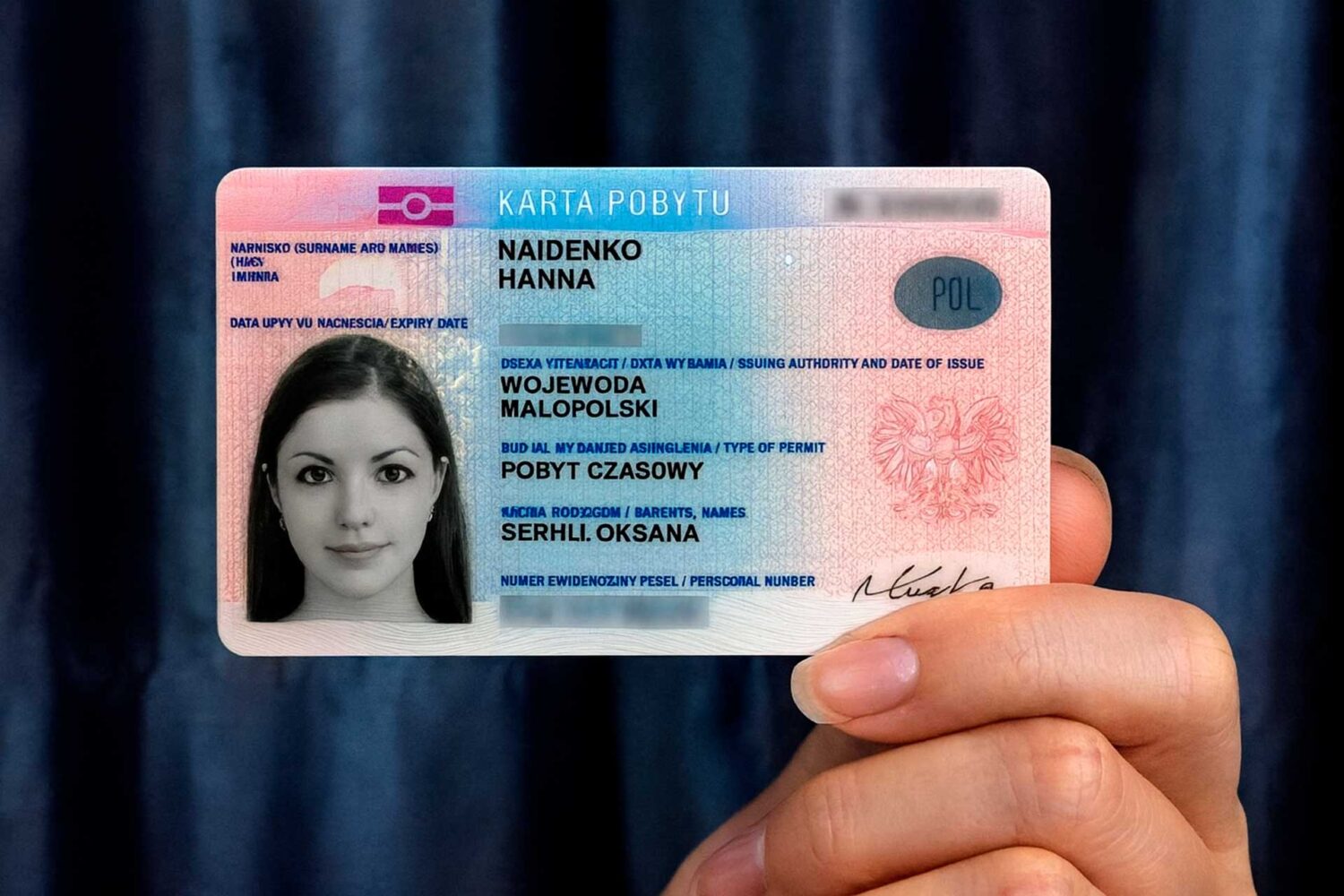
A Poland residence permit is a government-issued permission that lets a non-Polish citizen reside in Poland beyond short-term tourist or business visits. It comes in the form of a residence card (“Karta Pobytu”) that serves as proof of your legal status in Poland. Unlike a visa (which is usually for entry and short stays), a residence permit allows you to live in Poland for months or years at a time and is mandatory for most non-EU citizens planning to stay more than 90 days. In essence, the residence permit confers long-term staying rights – including the ability to work, study, or conduct business, depending on the permit type – while a visa is typically just an entry document for a limited duration.
Residence Permit vs. Visa: To clarify the difference, here’s a quick comparison between a Polish national visa and a residence permit:
| Poland National Visa (Type D) | Poland Residence Permit |
| Entry document allowing a long stay up to 1 year (Type D) in Poland. | Authorization for extended stay beyond 3 months, often issued for 1–3 years (temporary) or indefinitely (permanent). |
| Obtained from a Polish consulate in your home country before travel (used to enter Poland). | Obtained in Poland at a Voivodeship Office (province governor’s office) while you are legally staying in Poland. |
| Purpose-specific (work visa, study visa, etc.) and expires after its validity – you must leave or transition to a permit. | Purpose-specific (work permit, student permit, etc.) and renewable or can lead to permanent status. Grants a residence card as proof. |
| Allows travel in Schengen up to 90 days in 180 days. | Allows living in Poland and Schengen travel 90/180 days as a resident. Often includes local work rights. |
In short, a visa gets you into Poland, but a residence permit lets you stay legally long-term. Many people enter Poland on a Type D national visa and then apply for a temporary residence permit once in the country.
Who Needs a Poland Residence Permit?
Any non-EU/EEA citizen who plans to live in Poland for more than 90 days will need to obtain a residence permit. This applies to a wide range of individuals – for example, foreign professionals working in Poland, international students, those joining family, or entrepreneurs and digital nomads establishing themselves in Poland. Polish law requires third-country nationals (non-EU citizens) to secure a residence permit if they wish to stay beyond the period granted by their initial visa or visa-free allowance. Essentially, if Poland is going to be your home for more than a quick visit, you must legalize your stay through a permit.
EU/EEA and Swiss citizens: If you are a citizen of an EU or EEA member state (or Switzerland), you do not need a Polish residence permit to live and work in Poland. Thanks to free movement rights, EU citizens can reside in Poland visa-free. However, EU/EEA nationals must register their residence with local authorities if staying longer than 90 days, obtaining a certificate of registration rather than a “permit.” The process for EU citizens is simpler and not the focus of this guide. Here, we’ll concentrate on non-EU citizens, who do require Poland residence permits for long-term stays.
All categories of immigrants – including skilled workers, students, family members joining relatives, and remote workers – fall under the residence permit system if they are non-EU nationals. The specific type of permit you need will depend on your purpose of stay, as we cover below. It’s important to choose the correct category, because the requirements and rights can vary for each.
Types of Poland Residence Permits
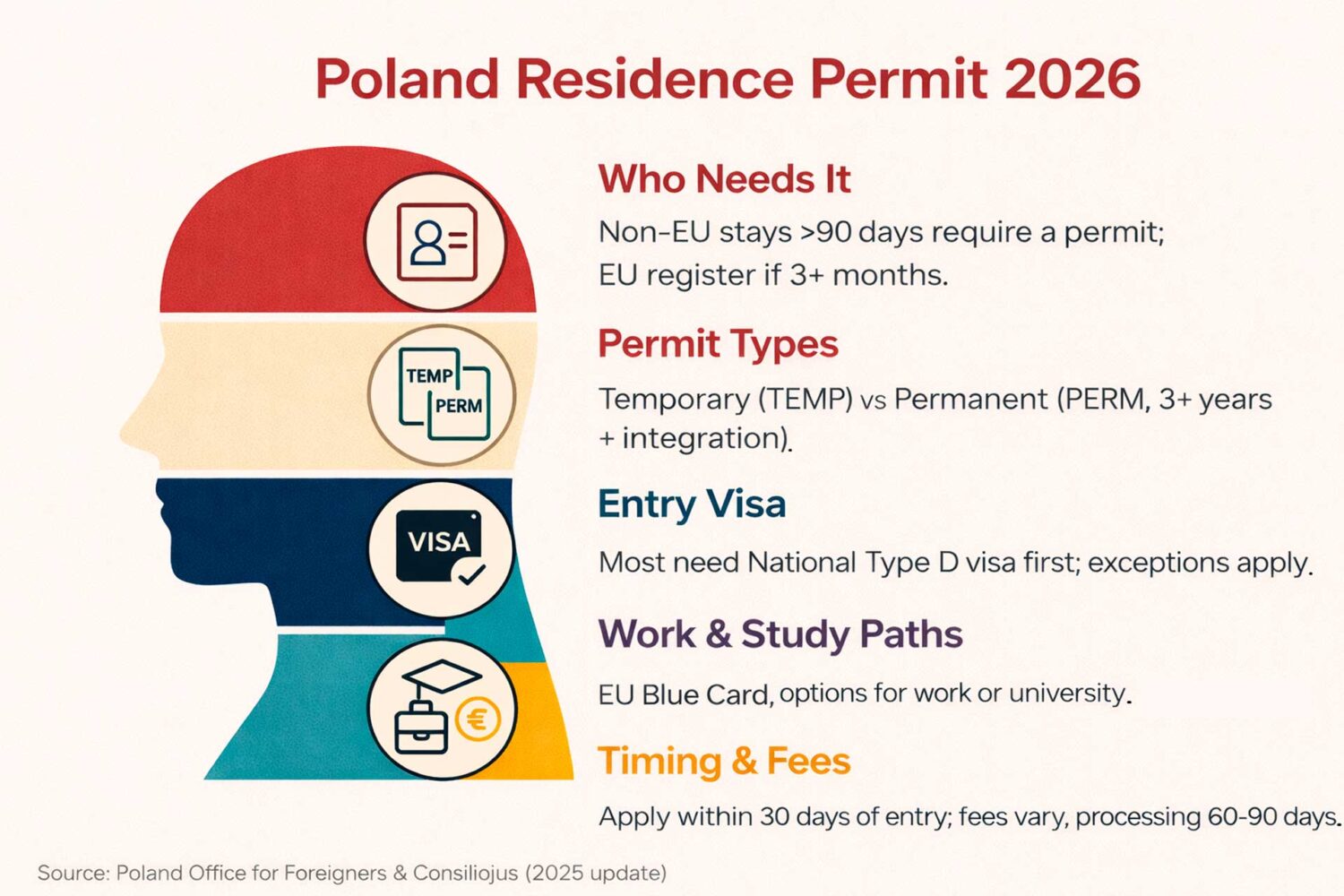
Poland offers several types of residence permits to accommodate different needs. Broadly, these fall into two main categories: temporary residence permits and permanent residence permits. Additionally, Poland implements an EU long-term residence permit status and special programs like the EU Blue Card for highly skilled workers. Understanding these options will help you determine your long-term immigration strategy.
- Temporary Residence Permit (Zezwolenie na pobyt czasowy): This is the most common first step for non-EU immigrants. It allows you to live in Poland for a limited period (up to 3 years) based on a specific purpose such as work, study, family reunification, research, or business. The permit’s validity is linked to the length of your intended stay (often 1 to 3 years) and can be renewed by applying for a new permit before it expires. You must have a justified reason (e.g. a work contract or university enrollment) to get a temporary permit. It’s essentially a medium-term residency that can be extended as long as your situation (employment, studies, etc.) continues. Most newcomers will start with a temporary residence permit.
- Permanent Residence Permit (Zezwolenie na pobyt stały): A permanent residence permit grants the right to live in Poland indefinitely. It is typically available only after you have lived in Poland continuously for a number of years or meet specific criteria. Unlike a temporary permit, the permanent permit has no expiration on your right to stay (though the physical residence card must be renewed every 5–10 years for identification purposes). Permanent residents enjoy a stable status – you can work in Poland without needing any additional work permit and come and go freely. However, qualifying for permanent residency usually requires at least 5 years of continuous legal stay in Poland on temporary permits (with some exceptions like marriage to a Polish citizen or Polish heritage, which allow a faster track). We’ll detail eligibility later in the guide.
- EU Long-Term Residence Permit: This is a long-term EC resident status defined by EU law, which Poland grants to foreigners who have lived in Poland for 5+ years continuously and meet integration requirements (such as stable income and basic knowledge of Polish language). It’s often similar in benefit to a permanent residence permit – allowing indefinite stay and work in Poland – but also facilitates mobility within the EU. Holders of an EU long-term residence permit may move to certain other EU countries under easier conditions. In practice, many people treat this as equivalent to permanent residency (and in Polish law, it is a separate but parallel status to the national permanent permit). If you qualify, Poland will issue an EU long-term resident card (marked “UE long-term resident”). Note: You cannot hold both a national permanent and an EU long-term permit simultaneously – you’d apply for one or the other when eligible.
- Special Case – EU Blue Card: The EU Blue Card is technically a form of temporary residence permit for highly skilled workers, but it’s worth mentioning separately. It’s designed for non-EU professionals with a university degree and a high salary job offer in Poland. The Blue Card confers temporary residence (usually up to 2–3 years, renewable) and the right to work in a specific high-skilled position, but with added benefits: for instance, after 18 months on a Blue Card in Poland, you can move to another EU country’s Blue Card scheme more easily, and Blue Card holders can qualify for certain long-term residence statuses a bit faster (e.g. only 2 years of proof of income for the EU long-term permit instead of 3). The salary threshold for a Blue Card in Poland is at least 1.5 times the average annual salary – roughly 12,300 PLN gross per month as of 2025. If you’re a highly paid professional, the Blue Card is an attractive option, but if not, a standard work-based residence permit will be your route.
Temporary vs. Permanent Residence – A Comparison
To summarize the key differences, here’s a comparison of Poland’s temporary and permanent residence permits (plus the EU long-term resident status):
| Aspect | Temporary Residence Permit | Permanent Residence Permit | EU Long-Term Residence |
| Validity | 3 years max per card (often 1–2 years), then must renew. | Indefinite duration (no expiry of status), but replace card every 5 years. | Indefinite (permanent status); renew card every 5 years (standard). |
| Eligibility | Must have a specific purpose (job, studies, family, etc.) and meet requirements for that purpose. No prior residency in Poland required. | Typically after 5+ years continuous legal stay in Poland. Exceptions: e.g. after 3 years of marriage to a Polish citizen + 2 years in Poland, or holders of the Pole’s Card (Polish origin) can apply immediately. | After 5 years continuous stay with temporary permits, plus proof of integration: stable income (meeting minimums for you and dependents) and Polish language knowledge (B1 level). Time spent as a student counts half. |
| Rights in Poland | Live in Poland and do the activities tied to your permit (work if it’s a work permit, study if student, etc.). Many categories allow employment without separate work permit (e.g. study, family reunification). Access public services with conditions. | Live and work in Poland without restrictions (no need for any work permit). Access to public healthcare, education, social benefits similar to citizens. Greater security of stay (not tied to single employer or course of study). | Same rights as permanent resident within Poland (work freely, access services). Additionally, easier mobility in EU: you can reside in another EU country more easily (you may need to meet that country’s conditions, but your status can transfer). |
| Schengen Travel | Yes – considered a Polish resident, you can travel visa-free in Schengen up to 90 days in 180 days (just like a tourist, but you must primarily reside in Poland). | Yes – Schengen travel up to 90/180 days is allowed just like for any Polish resident. Also, you can be outside Poland longer without losing status (but roughly 6+ months absence per year might reset continuity for citizenship). | Yes – Schengen travel 90/180. Can move to another EU country after holding status; after 18 months in Poland on Blue Card, you could move to another EU with a Blue Card more easily (Blue Card holders only). |
| Path to Citizenship | Time on temporary permit counts toward citizenship eligibility, but you usually must gain permanent residency first. (Exception: some may be eligible by Polish ancestry separately.) | Eligible for Polish citizenship after 3 years of holding permanent residency (and total at least 10 years in Poland, in practice), plus language at B1 and other integration criteria. Marriage to a Pole shortens this (3 years marriage + 2 years residence can apply for citizenship). | Same as permanent – once you have long-term residency, you can pursue citizenship after a few more years of continued residence. The Polish government is planning new naturalization rules (including a B2 language test and 5 years on permanent residency) to ensure strong integration. |
In summary, temporary permits are for your initial years in Poland tied to a purpose, while permanent (or EU long-term) permits are the end-goal for long-term settlers, granting stability and broader rights. Next, we’ll dive into the specific permit routes for different purposes: work, study, family, and so on.
Poland Residence Permit for Work (Employment-Based)
If you’re moving to Poland for a job or to seek employment, you will need a residence permit for work. Poland’s growing economy has made it a popular destination for foreign workers, and the government provides several pathways:
- Temporary Residence and Work Permit: This is the standard route for most non-EU employees. It’s a combined permit that lets you live in Poland and work for a specified employer. To apply, you typically need a valid work offer or contract from a Polish company and a work permit application supplement (often called Appendix 1) filled out and signed by your employer. Importantly, the salary offered must meet at least the Polish minimum wage for full-time work (regardless of hours). For example, the minimum monthly pay in 2025 is PLN 4,666 gross, so any job hiring a foreigner on a residence permit must pay at least that. You’ll also need proof of health insurance and accommodation in Poland, among other documents. The work permit part will tie your residence permit to that specific job position and employer. If you change jobs, you may need to apply for a new permit or update your permit with the new employer’s details.
- EU Blue Card for Highly Skilled Workers: As mentioned earlier, the EU Blue Card is an attractive option if you have a higher degree and a high-paying job. This special work-residence permit allows you to work in Poland without a separate work permit and offers benefits like family members being allowed to work and easier mobility to other EU countries. To qualify, you’ll need a Polish job contract of at least 1 year with a salary at least 50% above the average (which is around PLN 12,300/month in 2025). You must also have a university diploma and the job should require high qualifications. If you meet these criteria, the Blue Card can be better than a normal work permit because of its added perks (e.g. moving within EU after 18 months, quicker route to long-term residence). The Blue Card is usually granted for up to 2–3 years at a time and can be renewed.
- Other Work-Related Permits: Poland also has a few niche categories, such as seasonal work permits (for up to 9 months, in agriculture/tourism) and intra-company transfer permits (for employees of multinational companies). These are specialized and if you fall into those categories, you’d apply for the corresponding temporary permit (e.g. a temporary residence permit for seasonal work in agriculture). However, most long-term workers will use either the standard Residence and Work Permit or the Blue Card.
Key requirements for work permits: Besides the job offer and salary requirement, expect to provide proof of qualifications, a clean background (some voivodeships ask for a criminal record certificate for certain nationalities), and evidence of insurance and housing. Notably, all documents must be in Polish or officially translated into Polish for the application. You will pay a fee (stamp duty) of PLN 440 for a work-related residence permit application, and an additional fee (around PLN 100) for the residence card once approved.
Work permit validity: Your temporary residence and work permit will typically be granted for the duration of your employment contract, up to a maximum of 3 years. If your contract is indefinite or long, usually the office might give 2 or 3 years and you’d renew thereafter. Renewals require showing that you still meet the conditions (still employed, earning at least minimum wage, etc.). If you lose or quit your job, Polish law expects you to notify the office – you have a 30-day window to find a new employer who can sponsor you, or else the permit might be revoked. Changing jobs will involve getting a new Appendix 1 from the new employer and potentially a whole new application if the scope of work changes.
Family members: The spouse and children of a residence permit holder can generally obtain residence permits for family reunification (more on that below). If you’re working in Poland, your spouse on a family reunification permit will be allowed to work without needing their own work permit, which is a huge benefit for dual-career families.
Tip: Start the work permit process as early as possible. While you must submit your residence permit application no later than the last day of your legal stay (e.g. before your visa or 90-day visa-free period expires), you should begin gathering documents well in advance. Some employers need time to prepare the Appendix and some provinces (voivodeships) require appointments to file an application. Also, be prepared for processing times that can range from 1 to even 12 months depending on the region – so don’t panic if it takes a while; you can legally stay and continue working in Poland while the decision is pending (as long as your initial application was submitted in time).
Poland Residence Permit for Students and Researchers
Poland is home to many international students, thanks to its affordable tuition and vibrant student life. If you are coming to study at a Polish university or educational institution, you will need to obtain a temporary residence permit for studies. Similarly, academic researchers or doctoral candidates can apply for a residence permit for research purposes. Here’s what you need to know:
Student Residence Permit: This permit allows you to live in Poland for the duration of your studies. Typically, students enter Poland on a D-type national visa for study, and then apply for a temporary residence permit once in Poland (before the visa expires). The temporary residence permit for studies can be granted for up to 15 months initially (often covering a full academic year plus some extra time) and can be renewed annually or for the remaining duration of your program. To qualify, you must be enrolled in a Polish educational institution (university, college, etc.) and show evidence of:
- Enrollment/Acceptance letter: You need an official letter from the university confirming you’ve been admitted or are continuing studies.
- Financial means: Proof that you have enough funds to support yourself in Poland while studying (this could be bank statements, scholarship letters, or a sponsor’s letter). Poland doesn’t set a very high amount, but you must cover living costs and any tuition. As a rough guide, a few thousand zloty per semester may be required as proof.
- Health insurance: Students should have valid health insurance covering their stay (either public National Health Fund insurance if you enroll in it, or a private plan/policy covering medical expenses).
- Accommodation: An address in Poland – dormitory confirmation or rental agreement – should be provided to show where you’ll live.
The benefit of a student permit is that it legally allows you to work part-time in Poland without a separate work permit. Poland does not impose working hour limits on international students (unlike some countries); as long as you are enrolled and not interrupting your studies, you can work freely. Many international students take up part-time jobs or internships. After graduation, you may be eligible for a temporary residence permit for job search or entrepreneurship (Poland has a provision that graduates of Polish universities can stay for about 9 months to seek employment or start a business).
Researcher Permit: If you are coming to Poland as a researcher (for example, on a research fellowship, PhD program, or scientific project), there is a specific temporary residence permit for conducting scientific research. The requirements are similar to the student permit but centered on your research activity – you’ll need an agreement with a research institution or university in Poland and proof of sufficient resources and health insurance. Researchers may also bring their family on family reunification permits. Like students, foreign researchers in Poland are usually allowed to work and carry out their research without separate permits (and often their spouse can work as well under family reunification).
Academic tip: Time spent in Poland on a student residence permit counts as half toward the 5-year requirement for long-term residency. For instance, 2 years on a student permit would count as 1 year of residence for the purpose of qualifying for permanent residence or EU long-term status. This is something to keep in mind if you aim to settle in Poland permanently – after finishing studies, it might be wise to switch to a work permit or other full-counting permit to accumulate the years faster. For example, if you do a 4-year degree in Poland, that would count as 2 years toward the 5-year requirement, meaning you’d still need around 3 more years on a work permit to be eligible for long-term residence. Planning your post-graduation path can save you time on the road to permanent residency.
Documentation: Student permit applications often require a certificate from the school confirming your student status, proof of payment of tuition (or scholarship), and sometimes a letter explaining your study plan. Ensure all documents from your university are in Polish or officially translated. The application fee for a temporary permit is around PLN 340 (for non-work permits).
Working after graduation: If you find a job in Poland after finishing your studies, you will switch from a student permit to a work-based residence permit (or possibly a Blue Card if it’s a high-skilled job). The good news is Poland encourages retaining foreign graduates – the permit for job-seeking (for Polish graduates) gives you extra time to find employment. Once you have a job, the process is similar to the work permit described earlier, but you won’t need a labor market test (as graduates are exempt from that) and employers often welcome Polish-educated foreigners.
Poland Residence Permit for Family Reunification
Family unity is a significant aspect of immigration, and Poland allows non-EU foreigners to join their family members who are residents or citizens of Poland. If you have a spouse, parent, or child in Poland, you may be eligible for a residence permit for family reunification. This applies in several scenarios:
- Spouse or Child of a Polish Citizen: If you are married to a Polish citizen, or you are the minor child of a Polish citizen, you can obtain a residence permit in Poland on that basis. Spouses of Polish citizens typically receive a temporary residence permit for family members of a Polish citizen, usually granted for 3 years at a time (and renewable). After a total of 2 years of residence in Poland on that basis (and at least 3 years of marriage), the foreign spouse becomes eligible to apply for permanent residence themselves, which is a faster track than the normal 5 years. You will need to prove the marriage with a certificate and often attend an interview to confirm the genuineness of the marriage (to combat fraud). Children of Polish citizens can also get permanent residence directly in some cases. Family members of Polish nationals do not need a work permit to work in Poland once they have their residence card – they have open access to the labor market.
- Family of a Non-EU Resident in Poland: If your spouse or parent is a foreign citizen who already holds a Polish residence permit (temporary or permanent), you can apply for a temporary residence permit for family reunification to join them. This typically covers spouses and minor children (and sometimes dependent adult children or parents, on a case-by-case basis). The sponsor (the family member in Poland) must have a valid residence permit and enough income and housing to support you. The permit for family members is usually granted for the same duration as the sponsor’s permit (up to 3 years) and can be renewed as long as the primary holder’s status is valid. If your spouse holds a work permit or Blue Card, you as the family member can work in Poland without needing your own work authorization – the family reunification permit itself grants you the right to take up employment. This is a great advantage allowing immigrant families to have dual incomes.
- Family of EU/EEA Citizen: (Note: This is a different legal route, under EU freedom of movement rules. If your spouse is an EU citizen living in Poland, you fall under EU regulations and would get a residence card of a family member of an EU citizen. The rights are slightly different, but generally you also have the right to work. Since this guide focuses on non-EU sponsors, we won’t dive deep here.)
Requirements: For family permits, you must provide evidence of the family relationship (e.g. marriage certificate, birth certificate with translations). If joining a foreigner (not Polish citizen), the sponsor typically must show proof of stable income and housing to host you, and health insurance coverage. Poland wants to ensure that bringing family won’t put you or the family in destitution. The income threshold is not explicitly huge – usually having at least the minimum wage or a certain amount per family member suffices. As of 2024, an example reference is that an income around 776 zł net plus 600 zł for each dependent was considered the minimum living cost per month for long-term residency, so presumably a family sponsor should earn above that per person. Ensure to check the latest requirement from the office.
Validity and next steps: Your family reunification permit will often be for 1 to 3 years. If it’s based on your spouse’s temporary permit, you’ll renew it as they renew theirs. If your spouse attains permanent residency or citizenship, you will usually then transition to a more permanent status as well. For instance, being married to a Polish citizen for 3+ years and residing 2+ years in Poland on a permit can make you eligible for permanent residency in your own right. Many foreign spouses use this route to secure their status and eventually citizenship. Speaking of which, as a spouse of a Polish citizen, you can apply for Polish citizenship after 3 years of marriage and 2 years of uninterrupted stay in Poland (on a permanent permit) – a relatively quick path compared to others.
Example: John, a non-EU citizen, is working in Poland on a residence permit. He can invite his wife and 5-year-old child to Poland. His wife will apply for a temporary residence permit for family reunification as John’s spouse, and the child as John’s child. John must show that he has housing (e.g. a rental big enough for the family) and sufficient income to support everyone (his salary should be above the required minimum for a family of three). They file the applications, including the marriage certificate and child’s birth certificate, all translated into Polish. After approval, John’s wife and child get residence cards that are valid as long as John’s permit is valid. The wife can now also work in Poland without any extra permit, and the child can attend school. After a few years, as John obtains a longer status, the family can stay and integrate in Poland long-term.
Note: Poland also issues temporary permits for other family situations, like for family members of EU citizens, for minor children born in Poland (so they don’t have to leave), and some special cases like families of UK nationals who stayed post-Brexit. The general principle is Poland strives to protect family unity, within reasonable requirements.
Poland Residence Options for Digital Nomads and Entrepreneurs
In recent years, Poland has emerged as a hotspot for digital nomads and remote workers looking for a base in Europe. While Poland does not have a specific “digital nomad visa” by name, it offers alternative pathways for freelancers, entrepreneurs, and self-employed individuals to reside legally in the country. If you work remotely (for clients or an employer outside Poland) or wish to start a business here, consider these options:
Business Visa and Temporary Residence for Business Activity: One of the most viable routes for digital nomads is to register a business in Poland (often as a sole proprietorship, called “działalność gospodarcza”). Initially, you can apply for a Type D national visa for “economic activity” or other purposes to enter Poland. Once in Poland, you then apply for a temporary residence permit for the purpose of conducting business activity. To do this, you’ll need to show that you have opened a business (or plan to) and that the business has either already begun operations or is feasible. Key documents include a business plan or entry in the National Court Register (if you formed a company) or Central Register of Business Activity (if sole trader), proof of having sufficient funds or income from the business to support yourself, and standard requirements like health insurance and accommodation.
Example: Many remote freelancers choose to register as a sole proprietor in Poland. The process is straightforward and can even be done online, but note that in many cases you must have legal residence first. So a common strategy is: get a one-year national visa for tourism or other (some apply for a Poland Business Harbor visa if eligible, which was a special program, or simply a visa on the basis of “other purposes” stating you intend to explore business opportunities). Then in Poland, register your sole proprietorship (a quick process once you have a PESEL number and residence address). With the business certificate, you apply for the temporary residence permit as an entrepreneur.
Poland’s requirements for this permit are reasonable – you don’t need to show a huge initial investment. However, you typically must demonstrate that the business will generate income or already is generating enough to cover your costs (or you have savings to live on in the meantime). Proof of sufficient financial means is required in the application, as well as valid medical insurance and often a clean criminal record certificate from your home country. Interestingly, many who have taken this path report that Poland’s paperwork for business visas is simpler than other countries – for example, you might not need a local bank account or lease upfront, and some consulates don’t ask for an extensive background check. Still, requirements can vary, so be prepared with documentation.
Remote Work as a Nomad (Without Local Employer): If you prefer not to register a business, another approach is to use existing categories creatively. Some digital nomads come to Poland on a student visa (enrolling in Polish language courses or other studies) just to live in the country while working remotely – but that means actually attending classes and paying tuition, which might not suit everyone. Others use the family reunification route if they have a partner who has a permit (not applicable to everyone, of course). As of 2025, the Polish government has shown interest in attracting remote workers and might streamline regulations to accommodate them, but for now, the business registration route remains the most “official” path for a pure digital nomad.
What does the business permit entail? If you get a residence permit for business, you are expected to make a genuine economic contribution – this isn’t a “hang out and do nothing” visa. You will be paying taxes in Poland on any income your business earns and contributing to social security (ZUS) if applicable. Essentially, Poland welcomes entrepreneurs who are ready to integrate economically: you’ll be treated similar to a local sole trader. Many find this a fair trade-off: you gain a legitimate long-term stay and access to Poland/EU, and in return you pay Polish taxes and fees on your earnings. Poland’s tax rates for businesses (especially sole proprietors) can be quite reasonable if you use lump-sum or flat-rate taxation options. It’s advisable to consult a tax advisor to optimize this.
Tip for remote workers: If you primarily earn from abroad, one strategy is to show contracts or client agreements to prove your income source for the permit. For instance, a freelance IT consultant might include contracts with overseas clients and show that money will be coming into their Polish bank account – thus satisfying the income requirement. You should also prepare a simple business plan or description of your services in case the immigration office asks for it. Showing that you’re actively invoicing clients and have a projection of earnings will strengthen your case.
Networking and community: Poland has thriving expat and entrepreneur communities in cities like Warsaw, Kraków, Wrocław, and Gdańsk. As a newcomer, connecting with these groups (via co-working spaces, meetups, or Facebook groups) can provide support and up-to-date tips. Fellow digital nomads often share advice on dealing with immigration offices, finding English-speaking officials, etc. Keep in mind that rules can evolve; for example, the government’s interest in digital nomads might lead to a formal remote work visa in the future, so staying informed is wise.
In summary, while Poland doesn’t label anything as a “Digital Nomad Visa”, it offers a welcoming environment for remote professionals through its existing residence permit categories. The country’s advanced internet infrastructure, affordable cost of living, and central location make it a fantastic base for location-independent workers – and with a bit of paperwork and commitment (like registering a business or studying), you can secure your spot here legally and comfortably.

How to Apply for a Poland Residence Permit (Step-by-Step)
Now that we’ve covered the main permit types and scenarios, let’s go through the application process for a Poland residence permit. Most permits (temporary or permanent) follow a similar procedure, conducted at the regional Voivodeship Office (Urząd Wojewódzki) that handles foreigner affairs in the area you live. Below is a step-by-step guide for a typical temporary residence permit application:
- Enter Poland with the proper visa (if required). Before you can apply for a residence permit, you need to be legally present in Poland. This could be on a visa-free entry (if your nationality allows and you’re within the 90-day limit) or, more commonly, on a national D visa appropriate to your purpose (work visa, student visa, etc.). Make sure your passport is valid for the duration of your intended stay plus some extra (usually at least 6 months beyond). Note: Some people do arrive visa-free to apply for a permit (e.g. Americans can enter without a visa for 90 days and then apply), but consult the latest rules or a lawyer if attempting that, because certain permit types require entering on a specific visa.
- Gather the required documents. This is the most crucial and time-consuming part. While specific documents vary by permit type, common requirements include: Completed application form (available from the office or online). Fill it out in Polish; if you don’t speak Polish, it’s wise to get help to avoid mistakes. Photos: 4 recent passport-sized color photographs (biometric, 35×45 mm). Poland is strict on photo specifications (neutral expression, light background). Passport (original and copies): You’ll need to submit your passport for inspection and include photocopies of all used pages (all stamps and visas). Proof of stamp duty payment: Before filing, you pay the application fee at a bank or cash desk (usually PLN 340 for most temporary permits, or PLN 440 if it’s a work permit application). Attach the payment receipt to your application. Health insurance proof: Document showing you have valid health insurance in Poland (either public NFZ insurance or private insurance covering at least €30,000 in medical costs). For workers, this might be ZUS statements; for others, a travel insurance policy or insurer letter. Proof of sufficient funds: You must demonstrate you have money to support yourself (and family, if applicable) during your stay. This could be recent bank statements, an employment contract stating your salary, scholarship confirmation for students, etc. Poland calculates a required amount per day or month (e.g. typically 75 PLN/day of stay beyond 5 days, or a certain monthly minimum income). Ensure you meet the threshold – showing more is always better. Accommodation proof: A document confirming where you live in Poland – such as a rental agreement, official hotel booking, or an invitation letter if you live with someone. Even a written housing agreement or address registration (meldunek) can work. Specific documents for your permit type: This includes things like a work contract + employer’s declaration for a work permit, an acceptance letter for a student permit, a marriage certificate for a family permit, or business registration for an entrepreneur permit. Each permit category has an “Annex” or appendix form too (e.g. Annex 1 for employment to be filled by the employer). Make sure to check the official checklist for your category and provide all required attachments – missing documents can halt your application. Remember that all foreign documents must be in Polish. That means you’ll likely need certified translations by a sworn translator in Poland for items like birth certificates, marriage certificates, etc., plus an apostille/legalization from the country of issue if required. It’s wise to organize and label your documents clearly. An incomplete application can result in a formal request for you to fix it, which pauses the processing clock and can cause delays.
- Submit your application in person at the Voivodeship Office. Foreigners must apply in person (not by mail) at the competent office for your region. Locate the province (voivodeship) office for foreigners (each voivodeship has one, often in the capital city of that region). For example, in Mazovia (Mazowieckie, where Warsaw is) it’s the Mazovian Voivode Office; in Lesser Poland (Małopolska, Kraków) it’s the Małopolska Voivode Office, etc. Some offices require or allow online appointment booking – check their website. Others accept walk-ins or mail registration followed by an appointment letter. It’s strongly recommended to book an appointment early if possible, because slots can be scarce in high-demand regions. On the day of your appointment, arrive with your complete application package. You’ll typically submit the forms, all documents, and your passport for verification. The officer will check for completeness. If something small is missing, they might accept the application and ask you to deliver the missing item later. If something major is missing, they might refuse to accept it or issue a formal “call to complete documents” with a deadline. Assuming everything is in order, they will take your fingerprints (every applicant over age 6 is fingerprinted for the residence card biometric data). This is why you must apply in person – fingerprints are mandatory. Once this is done, you’ll get a stamp in your passport.
- Obtain the “stamp” in your passport. When your application is officially accepted, the Voivodeship Office will place a temporary stamp in your passport confirming submission. This stamp is very important: it legalizes your stay in Poland while your case is processing, even if your visa expires during that time. In fact, many applicants purposely apply on the last day of their visa’s validity to maximize the “bridge period” – and that’s completely allowed. With the stamp, you can continue to live in Poland until a decision is made. However, note: That stamp does NOT allow you to travel out of Poland and return if your visa is expired. It basically keeps you legal only within Poland. If you must travel abroad while waiting, you might need to obtain another visa to re-enter, so plan accordingly. In general, it’s safest to remain in Poland until you get your residence card.
- Wait for the decision. The official processing time for temporary residence is 60 days from the time your application is complete (i.e. all documents in). Permanent residence applications can officially take up to 3-6 months. In reality, processing times vary greatly. Major cities (like Warsaw, Wrocław) often have backlogs; waits of 4 to 8 months (or even more in complicated cases) are not uncommon. Smaller regions might process faster. You typically won’t be updated during this time. Some offices allow checking status via phone or in person, but there’s no universal online tracking. It requires patience. Do not work or do activities not allowed by your visa during this waiting time, unless your pending permit grants that right (e.g. if you applied for a work permit and had a work visa, you can continue working; if you applied as a student, continue your studies). The good news is as long as you have that stamp, your stay in Poland is legal even beyond your visa’s expiry.
- Decision outcome – approval or refusal. Eventually, you will receive a decision letter. If approved, congratulations! The letter of approval (decision) might be in Polish legal language, but essentially it means your permit is granted. If it’s a temporary permit, the decision will state the validity dates and the purpose (and employer name if work permit). If the decision is negative (refusal), the letter will state the reasons. Common reasons for denial include insufficient documents, not meeting income requirements, or errors in the application. You have the right to appeal a refusal within 14 days to the Head of the Office for Foreigners, or fix the issues and reapply, depending on the situation. It’s often wise to consult an immigration lawyer if you get a refusal.
- Pay for the residence card and collect it. Upon a positive decision, you must pay for the printing of your residence card (plastic ID). The cost is about 50 PLN for temporary (and 100 PLN for permanent cards) in many cases. After payment, the office will order your card. It usually takes a few weeks. Once ready, you’ll be notified (some offices post a list of ready card numbers on their site or send a letter/email). Go in person with ID to collect your card. The card is an extremely important document – it, along with your passport, is what proves your right to live (and work, if applicable) in Poland. Double-check the information on the card (name spelling, dates) at pickup.
During your stay: With the card in hand, you can travel in and out of Poland freely. At border control, show your passport and this Polish residence card; you won’t need a visa for Schengen as the card replaces that. Remember, you can visit other Schengen countries for up to 90 days in 180 days, but you cannot move your residence to another country on this card (except possibly if it’s an EU Blue Card after 18 months, as discussed). Always keep track of your card’s expiration. If you plan to stay beyond its validity, you’ll need to apply for a renewal (new permit) in advance – you can apply up to 3 months before expiry, and no later than the last day of the permit’s validity to stay continuous.
Application Tips:
- Always keep copies of every document you submit and proof of posting if you send any extra documents by mail.
- If your situation changes (you change jobs, address, etc.) during the process, inform the office in writing, as it could affect the decision.
- Be polite and patient with officials – immigration processes can be stressful, but a courteous approach goes a long way. Most offices have translation services or staff who speak English, but it’s not guaranteed; bringing a Polish-speaking friend can help.
By following these steps diligently, you’ll navigate the process much more smoothly. Thousands of people successfully obtain Polish residence permits each year – with preparation and persistence, you can be one of them!
Processing Times, Extensions, and What to Expect
As noted, the legal processing time for a temporary permit is 60 days, but delays are common. If your case is taking longer, it’s often not a cause for alarm. You might hear from the office if they need additional information or if there’s a backlog. In extreme delays, you (or a lawyer) can file a complaint of inaction, but usually it’s easier to wait or politely inquire if a lot of time has passed.
While waiting, do not exit Poland without a valid visa or card. If you only have the interim stamp and you leave the Schengen area, you may not be allowed to re-enter Poland on that stamp – you’d likely need to obtain a new visa to come back. This is a common pitfall: people assume the stamp is like a visa; it is not. It’s valid only inside Poland. So plan travel carefully until you have the physical residence card.
If for some reason your application will not be decided before your current permit/visa expires and you didn’t get the stamp (say you applied late or had a formal error), you could fall out of legal status. Avoid that at all costs by applying on time and responding quickly to any requests from the office.
Poland does not issue “extension” of temporary residence permits per se – each time you need longer stay, you must apply afresh for a new temporary permit (often we call it renewing, but legally it’s a new decision). For visas, there are limited extension possibilities, but again, typically one transitions to a residence permit instead of extending a visa.
If you need to change the purpose of stay (for example, from studies to work), you cannot simply modify an existing permit – you have to apply for a new permit under the new purpose. It’s permissible to hold multiple grounds (e.g., you study and work, but you have to pick one basis for the permit). Choose the purpose that is primary or offers the most benefits.
Rights and Benefits of Holding a Poland Residence Permit
Holding a Poland residence permit comes with numerous advantages beyond just the legal right to stay. Here are some of the key benefits you enjoy as a resident of Poland:
- Freedom to Live and Work in Poland: You can reside at any address in Poland and, if your permit type allows employment (most do), you can work legally. Temporary permits tied to work grant work rights for the specified employer or industry, while permits for studies, family reunification, etc., generally grant open access to the job market without need for a separate work permit. Permanent residents have unrestricted work rights just like a Polish citizen.
- Access to Healthcare and Social Services: As a resident, you are eligible to register for Poland’s public healthcare (NFZ) system, especially if you are working (your employer will contribute for you) or studying (you can pay a small monthly student rate), or you can voluntarily join. This gives you low-cost or free access to doctors and hospitals. You also gain a PESEL number (if you haven’t already) which is used for many services. Over time, you can access certain social benefits if you meet criteria (family benefits, etc.). Children of residence permit holders can attend public schools just like locals.
- Schengen Travel Without Additional Visas: Your Polish residence card allows you to travel throughout the Schengen Area for tourism or business trips up to 90 days in any 180-day period. For example, you can hop on a train to Germany or a flight to Spain for a short trip without worrying about a visa. This makes Poland a great base to explore Europe. (Just remember, you can’t move your residence to another country using a Polish permit; you’d need to apply for a local permit there after 90 days.)
- Stability and Peace of Mind: You no longer need to do visa runs or constantly watch the calendar. As long as you maintain your permit status, you can live long-term in Poland. Temporary permits give you a year or more at a time, and permanent permits remove the time limit entirely. You can rent apartments long-term, open bank accounts, get a local mobile phone, and really settle into life in Poland with the confidence that you won’t be asked to leave suddenly.
- Pathway to Permanent Residence and Citizenship: Having a residence permit is the first step toward deeper integration. After the required years, you can apply for permanent residence or EU long-term status, and eventually you might qualify for Polish citizenship (which grants you an EU passport). For those who plan to make Poland their home, this is a significant benefit – your time on a residence permit is building up to a more secure status. Poland has been increasing requirements for naturalization (like now aiming for 5 years on permanent residency and a B2 language level), but it’s still an attainable goal for a dedicated resident.
- Family Reunification: If you hold a residence permit, you can bring your close family (spouse and minor kids) to Poland under the family reunification permits as discussed. This means your family can enjoy the above benefits too – living, studying (kids can attend Polish schools), and working in Poland alongside you.
- EU Blue Card Specific Perks: If you have a Blue Card, one additional perk is that after 18 months you can move to another EU country to take up another high-skilled job without starting from scratch (the new country will still process a Blue Card for you, but you don’t need to wait 5 years). Also, Blue Card holders who become long-term residents can count time in other EU states towards that status if they move.
Overall, a residence permit is your key to unlocking a new life in Poland and Europe. It grants you rights close to those of a citizen (except voting and some public offices), especially if you stay long enough to get permanent residency. With the security of a residence permit, you can focus on your job, studies, or family without the constant stress of visa deadlines.
Leave your contacts to have an expert contact you shortly.
Responsibilities and Conditions for Permit Holders
Being a resident also comes with responsibilities. Here are some important obligations and conditions to keep in mind to maintain your lawful status:
- Keep Your Address Updated: You are required to notify the Voivodeship Office of any address change during your application process, and even after, you should update your address at the local city hall (Meldunek – address registration). It’s not strictly enforced for temporary residents, but updating ensures you receive important mail (like decision letters).
- Maintain Valid Insurance: You must continuously have health insurance coverage (public or private) during your stay – this is both a legal requirement and practical need. If you started with private travel insurance, consider enrolling in public insurance if you become eligible (through work or voluntary contributions).
- Follow the Permit Purpose: If you got a permit for a specific purpose, you should primarily be doing that activity. For example, a student should remain enrolled and attending classes; a work permit holder should be working for the employer listed. If you abandon the purpose (quit your job, drop out of school) without starting a new one, your permit could be in jeopardy. Always check if a change in your situation requires a new permit. In many cases, you can stay until your card expires, but you must declare changes and might have to apply for a new permit earlier. For instance, if you lose your job, you generally have 30 days to notify and either find a new employer or expect the permit to be revoked.
- Don’t Overstay/Break laws: This sounds obvious, but it’s critical. If your permit expires and you haven’t renewed or left, you’ll be overstaying illegally and risk deportation and a ban. Mark your calendar for 2-3 months before expiry to start renewal. Also, abide by Polish laws – certain crimes or even serious administrative offenses can result in your permit being canceled. Poland, like all countries, expects residents to respect local laws and integration norms.
- Travel with Documents: When traveling abroad, always carry your residence card and passport. Within Poland, it’s wise to have ID on you (either passport or card) as foreigners are expected to prove legality if asked by police or border guards. The residence card is an ID, but not a travel document on its own – you need the passport too when crossing borders.
- Taxes and Registration: If you work or do business, ensure you are correctly registered with the tax office and Social Insurance (ZUS). Paying taxes is an obligation but also strengthens your record for future permits or citizenship (showing you contributed). For example, permanent residence and citizenship applications often require proof of income and tax payments in Poland.
- Renewals and Switching: Plan ahead for renewals. Requirements might change over time (for example, increases in minimum income or new forms), so check the latest info a few months before you reapply. If switching from temporary to permanent, start preparing well in advance – permanent residency may require a Polish language certificate (for long-term EU) or other proofs that take time (like passing a language exam at B1 level or obtaining a certified diploma in Polish).
By staying aware of these responsibilities, you can enjoy your residency in Poland without issues. Thousands of expats have built stable lives in Poland by following the rules and becoming part of the society.
Transition to Permanent Residency and Citizenship
Many foreigners see a temporary residence permit as the first step in a longer journey: ultimately becoming a permanent resident or even a citizen of Poland. Here’s how that progression works and what to plan for.
Permanent Residency (PR)
After you have lived in Poland for a certain number of years on temporary permits, you may become eligible for a Permanent Residence Permit (pobyt stały) or the EU long-term residence permit (as discussed earlier). For most people, the magic number is 5 years of continuous stay. “Continuous” means you haven’t left Poland for more than 6 months at a time and not more than 10 months total over the 5 years (exceptions for important matters). If you’ve been a student, remember your student time counts half. Some categories allow quicker PR: for example, if you’re married to a Polish citizen, you can apply for PR after just 2 years of residence (and 3 years of marriage). Also, holders of the Pole’s Card (Karta Polaka) – a document for people of Polish descent – can apply for permanent residence immediately upon moving to Poland. Once you qualify, the application for permanent residency involves proving your years of stay (they’ll check their records and your passports for entry/exit stamps), and in certain cases proving basics like a stable income and a place to live. Uniquely, EU long-term permit requires a B1 Polish language certificate, whereas the national permanent permit (through marriage, etc.) might not require language proof (though knowing Polish certainly helps in the interview).
Permanent residency in Poland gives you nearly all the rights of a citizen except voting and some public sector jobs. It’s indefinitely valid – you only need to renew the card every 10 years (the card might say it expires in 5 years, but the law changed it to 10 for some; in any case, renewing the card is just a formality, not a re-evaluation of your status). As a permanent resident, you also have an easier time applying for other EU visas or even moving within the EU if you wanted (though you’d need to get a new permit in another country after a certain time).
Citizenship
Polish citizenship can be obtained in a few ways: by descent, by naturalization, or by presidential grant. For those who settled in Poland, naturalization by recognition is common – if you’ve lived in Poland for at least 3 years on a permanent residence (or long-term EU permit), have a stable income and housing, and speak Polish to at least B1 level (proven by a state language exam or Polish school diploma), you can apply to be recognized as a Polish citizen. The timeline effectively means ~8 years after you first got your temporary permit, you could be eligible (5 years temporary -> get permanent -> 3 years on permanent). Spouses of Polish citizens have a shorter path: they can often apply after 2 years of permanent residency (which itself they got quicker, as noted). The government is introducing a naturalization test and raising the language requirement to B2 in the near future, aiming to ensure new citizens are well-integrated. This means if you plan to go for citizenship, start learning Polish early! It’s a challenging language, but reaching B1/B2 in a few years is doable with dedication, and living in Poland gives you the best immersion.
Citizenship is not automatic – you must apply and prepare documentation (including your residence history, proofs of integration like tax payments, language certificate, etc.). But once granted, you enjoy all the rights of Poles and EU citizens, including the ability to live anywhere in the EU without immigration restrictions.
Plan ahead: If your goal is to be a permanent resident or citizen, plan your stay strategically. For instance: avoid long trips abroad that break continuity, aim to transition to a permit status that counts fully toward the 5 years (e.g. after studying, get a work permit), keep records of your economic activity (tax returns, etc.), and learn the language. The effort will pay off when you stand on solid ground as a long-term resident of Poland.
Tips for a Successful Application and Smooth Transition
Lastly, to wrap up, here are some original tips and lesser-known insights to help in your Poland residence permit journey:
- Start early and stay organized: This cannot be overstated. Research the specific requirements for your voivodeship (they often publish checklists online). Gather documents well in advance. If you need translations or notarizations, those take time – handle them before your appointment. Create both physical and digital copies of everything.
- Leverage expert help if needed: If your case is complex or you feel lost, consider consulting an immigration lawyer or a professional agency that specializes in Polish immigration. They can guide you, check your application, or even accompany you to the office. While this costs money, it can save you from errors that cause delays or rejections.
- Language matters: Try to learn basic Polish phrases or bring a translator for dealings at offices. Although many officials speak some English, the application and all communication will be in Polish. Even a few polite phrases and showing respect for the language can create a positive impression. Plus, you’ll need Polish eventually for long-term integration, so start early.
- Use the “last day” rule to your advantage: As mentioned, you are allowed to apply by the last day of your legal stay. Many immigrants do this intentionally – for example, arrive on a 1-year visa, and apply on day 364. This way, the stamp lets them stay perhaps another year during processing, effectively giving nearly 2 years from a 1-year visa. It’s legal, but make sure you do not miss that deadline. If you apply even one day late, the office will refuse to even accept your application, and you’ll be in overstay territory.
- Financial proof tip: Poland wants to see you can support yourself, but the rules don’t mandate huge amounts. If you don’t have regular income in Poland yet, show savings. The more the better – if you can show a bank balance that covers many months of living expenses, that usually satisfies concerns. Alternatively, a sponsor’s letter (like from a parent or spouse promising financial support) can be added, but usually financial independence is expected for most adult applicants.
- Translations and apostilles: Lesser-known insight: Even if the clerk doesn’t ask for a translation of a minor document, provide it. It smooths the process because the decision-maker will definitely need it in Polish. Also, certain documents like foreign police clearance or civil documents must be apostilled/legalized or they won’t be accepted as valid. Don’t overlook those formalities.
- Track changes in law: Poland’s immigration laws do evolve. For example, new amendments in late 2023/2024 tightened some procedures (in response to a visa scandal, they made rules about not initiating procedures if someone is on a foreign visa without proper mobility use). Also, minimum salary and income requirements go up as the economy changes (e.g., minimum wage to PLN 4,666 in 2025). Before applying, double-check the current requirements either on the official government site or via updated guides. Being aware of the latest criteria (like the loyalty declaration and B2 test planned for future citizenship) can help you prepare well in advance.
- Networking and support: Connect with others who have gone through the process. There are many expat forums, Facebook groups (“Expats in Poland” etc.), and even local NGOs that support foreigners. They can provide moral support and sometimes very practical advice like which office desk to go to, or which official is friendly, etc. Just remember everyone’s experience is anecdotal – always refer to official info when in doubt.
- Contingency plans: If, for any reason, your residence permit is denied or your plans change, have a backup. Maybe that means considering a different permit type, or reapplying with better documentation, or in worst case, exiting and re-entering on a new visa to reset the process. Don’t be discouraged by a setback; identify what went wrong (the office will list reasons if they deny) and address them. Persistence is often key – many who initially struggled were successful on a second try after correcting mistakes.
- Integration is key: While not a requirement for the initial permit, integrating into Polish society can greatly enhance your experience and future prospects. Learn the language, understand the culture, and engage with locals. When officials see you making an effort (for instance, speaking Polish during a permanent residence interview), it leaves a positive impression. Plus, practical integration (job stability, paying taxes, having Polish friends) indirectly supports your immigration status – you’re seen as a contributing member of society.
Finally, always remember why you’re going through this process. Whether it’s to advance your career, gain an education, be with loved ones, or embark on a new adventure in a different country – keep your goal in mind. The paperwork and waiting can be tedious, but the reward is living in the vibrant country of Poland, with its rich culture, opportunities, and central place in Europe. Many before you have navigated this successfully and are now happily calling Poland their home.
Obtaining a Poland residence permit is undoubtedly a journey – it requires patience, paperwork, and adaptability. But it’s a journey that opens the door to countless opportunities in one of Europe’s most dynamic countries. In this guide, we’ve covered everything from the basics of what a residence permit is, through the nuances of different permit types (for work, study, family, or remote work), down to the step-by-step application process and tips for long-term success.
Poland, as an EU member, offers not just a legal status but a chance to integrate into a thriving community, build a career or business, and even eventually become an EU citizen. The process may seem daunting, but by breaking it into clear steps and preparing thoroughly, you can navigate it with confidence. Always use the official resources (like the Voivodeship Office websites or the government’s foreigner portal) for the latest forms and instructions, and don’t hesitate to seek guidance if you’re unsure.
As you prepare your own application, keep this guide handy and tick off each part of the checklist. Double-check everything, submit on time, and be patient as your permit is processed. Soon enough, you’ll be holding that residence card in your hand – and with it, the freedom to fully embrace your new life in Poland.
If you’re about to apply, consider reaching out for a consultation with an immigration professional or a local legal advisor to review your documents – a fresh pair of eyes can catch details you might miss. If you’re already a permit holder, plan ahead for renewals or upgrading to permanent residency by improving your Polish and keeping your finances in order. And if you found this information helpful but still have questions specific to your case, you might contact the nearest Polish consulate or the foreigner’s office info-line for clarification.
Leave a Comment

We have prepared answers to the most common questions about Polish residence permit. If you want to clarify anything, please contact us - we will provide detailed explanations.
A Poland residence permit is an official authorization that allows non-EU citizens to legally live in Poland for longer than 90 days. It is issued as a residence card and differs from a visa, which is mainly used for entry and short-term stays.
Any non-EU/EEA citizen planning to stay in Poland for more than 90 days must apply for a residence permit. EU and EEA citizens do not need a permit but must register their stay if it exceeds 90 days.
Officially, temporary residence permits should be processed within 60 days. In practice, processing may take from 3 to 9 months depending on the region, workload of the office, and completeness of documents.
In most cases, no. Applications must be submitted in person in Poland at a Voivodeship Office. You usually enter Poland first on a national visa or visa-free entry, then apply for the permit.
If your permit expires and you have not applied for renewal, you may be staying illegally in Poland. You should apply for a new permit before the expiration date to maintain legal status.
Yes. A Poland residence permit allows travel within the Schengen Area for up to 90 days within any 180-day period, provided your main place of residence remains Poland.


Comments
No comments found.