
 EU Citizenship
 Slovenian Citizenship
 Romanian Citizenship
 Bulgarian Citizenship
 Austrian citizenship (investments)
 Spanish Citizenship
 Italian Citizenship
 Cypriot Citizenship
 Lithuanian Citizenship
 Portuguese Citizenship
 French Citizenship
 German Citizenship
 Hungarian Citizenship
 Dutch Citizenship
 Belgian Citizenship
 Croatian citizenship


Slovenia Residence Permit 2026: Types, Requirements & How to Apply
Author: Leon Scott
Published: 03.02.2026
Updated: 03.02.2026
A Slovenia residence permit is an official authorization allowing foreign nationals to live in Slovenia long-term (beyond 90 days). With this permit card, you gain the right to reside in Slovenia and even travel freely across other Schengen Area countries without additional visas. Slovenia, an EU member, attracts workers, students, families, and investors; as of late 2024 over 217,000 foreign nationals held valid Slovenian residence permits – about 10% of the population.
This comprehensive 2026 guide explains what a residence permit is, how it differs from a visa, the types of permits (temporary vs permanent), eligibility requirements for various categories (employees, students, family members, etc.), the step-by-step application process, fees and timelines, common reasons for rejection, the rights you gain, the path to permanent residency and citizenship, and answers to frequently asked questions. Whether you plan to work, study, join family, or invest in Slovenia, this neutral and up-to-date overview will help you navigate the process of obtaining a Slovenian residence permit.
What Is a Residence Permit?
A residence permit is a document (typically a biometric ID card) that grants a foreign national the legal right to live in Slovenia for an extended period. Unlike a short-term visa which is for brief visits, a residence permit allows stay beyond 90 days and often includes permissions like local work or study. In Slovenia, a residence permit is required if you intend to remain in the country for more than three months continuously. The permit is evidence of your legal status in Slovenia and contains your personal data (name, birth date, citizenship, photo, fingerprints, etc.).
Holding a Slovenian residence permit confers several benefits. It enables you to live in Slovenia long-term and access public services such as healthcare and banking. It also lets you enter other EU/Schengen countries visa-free for short stays, since Slovenia is part of Schengen. However, it is important to note that a residence permit is not citizenship; it is a temporary or long-term resident status. You must maintain certain conditions (like purpose of stay and good conduct) to keep your permit valid.
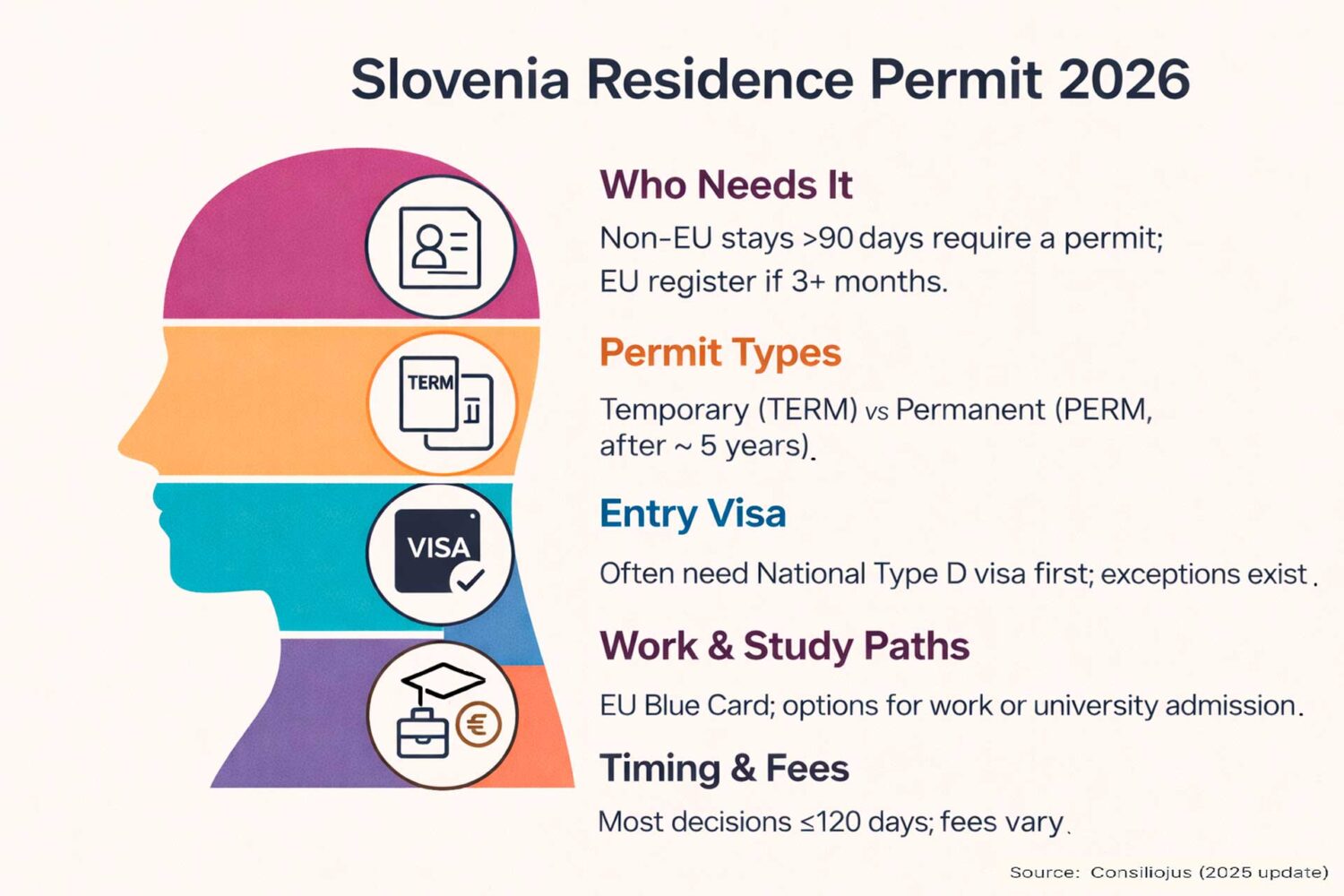
Most non-EU nationals need to apply for a residence permit if staying over 90 days, whereas EU/EEA citizens do not need a residence permit to live in Slovenia. EU citizens have the right of free movement – they can enter with a passport/ID and stay up to 3 months freely. For longer stays, EU nationals must simply register their residence and obtain a residence registration certificate (not the same as a non-EU residence permit) by showing proof of employment, study, or sufficient funds. In short, non-EU nationals require a Slovenia residence permit for extended stays, whereas EU nationals follow a lighter registration process.
Visa vs. Residence Permit
It’s easy to confuse visas with residence permits, but they serve different purposes. A visa is typically a sticker or stamp in your passport that allows entry into a country for a short-term visit, whereas a residence permit is a card that allows you to live in the country long-term. Key differences include:
- Duration: Visas (like Schengen tourist visas) are usually for stays up to 90 days in a 180-day period. A residence permit is for stays longer than 90 days, often valid for 1 year or more and renewable.
- Purpose: Short-stay visas are for tourism, business visits, or other temporary reasons. A residence permit is tied to long-term purposes such as employment, study, family reunification, or investment, granting you resident status in Slovenia.
- Form: A visa is typically affixed in your passport (or is an electronic authorization), whereas a residence permit is issued as a biometric ID card you carry alongside your passport.
- Rights: A Schengen visa does not give you the right to work or access benefits in Slovenia; it only allows entry and short stay. A residence permit usually comes with broader rights like the ability to work, access public services, and reside in Slovenia continuously (depending on permit type and purpose).
- Entry to Slovenia: Many non-EU nationals need a visa to enter Slovenia initially. In fact, if you’re applying for a first-time residence permit, you will likely need a long-stay visa (Type D) to enter Slovenia and finalize your permit. For example, Slovenia issues national D visas for those approved a residence permit abroad, allowing entry for up to 90 days to complete the process. (Some nationals who are visa-exempt for short stays may be allowed to apply for the permit after entering Slovenia, but generally obtaining a D visa via the embassy is the standard route.)
In summary, think of a visa as permission to enter or visit, and a residence permit as permission to live in Slovenia. If your goal is to move to Slovenia for work, studies or family reasons, a residence permit is required – a visa alone is not sufficient for long-term stay.
Types of Residence Permits in Slovenia
Slovenian law provides for two main types of residence permits for non-EU citizens in 2026:
- Temporary Residence Permit (časovno omejeno dovoljenje) – a fixed-term permit typically issued for one year initially (sometimes less, depending on purpose). It is renewable if conditions are still met. Most newcomers start with a temporary permit based on a specific purpose (work, study, etc.).
- Permanent Residence Permit (stalno prebivališče) – an open-ended permit that allows indefinite stay in Slovenia without further renewals of status. You become eligible for permanent residency after 5 years of continuous legal stay on temporary permits (with some exceptions allowing earlier eligibility). Permanent residents enjoy a more secure status and rights similar to Slovene nationals (except voting in national elections, etc.).
Comparison of Temporary vs Permanent Residence Permits:
| Aspect | Temporary Residence Permit | Permanent Residence Permit |
| Initial Validity | Up to 1 year (often 12 months) for the first permit. Some specific permits may be shorter (e.g. seasonal work ~6 months). | Indefinite (no expiration of status). The card itself is typically renewed every 5 years for update purposes. |
| Purpose of Stay | Issued for a specific purpose: employment, work or business, study, family reunification, research, internship, EU Blue Card, investment, volunteer, etc. You must document the purpose (job contract, university enrollment, marriage certificate, etc.). | Not tied to a specific purpose; allows living in Slovenia without conditions on work or study. You must have already fulfilled a 5-year temporary stay legally and continuously to qualify. |
| Renewal | Renewable if you continue to meet the conditions. Typically renewed in 1-year or 2-year increments depending on category (e.g. after the first year, work permits often renew for 2 years at a time). Some sub-types (like digital nomad or internship permits) are not renewable beyond their initial term. | No renewal of status needed (permanent status is permanent). However, you must not be absent too long from Slovenia or violate serious laws or you could lose PR. The physical PR card must be reissued periodically (every 5 years, with a new photo/fingerprints). |
| Key Rights | Rights to live in Slovenia and (if permit is a single permit for work) the right to work for the employer/purpose granted. Access to public health insurance is possible (often by contributing to health system), and children can attend schools. Travel in Schengen up to 90 days in 180 days is allowed. Note: Some temporary permits (e.g. study) may limit work hours (students can work part-time). Family members typically need their own permits to stay. | Broader rights: free access to employment (you can work for any employer or be self-employed without needing another work permit), full access to social benefits like any long-term resident, and greater security of stay. Permanent residents in Slovenia can also move to other EU countries more easily under EU long-term resident rules. They have a path to citizenship after a further period (see Long-Term Path). |
Slovenia’s Aliens Act defines many sub-categories of temporary residence permits depending on the purpose of your stay. Here are the common categories under which you can obtain a temporary residence permit:
- Employment or Work – If you have a work contract with a Slovenian employer or are transferred within a company, you can get a single residence and work permit (this combines a work permit and residence permit in one). This category covers regular employment, intra-company transfers, highly-skilled workers (EU Blue Card), seasonal work, and even daily cross-border commuters. The first work-based permit is usually one year, extendable for 2-year periods for ongoing employment.
- Business and Investment – Entrepreneurs or investors can obtain residency by starting a business or investing in Slovenia. For example, registering as an individual entrepreneur (sole proprietor) is a basis for a permit, and the permit can be extended if the business remains active. There are also investment-based options (e.g. significant investment in a company or real estate) that can qualify one for temporary residency.
- Study and Internship – Foreign students enrolled in a Slovenian university or educational institution can get a temporary residence permit for the duration of studies. This is typically issued for one academic year at a time and can be renewed each year until you finish studies. During studies, students are usually allowed to work part-time. Recent graduates may extend their stay for a short period (up to 9 months) to seek employment or start a business in Slovenia. Similarly, research scholars and academics can get permits for research work, and trainees/interns can get a non-extendable permit for up to 1 year of internship.
- Family Reunification – Immediate family members (spouse, registered partner, minor children, and certain dependent relatives) can join a foreigner who is legally residing in Slovenia. Generally, the sponsor (the resident in Slovenia) must have lived in Slovenia on a residence permit for at least 1 year before they can sponsor family reunification. (This waiting period is waived for certain categories like EU Blue Card holders, researchers, and some others.) A family reunification residence permit is usually issued for one year initially and can be extended, typically in 2-year increments, as long as the sponsor maintains legal residence. Note: Starting in 2024, adult family members must demonstrate basic Slovenian language proficiency (A1 level) when renewing their temporary permit for family reasons. This measure is aimed at encouraging integration of family migrants.
- Digital Nomads (Remote Workers) – As of November 2025, Slovenia introduced a temporary residence permit for digital nomads. This is for non-EU foreigners who work remotely for an employer or business outside Slovenia (including freelancers) and wish to reside in Slovenia while working online. The key condition is the individual is not entering the Slovenian labor market, so no local work permit is needed. The digital nomad permit can be granted for up to 1 year and is not extendable beyond one year. However, you may re-apply after a 6-month gap, or transition to another permit (e.g. employment) if you decide to take up work in Slovenia. Digital nomads must meet a higher income threshold – at least 2× the average Slovenian monthly net salary – to prove sufficient means. A perk of the nomad permit is that you can bring family immediately (no one-year wait) under family reunification, due to a specially favorable regime for nomads.
- Other Grounds – Slovenia’s law allows temporary residence for various other reasons as well. For instance, volunteers in approved programs can get a permit for up to 1 year (renewable if the volunteering continues). Retirees or persons of independent means might obtain a permit if they can show sufficient funds and a valid reason (e.g. plan to live in Slovenia long-term). In rare cases, residence can be granted for humanitarian or exceptional reasons – for example, if someone cannot return to their home country due to danger (subsidiary protection) or if a government ministry declares the person to be of special interest to Slovenia (e.g. an acclaimed artist or athlete). These special cases often have specific rules (for instance, a special-interest permit can be up to 5 years validity).
Permanent Residence Permit: After legally living in Slovenia for a certain time on temporary permits, you can apply for a permanent residence permit. In general, 5 years of continuous temporary residence is required. Starting November 1, 2024, applicants for permanent residency must also pass a Slovene language exam at A2 level (basic proficiency) as a condition. Some people can qualify in less time than 5 years: for example, immediate family members of Slovenian citizens or permanent residents or recognized refugees may be eligible after 2 years of residing in Slovenia. Permanent residence grants open-ended status – you no longer need to renew annually, and you enjoy enhanced stability and rights (e.g. easier access to jobs and social benefits). We’ll cover the path to permanent residency and citizenship in detail in a later section.
Leave your contacts to have an expert contact you shortly.
Requirements for a Slovenia Residence Permit
To successfully obtain a residence permit, you must meet certain requirements and provide documentation as evidence. The exact requirements vary slightly depending on the category of permit (purpose of stay), but the core criteria are generally the same. Below are the key requirements and documents needed for a Slovenian residence permit application:
- Valid Passport – You must have a travel document (passport) that will remain valid for at least 3 months beyond your planned stay. A copy of the passport (and often the original for verification) is required. Ensure your passport has blank pages for visas/stamps.
- Completed Application Form – Slovenia has specific application forms for temporary residence permits (available at embassies or online). You’ll fill in personal data and specify your reason for residence.
- Recent Photograph – One passport-size color photo meeting Slovenian specifications (35×45 mm, white background). The photo must be high resolution and recent (usually taken within the last 6 months).
- Proof of Purpose of Stay – Perhaps the most important requirement: you must provide evidence of the reason you are requesting residency. The law recognizes purposes like work, study, family reunion, research, volunteer work, etc., and you must substantiate yours with official documents.
- Proof of Sufficient Financial Means – You need to show that you have enough funds to support yourself in Slovenia, so as not to become a burden on the state. Typically, you must prove a regular income above a certain monthly minimum. The required amount can vary by permit type: for example, students in 2025 had to show at least €484.88 per month of income or scholarship. In general, applicants should demonstrate income roughly in line with minimum basic income or wages in Slovenia. Sources indicate a range from about €339 to €732 per month depending on the category. Proof of means can be in the form of pay slips, bank account statements, employment contracts specifying salary, scholarship letters, pension statements, or a combination of such documents.
- Health Insurance – You must have adequate health insurance coverage valid in Slovenia (and typically the EU). A travel or health insurance policy with minimum coverage of €30,000 for emergency medical treatment is required at the time of application. If you will be employed in Slovenia, eventually you’ll be enrolled in Slovenia’s health insurance system, but initially you need coverage on your own. Students can often use international student insurance or EU health card (if applicable). Ensure the policy covers the entire intended stay.
- Background Check / No Criminal Record – First-time applicants must provide a police clearance certificate from their country of citizenship (and possibly any country you’ve lived in recently) to prove you have no serious criminal record. This document should be recently issued (typically within the last 3–6 months) and must be authenticated (apostilled or legalized) if not from an EU country. A clean criminal record is essential; certain crimes or security risks can lead to refusal.
- Proof of Accommodation (Address in Slovenia) – You may need to show you have a place to live in Slovenia. This could be a rental contract, hotel booking, invitation letter from a host, or dormitory confirmation for students. For permanent residence, proof of a permanent address (and legal right to reside there, such as a lease or ownership) is required.
- Other Supporting Documents – Depending on your case, there could be additional documents: medical certificate, letter of authorization if someone is applying on your behalf, marriage certificate / birth certificates for family applications (with apostille/translation). For minors, parental consent or additional paperwork.
Translation and Legalization: All foreign documents (birth, marriage certificates, police records, etc.) that are not in Slovene must be translated into Slovene by a court-certified translator and usually legalized (apostille or consular legalization). This is very important: an official translation is required so that Slovenian authorities can read your documents. Using a translator certified by the Slovenian Ministry of Justice ensures the translation will be accepted. Plan for time and costs to translate and legalize documents as needed.
General Conditions: In addition to documents, you must meet some general conditions:
- You must not pose a threat to public order or security in Slovenia. Background checks and possibly an interview help ascertain this.
- You should not have an active ban on entry to Slovenia/Schengen.
- You must typically apply from abroad (at a Slovenian embassy/consulate) for your first residence permit. Only in some cases can you apply from within Slovenia (such as if you’re there legally for other reasons). Always check the latest rules or ask the embassy.
- Pay the application fees as required (discussed later).
Meeting all these requirements and submitting a complete application file is crucial for success. Missing documents or not fulfilling a requirement (for example, insufficient funds or an expired police certificate) can lead to delays or rejection. In the next section, we’ll go through the application process step by step.
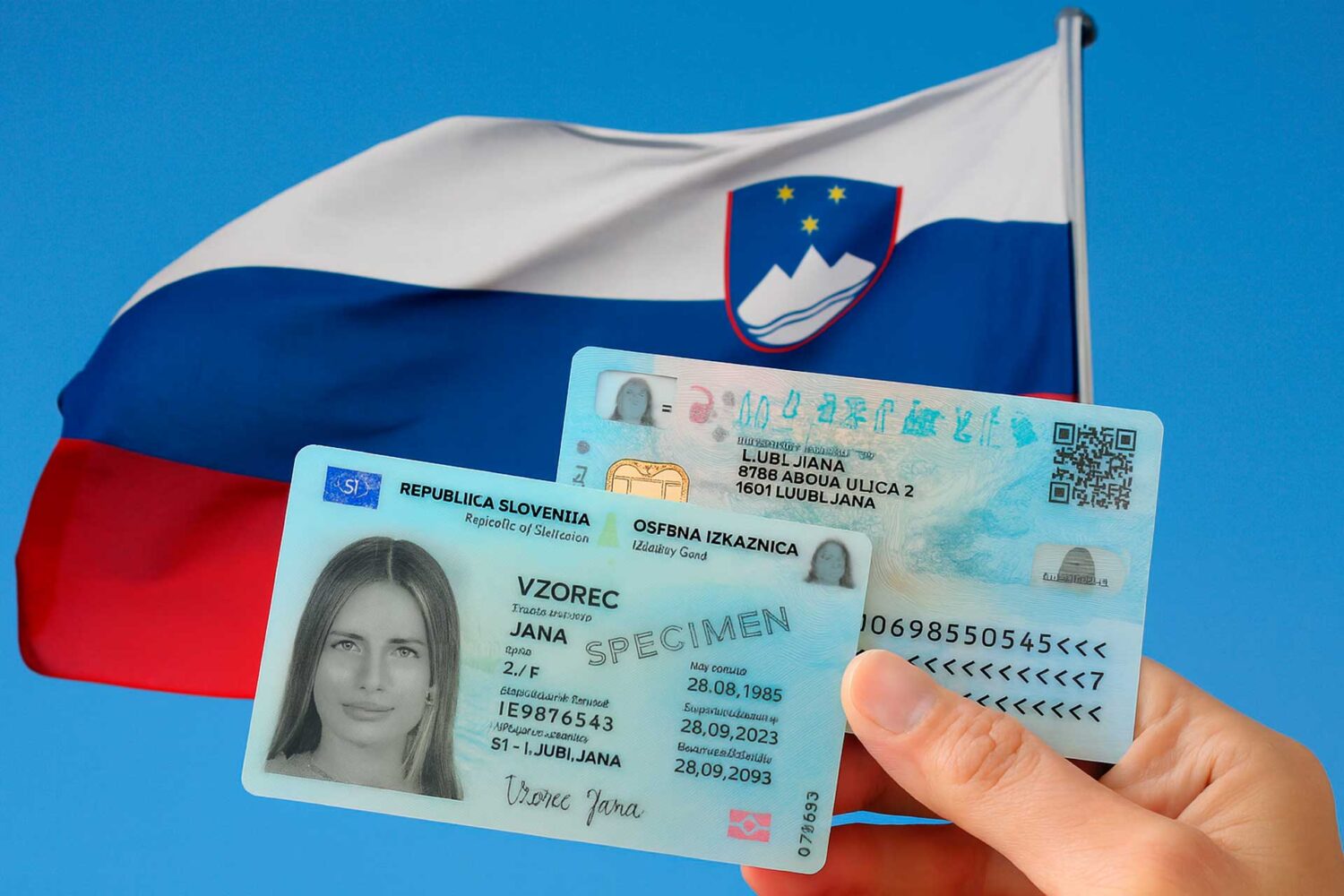
How to Apply for a Slovenia Residence Permit (Step-by-Step)
Applying for a residence permit in Slovenia involves several steps and careful preparation. Below is a step-by-step application checklist to guide you through the process:
- Research Your Permit Category and Gather Information: Determine under what category you will apply (work, study, family, etc.), as requirements can vary. Check the official Slovenian government guidelines or consult with an immigration lawyer to confirm the latest criteria for your permit type. Make a list of documents you need (see the Requirements section above) and ensure you can obtain each one.
- Secure an Entry Visa (if required) and Submit Your Application: Most first-time applicants must apply at a Slovenian embassy or consulate in their home country (or country of residence) before traveling to Slovenia. You will typically submit the residence permit application form (for temporary residence), all supporting documents as described, an application fee (usually paid at the consulate). The Slovenian consulate will accept your application, take your biometrics (fingerprints and signature) and forward everything to the authorities in Slovenia (Administrative Unit where you plan to reside).
- Wait for Processing: After submission, Slovenian authorities will review your application. The official processing time for a first residence permit is generally up to 30 days, and by law it can extend to 90 days if additional checks are needed. In practice, many permits are issued faster (often around 2–4 weeks), but delays are possible. As of 2026, due to administrative digitalization, some cases might even take a few months if backlogs occur. During this time, be responsive if the authorities request any additional information via the embassy. Once a decision is made, the embassy will notify you.
- Obtain the Long-Stay Visa (D Visa): If not already issued earlier, once your residence permit approval is imminent or granted, you will receive your D visa from the embassy. This visa is usually a sticker in your passport allowing single or multiple entry into Slovenia for the purpose of collecting your residence permit. The D visa is often valid for 90 days (up to 6 months or 1 year maximum in some cases). Note: Some applicants who do not need a visa to enter Slovenia (for example, citizens of visa-waiver countries like the USA, Canada, etc.) might be allowed to travel to Slovenia without a D visa. However, you still need the residence permit approval before you can legally stay long-term. When in doubt, getting the D visa is the safer approach.
- Travel to Slovenia and Register Your Address: Upon receiving your visa and approval, travel to Slovenia. Within 8 days of arriving, you must register your temporary residence address in Slovenia. Registration is done at the local Administrative Unit (Upravna enota) or sometimes at the local police station for foreigners. If you are staying in a hotel or student dorm, the accommodation provider may register you, but confirm this. For private accommodation, you’ll fill a registration form with your address. Registration is mandatory – it informs authorities where you live and is required to then receive your residence card. (EU citizens also must register after 90 days, as noted earlier, but non-EU temporary permit holders do it immediately on arrival.)
- Attend Biometrics Appointment (if required) & Receive Residence Permit Card: If you gave fingerprints and photo at the embassy already, Slovenia may produce your residence permit card and either send it to the embassy or to the Administrative Unit for pickup. Often, you will pick up your residence permit card in Slovenia at the Administrative Unit in your area. If your biometrics were not collected before, you’ll be called to the Administrative Unit to submit fingerprints and a digital signature for the card. Once the card is ready (usually a few days to a couple of weeks after arrival), you will receive your temporary residence permit card. Make sure all information on the card is correct (name spelling, dates, etc.). The card will show the type of permit and its validity dates.
- Register with Other Authorities (if applicable): With your residence permit in hand, there may be additional steps. If you came on a work permit, your employer might need to register you with the Slovenian Tax Office and Health Insurance Institute. Students should register at their university and can apply for a Slovenian residency number (EMŠO) if not automatically assigned. Everyone should consider obtaining a Slovenian tax number if you’ll have any financial activity (sometimes required for things like opening a bank account or signing a rental contract). Within 8 days of getting the permit, if not already, report your residence to the Central Population Register (this may be the same as the address registration done initially). Also, some municipalities may want foreign residents to register, but generally the administrative unit registration suffices.
- Comply with Permit Conditions: Maintain the conditions of your permit during your stay. For example, if you have a work-based permit, continue working for the employer or properly file for changes if you switch jobs. If you have a study permit, stay enrolled in school. Always renew on time (submit renewal application at least 30 days before expiry). If you move addresses within Slovenia, update your registration. Following the rules will ensure a smooth path to extending your stay and eventually gaining permanent residency.
By following these steps methodically, you cover all bases from preparation to settling in. The process might seem complex, but Slovenia’s system is considered straightforward by many immigrants – often it’s “just prepare the documents and apply”. The main challenges noted are the need for official translations and that initial applications cannot be done entirely online. But overall, with proper preparation, obtaining a Slovenian residence permit is quite achievable.
If you feel unsure or overwhelmed, consider consulting an immigration expert or attorney at our company who specializes in Slovenian immigration law. Our team can provide personalized guidance and help ensure your application is prepared correctly and submitted successfully.
Processing Time and Fees
Processing Time: The time it takes to get a residence permit in Slovenia can vary. Officially, the Administrative Units aim to decide on temporary residence permit applications within 30 days, and no later than 90 days in complicated cases. In practice, many applicants have reported getting approvals in about 2–4 weeks (around 15 days is a common timeframe for straightforward cases). Renewals of permits similarly take a few weeks in most cases.
However, 2026 updates indicate processing might slow down somewhat due to new procedures. The government is introducing more digital systems and thorough checks, which could extend processing to 3–5 months in some instances. This is not guaranteed for every case, but be prepared for possible delays. The best practice is to apply well in advance of your planned travel or before your current permit expires. Start gathering documents early, and submit your application as soon as you’re eligible to avoid stress if there are backlogs.
While waiting, you can track your application status via the embassy or the Administrative Unit. If the maximum time passes with no decision, you (or your employer) can inquire with the authorities. Fortunately, for work permits, if you applied for renewal in time, you can usually continue working on an expired permit until the decision is made.
Government Fees: There are several fees associated with obtaining a residence permit. Some are paid in local currency (at the embassy or in Slovenia), but we list them in Euros here for reference. The fee system distinguishes whether you apply from abroad (at an embassy) or in Slovenia (at an administrative unit), with embassy applications incurring higher issuance fees. Below is a summary of the typical fees:
| Item | Fee (EUR) |
| Long-Stay Visa (D Type) issuance | €77 |
| Residence permit application fee (processing fee) – if applied at embassy vs in Slovenia | €13 (abroad) / €4.50 (in Slovenia) |
| Residence permit issuance fee (to issue the permit decision) – if issued at embassy vs in Slovenia | €102 (abroad) / €50 (in Slovenia) |
| Single permit (combined work & residence) fee (if applying within Slovenia) | €70 |
| Residence permit card production | €15.47 (card printing cost) |
Table: Standard state fees for Slovenia residence permit applications (as of 2025–2026).
A typical first-time applicant applying from abroad will pay roughly €200+ in state fees in total. For example, around €77 for the D visa, €13 for the application, €102 for the permit issuance, and ~€15 for the card = ~€207. If applying within Slovenia, the fees are lower (since a D visa isn’t needed and the issuance fee is less). Note that payment methods vary: embassies might require cash or a bank payment for their portion, whereas in-country fees can often be paid with local payment slips.
Additionally, budget for other costs: Document translation and legalization can add a few hundred euros depending on how many papers you have. Also, if you use legal assistance or an immigration agency, those services will have their own fees.
Residence Permit Renewal Fees: Renewing a temporary permit usually costs the same as issuing a new one (often around €50 for issuance plus card cost). The law currently sets a €50 fee for issuing or renewing a temporary permit in Slovenia (plus the minor €4.5 application fee and €15 card). So renewals are relatively inexpensive, but remember the language requirements for certain renewals (family permits after May 2024 require proof of Slovene knowledge).
There are no fees for permanent residence permit issuance if you’re simply converting after 5 years (except the card printing fee), as at times these have been free or minimal – but you should confirm current policy when you apply. The card cost €15.47 remains for any card issued.
In summary:
- Expect around €200 in government fees for a first application (more if using an embassy).
- Renewals are on the order of €70 (in Slovenia) including the new card.
- Processing times are often a few weeks, but apply early in case it takes longer (some new rules may slow things down in 2026).
Keep your payment receipts and be mindful of processing timelines. If you plan to start work or school by a certain date, factor in the visa + permit processing combined (which could be a couple of months total). It’s always better to start sooner to buffer any delays.
Common Reasons for Rejection (and How to Avoid Them)
Not every application is approved. Sometimes residence permit (or visa) applications are rejected due to not meeting requirements or other concerns. Knowing the common rejection reasons can help you avoid pitfalls. Here are some frequent reasons and explanations:
- Insufficient Financial Means. The authorities conclude you don’t have enough funds to support yourself for the duration of stay. This happens if you fail to show proof of income or show an amount below the required minimum. Prevention: Provide bank statements, employment contracts, scholarship letters, or sponsor letters clearly showing you meet or exceed the monthly income threshold. If your funds are borderline, add extra evidence (savings, sponsor’s income) to be safe.
- Purpose of Stay Not Convincingly Proven. You did not provide sufficient evidence of the purpose for your long-term stay. For example, a vague invitation or missing contract can cause doubts. Prevention: Submit clear, official documents – e.g. a signed work contract, an official university acceptance letter, marriage certificate, etc. – that fully align with the type of permit you seek. Write a cover letter if needed to explain your purpose.
- Incomplete or Incorrect Documentation. Any missing document or incorrect form can lead to a refusal or at least a delay. Submitting false or forged documents will also result in an immediate rejection and possibly a ban. Prevention: Double-check the required documents list. Use a checklist. Ensure all documents are current (not expired) and officially certified where needed. Never submit fraudulent papers – Slovenia’s immigration checks authenticity diligently, and forgery is grounds for denial. If a document is unavailable, explain why and offer an alternative if possible.
- Lack of Health Insurance. If you fail to show a valid health insurance policy, your application may be rejected as incomplete. Prevention: Purchase a travel health insurance that meets the requirements and submit the certificate. Ensure it covers the entire period until you’d be in Slovenia’s health system.
- Criminal Record or Security Risk. If the background check reveals a serious criminal history, or if the applicant is suspected to pose a security or public order threat, Slovenia will deny the permit. This can include past deportations or crimes. Prevention: Obviously, one cannot change their past record, but minor offenses might be overlooked if disclosed honestly. Provide police certificates as required; if you have any criminal record, consider adding a personal statement or legal opinion on your rehabilitation. Ultimately, violent or serious crimes will bar you from obtaining a residence permit.
- Failure to Register or Local Compliance (post-approval). This is more about revocation than initial rejection: if you obtain the permit but then fail to register your address in 8 days, or don’t fulfill some post-arrival step, the permit could be canceled. Also, if you stop meeting the conditions (e.g. you quit the studies or job that was the basis of your permit), the permit might be revoked. Prevention: Follow all instructions after arrival. Always update the authorities if you change address or status. If you lose your purpose (job/study), inform the authorities and see if you can change the purpose of your permit.
In summary, the majority of refusals come down to not meeting the legal requirements. Slovenia’s process is rules-based: if you thoroughly provide evidence of all requirements, you are very likely to get approved (Slovenia “easily issues” visas/permits if conditions are met, according to legal experts). Always triple-check your application for completeness. If a rejection does happen, note that you have the right to appeal within 8 days of the decision for visas (and similar provisions for permits). Appeals cost a fee (~€153 for visa appeals) and will be reviewed by the Ministry of Interior. Alternatively, you can fix the issues identified and apply anew.
Rights and Benefits of a Residence Permit
Obtaining a Slovenia residence permit grants you numerous rights, opportunities, and benefits during your stay. While the exact rights can depend on the type of permit, here are some key benefits all legal residents of Slovenia enjoy:
- Live in Slovenia Long-Term: First and foremost, a residence permit allows you to legally reside in Slovenia beyond 90 days. You can rent accommodation, register for local services, and generally live like a local resident. You are no longer just a tourist – you have a temporary home in Slovenia.
- Freedom of Movement in Schengen: With a Slovenian residence permit card, you can travel to other Schengen Area countries for up to 90 days within any 180-day period without needing separate visas. For example, you could visit Austria, Italy, or France for short trips and return to Slovenia easily. (You cannot, however, move your residence to another country with this permit; it’s for travel purposes only.)
- Right to Work: Most residence permits either come with the right to work or are combined with a work permit (the “single permit”). But if you are on a permit that by definition doesn’t allow work (e.g. a pure study permit or an internship with no work component), you’d need to obtain an additional work authorization for employment. But most long-term permits are “single permits” that include work rights.
- Access to Healthcare: As a resident, you can enroll in Slovenia’s national health insurance scheme (either through your employer or as a student or voluntarily) which gives you access to public healthcare services. Even before that, you likely have private insurance as required for the permit. Either way, you can receive medical care in Slovenia. With a residence permit, once you register and contribute to the health system, you’ll be treated similarly to locals in terms of healthcare access.
- Banking and Financial Services: With a residence permit and local tax number, you can open bank accounts in Slovenia. This makes it easier to get paid if working, or manage finances while living there. You can also enter contracts, subscribe to mobile plans, etc., as a resident.
- Education: If you reside in Slovenia with children, they can attend public schools (primary and secondary education) like any other resident child. As a student resident, you can access university facilities, libraries, and even student subsidies for meals/transport. Over time, you may qualify for local tuition rates if you become a long-term resident.
- Social Security and Benefits: Residents who work and contribute to social security start accruing benefits. This includes things like pension rights, unemployment insurance, and parental leave, according to Slovene law. Temporary residents may not get the full range of social benefits (some are reserved for permanent residents or citizens), but working residents are covered by labor laws and social insurance. Permanent residents in particular get almost equal treatment to citizens in social benefits.
- Business Opportunities: With legal residence, you can also start a business or be self-employed in Slovenia. In fact, many permits are given on the basis of starting a business (you must register the company first). Once resident, you have the right to establish a company or act as a managing director. Slovenia’s access to the EU market means you can do business across the EU once established.
- Path to Long-Term Security: Holding a temporary residence permit is the stepping stone to permanent residency and eventually citizenship. Simply put, a residence permit puts you on the path to becoming a long-term member of Slovenian society. After 5 years you can become a permanent resident (with greater rights, like voting in local elections), and after ~10 years you could naturalize as a citizen (see next section). Thus, the residence permit is the beginning of a journey to full integration.
- Family Reunification: If you have a residence permit, you can (after meeting conditions) bring your close family to Slovenia under family reunification rules. This means your spouse and children can also enjoy the above rights once they obtain their residence permits. In the case of certain permits (e.g. digital nomad), family can come immediately; in others, you need one year residence first.
- Other Benefits: Living in Slovenia comes with a high quality of life – a clean environment, safety, and a central location in Europe. As a resident, you can get involved in the community, join local programs, and enjoy local resident rates for things like museums or public transport. You also are protected by Slovenian law – for example, tenant rights if renting, and consumer rights as an EU resident.
In essence, a residence permit gives you the legal footing to build a life in Slovenia. You have the security of knowing you won’t have to leave after 90 days, and you can work, study, access services, and participate in society. Many permit holders report that integration is quite smooth and that everyday life as an immigrant in Slovenia is comfortable. Of course, responsibilities come with rights: you must obey Slovenian laws and maintain your status (renew on time, etc.), but the system is supportive if you do your part.
Finally, one more benefit: as an EU country resident, you can often use your Slovene residence status to travel or even relocate to other EU countries under certain programs (for example, after 5 years you become an EU long-term resident which can ease moving to another EU state for work). So, it opens doors beyond Slovenia as well.

Long-Term Path: Permanent Residency & Citizenship
Many people who start with temporary residence in Slovenia aim to settle permanently. Here’s how you can convert your temporary status into permanent residency, and eventually Slovenian citizenship, along with the requirements and timelines updated for 2026.
Gaining Permanent Residency in Slovenia
After 5 years of continuous residence in Slovenia on a temporary permit, you become eligible to apply for a permanent residence permit. “Continuous” means you haven’t left for long periods and have kept your permits renewed back-to-back. Some key points:
- Language Requirement: As of November 1, 2024, applicants for permanent residency must pass a Slovenian language exam at A2 level (basic conversational level). You will need to provide a certificate of a successfully completed language exam from a recognized institution. This is a new requirement aimed at integration – start learning Slovene early in your temporary stay so you can meet this when the time comes. Keep in mind that from November 2024, free Slovenian language classes are offered to help non-EU nationals meet the language requirement – take advantage of those during your initial years. Passing A2 isn’t very difficult with some study; it’s roughly an elementary proficiency.
- Stable Income & Integration: You will need to show you have stable means of support and health insurance when applying for PR (usually by virtue of having a job or sufficient funds). Starting 2026, authorities may scrutinize that you genuinely reside in Slovenia (checking you have housing, etc.). They may also verify that you have no outstanding tax debts and are integrated.
- Application: You apply at the Administrative Unit with proof of 5 years residence (they have records, but you show current passport with stamps, current permit, language certificate, etc.). The fee for permanent permit is minor (often just the card fee) and if approved, you receive a permanent resident card.
- Rights: As a permanent resident, your status is no longer tied to a specific purpose or employer. You can live in Slovenia indefinitely. You enjoy almost all the rights of a citizen except a few (voting in national elections, holding certain public offices). You also gain EU long-term resident status, which allows you to move to other EU countries more easily for work or study (you’ll still need to apply there, but you won’t need a visa to move within the EU for long-term purposes under Directive 2003/109/EC).
Exceptions to 5-year Rule: сertain individuals can get permanent residency faster. Immediate family members of Slovenian citizens, of EU citizens in Slovenia, or of permanent residents might qualify after a shorter period (in some cases after 2 years of residence with family ties).Refugees under international protection can also apply after 5 years from the date of asylum grant (or possibly less for those with recognized refugee status – Slovenia aligns with EU law granting refugees long-term residence after 5 years).
Time spent in Slovenia on certain permits might count half or not at all: for example, time on a student residence permit counts only 50% toward the 5-year requirement (so you’d need say 5 years of study to count as 2.5 years). Also, some statuses like seasonal work, short-term business trips, intra-company transferees, and daily commuters do not count towards permanent residency at all. Those categories are explicitly not eligible for long-term stay status, meaning if you only ever held a seasonal worker permit, you cannot get PR unless you switch to a different type of permit and fulfill 5 years on that.
Path to Citizenship (Naturalization)
After spending time as a resident (temporary + permanent), you might consider becoming a Slovenian citizen through naturalization. Slovenia’s citizenship law requires a long residency period and fulfillment of integration conditions:
- The standard rule is 10 years of total residence, of which the last 5 years must be continuous permanent residence before you apply. In simpler terms, once you get your permanent residency (after 5 years), you need to hold that for an additional 5 years continuously, and then you can apply for citizenship (that totals 10 years).
- Language & Integration: You must demonstrate knowledge of the Slovenian language (typically B1 level or higher for citizenship) and general integration into society. You’ll likely need to pass a Slovene language test and a basic knowledge test about Slovenian history/culture or meet an integration criterion defined by law. (Slovenia’s law says “knowledge of Slovenian” and being of “good character” etc. Your A2 exam for PR is a start, but for citizenship a higher proficiency may be required; many countries require B1 for naturalization).
- Good Character: No criminal convictions of a serious nature, and you should not pose a security threat. Similar to permits, a clean record is needed.
- Financial/Tax Compliance: You should have no unpaid taxes or debts in Slovenia and be self-sufficient or employed. Fulfilling any civic duties (like if you were called for anything) is also expected.
- Renunciation of Previous Citizenship: Slovenia generally expects you to renounce your old citizenship upon naturalization unless you are an EU citizen or certain exceptions apply. However, they have exemptions where dual citizenship is allowed: e.g., if your home country does not allow renouncing, or if you’re married to a Slovenian, etc., you may be permitted dual citizenship. Slovenian citizens by naturalization can in some cases keep their original citizenship (case-by-case, especially for EU nationals or in extraordinary naturalizations).
Faster citizenship paths: Slovenia does have a few faster tracks. If you are married to a Slovenian citizen for at least 3 years, and have lived in Slovenia with them for at least 1 year continuously, you can apply for citizenship earlier. This is a significant shortcut – basically 1 year of residence (instead of 5) if in a stable marriage, but you still need language and other requirements. If you are of Slovenian origin (Slovene expatriate or descendant up to 4th generation) or a Slovenian emigrant, you have a shortened residency requirement (1 year). Recognized refugees and stateless persons can apply after 5 years of residence (so basically as soon as they get PR).
Extraordinary naturalization: If you have made an exceptional contribution to Slovenia or it’s in the national interest to grant you citizenship (e.g., a distinguished scientist, athlete, investor), the government can naturalize you without the full 10-year requirement. This is rare and discretionary.
The naturalization process involves submitting an application to the Administrative Unit or consulate, much like the permit, but with additional documents (proof of residence periods, language certificate, etc.). It can take months to a year for a decision. Once approved, you attend a ceremony and officially become a citizen (and get a Slovenian passport and all political rights).
Citizenship is the final step – it gives you the right to vote in all elections, obtain an EU passport (Slovenian passport, which is quite powerful), and call Slovenia your permanent home without any immigration restrictions. Note that you will then also be an EU citizen, which means freedom to live and work in any EU country outright.
Many foreigners in Slovenia do pursue permanent residency (it’s a valuable status), but not all go for citizenship, especially if they’d have to give up their original nationality. It’s a personal choice. Slovenia allowing dual citizenship for EU nationals and in certain cases helps; as of 2026, there’s an increasing number of naturalizations of long-term residents, reflecting the fact that foreign citizens make up over 10% of Slovenia’s population.
In conclusion, Slovenia offers a clear pathway: temporary residence ➔ permanent residence (after 5 years) ➔ citizenship (around 10 years, if desired). With patience and compliance, you can go from new resident to permanent resident, and finally to a Slovenian citizen enjoying all rights that come with that status.
New Developments and Tips for 2026
As we step into 2026, there are a few important developments in Slovenian immigration rules to note, as well as best practice tips for prospective applicants:
- Stricter Income and Self-Sufficiency Checks: The Slovenian authorities are expected to enforce higher income requirements for renewals and perhaps initial applications. You may need to prove an income above the minimum wage or a stable job contract to renew a temporary permit. Tip: maintain documented proof of your income (payslips, contracts) and ensure it stays above any threshold (the minimum gross monthly wage in Slovenia in recent years is around €1,100, so expect to show something in that range or higher if supporting family).
- Verification of Actual Residence: There will be more active monitoring that foreign residents are truly living in Slovenia (and not just holding a permit “on paper”). Officials might ask for evidence like a rental contract, utility bills, or local health insurance usage to confirm you reside at your registered address. Tip: always register your correct address and update it if you move. Keep records of your presence (e.g. local transactions, bills). Don’t plan to abuse the system by living abroad on a Slovenian permit – it could jeopardize renewals.
- Language and Integration Focus: Beyond the new language test requirements for PR and family permit renewals, there’s talk of introducing mandatory Slovene language courses or tests for long-term residents to ensure integration. We already see this with the A2 and A1 requirements from 2024. Tip: take advantage of free Slovene language courses offered by the government. Engaging in these courses not only prepares you for any exams but also demonstrates your effort to integrate (which can help in borderline cases).
- Tax Compliance: Starting 2026, expect that when renewing a permit, you might need to provide a tax clearance or confirmation you have no outstanding tax debts in Slovenia. This is to ensure foreign residents contribute fairly. Tip: File any required tax returns (for example, if you’re a resident, you may owe taxes on worldwide income, or if working, ensure your employer is paying your taxes). Keep documentation that you are in good standing with the Financial Administration (FURS).
- Longer Processing Times Possible: With added checks and digitalization of the system, some applicants are seeing processing times increase. Instead of a few weeks, it might take a few months in complex cases. Tip: Apply early. For renewals, you can usually apply 60 days before expiry – do so. For first applications, do not delay after you have your documents. And be patient; avoid making irreversible plans (like quitting a job back home) until you have your visa or approval in hand.
- Digital Nomad Visa/Permit: The introduction of the digital nomad permit in late 2025 is a new avenue, reflecting Slovenia’s openness to remote workers. If you qualify, this could be a convenient way to experience Slovenia for up to a year. Just remember it’s not extendable long-term, so use that time to decide if you want to transition to another permit (like starting a business or finding local employment).
- Consult Official Sources: Regulations can change. Slovenia might implement further Aliens Act amendments or new EU directives. Always check the official government website or up-to-date legal resources when planning your application. The Ministry of Interior’s website (gov.si) has an “Entry and Residence” section with the latest info.
Professional Advice: If your situation is complex (for instance, you have multiple nationalities, or you plan to bring family and start a business, etc.), consider consulting an immigration lawyer. A professional can ensure your application meets all criteria and can assist with appeals if necessary. This is especially useful now with new rules in flux.
Securing a Slovenia residence permit in 2026 is a well-defined process that can lead to a fulfilling life in a beautiful European country. By understanding the types of permits, preparing all requirements diligently, and keeping abreast of new rules (like language tests and stricter checks), you can smoothly navigate the application. This guide has covered both informational aspects (definitions, rights, comparisons) and actionable steps (how to apply, what to prepare), matching both informational and practical intent. Always refer to official sources or seek professional advice for your specific situation, as immigration laws can update.
Leave a Comment

We have prepared answers to the most common questions about Slovenia residence permit. If you want to clarify anything, please contact us - we will provide detailed explanations.
A visa is a short-term entry permit (for example, a Schengen tourist visa allows a stay up to 90 days), whereas a residence permit is for long-term stays in Slovenia beyond 90 days. A visa is typically a sticker in your passport for visiting, while a residence permit is a biometric card that lets you live in Slovenia and often work or study. If you plan to move to Slovenia for months or years, you will need a residence permit, not just a visa.
Any non-EU/EEA citizen who wants to stay in Slovenia for longer than 90 days continuously needs to obtain a temporary residence permit. This includes foreign nationals coming for work, study, family reunification, or other long-term purposes. (EU/EEA citizens have the right to reside in Slovenia without a permit, but must register with authorities if staying more than 3 months.) In short, if you are not an EU citizen or Slovenian citizen and you intend to live in Slovenia, you need to apply for a residence permit.
Without a residence permit, you can stay up to 90 days within a 180-day period if you have a valid Schengen visa or visa-free entry privilege. After 90 days, you must leave (or have a residence permit approved). There is no way to “extend” a tourist visa beyond 90 days in Slovenia; a residence permit is the only route to stay longer legally.
The main requirements include: a valid passport, a clean criminal record certificate, health insurance covering at least €30,000, proof of sufficient funds to support yourself (e.g., income, savings), and proof of purpose of stay (such as a work contract, university acceptance, or marriage certificate). You must also have a place to live in Slovenia (address registration) and apply from abroad in most cases. All documents not in Slovene must be officially translated and apostilled. Meeting these requirements and submitting a complete application file is crucial for approval.
Typically, you apply at the Slovenian embassy or consulate in your home country. You’ll submit the application form along with all required documents and pay the fees. The application is then processed by Slovenian authorities. If approved, you get a D visa to enter Slovenia and then collect your residence permit card at an administrative office in Slovenia. (Some nationals can apply in Slovenia if already there legally, but most will apply abroad.) See the “How to Apply” section above for detailed step-by-step guidance.
It can vary. Often it takes around 2–4 weeks (15–30 days) to get a decision if everything is in order. However, it can legally take up to 90 days in complicated cases. Recently, there are warnings that processing might take a few months if additional checks are implemented. In addition, factor in time to get the D visa (another ~15 days). It’s best to apply at least 2-3 months in advance of when you plan to move to Slovenia.
The first temporary residence permit is usually valid for one year (12 months). Some specific permits have shorter validity (e.g., a seasonal work permit might be 6 months, a digital nomad permit up to 1 year). After the first year, you can renew; renewals might be granted for 2 years at a time for work permits, or continue yearly for things like study.
Yes, you can renew temporary residence permits as long as you still meet the requirements. You must apply for renewal before your current permit expires (at least 30 or 60 days prior is recommended). Renewals are processed in Slovenia at the local administrative unit. You’ll need to update documents like proof of continued purpose (e.g., new work contract or proof you’re in the next year of studies) and proof of income/insurance. The renewal fee is about €50 (plus card cost). If you do this on time and nothing major has changed, renewal is usually straightforward.
Yes, through family reunification provisions. Spouses, registered partners, minor children, and certain dependent relatives can apply for a temporary residence permit to join you. The condition is usually that you, as the sponsor, have legally resided in Slovenia for at least one year on a residence permit, and you have adequate housing and income to support the family.
For the initial temporary residence permit, there is no language requirement – you can get a permit without knowing Slovene (as of 2026). However, if you aim for permanent residence, you will need an A2 level Slovene certificate starting Nov 2024. Also, if you’re a family member renewing your temporary permit after 2024, you need to show A1 level knowledge. And for citizenship, a higher level of Slovene (and an integration test) is required.


Comments
No comments found.