
 EU Citizenship
 Slovenian Citizenship
 Romanian Citizenship
 Bulgarian Citizenship
 Austrian citizenship (investments)
 Spanish Citizenship
 Italian Citizenship
 Cypriot Citizenship
 Lithuanian Citizenship
 Portuguese Citizenship
 French Citizenship
 German Citizenship
 Hungarian Citizenship
 Dutch Citizenship
 Belgian Citizenship
 Croatian citizenship


Switzerland Residence Permit: Requirements, Types, and How to Apply in 2026
Author: Leon Scott
Published: 20.11.2025
Updated: 09.04.2026
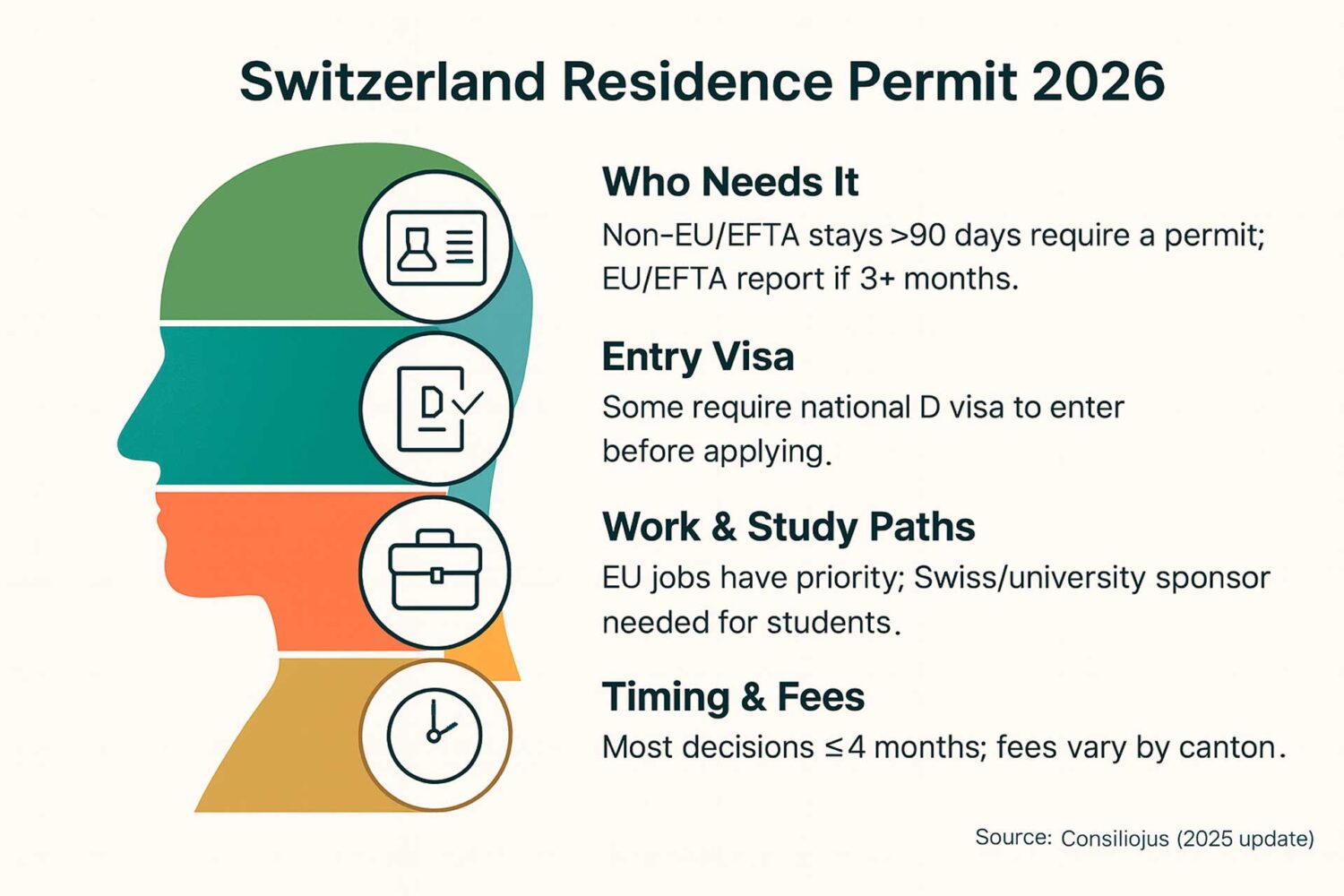
Switzerland is renowned for its high quality of life, economic stability, and beautiful landscapes, making it an attractive destination for people worldwide. However, moving to Switzerland long-term requires navigating the country’s residence permit system. All foreign nationals who plan to stay in Switzerland for more than 90 days must obtain a residence permit. This comprehensive guide will explain the types of Swiss residence permits, the requirements to get one, and how to apply, addressing common questions for EU/EFTA nationals, non-EU citizens (including U.S. and Indian citizens), investors, and others seeking temporary or permanent residency in Switzerland.
Overview of Swiss Residence Permits
Switzerland’s immigration system distinguishes between EU/EFTA citizens and non-EU (third-country) nationals due to bilateral agreements on free movement. EU/EFTA nationals benefit from relatively easier entry and residence procedures, thanks to the Agreement on Free Movement of Persons. They can enter Switzerland without a visa and have the right to obtain a permit if they have employment or sufficient financial means. In contrast, non-EU citizens face more restrictive rules – generally needing a pre-approved permit (often tied to a job offer or other specific purpose) and being subject to annual quotas.
Switzerland issues several categories of residence permits depending on the purpose and duration of stay. The main permit types include Permit L, Permit B, and Permit C, as well as special categories like Permit G (cross-border commuter) and Permit Ci (for certain family members of diplomats/international officials). Below is a brief overview:
- Permit L – Short-Term Residence Permit. Typically for stays up to one year (e.g. short work contracts or study programs). It’s a temporary permit that can sometimes be renewed once, up to a maximum of 24 months, but offers no long-term residency rights.
- Permit B – Initial / Temporary Residence Permit. Issued for longer stays with a specific purpose such as employment, family reunification, or study. For EU/EFTA citizens, a B permit is usually valid for 5 years (if they have a work contract or sufficient means). For non-EU citizens, B permits are often granted for 1 year at a time, renewable annually (initial validity can vary; some may get longer validity depending on circumstances). The B permit is tied to the purpose (e.g. a particular job or study program), so changes in your situation can affect the permit. This is the standard residence permit most foreigners start with.
- Permit C – Permanent Residence Permit (Settlement Permit). The C permit is Swiss permanent residency. It allows you to reside in Switzerland indefinitely with virtually the same rights as Swiss citizens (except voting rights). A C permit is typically granted after a lengthy period of continuous residence – usually 10 years for most non-EU nationals, but only 5 years for EU/EFTA citizens and citizens of certain countries like the USA and Canada. Holders of a C permit enjoy unrestricted work rights, the freedom to change cantons or employers, and no quota limitations.
- Permit G – Cross-Border Commuter Permit. For people who live in a neighboring country (like France, Germany, Italy, or Austria) but work in Switzerland. The G permit lets you commute for work; you must return to your home country at least once a week. Often valid for up to 5 years if you have a long-term employment contract.
- Permit Ci – Residence Permit with Employment for Family Members of Diplomats/Officials. Granted to the spouses and children of certain intergovernmental organization staff or diplomats posted in Switzerland, allowing them to live and work in Switzerland during the principal holder’s assignment.
- Other Special Permits. Switzerland also assigns special status permits in humanitarian or asylum contexts. For example, Permit F is for provisionally admitted refugees or individuals on humanitarian grounds, Permit N is for asylum seekers during the asylum procedure, and Permit S is a temporary protection status (e.g. used for people fleeing conflict, such as Ukrainians during the 2022 crisis). These are special cases not typically used for planned immigration through work or investment.
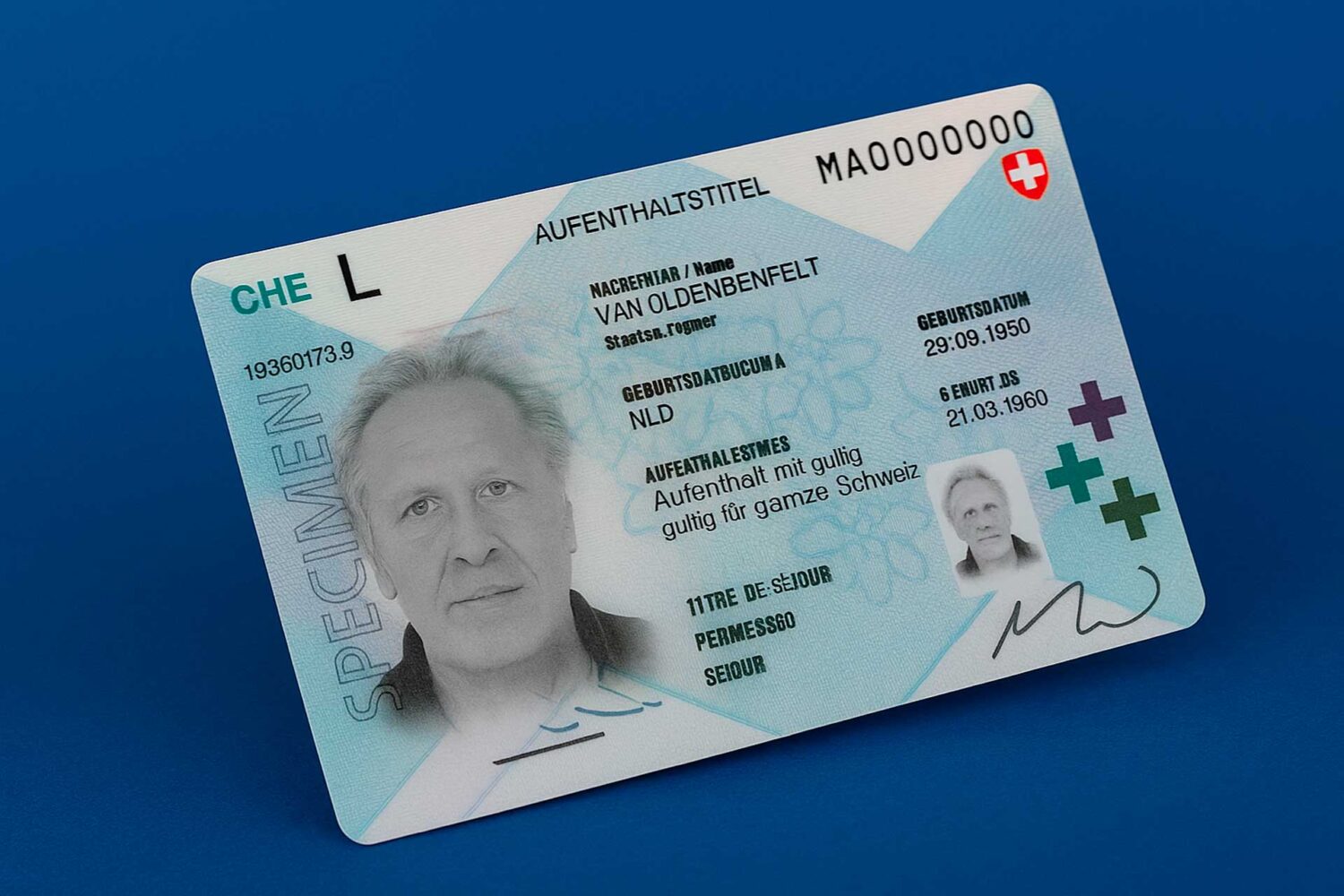
A Swiss residence permit card (credit-card format). Switzerland issues biometric foreigner identification cards for permits L, B, and C. The card contains a microchip with the holder’s fingerprints and photo, and it serves as proof of legal residency.
For an easy overview, the table below summarizes the main Swiss residence permit types, their purpose, and duration:
| Permit Type | Purpose / Who it’s For | Validity & Renewal |
| L Permit (Short-Term) | Short stays up to 1 year (e.g. short employment contract, internship, exchange studies). | Valid for the duration of the work contract or up to 12 months. Can be renewed once (usually max total 24 months). |
| B Permit (Residence) | Long-term temporary residence for work, family reunification, study, or financial independence. | EU/EFTA: 5-year permit (renewable) if employed or self-sufficient. Non-EU: often 1-year (renewable annually, subject to quotas) for work or other approved purpose. Can be extended as long as conditions are met. |
| C Permit (Settlement) | Permanent residence (after fulfilling residency requirements and integration criteria). | Indefinite validity (card renewed every 5 years). Granted after 5–10 years of residence (5 for EU/EFTA, US, Canada; 10 for others). Gives permanent resident status with full work mobility. |
| G Permit (Cross-border) | Commuters living in an EU neighboring country but working in Switzerland. | Typically valid up to 5 years (if employment contract is permanent or ≥1 year; shorter if contract <1 year). Must reside outside Switzerland and return weekly. |
| Ci Permit (International Officials’ Family) | Family members of diplomats or international organization staff in Switzerland, allowing employment. | Valid for the duration of the principal family member’s assignment in Switzerland. |
Other designations like F, N, S permits exist for refugees or asylum seekers (special situations beyond regular immigration). Additionally, Swiss nationals and EU/EFTA citizens do not require visas for entry, but if staying over 90 days, they still must register and obtain the appropriate permit after arrival.
Switzerland Residence Permit by Investment (Wealthy Individuals)
Switzerland does not offer a straightforward “golden visa” in the same way some countries do, but it does provide routes for wealthy foreigners to obtain a Swiss residence permit by investment or financial contribution. There are two primary pathways.
Lump Sum Taxation (“Forfait” Fiscal Deal)
This is the most well-known investor route, often called the Swiss Residence Program. Essentially, a non-EU national (also available to EU citizens, though EU have easier ways normally) who is financially independent and retires or lives in Switzerland without working can negotiate to pay a fixed annual tax to a canton in exchange for a residence permit. The minimum taxable base and tax amount vary by canton and individual, but generally one must agree to pay at least CHF 250,000 in taxes per year (some cantons require more).
In practice, the taxable base is often set as a multiple of your living expenses or a minimum lump sum (for example, Canton Vaud requires a taxable base of around CHF 400,000+ which results in roughly CHF 150k–300k in tax, depending on commune). Under this program:
- You must not work in Switzerland (no gainful employment allowed, though managing your global investments is fine).
- You should have sufficient wealth to afford the taxes and living expenses. Some cantons unofficially expect a net worth above a certain high threshold and age above 55 for retirees, but there are cases younger wealthy individuals also qualify.
- In return, you get a residence permit (usually a B permit) without needing to meet the labor market test. Family members (spouse and minor children) can be included in the application and also receive permits.
- This permit under lump-sum taxation is renewable as long as you continue to meet the tax payment agreement each year. For EU nationals, it’s typically a 5-year B permit. For non-EU nationals, some cantons issue it initially as a one-year B permit renewed annually (since it’s tied to the yearly tax contract).
- Benefits of this route include the right to live in Switzerland with your family, freedom to travel in Schengen (90 days in 180 outside Switzerland), and no requirement to disclose or tax your global income/wealth (tax is based on the lump sum agreement). Over time, you can still achieve permanent residence (C permit) after the standard 10 years (or 5 years if eligible nationality), and even citizenship later, provided you fulfill integration and language requirements.
Business Investment / Entrepreneur Permit
While Switzerland doesn’t grant residency purely for passive investment like buying property or bonds, starting or relocating a business to Switzerland can lead to a residence permit if certain conditions are met. If a non-EU national founds a company in Switzerland (or moves an existing business) that creates jobs for Swiss residents or otherwise serves an overriding economic interest, the canton may approve a residence permit for the entrepreneur. This usually requires a solid business plan and significant capital investment.
Common examples include establishing a regional headquarters, a tech startup with innovation value, or a business that will employ locals. The person might receive a B permit for self-employment if approved. Canton authorities evaluate such cases on an individual basis, considering the economic benefit to the region.
EU citizens have the right to move to Switzerland and start a business (they would get a B permit as self-employed, but must demonstrate the business is viable and can financially support them). Non-EU citizens, however, must typically already hold a B permit (e.g. family or other) to start a business, unless the business is itself the reason the permit is granted via the above criteria.
In summary, investment through business is possible but not guaranteed – it’s not a formal program, more a case-by-case immigration approval when significant economic value is proven.
Key Requirements for Investors. In both cases, ample financial resources are a must. For the lump-sum tax route, you need to prove your wealth/income to negotiate the tax deal (typically showing a substantial net worth and that you will not seek employment in Switzerland). For business investors, you need a strong plan and capital to invest. Notably, no specific minimum investment is codified in law for business cases, but to be persuasive, the investment should be in the millions of CHF or creating employment for several people.
Advantages of Swiss Residence by Investment. Aside from enjoying Switzerland’s lifestyle, investor permit holders can include their dependents, have access to Switzerland’s excellent education and healthcare, and after some years pursue permanent residency or citizenship like any other residents. For example, under lump-sum taxation, one still becomes eligible for a C permit after 10 years (or 5 for US/Canadian) and citizenship after 10 total years of residence (plus meeting language and integration criteria). Cantons might even allow early C permits for those investors after 5 years in some cases if integration is strong (this is canton-dependent).
Keep in mind that Switzerland’s residence-by-investment route is effectively a tax status agreement rather than a direct property or donation investment. It’s best suited for high-net-worth individuals who can afford a significant annual tax expenditure. The process typically requires engaging with cantonal tax authorities and may be facilitated by firms specializing in Swiss relocation (e.g. Henley & Partners or others) who can help structure the application. Each canton has some autonomy in approving these deals, so the threshold and welcome can vary (for instance, some cantons require higher minimum taxes or have unofficial quotas).
⚠️Important. If you obtain a Swiss residence permit via lump-sum taxation, you are not allowed to work in Switzerland for Swiss employers, since your status is predicated on not engaging in local economic activity (to prevent unfair tax avoidance). If you wish to work or run a business actively, you’d need to transition to a different permit category and would be subject to normal taxation on income. Many investor residents are retirees or manage businesses/investments abroad while living in Switzerland.
Leave your contacts to have an expert contact you shortly.
Requirements for a Switzerland Residence Permit
The requirements to obtain a residence permit in Switzerland depend on the permit type, the purpose of your stay, and your nationality. However, there are common Switzerland residence permit requirements that most applicants will need to fulfill:
- Valid Travel Document. A passport (or national ID for EU citizens) that is valid for the duration of your stay (for non-EU, passport should be valid at least 3 months beyond any visa/permit expiration).
- Proof of Purpose of Stay. Documentation to justify why you need a residence permit in Switzerland. This could be an employment contract from a Swiss employer, an university acceptance letter for students, a marriage certificate for family reunification, or evidence of sufficient financial means if you are not working (e.g. for retirees or investors). Essentially, you must fall into an allowed category (work, study, family, etc.) and provide evidence for it.
- Sufficient Financial Means. You must show you can support yourself (and any dependents) in Switzerland without relying on social assistance. This could mean proof of salary (for workers), scholarship or funds (for students), or personal wealth/income (for financially independent persons). Swiss authorities want to ensure you have a reliable source of income or savings to cover living expenses.
- Accommodation in Switzerland. You are usually required to have a place to live in Switzerland (rented or owned). When registering, you may need to show a rental contract or proof of address as part of your residence permit application. The housing must be suitable to accommodate you/your family (meeting local standards for space, safety, etc.).
- Health Insurance. Switzerland mandates health insurance for all residents. Proof of valid Swiss health insurance coverage is typically required upon registering for a permit. (You usually have up to 3 months after arrival to purchase Swiss health insurance, but it’s checked when issuing the permit).
- Clean Criminal Record. Applicants should not pose a security risk. You may be asked to provide a police clearance certificate from your country, showing no serious criminal history.
- Integration and Language (for long-term stay). While not strictly required for an initial B permit in many cases, proof of integration (such as basic knowledge of a local language and adherence to Swiss laws/culture) becomes important for permit renewals and when applying for a C permit (permanent residence). For example, to get a C permit, you often must demonstrate at least A2 level proficiency in an official language and show you are integrated (working or studying, not dependent on welfare, etc.). Some cantons may ask for an integration agreement even for B permits, depending on the situation.
- Other Specific Documents. Depending on the category, additional documents might be required – for instance, education credentials and CV for highly skilled worker permits, or business plans for self-employment permits, etc. If you’re applying as a non-EU specialist, your employer has to document efforts that no Swiss/EU worker could fill the role. For family reunification, you must show evidence of family relationship (marriage/birth certificates) and that the Swiss resident can financially support the family and has adequate housing.
These requirements ensure that anyone receiving a residence permit in Switzerland is coming for a legitimate purpose and will be self-sufficient and law-abiding. It’s important to check the specific requirements of your canton as well, since implementation can vary slightly by canton (especially regarding integration/language expectations).
✅Tip: All documents not originally in one of Switzerland’s official languages (German, French, Italian) or English may need to be accompanied by an official translation for the application. Always verify document requirements with the Swiss embassy or cantonal authority handling your application.

How to Get a Residence Permit in Switzerland (Application Process)
The process to apply for a Swiss residence permit differs for EU/EFTA citizens and non-EU citizens, and also depends on whether you apply from abroad or after arriving in Switzerland. Below is a step-by-step Switzerland residence permit application process covering the typical procedures:
- Determine Your Eligibility and Permit Type.
First, identify the category under which you qualify for a residence permit in Switzerland – for example, employment, education, family reunification, retirement, or investment. Your eligibility will determine which permit (L, B, or possibly a facilitated process) you should seek. Non-EU nationals generally must secure a reason (job offer, university admission, etc.) before they can get a permit. - Secure Necessary Approvals/Visa (if applying from abroad).
Non-EU/third-country citizens typically must apply from your home country before moving to Switzerland. This usually means applying for a long-term visa (Visa D) through the Swiss embassy/consulate, which triggers the residence permit approval process. The local cantonal authorities in Switzerland and the federal migration office (SEM) will review your case. Do not enter Switzerland as a tourist and start working/staying long-term without this approval. Your application abroad must be pre-approved by the canton and SEM before you travel. Once approved, you receive a visa D to enter Switzerland and collect the permit.
EU/EFTA citizens do not need an entry visa. They can travel to Switzerland freely. If staying more than 90 days, they must register at the local Residents Registration Office (Einwohnerkontrolle) of their commune within 14 days of arrival and before starting work. They should bring documents like passport/ID, job contract or proof of funds, rental agreement, etc. The permit is then issued by the canton. EU/EFTA nationals can even come to Switzerland to job hunt for up to 3 months (extendable to 6 months with an L permit) while looking for work, provided they have means to support themselves during the search. - Prepare Your Documents.
Gather all required documentation for your residence permit application. This typically includes: Valid passport or ID, Completed application forms, Passport-sized photos, Proof of purpose (employment contract, school enrollment, marriage certificate, etc.), Proof of finances (bank statements, work contract showing salary, etc.), Proof of Swiss health insurance (or application for one), Housing proof (rental contract or address registration), Background documents (police clearance, CV/resume for work applicants, etc.), Any required translations or certified copies. The exact document list can vary, so check the cantonal migration office guidelines. If a Swiss employer or school is involved, they often assist by providing or submitting necessary paperwork on your behalf. Employers must justify hiring a non-EU foreigner by demonstrating the job could not be filled by a local or EU person and that the salary and conditions meet Swiss standards. - Submit the Application.
Non-EU citizens – your Swiss employer or sponsor may need to submit the residence permit application to cantonal authorities on your behalf. In many cases, you (or your employer) file an application to the Cantonal Migration Office where you intend to live/work. After cantonal review, it goes to the federal level (SEM) for approval. Only after you receive the authorization, the embassy will issue you a visa D to enter Switzerland. When you arrive in Switzerland, you’ll present yourself to the commune office to formally register and get the permit card.
EU/EFTA citizens apply in person at the communal office (Kreisbüro or town hall) of your city of residence. You fill out a registration form for a residence permit. The application is straightforward if you have the required proofs (employment or sufficient funds). The communal office forwards it to the cantonal migration office which issues the permit. EU citizens can start work immediately after registering, even if the physical permit card is issued later. - Processing and Approval.
Wait for the authorities to process the application. Timelines vary: EU/EFTA permits are often processed in 2–4 weeks. Non-EU permits take longer due to the multi-step approval (canton + federal). It can take anywhere from 6 to 12 weeks (1.5 to 3 months), sometimes more if quotas are tight or additional checks are needed. For U.S. or other visa-exempt nationals, the process might be on the faster side of that range, but it’s wise to plan for a few months. UK citizens (post-Brexit) are treated as non-EU and see roughly 4–8 weeks processing. Student permits and family reunifications might take 4–10 weeks. High-volume periods (summer, year-end) can slow things down. It’s recommended to apply well in advance of your intended move. - Collect Your Residence Permit Card.
Once approved, you will receive your Swiss residence permit card (a biometric ID card). If you applied abroad, you enter Switzerland with the visa and then collect the permit card after registering your Swiss address. If you applied in Switzerland (EU citizens), you may get a letter when your permit card is ready to pick up at the migration office or it might be mailed to you. The card will show your permit type (L, B, or C), your personal details, and any notes (e.g. whether you are allowed to work). It serves as proof of your legal residence permit in Switzerland and should be carried with you along with your passport. The biometric card format, introduced in 2008, contains an embedded chip with your fingerprints and photo for security, and it allows you to travel in the Schengen Area without a separate visa when accompanied by your passport. - After Arrival – Registration Requirements.
Regardless of nationality, anyone moving to Switzerland must register with the local authorities. EU/EFTA nationals must do so within 14 days of arrival. Non-EU nationals typically register as part of collecting their permit. At registration, you’ll confirm your local address and provide documents like your passport, visa (if applicable), and work contract. You’ll also be asked to present proof of health insurance within 3 months if you haven’t already. The registration is crucial – failing to register or to pick up your permit can cause legal issues or fines. - Working on a Permit.
You cannot start working (if coming for a job) until the permit is approved or, at minimum, until you have registered and received at least a temporary authorization. For non-EU, this means you must wait for the official permit authorization. EU citizens can start work upon registering (since their right to work is given under free movement rules). Always double-check with your employer that all formalities are cleared before your first day of work. - Renewal and Staying Compliance.
Temporary permits (L and B) need to be renewed if you continue to reside in Switzerland beyond their validity. B permits are commonly renewed annually for non-EU (or every 5 years for EU). Submit your renewal application about 2–3 months before expiry (at least 2 weeks before at minimum, by law) to avoid gaps. For renewal, you may need to show that you still meet the conditions (e.g. you still have a job, or sufficient funds, and have obeyed laws). Permit L renewals are limited (max one renewal). Permit C (permanent residence) has no expiration as such, but you do replace the card every 5 years and must not violate certain conditions (like leaving Switzerland too long or becoming dependent on welfare without good cause, which could lead to downgrading back to B in extreme cases).
By following these steps, you can apply for a residence permit in Switzerland methodically. Keep in mind that for non-EU citizens, the process is more complex – involving strict quotas and labor market tests. It’s often helpful to consult with an immigration specialist or the cantonal migration offices if you have a unique situation. Patience and careful documentation are key in how to get a Swiss residence permit successfully. Starting early is important; begin preparations several months before your intended move.

Residence Permits for EU/EFTA Citizens
Obtaining a residence permit in Switzerland for EU citizens (and EFTA citizens from Norway, Iceland, Liechtenstein) is relatively straightforward due to Switzerland’s agreements with the EU. EU/EFTA nationals have the right to live and work in Switzerland, but they still must register and get a permit if staying long-term. Key points for EU/EFTA citizens:
- Right of Residence & Work. If you are an EU/EFTA citizen, you can move to Switzerland without a prior visa. For stays over 90 days, you need to apply for a residence permit (typically a B permit) within 14 days of arriving and securing an address. You will be granted a permit if you meet one of the following: Employment, Self-Employment, No Gainful Activity (e.g. retirees or financially independent), Students.
- Family Reunification. EU citizens in Switzerland can bring their spouse and dependent children (and even dependent parents in some cases) under family reunification. The family members, regardless of nationality, will get a residence permit as well (usually with the same duration as the EU citizen’s permit). The EU national must have enough space/accommodation and income to support the family, but the requirements are not overly strict if the EU national is employed or financially stable.
- No Labor Market Restrictions. Unlike non-EU, EU/EFTA citizens are not subject to quotas or labor market tests for regular permits. Swiss employers can hire EU nationals without needing to prove no Swiss could fill the job. There is free movement of labor, although Switzerland has a safeguard quota system for Croatian citizens that was in place for a transitional period. As of 2025, even Croatians now enjoy full free movement rights, since the temporary quotas for Croatia (imposed during 2023–2024) expired at end of 2024. Therefore, all EU-27 states have equal status in Switzerland.
- Permit Duration and Renewal for EU. The initial B permit for EU is usually 5 years. It is renewed for another 5 years as long as you still meet the conditions (e.g. you have a job or sufficient resources). If an EU citizen becomes unemployed, they do not immediately lose their permit – they can stay and look for work (typically up to 6 months or more) while receiving unemployment benefits or as long as they can sustain themselves. Only if an EU citizen remains without work and without sufficient means for an extended period could their permit renewal be in jeopardy. Generally, EU permits are quite secure and offer flexibility.
- Permanent Residence (C) for EU. EU/EFTA nationals can apply for a C permit after 5 years of continuous residence in Switzerland (standard for most Western European nationals; in practice almost all EU/EFTA now qualify in 5 years, given Croatia is now full free movement). They must show integration (basic language skills in local language and no dependency on social welfare or criminal issues). Once they have a C permit (settlement), they enjoy permanent resident rights and no longer need to fulfill specific permit conditions like employment – they can live in Switzerland indefinitely.
- EU Citizens’ Family Members who are Non-EU. If an EU citizen is residing in Switzerland, their non-EU spouse or children also gain rights as family members. For example, a South African spouse of a German working in Switzerland will get a residence permit via family reunification under the EU spouse’s rights. These family permits typically allow the family member to work as well (spouses of EU citizens have access to employment in Switzerland).
- Special Case – UK Citizens. Switzerland is not in the EU, but had free movement with the EU which included the UK before Brexit. After Brexit (post-2020), UK nationals are treated as non-EU for Swiss immigration purposes. However, Switzerland and the UK agreed on separate transitional arrangements. In recent years (2021–2025), Switzerland set aside a separate quota for UK citizens to get permits, but these quotas have not been fully used. A UK national now needs a permit to live/work in Switzerland just like any other foreigner. In most cases, if they have a job offer, they can get a B or L permit (under the quota system), and they can get a C permit after 5 years since the UK is accorded the same favorable 5-year timeline by Switzerland (similar to US/Canada). Essentially, Brits now must go through the process, though the Swiss government ensured quota availability for them through 2025.
For EU/EFTA citizens, moving to Switzerland is quite feasible – find a job or ensure you have means, then register and get your permit. There’s little uncertainty since no numerical limits (quotas) apply for the vast majority of EU nationals. This is why you’ll find large communities of Germans, French, Italians, etc. living in Switzerland on B permits with ease. Just remember that even as an EU citizen, you do need to obtain the residence permit card (it’s often colloquially called the “Ausländerausweis” or foreigner ID card). It’s not just a formality – it is required by law to formalize your stay beyond 90 days. Fortunately, the process is intended to be quick and user-friendly for EU citizens.
Residence Permits for Non-EU Citizens (Foreigners from Outside EU/EFTA)
If you are from outside the EU/EFTA (for example, a citizen of India, the United States, China, South Africa, Russia, etc.), the process to obtain a residence permit in Switzerland for foreigners from non-EU countries is more challenging. Switzerland strictly controls immigration from third countries through quotas and skill-based criteria. Here are the key considerations for non-EU applicants:
- Quota System. Switzerland imposes annual quotas on new work permits for non-EU nationals. For instance, in 2025 the quota is 4,500 B permits and 4,000 L permits for the whole country. These quotas are allocated among the cantons and a federal reserve. Once quotas for the year are used up, no further new permits (in that category) can be granted until the next year (exceptions exist for things like family reunification and international transfers which might not count against quotas). In practice, Switzerland has recently not exhausted all quotas – as of late 2024, many remained available – but the existence of quotas means there’s a numerical limit to how many non-EU citizens can get residence permits for work each year.
- Work Permit Criteria. To sponsor a non-EU foreigner for a work-based residence permit, Swiss employers must demonstrate that: no suitable Swiss or EU candidate could be found for the position after advertising (this is the labor market test), the foreign candidate has special qualifications or skills needed – typically meaning a university degree, specialized experience, or exceptional skills in a field, the salary and employment conditions meet local standards.
Only management-level jobs, technical specialties (IT, engineering, scientific research, etc.), and other high-skilled roles are typically approved. It is very difficult for non-EU citizens to get permits for low-skill or entry-level jobs due to these restrictions. In other words, Switzerland prioritizes its job market for locals and EU citizens; non-EU hiring is an exception for when talent cannot be found locally. - Application Process. As described earlier, a non-EU citizen usually needs to have a job offer first. Then the employer or the individual applies for a permit (with the employer’s endorsement) before entering Switzerland. If approved, the person gets a visa to enter and then a B or L permit on arrival. If the job contract is for a limited term (e.g. 6 months or 1 year), an L permit is likely (short-term permit). If it’s a longer-term or open-ended contract, a B permit is issued (subject to quota). Initially, many non-EU B permits might be given for 12 months and renewed annually, but some cantons may issue a multi-year B permit for an open-ended job after a couple of renewals. Changing jobs or cantons on a non-EU B permit can be restrictive – the permit is often tied to the specific employer and canton for the first few years. You usually need permission to change jobs (the new employer has to meet the same criteria and sometimes a new quota slot must be allocated).
- Study Permits. Non-EU citizens can get a residence permit by being accepted into a Swiss university or college. A student permit (usually an L or B for students) allows one to reside in Switzerland for the duration of studies. Students can typically work part-time (15 hours/week during term) after getting permission. After graduation, non-EU students have the right to stay an additional 6 months to job hunt; if they find a qualifying job, they can convert to a work permit without it counting against quotas in some cases (to encourage retention of Swiss-educated talent).
- Family Reunification. Non-EU citizens who hold a B or C permit in Switzerland have the right to bring their immediate family (spouse and children under 18) under certain conditions. The sponsor must have a housing of adequate size and sufficient income to support the family. If approved, the family members receive B permits (family reunification permits). Spouses of B permit holders are generally allowed to work (the employer just needs to notify authorities, and it usually doesn’t count against quotas) – this is a big advantage for families. Note that if you are a non-EU on an L permit, family reunification is not guaranteed; L permit holders may face restrictions or case-by-case approvals for bringing family, since L is short-term.
- Swiss Residence Permit for Indian Citizens. Indian nationals fall under the non-EU category, so the process is the same as above – one would need a Swiss employer to sponsor a work permit, or enrollment in a Swiss education institution, or a spouse/family connection, etc. There is no special quota just for India; Indians must compete under the general non-EU quotas. In recent years, many Indians in Switzerland come as skilled workers in IT, engineering, pharmaceuticals, or as students.
- Switzerland Residence Permit for US Citizens. American citizens are also non-EU, so they too need to have a basis like a job or Swiss spouse to get a permit. Americans do not need a short-term visa to enter Switzerland as tourists, but for stays over 90 days they must have a residence permit just like anyone else. In practice, many U.S. citizens in Switzerland come through corporate transfers, specialized jobs, or as retirees under the lump-sum taxation scheme. One notable difference: U.S. (and Canadian) citizens benefit from an expedited timeline for a C permit – they can apply for a C permit after 5 years of residence instead of 10. This is due to Switzerland’s reciprocal agreements and generally easier integration of certain nationals.
- Other Nationalities. Citizens of Canada enjoy the same 5-year C permit privilege as Americans. Citizens of Japan or Singapore do not have the 5-year rule by default (they typically wait 10 years for C, unless bilateral agreements change this), though they still come under the general non-EU process. Each nationality has its nuances (for instance, some countries have youth mobility programs or special trainee agreements – e.g., Switzerland has internship agreements with a list of countries including USA, Canada, etc., allowing young professionals to work in Switzerland for up to 18 months to gain experience). But the core path for non-EU remains: find an employer sponsor or other qualifying reason.
- Integration and Language. Non-EU permit holders should be mindful of integration requirements. Many cantons require non-EU B permit holders to sign an integration agreement and take language courses if needed. By the time you’re eligible for a C permit, you will typically need to show command of a national language at A2 written/B1 oral level and demonstrate you’re integrated (no criminal record, no social welfare dependence, familiarity with Swiss life). Fulfilling these makes it more likely your C permit application will be approved at the 5 or 10-year mark.
- Permanent Residence (C permit) for Non-EU. As discussed, standard is 10 years. Some exceptions: If married to a Swiss citizen or C permit holder, you can often get C after 5 years of marriage/residence. Americans/Canadians: 5 years. If an early integration is exceptional, some non-EU can get C in 5 years (for example, if you pass a language test at a higher level like B1/B2 and are working, some cantons might grant early C at 5 years even if you’re not from US/EU – this is discretionary). Children under 12 who move to Switzerland can get C automatically after 5 years (or even immediately in some family cases), since Switzerland tries to integrate young kids quickly.
In summary, for a non-EU foreigner, obtaining a residence permit in Switzerland requires more planning and usually professional opportunities. Popular routes for non-EU citizens include:
- Employment with a Swiss company (if you’re highly skilled in an in-demand field).
- Intra-company transfer (your company moves you to a Swiss branch).
- Marriage to a Swiss or EU national (family reunification).
- Study in Switzerland, then find a job after graduation.
- Wealth-based residence (lump-sum taxation or setting up a business as described earlier).
It is advisable for non-EU citizens to consult the Swiss embassy or a legal expert early in the process, as the rules are strict. Once you do obtain a B permit, you can enjoy life in Switzerland and, with patience, progress to a C permanent residence (and eventually even apply for Swiss citizenship after 10 total years of residency, if desired). Non-EU citizens who become permanent residents (C) have nearly the same rights as Swiss citizens in daily life – freedom to work anywhere, move anywhere in Switzerland, etc., which is the ultimate goal for many expatriates.
✍️ Facing immigration challenges? You don’t have to deal with them alone. Consiliojus lawyers will analyze your case, resolve legal obstacles, and guide you step-by-step toward a clear and secure path forward. 👉 Book your consultation today and take control of your future.
Temporary vs. Permanent Residence Permits
It’s important to understand the distinction between temporary residence permits and permanent residence in Switzerland:
- Temporary Residence Permits. Permits L and B are temporary. They grant you the right to reside in Switzerland only as long as you fulfill the conditions and their validity. L permits are short-term (up to 1 year, renewable once). B permits are longer-term (issued for one year for non-EU, five years for EU, with renewals). However, they are usually tied to a specific purpose – for example, working for a certain employer, studying at a certain school, or living with a certain family member. If that purpose ends and no new purpose justifies the permit, you might lose the permit. B permit holders are still considered foreign residents, and their permit can be revoked for reasons like unemployment beyond a certain time (for non-EU), reliance on social aid, or criminal activity. Furthermore, B permit holders may need permission to change cantons or jobs (for non-EU, there may be restrictions especially in initial years). In short, B is a temporary residence permit in Switzerland – it allows extended stay but not yet full settlement rights.
- Permanent Residence Permit (C Permit). The C permit is Switzerland’s permanent residency (also called settlement permit). It grants an indefinite right to live in Switzerland. A C permit holder no longer depends on a specific purpose or employer – you can take any job (or no job), live in any canton, and your status doesn’t need renewal annually (just a card renewal every 5 years for record-keeping). You have virtually the same rights as Swiss citizens in terms of work and movement, as well as access to social benefits, etc., with the notable exception of political rights (C permit holders cannot vote in federal elections or hold a Swiss passport). Achieving a Swiss C permit is essentially gaining permanent residence in Switzerland.
- Path from Temporary to Permanent. Most foreigners will spend a number of years on temporary permits (B) before they become eligible for a C permit. The normal path is: arrive on an L or B, renew B as needed, and after the required time (and meeting requirements) apply for the C. The transition isn’t automatic; you must apply for the C and prove you meet the criteria (language, integration, sufficient time in country). Once you have C, you can remain in Switzerland without worrying about employment conditions or renewal except in extreme cases. It’s worth noting that a C permit can be lost if you move away from Switzerland for too long (generally if you leave for more than 6 months without special arrangement, the C permit expires – though you can request a temporary suspension for up to 4 years if leaving for a good reason like work assignment abroad) or if you seriously violate laws.
- Permanent Residence vs Citizenship. Some expats choose to stay on a C permit indefinitely rather than apply for citizenship, as a C permit already grants most practical rights. Citizenship adds voting rights, a Swiss passport, and the inability to lose your right to live in Switzerland (as it becomes an inalienable right). But citizenship requires additional steps and often a longer integration test at the local community level. Many find Swiss permanent residence (C permit) sufficient for their needs, and it can be obtained sooner than citizenship (10 years for C vs typically 10+ and a more involved process for naturalization).
In everyday language, a B permit is often referred to as a temporary residence permit and a C permit as permanent residence. For example, a question like “How can I get permanent residence permit in Switzerland?” essentially means “How can I get a C permit?” — the answer to which is usually: reside legally for 5–10 years and meet integration requirements. On the other hand, someone asking about temporary residence permit Switzerland might be looking at the initial B permit process. In this guide, we have covered the steps for obtaining those initial permits and eventually the C permit for permanent status.
Swiss Residence Permit – Latest News and Updates
Switzerland’s immigration policies evolve over time. Here are some recent news and updates (as of 2024–2025) regarding Swiss residence permits and regulations:
- Non-EU Quotas for 2025. The Swiss Federal Council decided to maintain the same quota levels in 2025 as previous year. That means 4,500 B permits and 4,000 L permits are available for non-EU/EFTA newcomers in 2025. These quotas are distributed across Switzerland’s cantons. According to the State Secretariat for Migration, as of late 2024 many quota spots were still open (e.g., by October 2024 about 1,500+ of each quota were unused). This indicates that Switzerland’s job market, while highly competitive, is not completely saturating the quota – but the cap remains a consideration for employers planning to hire foreign specialists.
- Quotas for UK Nationals. For British citizens, Switzerland established a separate quota post-Brexit. This has been extended through 2025. Currently, 1,400 L permits and 2,100 B permits are reserved annually for UK nationals (released quarterly). As of end of October 2024, a large portion of those UK-specific quotas were also unused (over 1,100 L and 1,600 B still free). It’s expected that from 2026 onward, the UK will be merged into the general non-EU quota (depending on new agreements). In any case, UK nationals are no longer free movers in Switzerland and must secure permits like other foreigners, but the transitional quotas ensure room for them.
- Croatian Citizens Full Access. As noted, citizens of Croatia had been subject to temporary quota limits even after joining the EU, due to a “safeguard clause.” Those quotas (1,053 L and 1,204 B yearly) were quickly used up in 2024. The good news is that this restriction ended on 31 Dec 2024 – from 2025, Croatians have the same free movement rights as other EU citizens, with no quotas. This change marks the full implementation of free movement for all EU-27 in Switzerland.
- Integration Requirements & Language. In recent years, Switzerland has put more emphasis on immigrants learning local languages and integrating. A law that came into force in 2018 introduced standardized language requirements for C permits and facilitated integration criteria. For example, in many cases an A2 written and B1 spoken level in German/French/Italian is required for C (with some exceptions). Cantons now often require an integration agreement upon issuing a B permit, which might oblige the permit holder to take language courses. Ensure you stay informed on your canton’s rules – failing to meet integration benchmarks can affect renewals or upgrades (there have been instances where C permit applications were denied or even B permits downgraded if someone was long-term resident but never learned the local language at all).
- Residence Permit Cards and Biometric Data. Switzerland continuously updates its identity documents. The current biometric residence permit cards have been in use since 2011, storing fingerprint data. Swiss authorities are working on next-generation biometric ID cards for citizens as well (with consultations in 2024–2025). For foreign residents, the existing biometric permit cards remain standard. One change from July 2021 is that EU/EFTA citizens’ permit cards were also standardized in credit-card format (without a chip in their case). Always report if your permit card is lost or stolen – you can get a replacement from the canton for a fee.
- Special S Permit for Ukrainians. In response to the war in Ukraine, Switzerland invoked a never-before-used protection status called Permit S starting in 2022. This status grants temporary protection to people fleeing the conflict, allowing them to live and work in Switzerland without going through the normal asylum process. By mid-2023, tens of thousands of Ukrainians were living in Switzerland under this S permit. While this is a humanitarian measure (not an immigration route one can apply for ordinarily), it’s a noteworthy development in Swiss immigration law – showing flexibility in emergency situations. The S permit is temporary and reviewed periodically by the government depending on the situation in the origin country.
- Citizenship Simplifications. Although not directly a residence permit topic, it’s worth noting Swiss citizenship law was slightly relaxed in 2018 – requiring 10 years (down from 12) of residence to apply, and counting years spent in Switzerland between ages 8 and 18 double for eligibility (up to 4 bonus years). However, an applicant must hold a C permit and meet strict local integration tests. The number of people naturalizing has been steady; many long-term residents remain on C permits if they don’t want to go through the extensive process of naturalization. There was discussion in 2023–2024 about possibly easing some criteria (for example, making it easier for the “second generation” who were born or raised in Switzerland to get citizenship), but changes, if any, are incremental.
Overall, the Swiss residence permit system in 2025 remains stable. The country balances openness to skilled talent and wealthy individuals with a protective approach to its labor market and social system. Keeping abreast of the latest rules – such as quota announcements by the Federal Council each year and integration requirement updates – is important for prospective immigrants. Swiss authorities (SEM) regularly publish updates and FAQs about permits, and cantonal migration websites provide local guidance.
Securing a Switzerland residence permit may seem complex, but with the right information and preparation, it is achievable. The key steps are understanding which permit category fits your situation (work, study, family, etc.), meeting the necessary requirements, and diligently following the application process. In this guide, we covered everything from the different types of Swiss residence permits (L, B, C, etc.) to the detailed requirements and application procedure, as well as special pathways like residence permits by investment and conditions for EU vs. non-EU citizens. We also addressed common queries such as how to get a Swiss residence permit, whether you’re an Indian citizen, US citizen, or from elsewhere, and what it takes to move from a temporary permit to permanent residence in Switzerland.
Switzerland offers a high standard of living, security, and opportunity to those who make it their home, but it expects immigrants to be financially independent, law-abiding, and integrated into society. Plan ahead and start early – for non-EU nationals, finding a Swiss employer or preparing a strong application can take time. If you find the process daunting, consider seeking advice from our immigration professionals or services specializing in Swiss permits.
✍️ Immigration problems slowing you down? Let professionals take over. Consiliojus lawyers dig into every detail, build your strategy, and guide you through the process stress-free. 👉 Reserve your consultation and start resolving your case today.
Leave a Comment

We have prepared answers to the most common questions about Swiss residence permit. If you want to clarify anything, please contact us - we will provide detailed explanations.
Follow the steps above based on your nationality and purpose. For non‑EU/EFTA, start with a job offer and cantonal approval; for EU/EFTA, register and apply locally after arrival.
Primarily L, B, C, and G, plus Ci/F/N/S special categories. See our table under “Swiss residence permit types.”
Identity (passport), purpose (job/study/family/funds), housing & health insurance; for non‑EU/EFTA employment: specialist profile, precedence test, salary parity, and quota.
You register in person with your commune/canton; some cantons allow parts of the Switzerland residence permit application online (e.g., Geneva students), but biometrics are taken in person.
L is short‑term (up to ~1 year, extendable to 24 months); B is for longer stays (EU/EFTA usually 5 years; non‑EU/EFTA typically 1 year, renewable).
EU/EFTA often 5 years; non‑EU/EFTA usually 10 years (or 5 with fast‑track integration). Language proof is required (A2 spoken/A1 written; B1/A1 for fast‑track).
There’s no “golden visa,” but lump‑sum taxation (no Swiss employment) or business creation with economic interest may support a B permit—always case‑by‑case and canton‑driven.
Often yes; if your B is tied/conditional, you may need approval to switch. Check your permit remarks and ask the canton before moving.
Your identity details, permit type and validity; the card is biometric for many categories and produced centrally; EU/EFTA cards are chip‑less since the 2019–2021 rollout.


Comments
No comments found.