

 EU Citizenship
 Slovenian Citizenship
 Romanian Citizenship
 Bulgarian Citizenship
 Austrian citizenship (investments)
 Spanish Citizenship
 Italian Citizenship
 Cypriot Citizenship
 Lithuanian Citizenship
 Portuguese Citizenship
 French Citizenship
 German Citizenship
 Hungarian Citizenship
 Dutch Citizenship
 Belgian Citizenship
 Croatian citizenship


UAE Residence Permit (UAE Residence Visa) – Complete Guide for Expats
Author: Leon Scott
Published: 22.12.2025
Updated: 22.12.2025
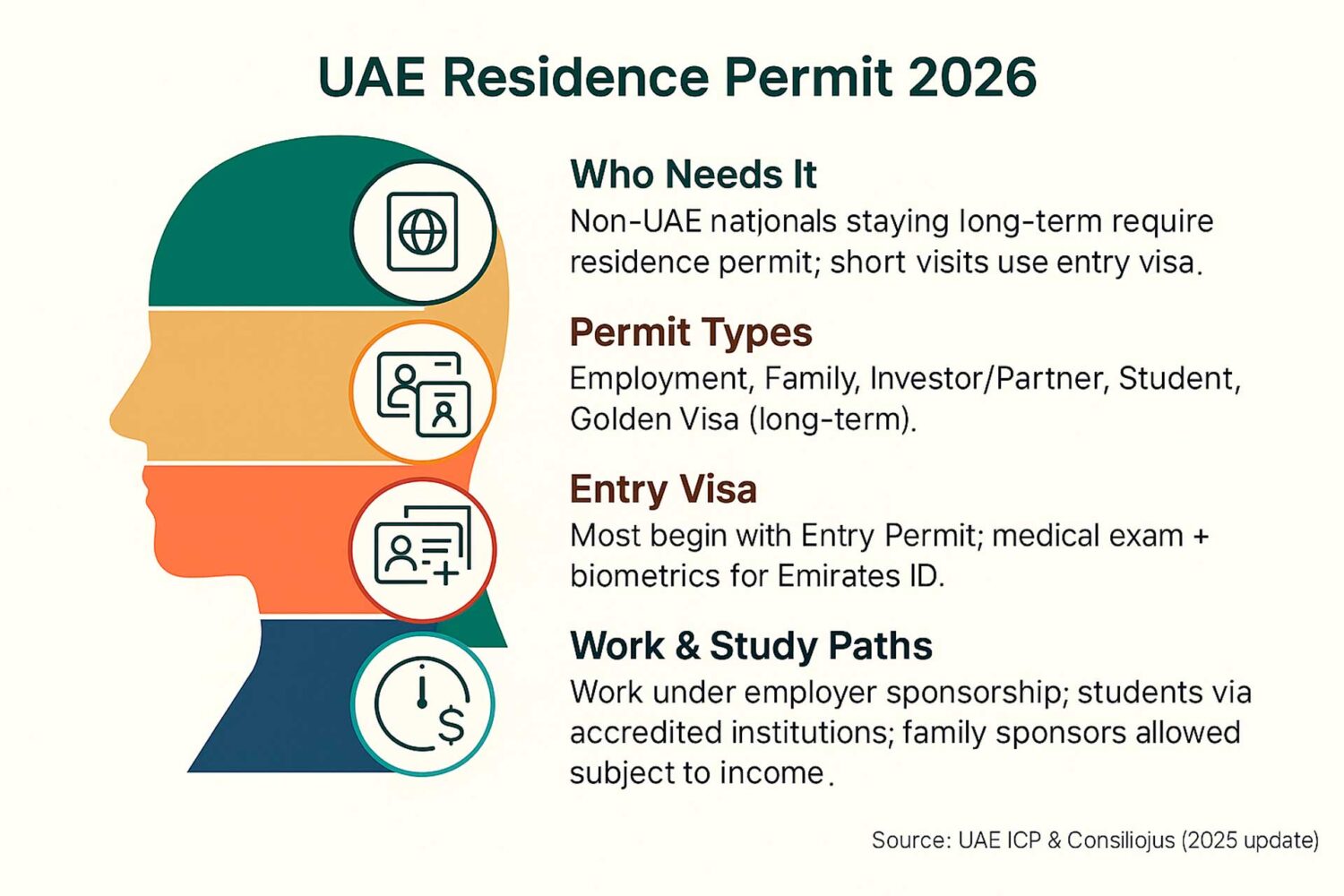
A UAE residence permit (often called a UAE residence visa) is an official authorization that allows a foreign national to live in the United Arab Emirates long-term. It is typically obtained after entering the UAE on an entry permit and fulfilling certain requirements (such as medical tests and ID registration). In practical terms, the residence permit takes the form of a visa stamp in your passport (now often electronic) and an Emirates ID card, which serves as your UAE residence permit card. Possessing a valid residence visa is mandatory for expats who wish to reside, work, or study in the UAE beyond short tourist visits.
What is a residence permit in the UAE? It is essentially your license to legally stay in the country. The permit is typically sponsored by a UAE employer, family member, or by oneself (in cases like investors, property owners, or freelancers under new visa schemes). It grants the holder legal status as a resident, meaning you can rent accommodation, open bank accounts, get a local mobile number, and more. The permit comes with a unique identification number linked to your immigration file. Many newcomers ask what is a residence permit number in the UAE – this usually refers to the Unified ID (UID) or the residency visa number assigned to you. For instance, your UAE visa sticker or e-visa will show a file number and UID number; this is often considered the residence permit number used in official processes. The Emirates ID card also has its own 15-digit number that serves as your identification number in the UAE. In summary, the UAE residence permit is the cornerstone of legal residency, and it comes in various forms and durations depending on the category.
Benefits of a UAE Residence Permit
Holding a UAE residence permit opens the door to a host of benefits and opportunities for expats. Here are some of the key advantages of having a UAE residence visa:
- Live and Work Legally: You can legally reside in the UAE and take up employment or run a business. For example, an employment residence visa allows you to work for your UAE employer, and investor visas let you manage your own business ventures. Without a residence visa, working in the UAE is not permitted.
- Open Bank Accounts and Financial Services: As a resident, you can open a local bank account, apply for credit cards or loans, and access financial services that are not available to tourists. UAE banks typically require a valid Emirates ID (residency ID) to offer full banking facilities.
- Rent Housing and Utilities: UAE residents can rent apartments or villas under long-term contracts and subscribe to utilities (electricity, water, internet). Landlords and service providers will ask for your Emirates ID and proof of residency.
- Access to Education and Healthcare: A residence permit enables you to enroll your children in schools (public or private) and also gives you access to government health services and health insurance options. Many health insurance plans are available only to residents, and having a visa is usually a prerequisite for comprehensive local insurance coverage.
- Apply for a Driving License: Residents are eligible to obtain a UAE driving license. With a residence visa and Emirates ID, you can go through the process of getting a local driver’s license. Tourists generally cannot get a UAE driver’s license (though they may drive on an international license for short visits).
- Sponsor Family Members: One major benefit is the ability to sponsor your family. A holder of a UAE residence visa (meeting certain income conditions) can sponsor their spouse, children, and in some cases parents, for their own dependent residence visas. This means your immediate family can also live in the UAE with you, under your sponsorship.
- Visa-Free Travel to Other Countries: Perhaps one of the most attractive perks is enhanced global mobility. UAE residency can make travel easier to many countries. As of 2025, UAE residents can travel to 80+ countries visa-free or visa-on-arrival, including popular destinations like Mauritius, Seychelles, Malaysia, Thailand, the Maldives, Georgia, Armenia, Serbia, and most of South America. This benefit applies regardless of your original nationality in many cases – the residence permit UAE holders carry often grants easier entry to certain countries that have special agreements with the UAE. (Always check specific requirements, as some destinations may still consider your passport nationality in addition to UAE residency.)
- Tax Benefits: The UAE levies no personal income tax on salaries. By residing in the UAE, many expats enjoy a tax-free income. Additionally, if you stay long enough to be considered a UAE tax resident, you may be eligible for a tax residence certificate for use in other jurisdictions. This can be a significant financial incentive for entrepreneurs and professionals.
- High Quality of Life and Services: Being a UAE resident means you can fully enjoy the country’s high standard of living. You have access to state-of-the-art infrastructure, secure communities, and modern amenities. You can set up utility accounts, buy cars, get resident rates on local attractions, and generally settle into life in a vibrant, multicultural environment.
In short, a UAE residence permit doesn’t just let you live in the Emirates – it grants a lifestyle with security and convenience. From everyday needs like banking and driving to long-term benefits like visa-free travel and family stability, the benefits of a UAE residence permit make it highly sought after by expatriates.
Leave your contacts to have an expert contact you shortly.
Types of UAE Residence Permits (Visa Categories)
The UAE offers many types of residence permits to cater to different purposes and people. The exact type of residence permit in the UAE you can get will depend on your situation – whether you have a job in the UAE, are starting a business, studying, or even retiring. Below are the main categories of UAE residence visas.
Work Visa (Employment Residence Visa)
This is the most common type for people who come to work in the UAE. It requires a work permit and a residence visa sponsored by an employer. Your UAE employer (a company or government entity) arranges the work visa for you as their employee. The process involves approval from the Ministry of Human Resources and Emiratisation (MOHRE) for a work permit, and then the residence visa issuance by immigration authorities. The work visa is typically valid for 1, 2, or 3 years depending on your contract and the regulations for that job.
With a work visa, you can legally work and live in the UAE. (Note: In the UAE, the term “work permit” often refers to the labor approval/document from MOHRE, while “residence visa” refers to the actual visa allowing you to reside in the country. In practice, both go hand-in-hand for employed expats – the work permit allows you to be employed, and the residence visa allows you to stay in the UAE to do that work.)
Family (Dependent) Visa
If you are a UAE resident (for example, on a work visa or investor visa), you can sponsor your immediate family members (spouse, children, and in specific cases, parents) for residence visas. The family residence visa is typically valid for 1 to 3 years and usually mirrors the sponsor’s visa duration. To sponsor family, the resident must meet certain requirements, including a minimum salary (currently at least AED 4,000 per month, or AED 3,000 with employer-provided housing).
Additionally, you must provide proof of relationship (attested marriage or birth certificates) and suitable accommodation. Family visas allow dependents to live, study, and (for spouses or adult children) sometimes work in the UAE (work is allowed if they obtain their own work permit or the family visa is converted to an employment visa). This category makes the UAE attractive for those moving with families.
Investor Residence Visa (Business or Property Investor)
The UAE encourages investment by granting residence visas to investors. There are two main sub-types:
- Property Investor Visa. If you purchase property in the UAE above a certain value, you become eligible for a residence visa. For example, in Dubai an investment in real estate worth at least AED 750,000 can qualify you for a 2-year property investor visa. Larger property investments can even qualify for longer visas or the Golden Visa (see below). The property must be completed (not off-plan) and unencumbered (or with a certain amount paid off in case of a mortgage). Property investor visas are renewable as long as you maintain the investment.
- Business/Company Investor Visa. If you set up a company or invest in an existing business in the UAE, you can get an investor visa (often called a partner visa if you’re a partner in a UAE company). Typically, establishing a company in a UAE free zone or mainland and investing the required capital will allow you to be the visa sponsor for yourself (and potentially your employees). These are usually 2- or 3-year visas, renewable as the business remains operational. For entrepreneurs and startup owners, this is a common route. Some free zones offer packages for investor residence visas as part of business setup.
Golden Visa (5-10 Year Long-Term Residency)
The UAE’s Golden Visa program is a special long-term residence permit for specific categories of investors, entrepreneurs, talented professionals, and outstanding students. It grants 5-year or 10-year residency without the need for a sponsor. For example, investors who purchase property worth AED 2 million or more or invest significantly in businesses may qualify for a 10-year Golden Visa. Likewise, highly skilled professionals in science, technology, medicine, or those with exceptional talents (and meeting salary or award criteria) can qualify.
Golden Visa holders enjoy extra benefits: they can sponsor themselves (no UAE sponsor needed), sponsor family members easily, and stay outside the UAE for any length of time without losing their residency. (By contrast, regular residence visa holders must not stay outside the UAE longer than six months at a time – more on that later.) The Golden Visa has been a game-changer for those looking for stability; for instance, it’s popular among investors and even expatriates who contribute to research or the arts. The cost for a Golden Visa application is higher than a normal visa (around AED 2,800–3,800 in government fees, or about AED 10,000 if including additional fees), but it offers a decade of residency.
Green Visa (5-Year Residency for Self-Sponsored Workers)
The Green Visa is a relatively new 5-year residence visa aimed at skilled professionals, freelancers, and investors who don’t require an employer or sponsor in the UAE. It allows you to self-sponsor. Categories that can get a Green Visa include:
- Skilled Employees who have a valid employment contract in the UAE but wish to sponsor themselves (certain salary and education level requirements apply).
- Freelancers or Self-Employed Individuals in specialized fields, who can show proof of income (e.g. earning a steady income above a threshold, such as AED 15,000 monthly) and a freelance work permit.
- Investors/Partners starting their own small businesses or startups (with a certain capital investment).
The Green Visa is valid for 5 years and can be renewed. It also offers an extended grace period of up to 6 months if it expires (longer than the standard grace period). However, note that Green Visa holders, unlike Golden Visa holders, generally must still adhere to the 6-month outside UAE rule – i.e. they shouldn’t be outside the UAE for more than 180 consecutive days or the visa could become invalid. The Green Visa is great for people with flexible or freelance work arrangements who want a longer-term solution than the usual 2-year visas.
Remote Work Residence Permit (Virtual Working Program)
The UAE introduced a remote work visa (also called the Virtual Working Program) for people employed overseas who wish to live in the UAE while working remotely for a non-UAE company. This is essentially a 1-year residency permit that is self-sponsored. To qualify, applicants must generally show proof of employment outside the UAE with a minimum monthly income (for example, Dubai’s program required around USD $5,000 monthly income; Abu Dhabi’s remote work visa requires at least USD $3,500 monthly income).
They also need valid health insurance and to pass background checks. The remote work residence permit allows you to live in the UAE for one year and even sponsor your family for that duration, without taking up local employment (your income must come from abroad). This visa has been popular among digital nomads and professionals who want to enjoy the UAE lifestyle (safety, infrastructure, climate) while keeping their foreign jobs. It can typically be renewed annually if you continue to meet the criteria.
Student Visa
Foreign students accepted into accredited UAE universities or colleges can get a student residence visa. This is usually sponsored by the educational institution (or sometimes by a parent if the parent is already a resident). A student visa is granted for 1 year at a time, renewable each year upon proof of ongoing enrollment.
Students need to maintain full-time student status. In recent years, outstanding students (with high grades) might qualify for longer-term visas or even Golden Visas under the talent category, but the standard student visa is yearly. After graduation, student visa holders typically have a short window to find a job (or start a business) and convert to another visa type, or otherwise must leave the country.
Retirement Visa
The UAE offers a Retiree Residence Visa for people aged 55 and above who wish to retire in the UAE. It is a 5-year visa (renewable) aimed at retirees who meet certain financial criteria. For example, Dubai’s retiree program has required that the retiree either invest in property worth around AED 1 million, or have at least AED 1 million in savings, or have a monthly income of around AED 15,000 (these criteria can be updated; RAKEZ notes similar requirements: owning property ≥ AED 1M, or savings ≥ AED 1M, or monthly income ~AED 15k-20k).
Retirees must also have valid UAE health insurance. This visa category allows those who spent years working (in the UAE or elsewhere) to enjoy the UAE’s safe and comfortable environment during retirement without needing employment.
Humanitarian Residence Permit
In a recent development, the UAE introduced a one-year renewable humanitarian residence permit for people from countries affected by wars or natural disasters. This humanitarian residence permit in the UAE is a special case visa that can be granted without a UAE sponsor to individuals who cannot return to their home country due to conflict or calamity.
For example, if someone from a war-torn country is in the UAE, they might be allowed to stay on a 1-year humanitarian visa (renewable annually) on humanitarian grounds. This reflects the UAE’s initiative to provide refuge in certain crises. The permit will become invalid if the situation changes or the holder no longer meets the conditions, but while active it lets the person live in the UAE legally for that year. (This is a new category, so if you believe you qualify, it’s best to check the latest rules or consult with ICP/GDRFA officials.)
Other Niche Categories
There are a few other specific visas such as Diplomat visas, Domestic worker visas (for nannies, drivers, etc., sponsored by the household), and special visas for dependents of GCC citizens. However, for most expats, the above categories are the primary routes.
Each type of residence visa has its own eligibility conditions and paperwork. It’s important to choose the category that fits your situation. For instance, an entrepreneur might have options between a normal investor visa or aiming for a Green or Golden Visa if they qualify, whereas a freelancer could choose between getting a freelance permit via a free zone (leading to a 2-year visa) or the 5-year Green visa for freelancers. An experienced immigration lawyer can help determine the best route, but it’s certainly possible to navigate on your own with the abundant information now available.
Requirements and Documents for a UAE Residence Visa
While specific requirements vary by visa type, there are common UAE residence visa requirements you should be prepared for. Generally, to obtain any UAE residence permit, you will need:
- A Valid Passport: Your passport should be valid for at least 6 months beyond the date of applying. A clear copy of the passport is required, and you’ll need to have blank visa pages for the visa stamp (if a physical stamp is used).
- Recent Photographs: Passport-size photos (usually 3×4 cm with a white background) are needed for the visa application and Emirates ID application. It’s good to have a handful of these ready.
- Sponsor Documents: If you have a sponsor (employer or family), you’ll need copies of the sponsor’s passport and UAE residence visa (for family sponsorship), or the company’s license and immigration card (for employment visas). For example, a dependent visa application will include a copy of the sponsor’s passport and residence visa, proof of relationship (attested marriage or birth certificate), and the sponsor’s employment contract or salary certificate.
- Entry Permit: If you are applying from outside the UAE, first an entry permit (entry visa) is issued. This is essentially a temporary visa that lets you enter the UAE to complete the residence visa process. The entry permit is typically arranged by the sponsor through ICP or GDRFA and is often valid for 60 days from issue for you to enter the country. (Some entry permits might be 90 days, but most are 60 days by UAE immigration rules.) If you’re already inside the UAE on a visit visa, an entry permit isn’t issued on paper; instead, you may do an “in-country status change” which converts your status to residence without exiting the country (by paying an additional fee).
- Medical Fitness Certificate: The UAE requires all newcomers on residence visas (and on each renewal) to pass a medical examination at an authorized center. This usually includes a blood test and chest X-ray, screening for communicable diseases such as HIV, tuberculosis, hepatitis, etc. A medical fitness certificate indicating you are free of those diseases is required before the visa can be issued. If someone fails the medical tests, the residence visa is denied (and existing visas can be cancelled for certain conditions). The medical exam is mandatory for adults over 18.
- Police Clearance (Good Conduct, in some cases): In recent years, UAE has on and off required a Police Clearance Certificate from your home country for work visa applicants. This requirement has seen changes, so check the latest rule. It’s intended to ensure the person has no serious criminal record. Not all visa types require it (often waived for family visas, student visas, etc.), but some employment categories might.
- Emirates ID Application: Part of the process is applying for an Emirates ID, which is the resident identity card. A copy of the Emirates ID application receipt is usually needed as part of the visa stamping stage. (The application is typically submitted after you clear medical test, and you do a biometric scanning for the ID.)
- Proof of Accommodation: Some visas, especially family visas, might require proof that you have accommodation in the UAE. This could be a tenancy contract (Ejari) in your name or your sponsor’s name, or a letter from an employer if company-provided housing is given. For sponsoring a spouse or children, you must show you have a place for them to live.
- Financial Documents: Depending on the visa, financial proofs are needed: For work visas, typically the company must meet salary criteria, but the employee doesn’t usually need to show bank statements (the employment contract suffices). For investor visas, you may need to show proof of investment (e.g. property title deed, share certificates, bank deposit for investors). For freelancer or Green visas, proof of income (e.g. bank statements showing the required monthly income) is needed. For retirement visas, documents proving your savings, property value, or pension income are required. For family visas, the sponsor must show proof of salary (an attested salary certificate from the employer or labor contract) meeting the threshold.
- Attested Certificates: If you are applying for a skilled employment visa, you might need to attest your educational degree (e.g. a university diploma) in your home country and the UAE Embassy, and then the UAE’s Ministry of Foreign Affairs. Similarly, marriage certificates and birth certificates used for family visa purposes must be attested by the relevant authorities and translated into Arabic by a certified translator. Attestation is a way to prove the documents are genuine.
- Health Insurance: The UAE now mandates that all residents have health insurance coverage. In some emirates like Dubai and Abu Dhabi, you cannot get a visa without at least a basic health insurance policy in place. So, as part of the visa process, you (or your employer) will need to provide proof of health insurance enrollment for the visa holder. Effective 2025, health insurance is mandatory for all new visas and renewals country-wide. Oftentimes, employers provide this for their employees. For others (like family sponsors or freelancers), you must purchase a policy yourself and show the insurance card or certificate.
- Visa Application Forms and Fees: If applying through a typing center or online, the forms will be filled out in Arabic. You or your sponsor will sign them. Various government fees must be paid (for entry permit, visa stamping, Emirates ID, medical test, etc.). Ensure you keep receipts as needed.
Each visa type might have additional specific documents (for example, a student visa needs an acceptance letter from the university; a remote work visa needs a letter from your foreign employer and salary slips; a humanitarian visa might require proof of situation in home country, etc.). The above list covers the common residence visa requirements in the UAE. It’s always a good idea to double-check the latest checklist provided by UAE immigration (the Federal Authority for Identity, Citizenship, Customs & Port Security (ICP) or the General Directorate of Residency and Foreigners Affairs (GDRFA) for your emirate) to make sure you have everything in order.

How to Get a UAE Residence Permit – Step-by-Step Process
If you’re wondering how to get a residence permit in the UAE, here is a step-by-step overview of the process. This applies generally to most visa types, though the exact steps might vary slightly depending on whether you are inside or outside the UAE and which category you fall under. We’ll assume a scenario where you have a sponsor (like an employer) arranging it; for self-sponsored visas, you would effectively be performing the “sponsor” steps yourself or via an agent.
- Secure a Visa Sponsor or Eligibility for Self-Sponsorship: The first step is to determine under which category you will apply for the residence visa. In most cases, you need a sponsor to apply on your behalf– this could be an employer (for a work visa), your own company or investment (for an investor visa), a university (for a student visa), or a family member (for a family visa). Except for the Green and Golden visas, as well as certain special visas, a UAE residence visa requires a sponsor. If you are going the self-sponsored route (Green visa, Golden visa, remote work visa, etc.), ensure you meet all the eligibility criteria before proceeding. For example, if you plan to self-sponsor under a freelance visa, you might first need to obtain a freelance permit from a UAE free zone or the MOHRE freelance platform, which then allows you to apply for a residence visa as a self-employed person.
- Apply for an Entry Permit: Once eligibility is confirmed, the sponsor will apply for an entry permit (also known as an entry visa or residence entry permit UAE) for the applicant. This application is typically done online via the ICP e-channel or GDRFA system, or through an authorized typing office. The entry permit is basically preliminary approval for you to enter the UAE for the purpose of completing residence visa formalities. If you are outside the UAE, you must wait for this entry permit to be issued. It usually comes in the form of an electronic PDF that your sponsor will email to you. The entry permit for residence is valid for 60 days from its issue date for a single entry. This means you must use it to enter the UAE within that time window. (If you are already inside the UAE on a tourist or visit visa, many categories allow you to skip this step by doing an “in-country status change” – essentially converting your visit visa to a residence visa without leaving. The sponsor still applies for the permit, but you don’t physically get a new visa stamped at the airport; instead you pay a fee to change status internally.)
- Enter the UAE on the Entry Permit: If you were abroad, once you have the entry permit, you can travel to the UAE. At passport control, you will present the entry permit printout; the immigration officer will stamp your passport with an entry stamp. Now you are in the country with the intention to finalize the residence visa. From the date of entry, you typically have up to 60 days (the same validity period of the entry permit) to complete all residence visa formalities. Don’t delay too long, as the entry permit can expire – if it does before you finish the process, you might have to start over or extend it. (Most people complete the steps within 2-4 weeks.)
- Undergo Medical Fitness Test: After arriving, one of the first tasks is to go for the required medical examination. Your sponsor (or PRO – Public Relations Officer – if it’s through a company) will give you details of approved government health centers to conduct this test. At the medical center, you will show your passport and entry permit, pay the fee, and they will do the necessary tests (blood test, X-ray). Within a few days, the medical fitness certificate will be issued (now often it’s electronic). You cannot get your visa without passing this test. If any issues arise (e.g., further testing needed), handle those promptly. If you are applying for a family visa for a spouse, note that the UAE may also require the spouse to undergo an HIV test – a positive result could lead to denial of the visa. Generally, children under 18 are exempt from medical tests. Once you have a “fit” medical certificate, you can proceed to the next steps.
- Apply for Emirates ID (Biometrics Enrollment): In parallel with or right after the medical test, you (or your typing center) will submit an Emirates ID application for you. The Emirates ID is the identification card all residents must have. You will need to visit an ICP service center or authorized fingerprinting center to give your biometrics – this includes fingerprints and a photograph. An application form (with your personal details and UAE address) is filled and the fee paid (fee varies by visa duration, e.g., about AED 370 for a 2-year ID). You’ll receive a registration receipt. The actual Emirates ID card will be printed after your visa is stamped, but applying and doing biometrics at this stage is required. This ID is what will later show your residence permit number (UAE ID number) which you’ll use in many official processes.
- Visa Stamping (Residence Permit Issuance): With your medical test passed and Emirates ID application in process, the sponsor can now formally apply for the residence visa stamping. This means the UAE immigration authorities (GDRFA for the emirate you’re in) grant you the residence permit and either stamp it in your passport or issue it electronically. Nowadays, UAE has started issuing electronic residence visas without a physical passport sticker (the Emirates ID card is considered proof of your residency). In some cases, you might still get a physical visa sticker in your passport (policies on this have been evolving). Either way, the application involves submitting all documents (passport, entry permit, medical certificate, insurance proof, etc.) to GDRFA/ICP and paying the visa fee. The fee can vary by duration; for example, a 2-year residence visa might have a government fee in the range of AED 1,000–1,500, not counting earlier steps. If everything is in order, approval is usually quick – often just a few days. Once approved, your status in the system changes to resident and you get your residence visa (permit).
Timeline: The overall processing time for a UAE residence visa is quite fast. In many cases, from the time of entry and medical test, it can take as little as 1 to 2 weeks to get everything done and the visa issued. In straightforward cases, approval can even come in 2–10 working days after completing the medical and ID steps. - Collect Emirates ID and Visa Documents: After approval, if a physical visa sticker was placed, you’d have your passport back with the visa stamp. More commonly now, you’ll receive an electronic residence permit document or you can download a copy of your e-visa via the ICA smart services. Soon after, your Emirates ID card will be printed. You might get an SMS when your Emirates ID is ready. Typically, IDs are collected from an Emirates Post office location you chose during the application, or delivered to your address if you opted for courier. The Emirates ID card will show your name, birth date, nationality, and a unique 15-digit number, along with the card’s validity dates. This Emirates ID is now your primary proof of residency – UAE no longer requires residents to carry a visa sticker in the passport, as all info is embedded in the ID’s chip. Make sure to pick up your ID card and sign the back. Keep it with you at all times, as it’s often required to be shown for identification.
That’s the general UAE residence visa process step-by-step. To recap in a simplified list:
- Sponsor and Entry Permit: Find a sponsor and have them apply for your entry permit.
- Enter UAE / Status Change: Use the entry permit to enter UAE (or change status if already inside).
- Medical Test: Complete the health screening and receive fitness certificate.
- Emirates ID Application: Submit ID application and give biometric data.
- Visa Stamping: Submit all documents to immigration for visa approval; pay fees.
- Receive Visa & ID: Get the electronic visa (or passport stamp) and collect your Emirates ID card.
Throughout this process, ensure your passport is kept with at least 6 months validity, and do not exit the UAE until the visa is fully issued (exiting mid-process might void the entry permit and complicate things). Once these steps are done, congratulations – you are officially a UAE resident!
If you entered on a tourist visa and want to convert it to a residence visa without exiting, that is possible by paying an in-country conversion fee (status adjustment). Many people colloquially ask about “tourist visa to residence permit UAE” – yes, you can do it. Just start the process with a sponsor while you’re on the visit visa; once the entry permit is approved, pay the additional fee for “Change Status” so you don’t have to exit. It’s a common practice and avoids the hassle of leaving the country during the process.
Emirates ID – The UAE Residence Permit Card
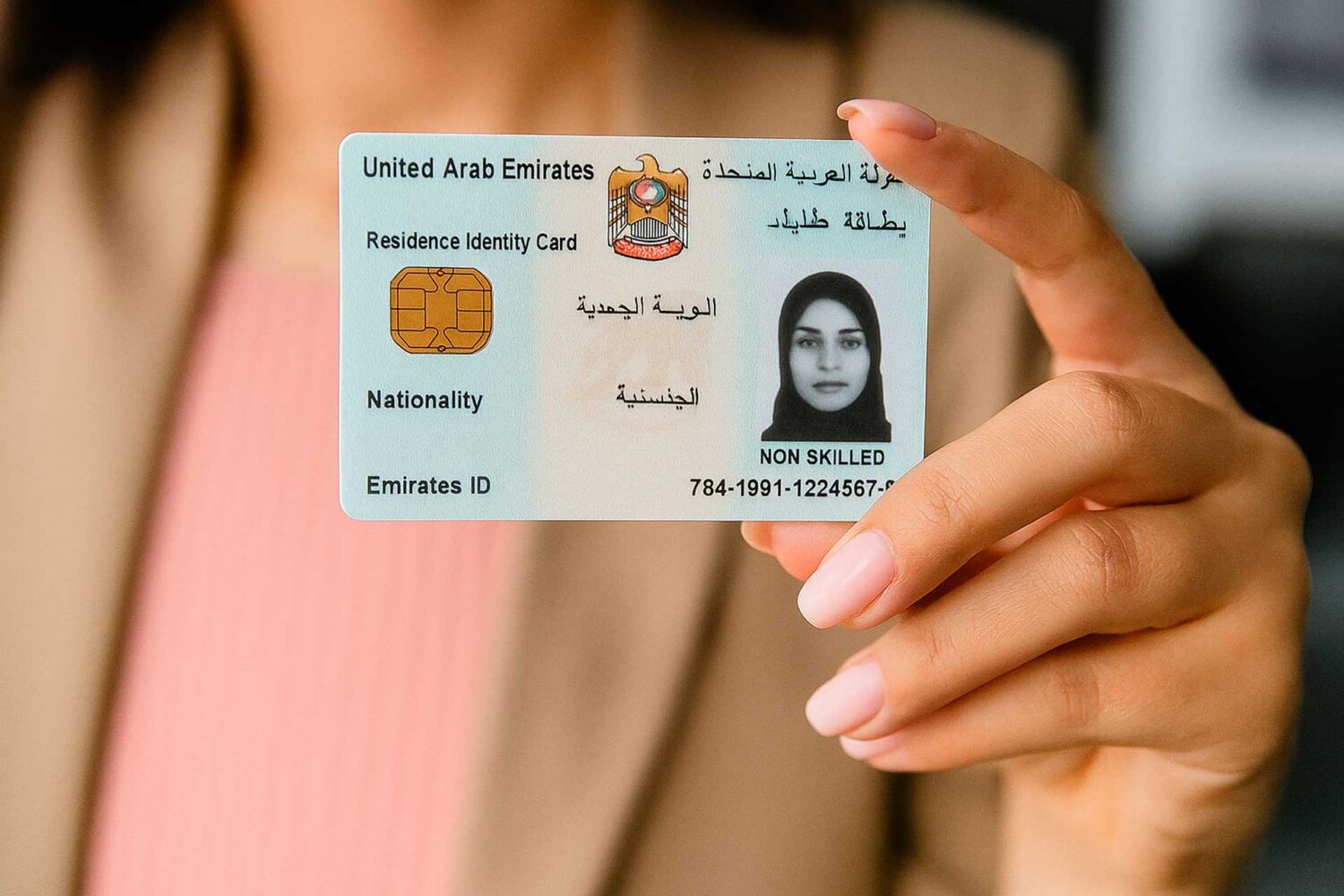
The Emirates ID is an identity card issued to all UAE residents (and citizens). It is often considered your residence permit card because it contains all key information about your residency status. The Emirates ID is the size of a credit card and features your photo, name, birth date, nationality, and a unique Emirates ID number (15 digits). It also has a chip that stores data like your biometric info. Effective April 2022, the Emirates ID replaces the residency visa sticker in passports as the primary proof of residency. So, when you have an Emirates ID, you essentially have evidence of your UAE residence permit.
What is the Emirates ID used for? Pretty much everything! You will use it to identify yourself for government and private transactions – for example, opening bank accounts, entering secure buildings, verifying your identity for a SIM card, passing through e-gates at airports, etc. Police and officials can ask for it at any time as proof of identity. It’s linked to your residency, so it shows validity dates that match your visa’s validity. Always carry it with you; losing it requires reporting and paying a replacement fee.
Many people also wonder about the numbers on the Emirates ID and visa documents – what is the residence permit number in UAE? On your visa (whether a sticker or electronic), there will be a “File Number” or “Residence Number”, and a Unified Identification Number (UID). The UID number is a unique number assigned to you the first time you enter the UAE; it stays the same across any visas you hold. The residence visa number (also sometimes called the residence permit number) is often the last part of the file number on your visa stamp. Meanwhile, the Emirates ID number is another unique 15-digit number on the card, which is used for identity verification in services. To clarify:
- UID (Unified Number): A permanent reference number for your immigration records (printed on visa and used in ICA systems).
- Residence Visa Number: Tied to a specific visa issuance – it may change each time you get a new visa. Often found on the visa label or e-visa document.
- Emirates ID Number: The number on your ID card, used for day-to-day identification in the UAE.
For example, when checking the status of your application on ICA’s website, you might input your Emirates ID number or your UID. Business Link UAE (a consultancy) explains that on the ICA application status page, you can find your UID (residence permit number) once you enter your details. In practical terms, when someone asks for your “residence permit number UAE”, they usually mean the UID or Emirates ID number, since those identify you as a resident in official systems.
Key features of Emirates ID:
- It’s issued for the same duration as your visa. So if you have a 3-year visa, your ID card will typically have a 3-year validity. You must renew the ID when you renew your visa.
- The first three digits of the Emirates ID number are “784” (the UAE country code), followed by your birth year, and other random digits plus a check digit.
- The card has advanced security features and biometrics; it’s very hard to forge.
- You should update your Emirates ID info if you change any personal details (like your name after marriage, or your phone number/address – phone updates can be done online easily).
One important change is that now Emirates ID alone is proof of your residence – you no longer need a passport stamp. As noted by UAE authorities, “the Emirates ID will now serve as the primary proof of UAE residency… passports will no longer be adorned with visa stickers”. If you need to show proof of your visa (for example, to a foreign embassy when applying for another country’s visa), you can use the Emirates ID and also print out your visa details online via the ICA smart services. The ICA or GDRFA system allows you to retrieve your visa information by entering your passport number and other details, which is useful for reference.
In summary, Emirates ID = your residence permit card. Guard it carefully. If lost, report and replace it quickly (you’ll need to show a police report to get a new one). When your visa is cancelled or expires and not renewed, you must surrender the Emirates ID to authorities (usually during the cancellation process the PRO will take it). It’s illegal to continue using an ID associated with an expired visa. Think of the Emirates ID as your all-access key to UAE life – from entering your office building, to passing immigration e-gates, to renting a car – it’s involved everywhere.
Validity and Renewal of UAE Residence Visas
How long is a UAE residence visa valid? The validity of a UAE residence permit depends on the type of visa and the sponsor. Most traditional residence visas (employment visas, family visas, etc. that are sponsored visas) are issued for 1, 2, or 3 years. The duration often depends on the sponsor’s category and the emirate:
- In Dubai and many emirates, standard work visas are 2 years for private sector employees. Government jobs can give 3-year visas. Family visas used to match that (2 or 3 years depending on sponsor’s visa).
- Recently, there are also 1-year visas (commonly for certain cases like domestic workers, orshort-term work assignments, or student visas which are 1 year renewable).
Meanwhile, the newer unsponsored visas (long-term visas) have longer validity:
- Green Visa: 5 years.
- Golden Visa: 10 years (or 5 in some categories).
- Retirement Visa: 5 years.
- Remote Work Visa: 1 year.
- Humanitarian Visa: 1 year.
To summarize, “It can be for 1, 2 or 3 years on a sponsored visa, or up to 5 or 10 years on an unsponsored visa – Golden and Green visas.”
These were the general provisions updated by the UAE government. Always check your visa sticker or e-visa document; it will clearly state the expiry date.
Residence visa entry permit validity: As mentioned earlier, the initial entry permit is usually valid 60 days for entry. After entering and converting to the residence visa, that entry permit is “used up”, and now the residence visa validity takes over.
Renewal: A UAE residence visa can be renewed upon expiry. UAE residence permit renewal essentially repeats parts of the original process: you’ll need a new medical test, an updated Emirates ID application, and submission of renewal to the authorities. You must also have a valid passport (with at least 6 months validity remaining). Typically, your sponsor will handle the renewal application (except in self-sponsored cases, you do it yourself). It’s wise to start the renewal process before your current visa expires – you are allowed to renew as early as 30 days before expiry in most cases, and even up to 6 months early for some long-term visas if special permission is given.
When your visa expires, there is usually a grace period during which you can stay in the UAE legally without incurring fines. In the past, this grace period was 30 days for everyone. However, recent rules have introduced flexible grace periods ranging from 30 up to 180 days depending on visa type. For instance, Golden Visa holders and some others may have up to 6 months grace to stay after expiry or cancellation, whereas a typical work visa might now have 60 or 90 days grace under new regulations (authorities announced in 2022 a 60- to 180-day grace for various categories). To be safe, check the latest grace period applicable to your visa. If unsure, assume 30 days unless informed otherwise. Overstaying beyond the grace period leads to fines (which are AED 50 per day for overstaying on a residence visa, as of the latest update in 2025).
Visa cancellation vs. expiry: If you quit your job and your employer cancels your visa (or if you cancel your investor visa, etc.), from the cancellation date you also get a grace period (similar to expiry). So it’s either after expiry or after early cancellation, you still have some time to exit or change status. If you find a new job or reason to stay, you can transfer/extend your visa during the grace period without fines.
Staying outside the UAE rule: A very crucial residence visa expiry rule to remember is the “6 month rule”: If a UAE resident stays outside the UAE for more than 6 consecutive months, their residence visa becomes invalid automatically. This means if you leave the UAE and don’t come back within 180 days, your visa is essentially canceled (even though the printed expiry date might be later). There are some exceptions:
- Golden Visa holders are exempt from this rule – they can stay abroad for extended periods and not lose their residency.
- Certain people with special permissions (e.g., those on government study scholarships abroad, or medical treatment abroad with permission) can exceed 6 months with prior approval.
- During the height of COVID-19, temporary exceptions were made, but those are no longer in general effect.
For most normal visa holders, be mindful of this. If you must be away >6 months, there is a new procedure to apply for a re-entry permit (essentially permission to re-enter after 6 months away), which you have to apply for while outside before coming back, and you need a valid reason. But it’s easier to just not exceed the 6-month limit if possible, to avoid the hassle. If your visa is voided due to 6 months outside, you would need a new visa process all over again to return.
Renewal process: When renewing, you’ll repeat medical test and ID renewal. If your visa was sponsored by an employer and you’re still with them, they will do the paperwork. If it’s a family visa, you as the sponsor must handle renewing your dependents’ visas. Fees for renewal are similar to first time. Importantly, at renewal, you must clear any fines (like overstay fines if you missed grace period, or any unpaid traffic or other fines linked to your ID sometimes need clearing). Also, health insurance must be renewed (if your insurance policy lapsed, you’ll need a current one, as it’s mandatory for renewal).
After renewal, you get a new visa expiration date a year or years ahead, and your Emirates ID card will be updated (in fact, you get a new ID card issued each time with the new expiry). Keep the old ID until they ask for it or until the new one arrives.
In summary: A UAE residence permit’s validity can range from 1 year up to 10 years. Always note your expiry date and renew on time. UAE authorities have made renewals more streamlined (for example, in some cases widows or divorcees who were on family sponsorship have simplified procedures to renew their visa temporarily in their own name). Plan ahead so your life in the UAE isn’t interrupted by an expiring visa.
The UAE’s residency system has become quite flexible and welcoming, reflecting the country’s goal of attracting talent and investment. Whether you come as a professional employee, an entrepreneur, a student, or a retiree, there is likely a UAE residence permit suited to you. With proper guidance and preparation, obtaining it is straightforward – and as we’ve seen, the rewards (from career opportunities to global mobility) are well worth it.
Cost of a UAE Residence Visa (Government Fees and Expenses)
One important consideration is the UAE residence permit cost. The total residence visa UAE price depends on the type of visa, its duration, and the emirate in which it’s issued. Costs are divided into several components: government fees (for entry permit, visa issuance, Emirates ID, medical), plus any typing or service fees, and additional expenses like insurance or document attestation.
To give an idea, here’s a breakdown of typical costs (in UAE Dirhams, AED):
- Entry Permit issuance fee: ~ AED 500 – AED 1,000 (this can vary; sometimes around AED 500 for 2-month entry permit).
- Visa stamping fee: ~ AED 500 – AED 600 for the actual stamping/issuance in passport.
- Medical Exam: AED 300 – AED 500 (depending on normal or fast-track service).
- Emirates ID fee: AED 170 for 1-year, ~AED 270 for 2-year, ~AED 370 for 3-year (roughly AED 100-120 per year of validity).
- Insurance: If not provided by employer, basic health insurance might cost anywhere from AED 600 – AED 1,200 per year per person for minimal plans (premium plans cost more).
- Typing center/service fees: AED 100–200 typically for processing your forms.
For a standard 2-year work visa in 2025, an estimate including all fees (medical, ID, etc.) might be around AED 3,000 to AED 7,000. This range can be on the higher side if including premium medical or urgent processing. If an employer sponsors you, the employer usually bears these costs (and might deduct some from your salary depending on company policy, but legally many of these should be employer-paid for work visas).
For those who are self-sponsoring (like setting up a company or getting a freelance visa), you will bear the costs. Investor visas obtained through company setup will include license fees, etc., so initial costs can be higher (though there are packages that start around AED 13,000+ for company + visa in some free zones). However, focusing just on visa fees:
- Cheapest residence visa in UAE: Some categories of visas are relatively low cost. For instance, some free zones offer a freelance visa or investor visa package with total visa costs around AED 3,500–4,500. Shuraa, a business consultancy, notes that “the cheapest residence visa in UAE usually starts around AED 3,990” for options like a freelance permit visa. These typically cover an entry permit valid 90 days and then the residency, but may exclude additional costs like medical and Emirates ID.
- Two-year vs Three-year visas: Interestingly, a 2-year visa in Dubai might cost about AED 3,500 in government fees (without insurance), and up to AED 5,000-6,000 with insurance. A 3-year visa could be around AED 3,700 without insurance, up to ~AED 5,400 with insurance. So per year, the cost goes down slightly for longer visas.
- Family visa costs: The family residence visa UAE cost per dependent is similar to a work visa in fees, except there’s no labor charge. You’ll pay entry permit ~AED 500, visa fee ~AED 700-1,000, medical ~AED 300 (for adults), ID ~AED 270 (for 2-year) or ~AED 370 (3-year), insurance as required. So sponsoring a child’s residence visa might cost on the order of AED 1,000 to 2,000 if you choose a 2- or 3-year visa and basic insurance (children often cheaper to insure). Some rough figures: one source indicated around AED 2,200 in fees for a 2-year family visa for a child (excluding insurance). Also, note that currently children under 18 are exempt from UAE visa fees for visit visas when traveling with parents, but for residence visas, they do pay the fees (though their medical test is not required if under 18, saving a bit).
- Golden Visa cost: Golden Visas have application fees and issuance fees that are higher than normal. The 10-year Golden Visa can cost roughly AED 2,800 to AED 4,000 in government fees (not including the cost of whatever investment you must make). Some reports put the total around AED 10,000 when including additional “exceptional” processing fees or medical etc. For instance, one source cites 10,400 AED total including all fees for Golden Visa. But considering the length, that’s not too bad spread over 10 years.
- Green Visa cost: The government fees for a 5-year Green Visa might be somewhat between a normal visa and a Golden visa. While exact figures aren’t given here, expect perhaps ~AED 3,000 or more in fees (since a 5-year ID card itself would cost ~AED 700). However, elimination of needing a sponsor could save you other costs in the long run (like no need for a company license if you qualify via salary and freelance permit from MOHRE which costs maybe AED 7,500 for 5 years).
- Other costs: Don’t forget document attestation fees if needed (attesting a degree or marriage certificate can add a few hundred dirhams per document including embassy fees). If you use a PRO service or agency, their service charges will also add to the cost but can be worth it if they handle everything smoothly.
In a practical example, if someone asks “how much is a UAE residence visa for 2 years?”, a safe answer might be: around AED 3,000 to AED 5,000 in total government and related fees for one person, assuming standard processing and excluding any large consultancy fees. If doing it completely on your own, you could be at the lower end; if through a service or in an expensive free zone, you might hit the higher end. The residence visa UAE price is a combination of many small fees that add up.
For budget-conscious expats, some emirates have slightly lower fees or offers:
- Some Northern Emirates (like Ras Al Khaimah or Ajman) might have marginally lower municipality fees for visas, etc. But the difference is not huge.
- If you’re looking for the cheapest way, many find that getting a freelance visa or a sponsor through a small business setup can be cost-effective, since you can essentially sponsor yourself for under AED 4k in fees plus the cost of a freelance permit. For example, a 1-year freelance visa could be around AED 3,000 (some free zones offer one-year visas that you renew annually).
- Family visas for wife/children sponsored by an employed resident are usually cheaper than the primary sponsor’s own visa because the employer often already covered the sponsor’s cost. You’ll just pay the dependent fees which as noted can be around AED 1k+ each per year of visa.
Finally, note that rules can change – the UAE has periodically revised visa fees. There are also overstay fines if you delay renewal (AED 50 per day). And if you ever need to cancel a visa (like when leaving the country), there are small fees for that too (a visa cancellation via a typing center might cost around AED 100-200 in total).
In summary, while getting a UAE residence permit isn’t free, it’s often quite reasonable considering the benefits. Most expats find the costs manageable, especially if employed (since employers typically bear most of it). If self-funding, plan a few thousand dirhams in your budget for the process. Always check with the relevant immigration authority for the latest fee schedule or consult an immigration expert for a detailed quote in your scenario.
Visa-Free Travel Privileges for UAE Residence Visa Holders
One of the frequently asked questions is about visa-free countries for UAE residents – that is, which countries UAE residence permit holders can visit without needing a visa in advance. The UAE passport itself is very powerful, but even if you’re not a UAE citizen, holding a UAE residence visa can significantly ease travel to many destinations around the world. This is a valuable benefit of a UAE residence permit, especially for expats whose original passports might not be very strong for travel.
As of 2025, UAE residents enjoy visa-free or visa-on-arrival access to a large list of countries – over 80 countries by some counts. This is because many nations offer special entry privileges if you have a valid UAE residence visa (often with the condition that your UAE visa is valid for at least 6 months). This effectively boosts your travel freedom beyond what your passport alone would allow.
For simplicity, here’s a quick list of visa-free travel countries with UAE residence permit (assuming at least 6 months validity on your UAE visa), irrespective of nationality of passport (though always double-check if any additional requirements apply):
- Middle East/Gulf: Oman (for certain nationals), Qatar (often visa-on-arrival for expats from many countries if resident in GCC), Bahrain (VOA for many UAE residents), Saudi Arabia (recently opened up tourism, but not an automatic benefit – they have an e-visa system; however, if you have a UK, US, or Schengen visa or a USA green card or EU residence, you can get Saudi e-visa – that’s separate from UAE residency).
- Asia: Armenia, Azerbaijan, Georgia, Thailand, Malaysia, Singapore, Indonesia, Sri Lanka (requires an online ETA, but easy for UAE residents), Maldives, Nepal (was visa on arrival for everyone anyway), Hong Kong (UAE residents who are Indian passport holders can enter Hong Kong visa-free for 14 days, for example).
- Africa: Seychelles, Mauritius, Kenya (VOA), Tanzania (VOA), Egypt (provides visa on arrival to certain nationalities if they have UAE residency, e.g., Indians), Morocco (if your nationality requires visa, UAE residency might not bypass it for Morocco, except possibly for some).
- Europe: Albania, Serbia, Montenegro, Bosnia & Herzegovina (some of these are time-limited and change with seasons or bilateral agreements), Cyprus (not usually, unless you have Schengen), and if you hold a valid multiple-entry Schengen visa or certain other visas in your passport along with UAE residency, you can leverage those for some other countries. But pure UAE residency doesn’t automatically grant Schengen access.
- Americas: Many Central American and Caribbean nations are open with visas on arrival or e-visas if you have US/EU/UK visas, but a few also mention UAE residency. For example, Barbados and Mexico have eased entry for those with GCC residency (Mexico allows those with valid UK/US/Schengen/Japan visas or permanent residents of certain places – not sure if UAE counts, likely not since it’s not listed; better example: Dominican Republic has a cheaper visa fee for UAE residents).
Always check the latest entry requirements of the country you plan to visit, because policies change. An updated resource or the consulate of the country can confirm if “UAE residence permit visa free countries list” is applicable to you. As a rule of thumb, having a UAE visa significantly improves your chances of visa-on-arrival in dozens of countries because it indicates you are a legal resident in a stable country and likely have financial means (since UAE has income requirements for its visas). This is seen as a positive by other nations.
To travel, you will of course carry your Emirates ID and passport. Some immigration officers abroad may ask to see your UAE Residence Visa (the sticker or e-visa printout) to verify it, so keep a copy. And note, visa-free doesn’t mean unlimited stay – each country will have its own allowable stay (often 30 days or 90 days). For instance, Kazakhstan doubled its visa-free stay for UAE residents from 15 to 30 days recently, and places like Dominica give a generous 21 days to 6 months depending on agreements.
In summary, UAE residency enhances your global mobility. Whether for a spontaneous holiday to Baku or a business trip to Singapore, your UAE residence visa is a valuable asset. This is an often under-appreciated perk of being a UAE resident – you can literally plan vacations on short notice to many countries without the hurdle of embassy visa applications, thanks to the visa-free travel for UAE residents.
Obtaining a UAE residence permit can be one of the best decisions for an expatriate seeking opportunities in a dynamic country. The process is streamlined and, as we’ve discussed, offers routes for everyone from professionals and students to retirees and investors. As an experienced immigration lawyer would advise, make sure to keep your documents in order, adhere to the rules (like renewal timelines and travel restrictions), and take full advantage of the benefits that come with your UAE residency – be it launching a career, securing your family’s future, or trotting the globe more freely.
Leave a Comment

We have prepared answers to the most common questions about UAE residence permit. If you want to clarify anything, please contact us - we will provide detailed explanations.
It’s relatively quick. Once your entry permit is issued and you arrive in the UAE, the remaining process (medical test, ID, stamping) generally takes a few days to a couple of weeks. In many cases, people get their full residence visa approved within 2 to 10 working days after completing the medical exam.
A work permit (labor permit) is permission from the labor authorities for a company to employ you; a residence visa is permission from immigration for you to live in the UAE. In the employment context, you need both – the work permit allows you to legally work, and on its basis, the residence visa is granted. The work permit process is handled by MOHRE, and the residence visa by ICP/GDRFA. It’s good to know the work permit is what ties you to your employer, whereas the residence visa is what lets you reside and do things like rent a home, get an Emirates ID, etc.
Yes. If you are a UAE resident (with a valid work, investor, or other visa) and earn above the minimum salary requirement (around AED 4,000 or AED 3,000 + housing), you can sponsor your spouse and children. You’ll need marriage and birth certificates (attested) and to pay separate visa fees for each family member. Their visas will be dependent on yours (if your visa is canceled, theirs will need renewal or will also be canceled). You can also sponsor parents under certain conditions (higher salary, deposit, etc.). Family visas are usually issued for 1-3 years and can be renewed.
If you don’t renew in time, you have a grace period (between 30 to 180 days, depending on visa type) during which you can stay without fines. After that, fines accumulate at AED 50 per day. It’s important to renew or cancel and exit within the grace to avoid penalties. If you know you’re not renewing (leaving the UAE), it’s best to formally cancel the visa and Emirates ID, then exit – this stops fines and is required if you plan to return on another visa later.
The Emirates ID is the identification card that proves you are a resident, containing your residence permit details electronically. The residence visa is the status granted in your passport or electronically by immigration. You need the Emirates ID to prove your residency in daily life. They are closely linked; one could say the Emirates ID card has effectively become the de facto residence permit since 2022.
You can use the ICP online portal or GDRFA Dubai website to check your visa status. By entering your passport number or Emirates ID number, you can see if your visa is active, and its expiry date. There are also smartphone apps (UAE ICP app, DubaiNow) where after creating an account, you can see your visa and Emirates ID info easily. This is handy to keep track of renewal dates.
Yes, there are options: investor visas, remote work visa, Green Visa, Golden Visa, student visa, etc. These allow you to live in UAE without a company sponsoring you in the traditional sense. You will need to meet the criteria of those visas (like investing in property, starting a business, being a freelancer with income, or studying at a university) and essentially sponsor yourself. For example, the Green Visa and Golden Visa let you sponsor yourself and even your family. The one-year remote work visa also is self-sponsored. So yes, you can absolutely live in the UAE without an employer, given you use one of these pathways.
No. Working on a tourist visa is illegal in the UAE. To work legally, you must hold: A valid work permit, and A corresponding UAE residence visa. Violating this rule can result in fines, deportation, and bans from future entry.
Generally, you cannot sponsor a sister for a UAE residence visa under normal family sponsorship rules. Exceptions may apply in rare cases (for example, humanitarian reasons or if you are the legal guardian), but approval is discretionary and not guaranteed. Most family visas are limited to spouses, children, and sometimes parents.
If you have a physical visa sticker, the residence permit number is typically printed near the visa file number on the visa page. For electronic visas, it appears on the official visa PDF issued by immigration. If you have an Emirates ID, your UID or Emirates ID number can also be used to retrieve your residence visa details online.


Comments
No comments found.