

 EU Citizenship
 Slovenian Citizenship
 Romanian Citizenship
 Bulgarian Citizenship
 Austrian citizenship (investments)
 Spanish Citizenship
 Italian Citizenship
 Cypriot Citizenship
 Lithuanian Citizenship
 Portuguese Citizenship
 French Citizenship
 German Citizenship
 Hungarian Citizenship
 Dutch Citizenship
 Belgian Citizenship
 Croatian citizenship


French Residence Permit – Requirements, Types, and Application Process in 2026

Author: Leon Scott
Published: 15.12.2025
Updated: 16.01.2026
A French residence permit (in French, titre de séjour or carte de séjour) is an official card that allows non-EU/EEA citizens to live in France legally for an extended period. It is a biometric ID card containing your photo, personal details, and a unique permit number used for identification in France. It is not the same as a visa – typically, you first obtain a long-stay visa to enter France, and then apply for a residence permit if you plan to stay longer than 90 days. EU/EEA and Swiss citizens usually do not need a French residence permit to live in France (they have freedom of movement), but after Brexit, UK nationals are treated as non-EU citizens and must get a residence permit if staying more than 90 days in France.
Moving to France long-term is one of the most exciting life decisions a person can make — but before you can live, work, study, or build a life here, you must understand what a French residence permit is, who needs it, how to get it, and how to renew it. This guide answers the questions people search for most: how to get French residence permit, French residence permit requirements, French residence permit application process, French residence permit renewal, and more.
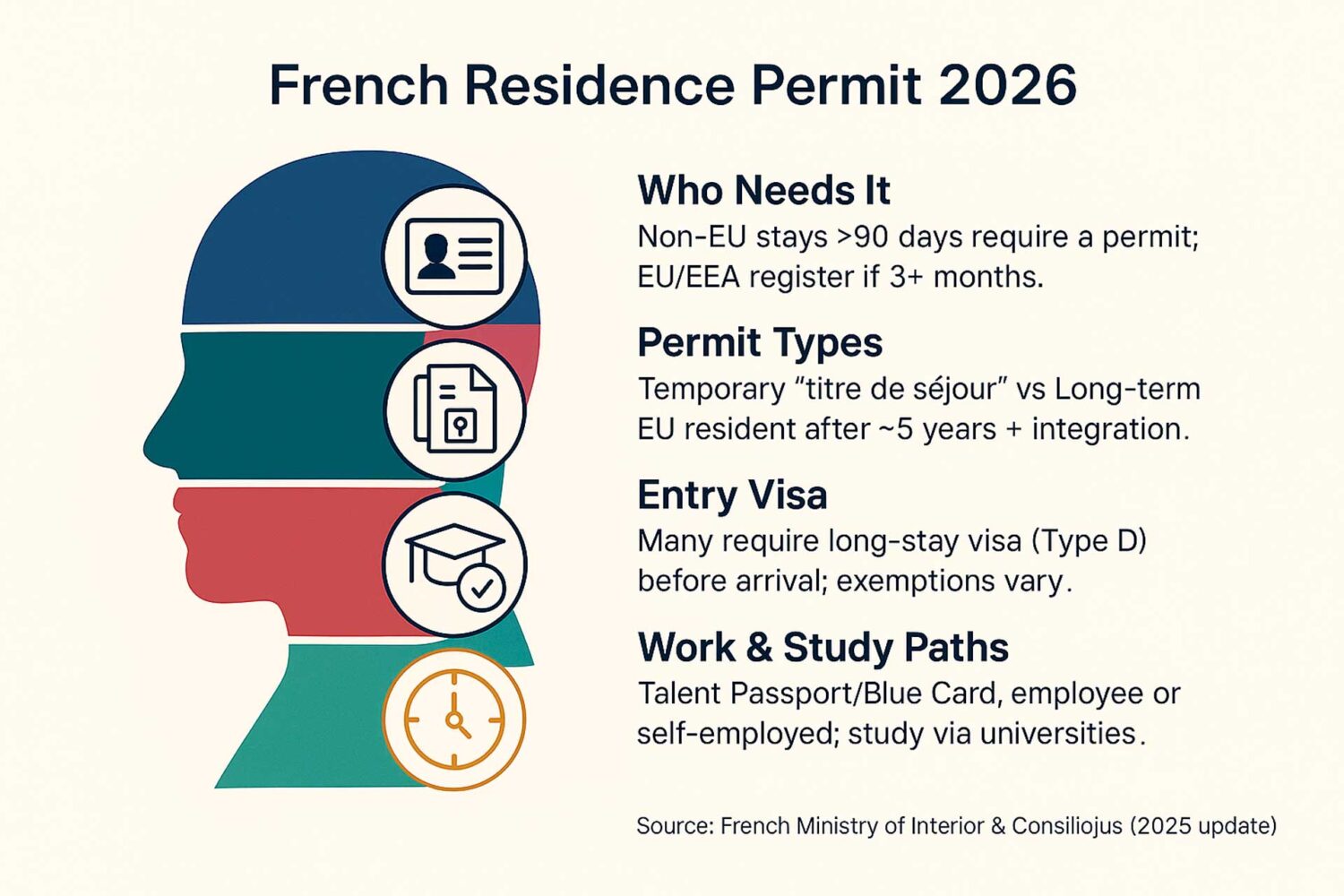
Types of French Residence Permits
France offers several types of residence permits depending on the purpose and length of your stay. Most permits are either temporary (short-term) or long-term:
- Long-Stay Visa (VLS-TS) – Visa de Long Séjour. This is the first step for non-EU citizens. If you plan to stay in France for over 90 days, you must apply for a long-stay visa before traveling. The VLS-TS (Visa Long Séjour – valant titre de séjour) is a visa that doubles as a temporary residence permit for up to one year. You must validate the VLS-TS online within 3 months of arrival to activate your residency status. After the first year, you would apply for a physical residence permit card.
- Temporary Residence Permit (Carte de Séjour Temporaire). After your VLS-TS expires, you can obtain a one-year residence permit (renewable). This card allows you to reside in France for 12 months at a time, and can usually be renewed up to 3 times (covering your first ~3-4 years in France). Temporary permits are often issued for purposes like work, study, family visits, or private life. For example, a spouse of a French citizen or someone on a work contract might receive a one-year carte de séjour labeled with the relevant category (e.g. “vie privée et familiale” for family, “salarié” for employees).
- Multi-Year Residence Permit (Carte de Séjour Pluriannuelle). In many cases, France can issue a multi-year residence permit after you have completed one year of legal stay. These permits are valid for 2 to 4 years at a time. To qualify, you must continue to meet the conditions of your original visa (for instance, still be enrolled as a student or still have your job). Common multi-year permits include the student residence card (often covering the remaining duration of your study program) and the Passeport Talent (Talent Passport) for qualified workers, investors, or researchers (valid up to 4 years). Multi-year cards reduce paperwork by avoiding annual renewals.
- Special Work Permits & Talent Passport. France encourages skilled professionals and investors through the Talent Passport program. The Passeport Talent is a 4-year residence permit designed for specific groups, such as highly skilled workers, certain professionals, entrepreneurs, investors, and researchers. For example, EU Blue Card holders (highly-paid employees) and business investors fall under this category. The Talent Passport often has streamlined requirements, like investing a certain amount (e.g. €30,000+ for entrepreneurs), and it can cover immediate family members. If you have a valid job offer in France or plan to start an innovative business, this route can lead to a multi-year residence permit in France for non-EU citizens with talent or investment credentials.
- Student Residence Permit. International students staying in France longer than 3–6 months will need a residence permit. Typically, a student gets a VLS-TS visa for the first year of studies, then must apply for a student carte de séjour for subsequent years. To qualify, you must be accepted by a French school/university, show proof of sufficient funds (around €615 per month), have health insurance, and be over 18. Student residence permits allow you to study and even work part-time. They are usually one year (or sometimes multi-year if your program is longer) and are renewable until you finish your studies. After graduation, you may transition to a work permit or a special job-search permit to stay and find employment in France.
- Family and Marriage-Based Permits. France offers family reunification visas and permits for those joining spouses or family. If you are married to a French citizen, you can apply for a spouse visa and get a one-year “Private and Family Life” residence permit (vie privée et familiale). After 4 years of marriage and living together in France (or 3 years if married to a French citizen abroad and then moving to France), a spouse of a French national often becomes eligible for a 10-year resident card. For other family members: if you have a parent, child, or spouse who is a legal resident in France, you can apply for family reunification. This requires proof of the family relationship (marriage or birth certificates), that the sponsoring family member has stable income and housing, and in some cases you must pass basic French language and integration evaluations. Family-based permits are usually temporary at first, but can lead to long-term residency. Marriage to a French citizen is a common path; for example, a foreign spouse gets a one-year permit, renewable, and can later qualify for a 10-year carte de résident.
- Visitor and Retiree Permits. If you want to live in France without working (for example, retirees or long-term visitors), you can apply for a visitor residence permit. This is typically a one-year permit (renewable) given to those who promise not to engage in paid work in France. Key requirements include proving you have sufficient income or savings to support yourself (often at least €1,426 per month for a single person, which is roughly equivalent to the French minimum wage), health insurance, and accommodation in France. For retirees, pension statements or retirement savings are used as proof of income. Visitors and retirees must renew annually and continue to show they meet financial requirements. (Note: Algerian citizens have a special 10-year “retired” residency certificate under a bilateral treaty, but generally other non-EU retirees use the standard visitor status.)
| Permit Type | Who It’s For | Duration |
| VLS-TS (Long-Stay Visa Equivalent) | Students, workers, spouses, visitors | 3–12 months |
| Carte de Séjour Temporaire (Temporary) | First-year residency | ~1 year |
| Carte de Séjour Pluriannuelle (Multi-year) | Long-term work/study/family | 2–4 years |
| Talent Passport Residence Permit | Skilled professionals, investors, startups | Up to 4 years |
| Carte de Résident (Resident) | After 5 years | 10 years |
| Carte de Résident Longue Durée – UE | EU long-term residents | 10 years |
| Family/Marriage Permit (vie privée et familiale) | Spouse/parents/children | 1–4 years |
Each carte de séjour is labeled by its category (student, salarié, visiteur, etc.) and has an expiration date. During its validity, a French residence permit (or long-stay visa) also allows you to travel within the Schengen Area for up to 90 days in any 180-day period without a separate visa. For example, with a French residence permit card, you can visit Spain or Germany as a tourist for a short trip.
However, travel outside Schengen (e.g. to the UK or USA) still depends on your nationality – your French residence permit does not replace a visa for countries like the United States or UK. (In other words, can you travel to the USA with a French residence permit? – No, not unless your passport would normally allow you to travel there visa-free. You would still need a US visa or ESTA based on your citizenship. The same goes for travel to the UK post-Brexit – check the visa rules for your passport, as the French permit alone isn’t sufficient for entry.)

Requirements and Application Process for a French Residence Permit
How do you get a French residence permit? The process can be broken into a few key steps and requirements. Here’s what you need to know.
Applying from Abroad vs. In France
If you do not yet live in France, you usually start by applying for a long-stay entry visa at the French embassy or consulate in your home country. Once you arrive in France with the visa, you complete the residence permit formalities (such as validating a VLS-TS visa online, or visiting the local immigration office for a medical visit if required).
If you are already in France (for example, you are extending your stay or changing status), you submit your residence permit application at the prefecture (Préfecture) office for your area or via the online portal. France now has an online system called ANEF (Administration Numérique pour les Étrangers en France) for many permit types. In Paris, applications are handled by the Police Prefecture, while in other regions it’s the Department Prefecture or sometimes the Sub-Prefecture.
Key Requirements (Documents)
When applying for a French residence permit, you must prepare a set of official documents to prove your identity and eligibility. Common French residence permit requirements include:
- Valid Passport – Your passport (with the relevant visa) is required. You’ll provide copies of the ID page and any French visa pages.
- Proof of Accommodation in France – e.g. a rental lease, property deed, or an attestation from your host. This shows you have a place to live.
- Proof of Sufficient Financial Means – bank statements, employment contract with salary, pension slips, or scholarship letters to show you can support yourself without relying on French welfare. For example, a student must show at least €615 per month, while a non-working visitor needs around €1,426 per month in income or savings. These amounts come from official guidelines and roughly correspond to the minimum living income in France.
- Health Insurance – documentation of health coverage (private travel insurance or enrollment in French Social Security or student health plan). The insurance must cover you for the duration of your stay.
- Passport-style Photos – Usually two recent photos that meet ICAO standards (35x45mm, neutral expression, etc.).
- Birth Certificate – A full copy of your birth certificate, often with a French translation by a certified translator if not originally in French.
- Marriage or Family Documents (if applying on basis of family) – e.g. marriage certificate, children’s birth certificates, proof of French spouse’s nationality, etc.
- Republican Integration Contract (CIR) – For first-time long-stay applicants, you will sign a contract to respect French republican values (this is usually done at the OFII appointment or prefecture). It’s a formality where you agree to attend a day of civic training and, if needed, language training.
- Fiscal Stamp for Fee (Timbre fiscal) – Payment for the residence card issuance fee. Most first-time cards cost €200 in tax + €25 stamp (total €225). Students and some categories pay less (sometimes around €50). A long-stay visa itself usually costs €99. Fees are paid by buying electronic tax stamps online or at a Tabac shop.
Tip: All documents in a foreign language must be translated into French by an official translator and sometimes authenticated (with an apostille or notarization). Always check the latest document checklist from the prefecture or the official Service-Public.fr site.

When to Apply (Timing)
It’s crucial to apply on time. If you are renewing or changing a status in France, submit your application at least 2 months before your current permit expires. If you apply too late, you might have to pay a €180 late fee for regularization. For those abroad, you can start the visa process about 3 months before your planned travel date. And remember, if you got a VLS-TS visa, you must validate it within 3 months of arriving in France (this is done online at the official visa website). Failing to do so can make your stay illegal even though you have a visa.
Application Process
If you are asking how to get a French residence permit, the path is usually:
- Choose the right status. Decide whether you will study, work, join family, invest or retire. This defines your residence permit in France type.
- Apply for the long‑stay visa. From abroad, most people apply for a VLS‑TS on the France‑Visas website and at the French consulate. During its validity this visa functions as a French residence permit and allows some Schengen travel.
- Arrive and validate. Once in France, validate the VLS‑TS online within the first three months so it becomes your first France residence permit card.
- Prepare the French residence permit application. Gather documents for your case. This is the practical French residence permit application process and answers how to apply for a French residence permit and how to get France residence permit.
- Submit and attend biometrics. File your French residence permit application via the ANEF portal or at the prefecture, give fingerprints and photos, attend interview, and receive a temporary receipt while the card is being produced.
- Receive Your French Residence Permit Card. Once approved, you receive your French residence permit card (carte de séjour).
Depending on your situation, you will either apply online or in person. Many categories (students, visitors, some work permits) can be done through the online ANEF portal, where you upload scanned documents and submit electronically. Other permits, especially first-time applications or those requiring fingerprints (biometrics), may require an in-person appointment at the prefecture.
For example, for your first carte de séjour in France, you’ll likely need to visit the prefecture to give fingerprints and show originals of your documents. After submission, if everything is in order, the prefecture will issue you a récépissé (a receipt of application). This temporary document serves as proof that you are legal while your new card is being processed. Processing times can vary from a few weeks to a few months. Once approved, you’ll be notified to pick up your residence permit card (bring your passport and pay any remaining fees when picking it up).
Travel During Processing
If you need to travel abroad while waiting for your card, be cautious. The récépissé plus your passport can allow re-entry into France, but it might not be recognized for travel to other countries. Always check with authorities before traveling during renewal periods.
Leave your contacts to have an expert contact you shortly.
Renewing or Changing a French Residence Permit
Your French residence permit will eventually expire, so understanding renewal is important. French residence permit renewal or French residence permit extension is usually straightforward if your situation remains the same.
When & Where to Renew: Plan to renew about 2 months before expiration of your current permit. You will typically renew at the same prefecture that issued your card, or via the online system (ANEF) if available for your permit type. In Paris, renewals go through the central Prefecture de Police. Some biometric data (photo, fingerprints) may require an in-person visit even if you applied online.
Documents for Renewal: Renewals require much of the same documentation as the initial application, plus proof you continued to meet the conditions:
- Your current residence permit card (to be surrendered when you get the new one).
- Passport (valid) and copies.
- Proof of address (a recent utility bill or rental contract dated within last 3 months).
- Proof of financial means (recent pay slips, tax returns, bank statements). For example, a student renewing must again show about €615+/month, while a retiree shows pension statements.
- Proof of health insurance (if not in the French system yet).
- Continued purpose: e.g. a student needs a school attestation that they are still enrolled; a worker needs a new work contract or a letter from employer; a married spouse of a French needs a proof of marriage continuity, etc.
- If anything changed (new marital status, new address), bring documents to update that (and remember to report address changes to the prefecture within 3 months by law).
After submitting a renewal, you will get a renewal récépissé which extends your rights until the new card is ready. As long as you apply on time, you remain legal in France during processing, even if your old card expires in the meantime. Warning: If you miss the renewal deadline without a good reason, you might have to pay a €180 fee and risk a gap in legal status.
Changing Status: Sometimes your plans change – a student graduates and finds a job, or a worker gets married and wants a different permit. France allows you to change the category of your residence permit without leaving the country, but you must apply before your current permit expires (ideally 2–4 months prior). Common changes include:
- Student to Employee (work permit) – you’ll need a work contract and possibly the employer’s approval through the labor authorities.
- Temporary to Multi-Year – after a year on a temporary card, you might qualify for a 2-4 year card if conditions are met.
- Any status to Long-Term Resident – after several years, you try for the 10-year card (requires meeting those integration, language, and income conditions).
- Visitor to Talent Passport or Work – if you find a job or start a company.
Each status change has its own forms and required proofs (e.g., for a work permit you need a job contract and salary meeting minimums). If you don’t meet the criteria or have any legal issues (like an OQTF – obligation to leave France notice – in your history), the change can be refused.
Always prepare documents carefully and apply early for a change of status. The fee for a new carte de séjour after a status change is usually the same (€225). If you initially entered France without the proper long-stay visa and try to change status, a €200 penalty fee may apply for regularizing your status.

Benefits of a French residence permit (including travelling rights)
A valid French residence permit gives you more than just the right to stay.
- Live, work and study in France. With a suitable residence permit France, you can reside in France for the length of the card, work for an employer or run a business (if your permit authorises work), study at French institutions and access many public services. Holders of a 10‑year French permanent residence permit enjoy strong stability: they can live and work in France long term and renew the card every 10 years with simplified checks.
- Travelling rights in Europe and beyond. Most holders of a long‑stay visa or France residence permit may travel within the Schengen Area (for example Spain, Italy, Germany) for up to 90 days in any 180‑day period without an extra visa, as long as France remains their main residence. But your card does not replace a U.S. visa or ESTA. You must follow U.S. rules based on your nationality. Also, you can’t travel to UK with French residence permit. The UK is not in Schengen. You need a UK visa if your passport requires it; the French card mainly helps you re‑enter France. But with the EU long‑term card (résident longue durée‑UE), you can more easily move to another EU country and apply there for a local permit, although conditions vary by state.
- Family life and long‑term perspective. With cards like a French residence permit marriage, family reunification permits or talent passport residence permit France, you can bring eligible family members to join you. Over time many families move from temporary cards to a France long term residence permit or 10‑year card and, if they wish, to French citizenship.
Path to Permanent Residency & Citizenship
After spending some time in France on temporary permits, you may become eligible for more permanent residency status.
10-Year Resident Card (Carte de Résident)
This is a long-term French residence permit valid for 10 years (and renewable every 10 years). In general, you can apply for the 10-year card after 5 years of continuous legal residence in France. You must show that you have integrated into French society, including basic French language ability and respect for French laws and values. There are important exceptions that let some people get a 10-year card faster:
- Spouses of French citizens can often get the 10-year card after just 3 years of marriage and cohabitation in France.
- Parents of a French minor child (who have a vie privée et familiale permit) may obtain a 10-year card after 3 years in France as well.
- Refugees and stateless persons qualify for 10-year cards one year after recognition of status.
- Certain nationalities with historical ties (e.g. Algerians, or citizens of countries with bilateral agreements like Morocco or Tunisia) can sometimes get a 10-year card after 3 years of regular residence, under specific conditions. (For instance, Tunisian nationals can be eligible after 3 years on any residence permit.)
- People who came through family reunification (joining a non-European spouse or parent who already holds a 10-year card) can apply for their own 10-year card after 3 years in France.
The 10-year carte de résident allows you to work freely in France and live with much more stability. It’s often considered a step below citizenship – you remain a foreign national but with secure rights in France.
Important: Starting in 2025, applicants for the 10-year resident card must prove at least A2 level French proficiency (basic conversation). By January 2026, this language requirement is expected to rise to B1 level (intermediate). Some people are exempt from the language test (for example, those over age 65, or who have certain disabilities), but most adults will need to pass a language evaluation or show a certificate. Additionally, you must have stable financial resources (e.g. income at least equal to France’s minimum wage, about €21,600 per year) and sign an “integration into the Republic” contract affirming your commitment to French values.

EU Long-Term Residence Permit (Carte de Résident “Longue Durée – UE”)
This is a special 10-year residence permit indicating long-term EU resident status. The requirements are similar to the normal 10-year card (5+ years residence, stable income, integration, language), but you must also have been on certain eligible visas during those 5 years. For example, time spent in France as a student does not count toward the EU long-term resident card. Time under work permits, Talent Passport, family permits, or visitor status does count. The benefit of the Longue Durée – UE card is that it can make it easier to move to another EU country.
If you hold this status in France, you can settle in another EU member state (outside France) without needing a new visa, though you’ll have to apply for a residence permit in the new country within 3 months. Essentially, the EU long-term card facilitates mobility in Europe for long-term residents. (Note: UK is not in the EU, so this doesn’t apply to the UK. And some EU countries have additional conditions or quotas for accepting long-term residents from other EU states.) Also, keep in mind that if you leave France or the EU for too long (generally over 12 consecutive months outside the EU), you could lose the EU long-term resident status.
Permanent Residence Permit (Carte de Résident Permanent)
After holding two consecutive 10-year resident cards (i.e. about 20 years of continuous residence) or in certain cases after age 60 with long-term residence, one can be granted a permanent resident card. This card does not have to be renewed every 10 years; it grants indefinite stay. In practice, the physical card may still be renewed every 10 years for an updated photo, but the status is permanent. To get this, you must have a clean legal record and continued integration (including French language knowledge). Permanent residency gives almost all the same rights as a French citizen except the right to vote in national elections (you can vote in local EU elections if you have EU long-term status). Many people use the permanent card as a step before applying for French citizenship.
France offers diverse pathways for temporary, long-term, and permanent residence. Whether you’re a student, employee, investor, or family member, understanding how to get a French residence permit, its requirements, and the application process is the first step toward building your life in France. France’s immigration system can seem complex, but with the right preparation it is manageable. Make sure to choose the right type of French residence permit for your situation, gather all required documents, and apply on time. With a French residence permit in hand, you can enjoy life in France – from work or study opportunities to the freedom of traveling across Europe – all while on the path to a more permanent status in this beautiful country.
Before filing a French residence permit application, always check the latest official guidance and, if your situation is complex, consider speaking to a qualified immigration lawyer.
Leave a Comment

We have prepared answers to the most common questions about French residence permit. If you want to clarify anything, please contact us - we will provide detailed explanations.
To get a French residence permit, most non-EU/EEA/Swiss citizens must first apply for a long-stay visa (VLS-TS) in their home country. After arriving in France, you validate the visa or apply at the prefecture/ANEF portal for your first residence card. You must prove your purpose of stay (work, study, family, etc.), have stable finances, health insurance, and a valid passport.
On your French residence permit card, there is a unique identification number (typically labeled Numéro du titre or identifiant). This French residence permit number is used on official paperwork (for example, when you register with health insurance or apply for services). It’s different from your visa number or passport number.
Short absences are fine, but if you have a 10-year or long-term EU permit, avoid leaving France (and the EU) for over 3 consecutive years or you risk losing your French permanent residence. For the EU long-term resident permit, absences from the EU longer than 12 months at a time can cancel the status. Always check the rules on permitted absence duration for your specific card.
Within the Schengen Area, yes. A valid French residence permit (or VLS-TS visa) lets you travel to the other 26 Schengen countries for up to 90 days in a 180-day period. However, the French residence permit is not a travel visa for non-Schengen countries. For example, traveling to the UK with a French residence permit still requires you to follow UK entry rules (most likely you’ll need a separate visa unless your nationality is visa-exempt for the UK). Likewise, traveling to the USA with a French residence permit will require a U.S. visa or ESTA.
EU/EEA citizens and Swiss nationals don’t need a residence permit to live and work in France; their passport/ID is sufficient for legal stay. They can, however, request an EU citizen registration card if they want. British citizens, since Brexit, must apply like other non-EU citizens for stays over 90 days, unless they have the special WARP permit (for those who were already residents in France before 2021).
No. Even with marriage to a French citizen you must apply and prove the relationship is genuine. A French residence permit marriage case normally starts with a temporary card and can lead later to a 10‑year card.
No. A French residence permit only allows you to work in France. If you want to work in Germany, you need a German work visa or residence permit, even if you live in France.
A 10-year carte de résident is typically available to: Non-EU nationals who have lived legally in France for 5 consecutive years. Spouses of French citizens after 3 years of marriage + cohabitation in France. Parents of French minor children (after 3 years in some cases). Refugees and stateless persons (automatic issuance). Certain nationals under bilateral agreements. Applicants must also show stable income, integration into French society, and usually pass a French language test (A2–B1 depending on category).


Comments
No comments found.